Apollonio, later Champion — and the trail of "Campione"
A page started in answer to a call for help in a genealogy group: a family born in Rovigno in the 1820s, who emigrated to Brownsville, Texas and anglicized Apollonio to Champion — carrying a family nickname, Campione, now found exactly where the original post said it would be, in a Rovinj parish census record.
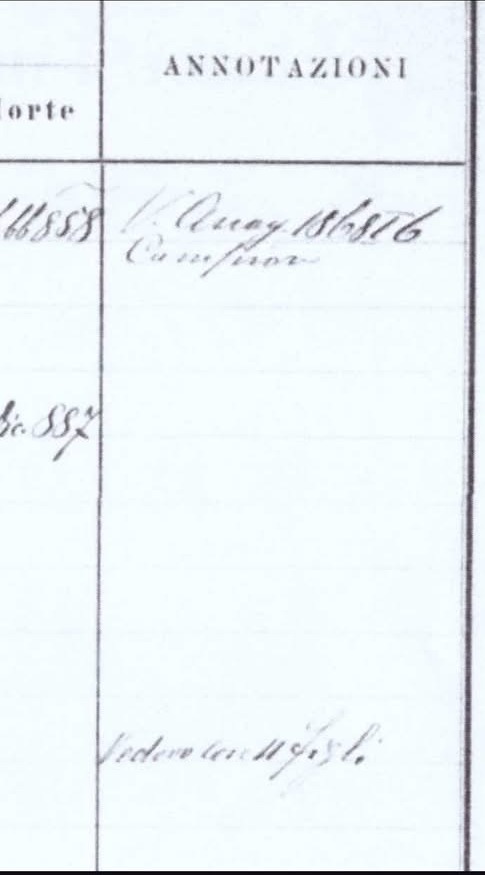
The family sheet itself is now identified — it's a page from Rovinj parish's Status Animarum ("stanje duša," a household-by-household census kept by the church) for house no. 833, headed by Giorgio Apollonio and his widow Maria Bronzin, certified as a true copy by the State Archive in Pazin. The "Campione" annotation the original post asked about is right where it should be, in the Annotazioni column next to Giorgio's death entry.
The original request
Posted to a genealogy group, asking for help locating one of the documents referenced in a family history book:
"Hi! I was wondering if anyone could help me with this search! Our ancestors were born in Rovigno Istria in the 1820s, and emigrated to Texas. In Istria, their last name was Apollonio but when they came to the states, they changed it to Champion. Supposedly they had a nickname of Campione. The family sheet references Campione in the upper right, see the photo. There is a family history book which vaguely states other places that the nickname Campione can be found, but I can't find the documents! Please see the typed images for info. Can anyone help me look for one of the documents mentioned that state the name Campione in the annotation? Or point me in the right direction? Thank you all so much!" — original post, as written
The book: Campion(e) History, by Raul Guerra
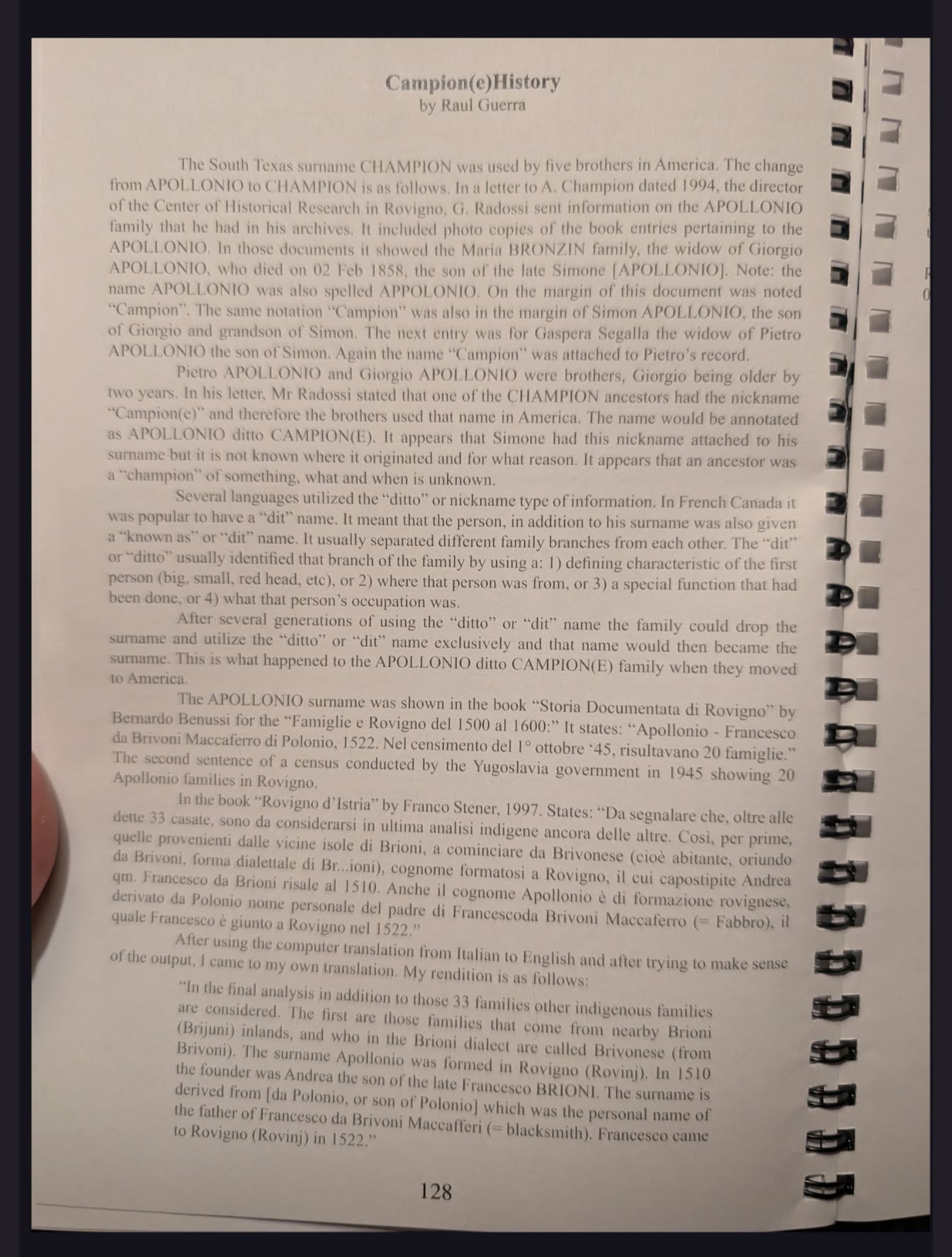
The typed pages from the family history book, page 128, explain exactly where the name comes from and how it became a surname:
"The South Texas surname CHAMPION was used by five brothers in America. The change from APOLLONIO to CHAMPION is as follows. In a letter to A. Champion dated 1994, the director of the Center of Historical Research in Rovigno, G. Radossi, sent information on the APOLLONIO family that he had in his archives. It included photo copies of the book entries pertaining to the APOLLONIO. In those documents it showed the Maria BRONZIN family, the widow of Giorgio APOLLONIO, who died on 02 Feb 1858, the son of the late Simone [APOLLONIO]. Note: the name APOLLONIO was also spelled APPOLONIO. On the margin of this document was noted "Campion". The same notation "Campion" was also in the margin of Simon APOLLONIO, the son of Giorgio and grandson of Simon. The next entry was for Gaspera Segalla the widow of Pietro APOLLONIO the son of Simon. Again the name "Campion" was attached to Pietro's record." — Raul Guerra, Campion(e) History, p. 128
And on where the nickname itself came from:
"Pietro APOLLONIO and Giorgio APOLLONIO were brothers, Giorgio being older by two years. In his letter, Mr Radossi stated that one of the CHAMPION ancestors had the nickname "Campion(e)" and therefore the brothers used that name in America. The name would be annotated as APOLLONIO ditto CAMPION(E). It appears that Simone had this nickname attached to his surname but it is not known where it originated and for what reason. It appears that an ancestor was a "champion" of something, what and when is unknown. […] After several generations of using the "ditto" or "dit" name the family could drop the surname and utilize the "ditto" or "dit" name exclusively and that name would then became the surname. This is what happened to the APOLLONIO ditto CAMPION(E) family when they moved to America." — Raul Guerra, Campion(e) History, p. 128
Found: the document itself — house 833, Rovinj Status Animarum
This is a Stato delle Anime / Status Animarum page — a household census the parish kept, updated over years as children were born, married, emigrated, or died — for house no. 833 in Rovigno, certified by the Državni arhiv u Pazinu (State Archive in Pazin) as a true copy of the original.
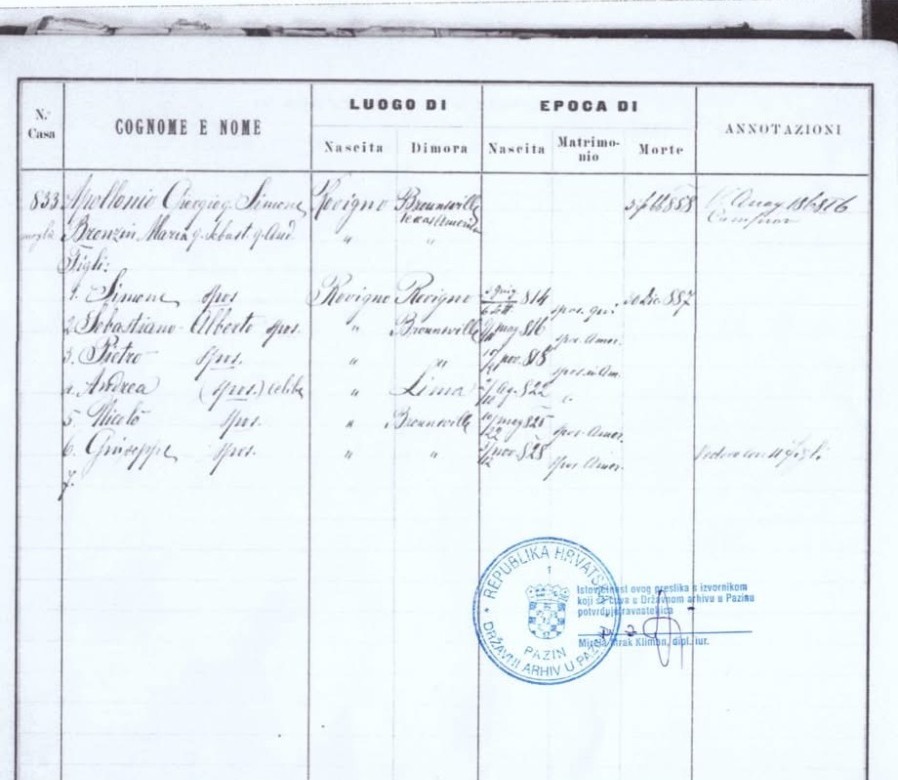
| Household head | Apollonio Giorgio, q. [fu, "the late"] Simone — born Rovigno, died 2 Feb 1858. |
|---|---|
| Wife | Bronzin Maria, q. Sebastiano, q. Giovanni — listed as his widow. |
| Sons listed | Simone · Sebastiano Alberto · Pietro · Andrea (celibe, "unmarried" — residence given as Lima) · Nicolò · Giuseppe. Residence ("Dimora") for several of the sons is given as Brownsville — Texas, right in the record itself. |
| Annotazioni | Two notes in the margin: a date (~1 Aug 1858) with "Campione" written directly beneath it, against Giorgio's death entry — the exact annotation the original post was looking for — and a second note further down reading "Vedova con [6] figli" ("widow, with 6 children"). |
The family tree — Apollonio detto Campione
From a typed "APOLLONIO detto CAMPIONE / CHAMPION CHART," matching and extending the Status Animarum entry above:
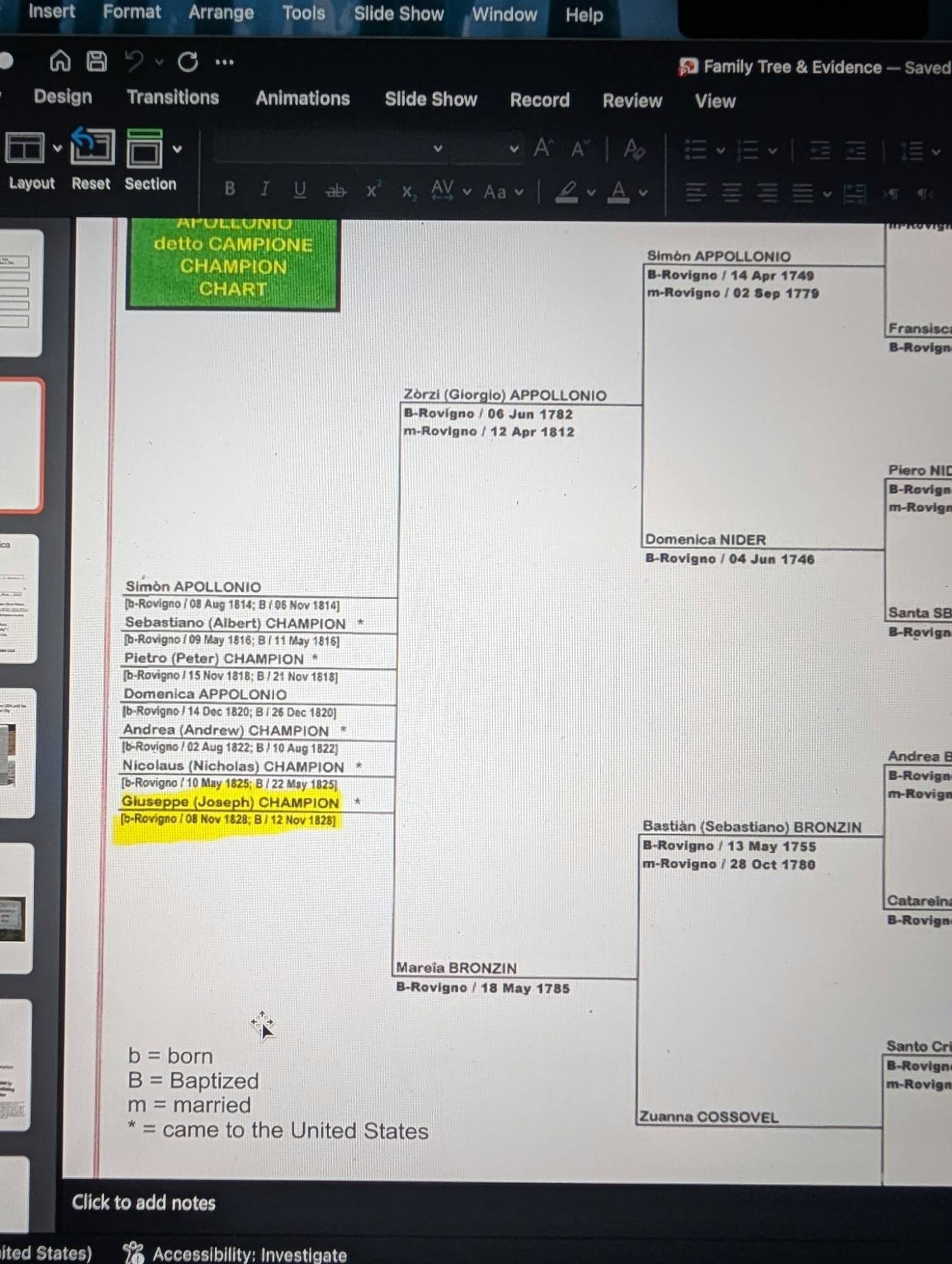
* Albert, Peter, Andrew, Nicholas, and Joseph are the "five brothers" the family history book opens with. The book's second "Campione" annotation, on Pietro Apollonio son of Simon (Giorgio's brother, via his widow Gaspera Segalla), belongs to a different, earlier branch — Simon (b. 1749)'s son Pietro, not to be confused with Giorgio's own son Pietro/Peter Champion above.
Found: the brothers themselves, in Texas
U.S. census records match the Rovigno chart closely enough to remove any doubt these are the same men — and add the Gulf-port arrival record the roadmap only hoped might exist.
| The 1850 arrival | A passenger index entry for "L Champion," age 33, born Italy 1817, arriving in the United States in 1850 aboard the ship Louisiana — United States, Index to Passenger Arrivals, Atlantic and Gulf Ports, 1820–1874 (a supplemental index covering Gulf and Atlantic ports excluding New York). The initial is almost certainly a misread "A" for Albert (b. 1816) — the age and birth year match him more closely than any other brother. This confirms the Gulf-coast arrival route the roadmap proposed, rather than a direct Texas landing. (FamilySearch record) |
|---|---|
| 1850 census — Webb, Texas (Rio Grande Valley) | Albert Champion (32, Italy), Peter Champion (b. 1820, Italy), and Nicolas Champion (b. 1823, Italy) all already resident here — the earliest U.S. record of any of the brothers, within a year of the "Louisiana" arrival above. Albert's household includes Jose Ma Solis, Estefana Solis, and Josefa Champion (age 20, Mexico) — Albert's Mexican in-laws and, it appears, his wife. (Albert, Peter, Nicolas) |
| 1860 census — Point Isabel, Cameron Co. | Albert, Peter, Joseph (b. 1829), Nicolas (35, with wife Teresa, Mexico, and children Simon/Nicolas/Catharine/ Sebastian all born in Texas), and a George Champion (20, born Austria ~1840) living in Nicolas's household — too young to be one of the five brothers, and not yet placed on the chart. Worth treating as an open question rather than assuming who he is. (Albert, Peter, Joseph, Nicolas & household, George) |
| 1870 & 1880 census — Brownsville / Justice Precinct 1 & 3, Cameron Co. | Albert Champion (Brownsville, 1880: wife Estefana, children John, Euphemia, Anita, Joseph, Frank, Rosa) · Peter Champion (Justice Precinct 3, 1880: wife Felicita, ten children with Spanish given names — Anestacia, Emelio, Feliceta, Louisa, Gregoria, Pablelita, Juana Maria, Timoteo, Estefena, Miguel) · Nicholas Champion (Justice Precinct 3, 1880: wife Terresa, children Lasaro, Mary, Sebastian, Simeon, Margarita, Jose Angel, Catarina) · Joseph Champion (Justice Precinct 1, 1880: wife Marcela, ten children). 1870: Albert, Peter, Nicholas, Joseph · 1880: Albert, Peter, Nicholas, Joseph |
| Andrew — not among them | No Andrew/Andrea Champion turns up in any Cameron County census — and a published family account (below) explains why in more specific terms than this page first guessed: not "Lima," but the 1849 California Gold Rush, reached by ship to Panama. He was never heard from again. |
All four Texas brothers married women from Mexico and raised large bilingual families on the border — which is worth noting on its own: within one generation, an Istrian "detto Campione" household became a Rio Grande Valley Tejano one.
Found: a published biography, and a family that already did this research
Two more sources close most of what was still open about the Texas side — one an authoritative published biography, the other a family member who has spent over a decade doing exactly this kind of work.
| The Handbook of Texas entry | The Texas State Historical Association has a full sourced biography, "Champion, Albert", written by "A. A. Champion" — almost certainly a descendant, and quite possibly connected to the "A. Champion" who received Radossi's 1994 letter in the first place. It confirms Albert spent "several years at sea" before settling in Mobile, Alabama in the early 1840s, then moved to New Orleans, where Peter and Nicholas joined him — the Gulf-route mechanism the roadmap only guessed at, now stated outright. The brothers ran sail lighters at the founding of Point Isabel, Albert later ran the U.S. Mail Stage Line (1858–73) and two ranches (La Florida, the oldest in Cameron County, and La Gloria), married Estéfana Solís in 1850, and was appointed pilot commissioner for the Brazos Santiago port in 1873. He died in Brownsville on 20 Sep 1890. Its bibliography cites the Brownsville Herald (17 Jan 1937), the Gilbert D. Kingsbury Papers (Briscoe Center, UT Austin), and the Joseph Kleiber Letters (UT Brownsville) — three named primary sources not yet checked directly. |
|---|---|
| A family history project already exists | A Find a Grave contributor named "Rovigno Champions" — active for 15+ years, 494 memorials added — maintains 19 virtual cemeteries for this exact family, including "Original Champion Brothers and Wives" (9 memorials) and "Champion Family of South Texas" (412 memorials). This is very likely the single best living contact for anything still open on this page — including the two missing "Campione" annotations back in Rovigno. |
What their records add
| Deaths and burials, confirmed | Albert d. 20 Sep 1890, Old City Cemetery, Brownsville (Champion Vault, Blk 11 Lot 26) · Peter — recorded here as "Pietro Campeoni Champion" — d. 20 May 1898, same cemetery (Blk 60 Lot 01) · Nicolas d. 1889, Our Lady of Mercy Catholic Cemetery, Mercedes · Joseph ("Jose," carrying his mother's name as a middle name, Joseph Bronzin Champion) d. 26 Mar 1882, Port Isabel City Cemetery. "Campeoni" and "Bronzin" surviving as recorded middle/alternate names is itself a small, independent echo of the "Campione" nickname trail. |
|---|---|
| Three Solís sisters | Albert married Estéfana Solís, Peter married Maria Felicitas Solís, and Nicolas married Teresa Solís — all three daughters of Francisco Solís and Anastacia Rivas. Joseph married Marcela Garcia in 1861. A fourth Solís woman, Cirilda Solís Champion (1843–1919), also appears among the "original wives" — not yet placed, but plausibly a second marriage after Marcela's 1880 death. |
| Only four brothers, not five | Both Albert's and Joseph's memorials state plainly: "Four of the six [sons] immigrated from Italy to Texas... Andrew (1822–?)" has no memorial and no death date recorded by the family itself — independent confirmation, from a completely different source than the Rovigno register, that Andrew did not come to Texas. |
| Direct evidence of the maritime connection | Joseph's own U.S. census entries record his occupation as sailor (1860), seaman (1870), then stock raiser (1880) — the Rovigno-to-Gulf-coast maritime link the roadmap proposed, now documented directly rather than inferred. |
| A discrepancy — now resolved | Find a Grave gives Giorgio's death year as 1850 ("Giorgio Campeoni, 1783–1850"), against the 2 Feb 1858 on the certified Status Animarum copy this page holds. A public Geni.com profile for Giorgio — sourced from an Ancestry.com tree (ID 111701831, managed by Geoffrey David Trowbridge, another possible contact) — independently gives his death as 1858, matching this page's own certified document. Two independent sources now agree against Find a Grave's one; 1850 looks like the actual typo. The same Geni profile gives Simon Appollonio's fuller name as "Simone Appollonio DeChampione" — the epithet already fused onto his name as a surname-in-practice a generation before the book's own account of the brothers adopting it formally in Texas. |
| George, fully resolved | A logged-in Geni profile settles it: George Champion, b. 24 Aug 1840, Rovigno, d. 1873, was Simon Apollonio's own son (by his second wife, Mattea Segariol) — Giorgio's grandson, not his son. Simon — the brother who supposedly "stayed in Rovigno" — in fact had at least three sons of his own who carried the Champion name: George, Antonio, and Giuseppe. George himself emigrated and is exactly the 20-year-old found in uncle Nicolas's 1860 household; he later married Cirila and had five children (Virginia, Albert, Cirilda, Josefina, Louis), all with their own Find a Grave memorials in the "Rovigno Champions" project. This is a genuinely different George from Albert's own son George Champion Sr (1852–1929) — two cousins sharing a name, both real. |
| Peter and Nicolas, individually | Peter's memorial gives his marriage to Felicitas Solís as 7 Dec 1856 (not 1850) and lists all twelve children, including a Timoteo (b. 1858) matching the child seen in the 1880 census. Nicolas's memorial confirms his marriage to Teresa Solís in 1854 and his death in Santa Maria, Cameron Co., in 1889. |
| "Four" or "five" — the family's own records disagree | Albert's, Joseph's, and Nicolas's memorials all say "four of the six [sons] immigrated... to Texas" — but Peter's says "five of their six children immigrated to Texas." This is a real inconsistency inside the family's own Find a Grave project, not just between it and the Rovigno register — worth asking "Rovigno Champions" directly whether Andrew is now believed to have reached Texas after all, or whether this is simply a copy-paste slip between memorials. |
| A possible living descendant | A commenter named Frances Skipworth left messages on Albert's memorial calling him "great, great grandpa," and on Joseph's and Nicolas's calling them "great, great uncle" — consistent with being a direct descendant of Albert specifically. Worth a polite Find a Grave message alongside the one to "Rovigno Champions" above, since she may be a different person with her own knowledge of the family. |
Found: a town founder, a landmark building, and a museum in the family's own store
Joseph's own son turns out to have a Handbook of Texas entry of his own — and the building he built in 1899 is still standing, and still open to the public.
| Handbook of Texas: "Champion, Charles" | Charles Champion: Pioneer Merchant and Developer of Port Isabel, Texas, by Norman Rozeff, confirms Charles (1870–1926) as Joseph's son (here "Joseph Bronson Champion") and Marcela Garcia's — matching "Charles A. 'Carlos' Champion I" already found via Find a Grave. Charles and his brother John clerked in Point Isabel's Hess General Store as young men; John bought half of it by 1887, and Charles bought the rest in 1894, renaming it "The Champion Store." In 1899 he built a two-story brick building, "The Key of the Gulf," which held the store, the U.S. Customs House, and the post office — Charles served as Point Isabel's second postmaster. He later co-owned the Santa Isabel land grant itself (which contains Point Isabel) with Judge James B. Wells, Jr., married Margarita Orive in 1897, and died in 1926, buried in Port Isabel City Cemetery — on land he had personally donated to the Catholic Church as the town cemetery. |
|---|---|
| The building still stands — as a museum | The 1899 Champion building is now the Port Isabel Historical Museum, 317 E. Railroad Ave., Port Isabel — still trading under the family name in spirit, with the original fish mural (painted 1906) still on its façade. The museum's own page adds one more precise detail not seen elsewhere: Joseph Champion "settled in Texas in 1855." A Texas Historical Commission marker for Charles Champion stands at the same address. |
| A published book to track down | The Handbook entry's bibliography cites Charles Champion, Point Isabel Pioneer: His Family and His Life, 1870–1926 (Laguna Madre Museum Foundation and the Port Isabel Historical Museum, 1999) — a real, dedicated, published family history book, unlike the private "Campion(e) History" pamphlet. Not yet found in any online catalog; the museum itself is the obvious place to ask whether it still has copies. |
Found: the origin story, told by a great-grandson
A full open-access volume from UT Rio Grande Valley's regional history series turns out to contain a detailed, sourced account of exactly this family's arrival — written by a direct descendant. This settles most of what "Where to look next" (below) was still guessing at.
| The source | Frank Champion Murphy, "Don Juan Jose de Solis, Albert Champion, the Border Cattle Raids, and the Birth of the Cattle Kingdom," in Additional Studies in Rio Grande Valley History (Brownsville: University of Texas at Brownsville and Texas Southmost College, 2008), pp. 148–185+. The full volume is freely downloadable from ScholarWorks @ UTRGV. The author states plainly that Albert and Estéfana Solís "would be my great-grandparents" — Frank Champion Murphy is himself part of this family, not an outside historian. |
|---|---|
| Why Austria, and why the sea | The brothers' motive for leaving wasn't opportunity — it was conscription. The Austrian Empire annexed the Adriatic coast at the Congress of Vienna in 1815; each brother, as he came of age under Habsburg rule, "went to sea... to avoid conscription by the hated Austrian army" rather than serve. That is the real root of the maritime connection this page's roadmap only guessed at. |
| The actual mechanism: hauling war supplies | By 1846 all four — Albert (32), Peter (30), Andrew (26), Nicholas (23) — had independently ended up in New Orleans after years sailing "the stately sailships of the period." When the U.S. Army massed supply ships at New Orleans and off Brazos Santiago Pass for Zachary Taylor's Point Isabel garrison during the Mexican–American War, the brothers' sailing experience put them to work lightering war matériel ashore. They stayed aboard those ships through the war's end in 1848, then settled in Point Isabel for good — Albert opened a general store, Peter ran a hotel, and Nicholas built the sail lighters that gave the family its start ferrying goods off the bar. |
| Andrew's actual fate | Not Lima — the 1849 California Gold Rush. "Despite the earnest entreaties of his brothers," Andrew sailed for California by way of Panama, crossing the isthmus overland. Letters arrived for a while, "and then suddenly, silence, and all efforts to reach him failed." This supersedes this page's earlier reading of the Status Animarum "Dimora" column as "Lima" — worth rechecking that word against the original image with this in mind. |
| The Solís match, in full | The Solís family — Francisco Solís and Anastacia Rivas, with daughters Felicitas, Estéfana, and Teresa — fled the lawlessness of post-war Matamoros for Point Isabel at almost the same moment. Peter married Felicitas (1849/50), Albert married Estéfana (1850), Nicholas married Teresa, and later the brothers' nephew George (Simon's son) married a fourth Solís woman, Cirilda — resolving the "not yet placed" Cirilda Solís Champion from the Find a Grave data above. Joseph, arriving last, married Marcela Garcia, a Solís cousin through her mother Antonia — "the union... was now a reality, five-fold." |
| The ranches, and a surviving brand | Albert developed La Florida (Cameron County's oldest ranch settlement) and La Gloria, adjoining Josiah Turner's Galveston Ranch, plus range at Tío Caño. His cattle brand — a capital "A" whose crossbar extends into a "C," read as "AC Connected" — was still on cattle the author knew in the 1930s, and the branding irons themselves were still in the family, on the author's own wall, as of 2008. |
| A named family archive | A footnote cites "the Champion-Murphy family papers" directly, alongside a 1944 U.S. Government Printing Office volume, Texas Cattle Claims — both real, specific sources for anyone continuing this research, and a strong sign that Frank Champion Murphy or his descendants may hold considerably more than what's in this one article. |
| Who Frank Champion Murphy was | Traceable independently: born Vinton, Iowa, 1920, to Lucile Champion and Capt. Edward A. Murphy; spent boyhood summers on the family's La Gloria/La Florida ranch near Brownsville; became the American Angus Association's staff artist for nearly 60 years — his painting of the first Angus bull imported to the U.S. appeared on an 8-cent postage stamp in 1973, and over 130 of his works are held at Angus Association headquarters in St. Joseph, Missouri. He died 28 June 2010 in Wheaton, Illinois, survived by his wife Evelyn, son Tom Murphy, and daughter Julie (Rich) Heller — the two most concrete living-descendant leads found anywhere on this page, and the people most likely to know where the "Champion-Murphy family papers" are today. |
The same author's companion piece, "Lucile Champion's Brownsville: Remembrances of Another Time" (also freely downloadable, same series, vol. 10), corroborates all of the above independently and adds Frank Champion Murphy's own line down from Albert: Albert's son Frank Champion married Henrietta Elizabeth Edwards — a Georgia family, Huguenot on her mother's side, that had resettled on the Mexican side of the border in Camargo and Mier after the Civil War — on 18 Aug 1886 at the Starr County courthouse, later solemnized as a Catholic ceremony in Brownsville. Their daughter Lucile Elizabeth Champion (b. 25 Feb 1889, Mier) was the author's mother. Henrietta and Lucile's baby sister Gussie both died of typhoid in 1894, three weeks apart, leaving Frank a widower raising five-year-old Lucile alone — Frank never remarried. Albert himself died in Brownsville in 1890, independently matching the Handbook of Texas date above.
Found: the primary source itself — and the author's own family
More pages have surfaced, from a spiral-bound book titled simply "Champion: The Champion Family of Point Isabel — Campeoni, Originally from Rovigno d'Istria, Italy." This appears to be the actual primary document both the Handbook of Texas entries and Frank Champion Murphy's academic article drew from — its "Part Three," on Albert, matches the Handbook almost line for line, and both are credited "By: A.A. Champion."
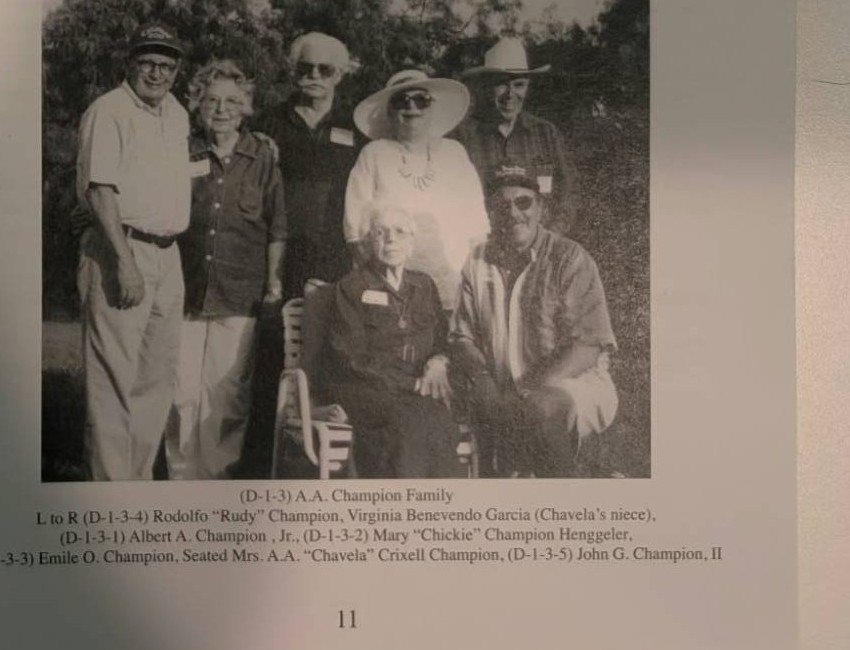
| The author's own family, named | A group photograph captioned "A.A. Champion Family" names, directly: Mrs. A.A. "Chavela" Crixell Champion (A.A.'s own wife) and five children — Rodolfo "Rudy" Champion, Albert A. Champion Jr., Mary "Chickie" Champion Henggeler, Emile O. Champion, and John G. Champion II. The book's bibliography separately states the underlying family documents are "in possession of A.A. Champion, Brownsville, Texas." Between this family and Frank Champion Murphy's, and the "Rovigno Champions" Find a Grave project, this page now has three independent living-family threads to pull on — this one names the most people at once. |
|---|---|
| A.A. Champion, identified | Find a Grave confirms it: "A.A. Champion" is Alberto Alfonso Champion (27 Jun 1899 – 21 Dec 1990, Port Isabel/Brownsville), "Chavela" is Isabel Crixell Champion (1900–2002) — "Chavela" being a common nickname for Isabel — and his own parents were John G. Champion (1862–1943) and Enriqueta "Henrietta" Orive Champion (1872–1912). That traces A.A. Champion's own line back through Joseph, the youngest of the original emigrant brothers, not Albert — a different branch than Frank Champion Murphy's. |
| His own children, mostly already gone too | Of the five children in the photo, two are independently confirmed deceased: Mary Champion Henggeler (1922–2005, no children shown) and Emile Oswald Champion (1924–2007, a WWII veteran whose own headstone reads "loving husband, father and grandfather" — so his line continues, just not yet traced). Rudy, Albert Jr., and John G. II haven't been checked individually. Any living contact from this branch is very likely a generation further down — grandchildren, most plausibly through the Henggeler or Babick (Emile's wife's family) surnames — which is a reasonable thing to ask "Rovigno Champions" about directly, rather than something to hunt for name-by-name here. |
| The full bibliography, precisely | Joseph Kleiber Letters (transcript, Texas Southmost College Library, Brownsville); G. D. Kingsbury, "The Lower Rio Grande Valley" (Kingsbury Papers, University of Texas Library, Austin); James Heaven Thompson, "A Nineteenth Century History of Cameron County, Texas" (M.A. thesis, University of Texas, 1965); Minutes of the Brownsville City Council, Book A (1868–70, City Secretary's Office); and A.A. Champion's own family documents. |
|---|---|
| Simon's Rovigno/Pola line may still exist, in Croatia/Italy | This book adds that Simon Apollonio's son Antonio (by his second wife, Eufemia Paliaga) married Antonia Cralich and died in Pola (Pula) on 27 Oct 1906; his brother Giuseppe and one of Antonio's own sons were still living in Rovigno shortly before World War II. That's a real, dated lead for descendants who never left Istria at all — worth mentioning specifically in the Centro di Ricerche Storiche letter. |
| A discrepancy worth naming plainly | This book's own family list gives Giorgio and Maria Bronzin exactly six children — all sons, and never mentions a daughter. That conflicts with the typed "Apollonio detto Campione" chart used earlier on this page, which includes a daughter, Domenica (b. 1820). Two family-compiled sources disagree here; this page isn't resolving it in either direction, just flagging it for whoever can check an actual register. |
| George's birthdate — even this book disagrees with itself | The narrative text states nephew George was "born in Rovigno on August 26, 1840" — matching Geni and this page's own 1860 census reading — but this same book's own genealogy card for George gives his birth as August 26, 1848. Same day and month, different decade, within one document. 1840 is very likely correct. |
Color, for the record: this book preserves an actual quoted 1859 letter from Albert, refusing to run his stage line's mail into a Cortina-surrounded Brownsville — "I shall send the mail tomorrow, since it is pretty certain that the rider will be taken... I shall wait until I can send it safely..." — and confirms Albert's ranches, La Florida and La Gloria, and that "a member of the family together with the late Judge James B. Wells owned the entire [Point Isabel] town site at one point in time."
Found: two existing family trees already built — on MyHeritage
Exactly as guessed: someone has already done this. A MyHeritage search for "Giorgio Apollonio" turns up two separate, independently-built trees covering this exact family, both still live and both contactable directly through the site.
| Roberto Marchetto's tree | "Marchetto Roberto Albero Genealogico" — 7,717 profiles, 169 photos, last updated 2 months ago (still active). Independently gives Giorgio's death as 2 Feb 1858 — a third source now agreeing with this page's own certified document and with Geni, against Find a Grave's "1850." It also lists Domenica Appolonio Campione (b. 1820) as a real daughter of Giorgio and Maria, resolving the "six vs. seven children" discrepancy raised above in favor of seven — the typed chart and Geni were right, the "Champion Family of Point Isabel" book's omission of her looks like the outlier. It gives Simon Apollonio two marriage years, 1839 and 1862, close to but not identical to the family book's naming of Mattea Segariol and Eufemia Paliaga. The site has a working "Contact Roberto" button. |
|---|---|
| Luis Fernando Gutierrez Champion's tree | "Gutierrez Champion Web Site" — smaller (184 profiles, 45 photos), last updated in 2024. The manager's own surname, Gutierrez Champion, suggests he may himself be a descendant through a daughter who married into a Gutierrez family — worth treating as a possible direct-family contact, not just a fellow researcher. Its version of Giorgio's record repeats the "1850" burial date, which suggests that error may have propagated from Find a Grave into other trees rather than the reverse. Also has a working "Contact" button. |
Neither tree's public search snippet shows a scanned document or a source note for the "Campione" annotation itself — so this doesn't hand over the missing records directly — but Marchetto's tree in particular has 169 photos attached somewhere in its 7,717 profiles, and either manager may well have exactly what Radossi sent in 1994.
Where to look next
FamilySearch's microfilmed Rovinj parish collection (Matična knjiga, 1553–1913) only covers births, marriages, and deaths (Rođeni / Vjenčani / Umrli) — it does not include Status Animarum books, so this document was never going to turn up in an ordinary FamilySearch search. But the State Archive in Pazin's own register database (dapa.hr) lists the Status Animarum ("stanje duša") holdings for Rovinj/Rovigno directly:
| Rovinj/Rovigno stanje duša | Ten volumes, all held at ŽU Rovinj (the Rovinj parish office) and all marked as digitized and viewable in DAPA's reading room: 1861–1866, two undated "XIX. st." (19th century) volumes, two more spanning "XIX–XX. st.," then 1905–1920, 1908–1923, 1914–1923, 1923, 1923–1942, and 1928. |
|---|---|
| Best candidate | House 833's own annotation is dated close to Giorgio's 1858 death, which is earlier than the 1861–1866 volume's stated range — Status Animarum books were running ledgers kept open for years, so the same physical volume very plausibly starts earlier than its catalogued end-date range suggests. The two 19th-century volumes marked only "XIX. st." are worth checking first alongside 1861–1866. |
| How to actually see them | These are marked "digitalno (u čitaonici)" — digitized, but viewable only in DAPA's own reading room in Pazin, not online. The practical path is a direct research request to Državni arhiv u Pazinu (contact via dapa.hr) asking specifically for the Status Animarum entries of Simon Apollonio (son of Giorgio, grandson of Simone) and of Pietro Apollonio (son of Simone, via widow Gaspera Segalla) in the Rovinj "stanje duša" volumes — the same request that, if it can reference the 1994 Radossi letter and house 833 as a known match, gives the archive a very specific thing to look for rather than a blind search. |
Research roadmap — telling the fuller story
Finding house 833 answers the original question. These are the directions worth pursuing next, organized by what each one actually adds to the story rather than just closing the one open citation.
1 · Close the paper trail — the two missing annotations
| Go straight to the source | The Centro di Ricerche Storiche di Rovigno (crsrv.org) — the institute Radossi directed from 1969 until 2018, and the one that supplied the 1994 letter and photo copies in the first place — is very much still open, at Trg Matteotti 13, Rovinj (info@crsrv.org, +385 52 811 133). Radossi himself is now honorary president of the Unione Italiana; the institute may still hold his 1994 research file on the Apollonio family, which would skip re-finding the other two annotations from scratch. |
|---|---|
| The archival fallback | If the CRS's own file can't be found, the direct request to Državni arhiv u Pazinu for the Simon Apollonio and Pietro Apollonio/Gaspera Segalla Status Animarum entries (detailed above) is the fallback path. |
| Look for the letter itself | A surviving copy of the actual 1994 letter (to "A. Champion") — in family papers on the Texas side — would likely settle both a. what house numbers the other two annotations are under, and b. who "A. Champion" was, a living link between this research and whoever holds the rest of the family history book today. |
2 · Why "Campione"? — the nickname's own origin
| Read past the one quoted page | The book quotes two local histories — Bernardo Benussi's Storia Documentata di Rovigno and Franco Stener's Rovigno d'Istria (1997) — but only for the Apollonio surname's own formation (from Francesco "da Brivoni," son of Polonio, arriving in Rovigno in 1522). Neither excerpt yet explains what made a later Apollonio a "champion" of something. Worth reading both in full for a passage that does. |
|---|---|
| Date the nickname more precisely | Radossi's letter says only that Simone (the earliest Apollonio named on the chart, or possibly his own father, unstated) carried it first, and that where and why is unknown. Since FamilySearch's own Rovinj microfilms (Rođeni 1560–1863, Vjenčani 1564–1907) are the town's actual parish registers — a different, earlier-starting set than the Status Animarum books — checking Apollonio entries there before 1749 (Simon's birth) could catch the nickname's first written appearance and possibly the occasion behind it. |
3 · Why Texas, and why so early? — answered
| Fully explained, by a descendant's own account | Frank Champion Murphy's 2008 article (see "Found: the origin story," above) answers this outright: the brothers went to sea individually to dodge Austrian conscription after the 1815 annexation of Istria, converged on New Orleans by 1846, and were pulled to Point Isabel specifically because the U.S. Army needed experienced sailors to lighter war supplies ashore for Zachary Taylor's garrison during the Mexican–American War. They stayed once the war ended in 1848. Nothing about this was accidental or purely maritime-general — it was wartime demand for exactly their skill, arriving at exactly the right port at exactly the right time. |
|---|---|
| Still worth pursuing | The Louisiana passenger record (found separately, likely Albert's own 1850 arrival) — worth checking whether it fits as a return trip or a separate family member's crossing, now that the main arrival is dated to 1846 via New Orleans rather than a single 1850 voyage. Texas naturalization records for the four brothers, and the diocesan sacramental registers for the earliest Point Isabel/Brownsville parish (see the ready-to-send letter, below), remain open. |
4 · The five brothers and their descendants today
| Reconstruct each brother's own family | Wives, children, and where each Champion line settled — via census and Cameron County vital and land records — both for its own sake and because a descendant somewhere is the most likely person to hold the rest of the family history book (only page 128 has been seen on this page so far) or a copy of the Radossi letter itself. |
|---|---|
| Burials | Find a Grave and Cameron County cemetery records for Albert, Peter, Andrew, Nicholas, and Joseph Champion — a fast way to locate the family's own later generations. |
Ready to send
Seven enquiries, drafted and ready to send as-is or adapt. Each names exactly what's already been found, so the person on the other end has a specific thing to check rather than a cold genealogy request.
To "Rovigno Champions" on Find a Grave
Via Find a Grave's own "Send Message" on their profile — likely the single best lead on this whole page, since they've already documented hundreds of this family's own descendants.
"Hello — I hope this reaches you well. I'm researching the Apollonio/Campione family of Rovigno (Rovinj), who became the Champion family of Point Isabel and Brownsville, and I came across your 'Original Champion Brothers and Wives' and 'Champion Family of South Texas' virtual cemeteries — extraordinary work.
I'm trying to track down two more references to the family nickname "Campione," mentioned in a 1994 letter from Giovanni Radossi (director of the Centro di Ricerche Storiche di Rovigno) to an "A. Champion." I believe this was Alberto Alfonso Champion (1899–1990), who also wrote the family history booklet "Champion: The Champion Family of Point Isabel" and the Handbook of Texas entry on Albert, under the name A.A. Champion — his own bibliography lists "family documents in possession of A.A. Champion, Brownsville, Texas." If you're in touch with any of his children (Rudy, Albert Jr., Mary "Chickie" Henggeler, Emile, or John G. Champion II) or their own families, they may well have Radossi's original letter and its photocopies, which reportedly showed all three "Campione" annotations. I've already found one of the three myself — the "Campione" annotation on Giorgio Apollonio's own Status Animarum record (house 833, Rovigno) — but the letter mentions two more: one on Simon Apollonio (Giorgio's son) and one on Pietro Apollonio (Simone's son) via his widow Gaspera Segalla — neither found yet.
Do you know whether the Radossi letter, or the rest of the family history book it's quoted from (Campion(e) History, by Raul Guerra), still exists in the family? I've also confirmed via Geni that Simon Apollonio (b. 8 Aug 1814) died 30 Dec 1887 in Rovigno, married twice, and that his son George (b. 1840) is the "George Champion" found in his uncle Nicolas's household in the 1860 census — so Simon's own line reached Texas too, even though he stayed. And I noticed a small discrepancy: your own records give Giorgio's death as 1850, while both a certified Rovigno parish record and Geni give 2 Feb 1858 — worth a correction if you're able. Thank you so much for any help, and for all the work you've already put into this family's history." — draft, ready to send in English
To the Centro di Ricerche Storiche di Rovigno
info@crsrv.org · Trg Matteotti 13, 52210 Rovinj-Rovigno · Radossi's own institute, still operating from the same building.
"Gentile Centro di Ricerche Storiche di Rovigno,
Vi scrivo per conto della famiglia Champion (in origine Apollonio), di Rovigno, emigrata a Brownsville, in Texas, verso il 1850. Stiamo completando una ricerca genealogica iniziata dal Prof. Giovanni Radossi, che nel 1994 scrisse una lettera a un membro della famiglia (indicato come "A. Champion") allegando fotocopie di voci d'archivio riguardanti la famiglia Apollonio di Rovigno — in particolare l'annotazione "Campione" trovata su tre atti: quello di Giorgio Apollonio (morto il 2 febbraio 1858, figlio del fu Simone) e di sua moglie Maria Bronzin; quello di Simon Apollonio (figlio di Giorgio); e quello di Pietro Apollonio (figlio di Simone), tramite sua moglie Gaspera Segalla.
Abbiamo già ritrovato il primo di questi tre atti — lo Stato delle Anime della casa n. 833 di Rovigno, con l'annotazione "Campione" accanto alla voce di morte di Giorgio Apollonio — in una copia autenticata dall'Archivio di Stato di Pisino (Pazin). Ci mancano ancora gli altri due.
Un'altra fonte familiare indica che il figlio di Simon, Antonio Apollonio (sposato con Antonia Cralich), morì a Pola il 27 ottobre 1906, e che suo fratello Giuseppe e uno dei figli di Antonio vivevano ancora a Rovigno poco prima della Seconda guerra mondiale. Se esistono discendenti di questa linea, potrebbero essere loro stessi in possesso di informazioni preziose.
Sareste così gentili da verificare se il fascicolo di ricerca del Prof. Radossi su questa famiglia — quello alla base della sua lettera del 1994 — sia ancora conservato nel vostro archivio? Qualunque informazione, anche parziale, ci sarebbe di grande aiuto.
Vi ringraziamo molto per il vostro tempo e per il lavoro che il Centro svolge da decenni per la nostra comunità.
Cordiali saluti," — draft, ready to send in Italian
In English, for reference: "I'm writing on behalf of the Champion family (originally Apollonio) of Rovigno, who emigrated to Brownsville, Texas around 1850. We're completing genealogical research begun by Prof. Giovanni Radossi, who in 1994 wrote to a family member ('A. Champion') enclosing photocopies of archive entries for the Apollonio family of Rovigno — specifically the annotation 'Campione' found on three records: that of Giorgio Apollonio (died 2 Feb 1858, son of the late Simone) and his wife Maria Bronzin; that of Simon Apollonio (Giorgio's son); and that of Pietro Apollonio (Simone's son), via his wife Gaspera Segalla. We've already found the first of these three — the Status Animarum for house no. 833 in Rovigno — in a copy certified by the State Archive in Pazin. We're still missing the other two. Another family source indicates that Simon's son Antonio Apollonio (married to Antonia Cralich) died in Pola on 27 Oct 1906, and that his brother Giuseppe and one of Antonio's own sons were still living in Rovigno shortly before World War II — if descendants of this line still exist, they themselves may hold valuable information. Could you kindly check whether Prof. Radossi's 1994 research file on this family survives in your archive? Any information, even partial, would help enormously. Thank you for your time and for the Centre's decades of work for our community."
To the State Archive in Pazin (DAPA)
dapa@dapa.hr · Vladimira Nazora 3, 52000 Pazin · the fallback if the Centro's own file doesn't survive.
"Poštovani,
Istražujemo obiteljsku povijest obitelji Apollonio (kasnije Champion u SAD-u) iz Rovinja. U vašoj bazi matičnih knjiga pronašli smo podatak da se deset svezaka "stanje duša" (status animarum) za župu Rovinj čuva u Župnom uredu Rovinj, digitalizirano i dostupno u vašoj čitaonici (razdoblja: 1861.–1866., dva sveska "XIX. st.", dva "XIX–XX. st.", te 1905.–1920., 1908.–1923., 1914.–1923., 1923., 1923.–1942. i 1928.).
Već posjedujemo ovjerenu presliku jednog zapisa iz te vrste knjiga — kuća br. 833, obitelj Giorgio Apollonio (umro 2. veljače 1858., sin pok. Simeona) i njegove udovice Marije Bronzin, s bilješkom "Campione" uz zapis o smrti.
Tražimo dva daljnja zapisa iste vrste, spomenuta u pismu g. Giovannija Radossija iz 1994. godine:
1. zapis Simona Apolonija (sina gore navedenog Giorgia, unuka Simeona) — rođen 8. kolovoza 1814., umro 30. prosinca 1887. u Rovinju, dva puta oženjen (Eufemia Peliaga, potom Mattea Segariol);
2. zapis Petra Apolonija (sina Simeona), naveden preko njegove udovice Gaspere Segalla.
Biste li nam mogli reći jesu li ovi zapisi dostupni za pregled ili naručivanje preslike, te koji je postupak? Unaprijed zahvaljujemo na pomoći.
S poštovanjem," — draft, ready to send in Croatian
In English, for reference: "We're researching the Apollonio family (later Champion in the US) of Rovinj. Your register database lists ten 'stanje duša' (status animarum) volumes for the Rovinj parish, held at the Rovinj parish office and digitized for viewing in your reading room. We already hold a certified copy of one such record — house no. 833, Giorgio Apollonio and his widow Maria Bronzin, with the annotation 'Campione' beside the death entry. We're looking for two further entries mentioned in a 1994 letter from Giovanni Radossi: Simon Apollonio (Giorgio's son, b. 8 Aug 1814, d. 30 Dec 1887 in Rovigno, married twice — Eufemia Peliaga, then Mattea Segariol) and Pietro Apollonio (Simone's son, via his widow Gaspera Segalla). Could you tell us whether these are available to view or to order as copies, and what the process is? Thank you in advance."
To the Diocese of Brownsville
chancery-receptionist@cdob.org · (956) 542-2501 · for the earliest Point Isabel/Brownsville-area parish's 1850s sacramental registers.
"Dear Chancery Office,
I'm researching the Champion family (originally Apollonio, of Rovigno, Istria), who settled in the Point Isabel / Brownsville area of Cameron County in 1850. Four brothers emigrated and settled there: Albert (b. 1816), Peter (b. 1818), Nicholas (b. 1825), and Joseph (b. 1828) Champion. U.S. census records place them in the area from 1850 onward, married to wives from Mexico (Estefana Solis, Felicita, Teresa, and Marcela), with children born in Texas from the 1850s through the 1870s.
Could you tell me which parish would have served the Point Isabel/Brownsville area in the 1850s–60s, and whether that parish's baptism and marriage registers from that period survive — either at the parish itself or on microfilm elsewhere? I'd be very grateful for guidance on where to direct a records request for this family.
Thank you for your time," — draft, ready to send in English
The Catholic Archives of Texas in Austin (Selena Aleman, selena@txcatholic.org) holds microfilm of many early Texas parish registers, but directs genealogical requests to the parish or diocese first — the Diocese of Brownsville is the right starting point, not CAT directly.
To the Port Isabel Historical Museum
info@portisabel-texas.com · (956) 943-7602 · 317 E. Railroad Ave., Port Isabel — housed in the actual building Charles Champion built in 1899.
"Hello — I'm researching the Champion family, originally Apollonio of Rovigno, Istria, who settled in Point Isabel around 1850. I understand your museum is housed in the building Charles Champion built in 1899, and I read the Handbook of Texas entry on Charles citing a 1999 book, Charles Champion, Point Isabel Pioneer: His Family and His Life, 1870–1926, published by the Laguna Madre Museum Foundation and the Port Isabel Historical Museum.
Does the museum still have copies of this book, or any archival material on the wider Champion family — Charles's father Joseph, his uncles Albert, Peter, and Nicholas, and their own emigration from Rovigno around 1850? I'd be very grateful for any guidance on what the museum holds, or who else might know.
Thank you for preserving this building and this family's history." — draft, ready to send in English
To Roberto Marchetto, via MyHeritage
Via the "Contact Roberto" button on his MyHeritage tree — 7,717 profiles, 169 photos, actively maintained.
"Hello Roberto — I came across your family tree ('Marchetto Roberto Albero Genealogico') while researching the Apollonio/Campeoni family of Rovigno who became the Champion family of Point Isabel, Texas. Your tree's dates for Giorgio Apollonio (d. 2 Feb 1858) and his daughter Domenica match documents I've found independently, which gives me real confidence in your research.
I'm specifically trying to find two archival references to the family nickname "Campione," mentioned in a 1994 letter from Giovanni Radossi (Centro di Ricerche Storiche di Rovigno) to a family member: one on Simon Apollonio's own record (Giorgio's son, b. 1814, d. 1887), and one on Pietro Apollonio's record (Simon's brother, i.e. Giorgio's own brother) via his widow Gaspera Segalla. Do any of your 169 photos include these, or the original Radossi letter? Any lead at all would be a huge help — thank you for the work you've already put into this family." — draft, ready to send in Italian or English, via MyHeritage messaging
To Luis Fernando Gutierrez Champion, via MyHeritage
Via the "Contact" button on his MyHeritage tree — his own surname suggests he may be a direct descendant, not just a researcher.
"Hello Luis Fernando — your surname caught my eye on your MyHeritage tree ('Gutierrez Champion Web Site'), which includes Giorgio Apollonio/Campeoni of Rovigno and his children, including the Champion brothers of Point Isabel, Texas. Are you a descendant of this family yourself? I'm researching the same family — specifically two "Campione" annotations mentioned in a 1994 letter from Giovanni Radossi to a family member, on Simon Apollonio's and Pietro Apollonio's records, neither found yet. If you're connected to this family, I'd love to compare notes and hear anything you know." — draft, ready to send in English, via MyHeritage messaging