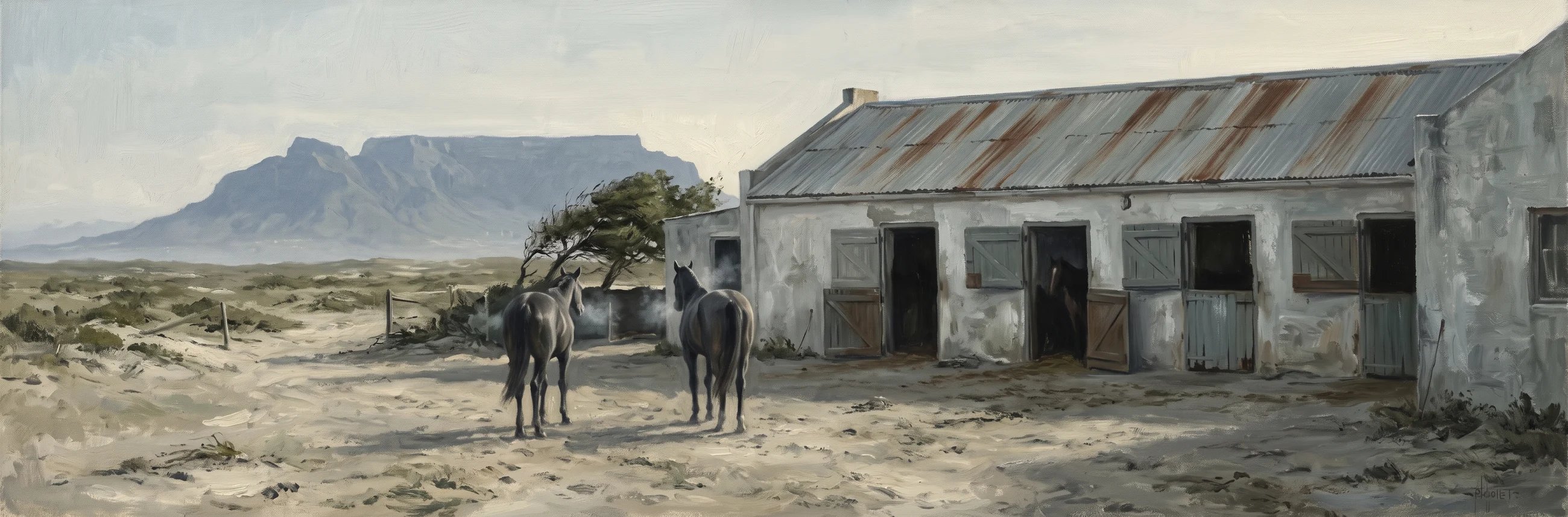
Three generations back, a horseman out of Rosario.
Rosario · the Cape · the Rand · Brisbane — a family that kept Spanish names for eighty years in a country that had no use for them.
A modern painted impression, not a photograph, and not a picture of any building this family is known to have owned — it stands for the yard at Rugby recorded in the 1931 building file. The signature in its corner is the image generator's invention.
This archive was built for David Defranceski, born in Johannesburg, living in Brisbane — and it runs backwards from his mother: to Germiston, where her father died; to Wynberg, where her grandparents married in 1911 and their sons were baptised; to Newlands, where the horseman died in 1950; and to Rosario de Santa Fe, where his own passport says he was born and where the registers do not yet agree.
It is a public archive with one rule: the living are left out — omitted, not hidden. And a second rule, which is harder: every claim says how well it is known. Documented Inferred Family lore
His father has a name.
An Argentine army enrolment card — clase de 1882, born at Rosario de Santa Fé, enrolling office Capetown — names Juan Carlos Lerena and María Lerena as the parents of Pablo Armando Lerena. It had been sitting behind a machine-made index that spelled him Armand Lorena and placed him 1,400 km away in Salta.
Corroborated from the other side of the ocean: his eldest son, named in the 1950 estate, was Ricardo Juan Carlos Lerena. Read the card →
What the family remembered, and how it has held up
Four traditions were handed down. Three now have documents; one has evidence against it.
| The claim | Where it stands |
|---|---|
| An Argentine great-grandfather, from Rosario | Confirmed His own passport gives Rosario de Santa Fe, 22 February 1882, and records him as Argentine by birth. The tradition was exactly right. The passport → |
| He brought horses | Confirmed Trainer on his passport; horse-dealer at his marriage; the Argentine 6th Cavalry in 1915; Race Horse Owner at his death; a 1931 file for stables at Rugby; a yard that took apprentices; and, among his debts, a claim for £26 of carrots. The horses → |
| He was Consul General | Disputed Nothing supports it. On the 1940 passport the consular signature belongs to A. B. Bayne; Pablo Armando is the bearer. The family did hold an Argentine consular passport, which may be how the story began — and the family's own note says the post may have been Uruguayan. |
| He had an ostrich farm | Doubtful The deeds registers show him holding no land at all, and every document places him in Cape Town racing rather than the Karoo. Not disproved — Oudtshoorn is unsearched, and a farm could have been leased. South Africa → |
Eight numbers
Where it stands, and where it stops
The line is closed and documented from Pablo Armando Lerena — born 1882, died at Newlands in 1950 — through Nuno Fernando Lerena to David's mother. His wife Mary Septima Taylor can be traced four generations further, to a James Taylor born about 1796 in Suffolk, and a family settled at Bideford and Northam in north Devon.
Above him the line now runs one generation further, to Juan Carlos Lerena and María Lerena, on his own army enrolment card. That card also does what no other document had managed: it corroborates the passport from outside the family, in Argentine hands, giving the same year and the same birthplace. The card →
What still stops is the baptism — and on 13 September 2026 the question changed shape. The Rosario index has been read letter by letter, under any surname, for 1881, 1882 and 1883; the 1879–1901 volume end to end; and now the earlier volume too, 1731 to 1879, eighty openings. Across both volumes and a hundred and seventy years, the surname Lerena appears once. Until 1888 the cathedral was the city’s only parish. A boy born there in February 1882 to a father named Lerena ought to be in that book; so ought his brothers and sisters, and his father’s marriage, and none of them is. A household that lives in a parish leaves baptisms. This one leaves nothing. The sweep →
And the one Lerena who is there points away from Argentina altogether. Folio 229, February 1866: the act names Don Luis Lerena Lenguas and Doña Julia Juanicó and says of both, “naturales del E. Oriental” — natives of Uruguay. The godfather, another Don Luis Lerena, stood by proxy, which is what one does from the other side of the river. Published Uruguayan genealogy makes that family the Lerena Lenguas of Montevideo — one of whose sons co-founded the Argentine Stud Book, and Pablo Armando trained and owned racehorses. Nothing yet links the two houses. But it says where to look next. Hypothesis 1c →
And one thing the card does not settle, said plainly: María is written with her husband’s surname. Whether she was a Lerena by birth — which would make the marriage one between kin — or was entered under her married name, the card cannot tell. Her maiden name is the next thing to find.