One letter of this surname was changed on purpose, and the reason was a war.
Graaff-Reinet · Cradock · Barkly East · Johannesburg — a Cape Dutch family that kept marrying British women, and came off the train at the Rand with nothing.
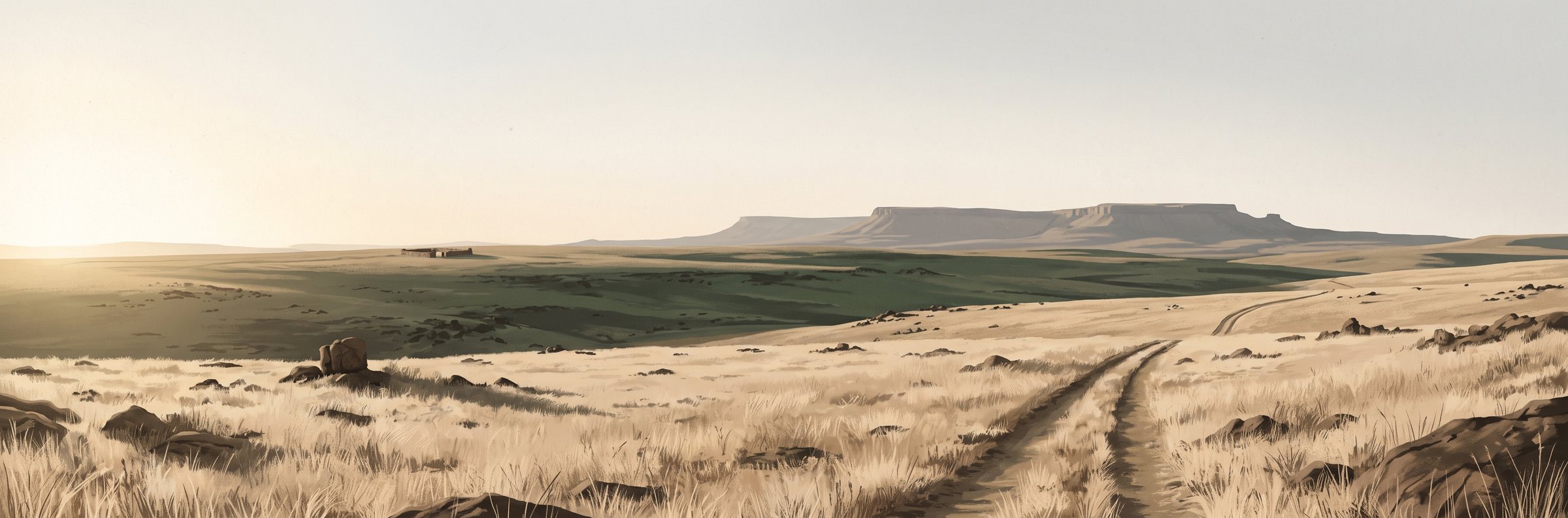
A modern illustration, not a photograph, and not a picture of any farm this family is known to have held — it stands for the country below the Stormberg between Barkly East and Dordrecht, where they were living when the war came. There is no photograph of their farm, and this archive does not invent one.
This archive was built for David Defranceski, born in Johannesburg, living in Brisbane. It runs backwards from his grandmother Catherine Mary Sophia Booyzen (1929–2013) — who married Nuno Fernando Lerena at St Joseph's, Mayfair, in 1949 — into the north-eastern Cape: to Barkly East and Dordrecht, to Cradock and Graaff-Reinet, and out again to Württemberg, to Soho, and to a County Cork that may or may not be real.
It is a public archive with one rule: the living are left out — omitted, not hidden. And a second rule, which is harder: every claim says how well it is known. Documented Inferred Family lore
What the family remembers, and how it has held up
One long piece of testimony sits at the centre of this archive — recorded on the family tree from Tersia Booyzen, told to her by her father. It carries seven separate claims. None of them has yet been proved. Two are already in trouble, and three now have strong circumstantial support that did not exist before this archive was built.
| The claim | Where it stands |
|---|---|
| The family were Cape Rebels | Yes — but under the other surname Of the 26 Booysens on the roll not one is from this district, and Booyzen returns nothing at all. The surname BARRY had never been searched. It returns four, and two are here: Fred J. Barry of Ivanhoe, Barkly East / Wodehouse, tried June 1901 — the same month as Daniel Willem Schoeman of Caerlaverock, in whose house the family married five weeks later — and Richard Peter Barry of Jerpoint, which is Kathleen Barry's brother's name. Identity unproven; the district is not. The rebels → |
| The spelling was changed to avoid the "joiners" | The change is on paper. The spelling was not new. On the 1905 death form the clerk writes Booysen and the dead man's son signs Booyzen, four lines apart — though what carries weight there is the signature, not the contrast, since Cape clerks of 1904–07 demonstrably spelled one Middelburg constable both ways in the same registry. And the z was never invented: the Cape archives hold 39 documents under BOOYZEN, the earliest 1779 — a hundred and twenty years before the war — and an 1851 register writes the family Booyzen in the same hand that writes the godparents Pieterzen. As for the motive, the joiners register holds one Booysen in the country, and he is a Free State man from Heilbron. The name → |
| A forebear was shot and killed by the British | Disproved for both candidates Petrus Jacobus died in 1884, fifteen years before the war. And Willem Hermanus died of an ulcer of the stomach at Indwe on 13 September 1905, after fourteen months' illness, under a doctor's care — the death registration has now been read. Whoever the story means, it is neither of them. The document → |
| The farm was burned out | Support, and a complication He is a Boer — farmer, of Lady Grey — at his marriage in 1879, and a Mason at his death in 1905; a man who works land and then works stone has often lost the land, and the war sits in that interval. But his father's 1884 estate leaves “moveables only, such as wearing apparel”, so this household was landless fifteen years before the war. Any account beginning with a prosperous farm being burned has to account for 1884 first. The documents → |
| The women and children were put in a concentration camp | Searched, and not found The University of Cape Town's camp database has now been searched: Barry returns nothing at all, and the five Booyzens in it are every one Transvaal. But that database is built largely from camp death lists — it records who died far better than who was interned and walked out — so the claim is unsupported, not disproved. What was searched → |
| They came to Johannesburg and the boys went onto the mines | Half-confirmed, and the mines half is not holding The move is certain: the birthplaces run Barkly East, Indwe, then Johannesburg, and the family's estates are all in the Transvaal. But of the occupations this archive has actually read for these men — boer then mason, tree nurseryman, clerk on the South African Railways — not one is a miner, and no Booyzen mining record appears anywhere in the national archives index. What was searched → |
Why this archive exists
In 1915 a man at Barkly East filled in his own mother's death notice. Where it asked for her parents' names, he wrote:
"Father: Kolbe, thinks James was christian name.
Mother: Unknown."
His grandfather was George Augustus Kolbe — who married at sixteen on a sworn lie in Shoreditch, sailed on the Nautilus in 1819 as an 1820 Settler, preached across the Orange River, and named a Karoo farm after the Württemberg his own father had left. His grandmother was Margaret Downing of London.
Both of them lie under a cut-stone monument at Burgersdorp — names, London birthplaces, farm and dates carved into it — about forty miles from where that notice was written.
The family forgot them inside seventy years, with the headstone still standing.
And it had happened before, on the other side of the house. In 1840 a relative of James Montjoy filled in the same printed form at the same box. He knew the dead man's trade, his house, what it was worth, the village he died in and the name of his wife's first husband. Where it asked for the parents, he wrote:
"Names of the Parents of the Deceased. Not Known." — and for birth-place, only "Europe".
James Montjoy had died thirteen years earlier. That is the oldest document in this archive and the top of that line, and it is where the line stops — not because the records run out, but because the family's own memory had already run out by 1840. The 1840 notice →
Everything on this site was recovered from documents that were already in the family's own tree, scanned and attached and never once transcribed. The documents →
Six numbers
The shape of it
Strip the archive to one sentence and it is this: a Cape Dutch male line that married British women for three generations running, and then, in one war, chose a spelling that put it on the Boer side of a family argument.
The men are Booysen — Gerthardus Lodewikus, then four Petrus Jacobuses, then Willem Hermanus, at Graaff-Reinet and Cradock and Barkly East. The women are not. Mountjoy (1838). Barry (1879). Kinnear (1940s). Behind the Barrys, Kolbe — a German tailor's family out of Soho who sailed as 1820 Settlers and named a Karoo farm Wurtemburg. Behind the Kolbes, Downing.
That is why David Defranceski's great-grandfather, born on a farm in the Eastern Cape in 1901, was christened George Downing Mountjoy Booyzen. Every one of those forenames is a woman's surname. The women →
And it is why the tree folds back on itself: in 1924 George married his own first cousin once removed, so his daughter Catherine descends from one Barry–Kolbe couple twice over. The cousin marriage →
Sibling archives
Same method, same author. The Defranceski (Istria), The Falco (Arienzo, Campania) and The Lerena (Rosario, the Cape, Brisbane). Catherine Mary Sophia Booyzen's marriage to Nuno Fernando Lerena in 1949 is the hinge between this archive and that one.