The name
Booyzen is not a variant spelling that drifted. It is one family's deliberate break from a mass surname — and the distribution figures, gathered a century later and entirely independently of the family, say exactly that.
The claim being tested
"There were some Booysens who were joiners, fighting on the side of the British, so our great grandfather changed the spelling to Booyzen so as not to be associated with them." — family testimony recorded on the MyHeritage tree from Tersia Booyzen. The full account →
Documented That a change happened is on the record twice over. MyHeritage carries "Former name: Booysen" as a formal Name Change fact on Willem Hermanus "William Henry" Booyzen (1851–1905) — and, far better, both spellings appear on a single sheet of paper in September 1905.


The informant is John Barry Booyzen, the eldest son, twenty-one, recorded as present at the death. His father is buried under the old spelling; he signs the new one. The full document →
Family lore The motive — the joiners — is testimony, and cannot be proved from a spelling alone.
But a deliberate break from a large surname should leave a very particular fingerprint in the population a century later: a tiny name, in the wrong province. That is precisely what is there.
The complication: he may have been signing a z in 1879
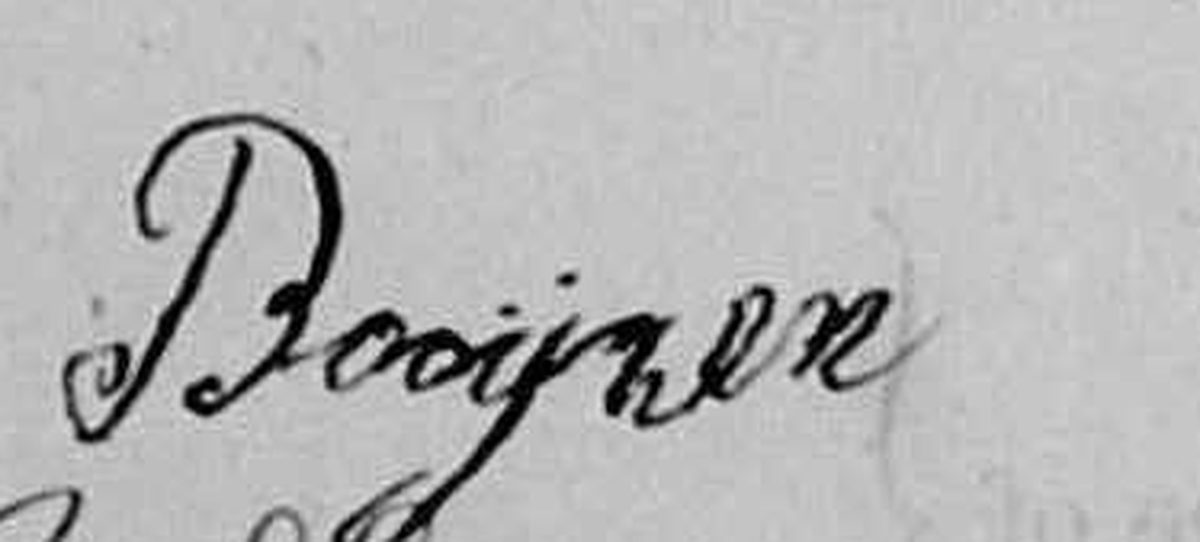
He signed what reads as "Booij_en" — the older Dutch ij digraph, with a medial letter whose descending loop is more consistent with z than s.
If that reading is right, the z was already his own hand in 1879 — twenty years before the war — and the testimony explains a motive for something that had already happened.
Not established The reading is not certain. Cursive Dutch s and z are genuinely confusable, and this is a photograph of a duplicate register rather than the original. The archive states both readings and prefers neither.
Note what it would and would not overturn. It would not touch the distribution evidence below — the name would still be a tiny, Gauteng-concentrated break from a Cape surname. It would move the date of the break back a generation, and make the joiners a remembered reason rather than the original one. The register →
The control that changes what a z is worth
Documented The archive has now read the 1851 Graaff-Reinet baptism register from the Cape Town Archives scan rather than from a photograph of it. Entry No. 2809, Willem Hermanus, born 4 May 1851, baptised 31 October 1851 at Achter Sneeuwberg. The father's name is written out, unambiguously, with a z:

Taken alone that would be a discovery: the z, already on paper, two generations early. It is not, and the same entry says why. Three lines below, the same clerk in the same ink writes the godparents' surname twice — and writes it the same way:
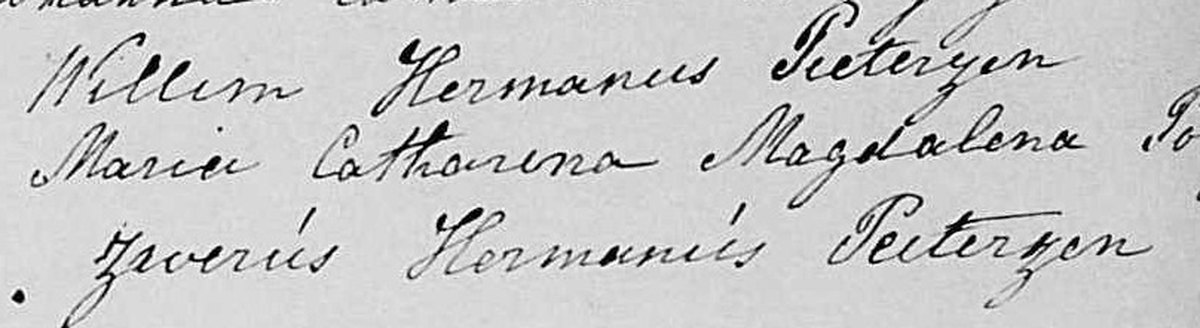
Pietersen is not a family that changed its name. In Dutch orthography -zen is the ordinary way to write the patronymic ending, and this clerk wrote it that way for everybody who came to his font. The z in Booyzen here is the clerk's spelling convention, not the family's claim on it.
What this costs the argument, and what it does not. It removes any reading in which the z was invented — in 1905, on the road north, or by any one man. The spelling was ordinary Cape-Dutch orthography and was lying about in the registers the whole time. It also weakens the 1879 signature above: a z-shaped letter in a Dutch hand is no longer evidence of anything in particular.
It leaves the 1905 sheet standing, because that document does not turn on the shape of a letter. It turns on two different spellings of one man's name on one page — the registering clerk writing Booysen, the son signing Booyzen four lines below. A divergence within a single document is still a divergence. And it leaves the distribution evidence below entirely untouched: 646 against 53,764, in the wrong province. Whatever the family did, they did it — the population figures are not a matter of handwriting.
This archive's own correction An earlier pass read this register from a photograph on the family tree and recorded the father as Boo[i]j[s/z]en — ambiguous — and the witnesses as Pietersen, with an s. Both readings were wrong, and the second was the one that mattered: it hid the control. The archive scan settles both.
The spelling is a hundred and twenty years older than the war
The 1851 register suggested it. The Cape Archives index settles it.
The National Automated Archival Information Retrieval System was searched for the z spellings in the Cape Town Archives Repository. It is not a small number, and it does not start where the family story says it should:
| Spelling | Documents in KAB | Earliest |
|---|---|---|
| BOOYZEN | 39 | 1779 |
| BOOIJZEN | 3 | 1792 |
The earliest is KAB CJ 2633: 29 — "BOOYZEN, CHRISTINA. TESTAMENT. 1779." Then a will in 1808, a memorial to the Colonial Office in 1810, a liquidation account in 1820, a Stellenbosch testament in 1821, and on without a gap through the nineteenth century.
The Anglo-Boer War began in 1899. Somebody was already writing this surname with a z a hundred and twenty years before it.
Be precise about what this kills and what it leaves standing.
Killed: any version of the story in which the spelling itself was created — invented by a great-grandfather, coined on the road north, made up to escape the joiners. It was ordinary Cape orthography before the family in question was born.
Left standing: that this family changed which of the two existing spellings it used. That is a different claim, and the 1905 death registration still supports it — the clerk writes Booysen and the son signs Booyzen four lines below, on one sheet. Choosing an old spelling is still choosing.
Untouched: the distribution figures below. 646 against 53,764, concentrated in the wrong province. Whatever this family did, the population data still shows it.
And a Booyzen, with a z, in Cape government service in 1904
Three files in the Attorney-General's series, all spelled with the z, two years after the war ended:
| KAB AG 1393: 1547 | "BOOYZEN, PJ. Leave of absence, Middelburg Police Office." | 1904 |
| KAB AG 1648: 8946 | "BOOYZEN, PJ. Constable. Application for leave. Middelburg." | 1905 |
| KAB AG 1772: 11084 | "BOOYZEN, PJ. Constable. Leave of. Middelburg." | 1907 |
| KAB DOC 4/1/1075: 5377 | Mortgage bond, Pieter Ignatius du Plessis and Petrus Jacobus Booyzen | 1904 |
| KAB DOC 4/1/1185: 1256 | Mortgage bond, the same two men | 1906 |
Not connected to this family — yet Petrus Jacobus is this family's core male name, carried by three generations of it. Middelburg is the district where Petrus Jacobus Booysen died at Zevenfontein in 1884. And a man of that name, spelled with the z, is a police constable there in 1904, 1905 and 1907, holding mortgage bonds in 1904 and 1906.
The archive cannot yet show he is a relative, and says so. But if he is, it is worth sitting with: the testimony says the spelling was changed to avoid being taken for men who served the British — and here is a Booyzen, spelled the new way, in the Cape colonial police. Open questions →
One constable, one town, both spellings — and it weakens the 1905 sheet
The strongest single test of what these two spellings meant to the people writing them turns out to have nothing to do with this family at all.
The Cape Attorney-General's registry files hold seven documents about a police constable at Middelburg between 1904 and 1907. They are plainly one man — one rank, one station, one run of leave applications. The registry clerks could not agree how to spell him:
| Reference | As filed | Year |
|---|---|---|
| KAB AG 1393: 1547 | BOOYZEN, PJ. Leave of absence, Middelburg Police Office | 1904 |
| KAB AG 1543: 14632 | Five pound note found by PJ BOOYSEN, Middelburg | 1904 |
| KAB AG 1594: 3531 | BOOYSEN, PJ. Constable. Application for leave. Middelburg, Cape | 1905 |
| KAB AG 1628: 6598 | BOOYSEN, PJ. Constable. Application for leave. Middelburg | 1905 |
| KAB AG 1648: 8946 | BOOYZEN, PJ. Constable. Application for leave. Middelburg | 1905 |
| KAB AG 1659: 10381 | BOOYSEN, PJ. Constable. Application for leave. Middelburg | 1905 |
| KAB AG 1772: 11084 | BOOYZEN, PJ. Constable. Leave of. Middelburg | 1907 |
Four times with an s, three times with a z — and twice both ways inside 1905, months apart, in the same registry, about the same man's leave.
What this does to the archive's own centrepiece. This site has leaned hard on the 1905 death registration: the clerk writes Booysen, the son signs Booyzen, four lines apart. That has been read as the change caught in the act.
These seven files say that in exactly those years, in official Cape writing, the two spellings were interchangeable labels for one person. So the clerk's Booysen on the 1905 form is not evidence of an older spelling being displaced. It is what a Cape clerk in 1905 might write on any given day, for anybody.
What survives is narrower, and it is the half that was always the stronger half: the son signed. A clerk's hand records a clerk's habit; a signature records a man's own choice of how his name is spelled. John Barry Booyzen chose the z. The contrast with the clerk beside him is no longer the point.
And the constable is not shown to be family Petrus Jacobus is this family's core male name and Middelburg is the district where Petrus Jacobus Booysen died at Zevenfontein in 1884 — and where his son Gerrit Jacobus married in 1896 and had a son baptised Booyzen in 1904. The constable sits in the middle of that, and may well be one of them. The archive cannot show it, and says so. Open questions →
How rare Booyzen is
Forebears, accessed 9 September 2026: 646 bearers worldwide, the 507,320th commonest surname on earth, an incidence of 1 in 11,281,031. Ninety-six per cent are in Africa.
Where the 646 Booyzens are. Ninety-five per cent of them are in one country.
| Country | Bearers | Incidence | Rank in country |
|---|---|---|---|
| South Africa | 616 | 1:87,951 | 10,814 |
| Australia | 16 | 1:1,687,231 | 81,699 |
| United Arab Emirates | 6 | 1:1,527,046 | 51,993 |
| United States | 3 | 1:120,819,644 | 1,331,040 |
| Botswana | 1 | 1:2,186,929 | 30,250 |
| Ireland | 1 | 1:4,708,939 | 29,543 |
| England | 1 | 1:55,718,059 | 489,080 |
| Saudi Arabia | 1 | 1:30,855,817 | 63,028 |
| Turkey | 1 | 1:77,821,422 | 191,047 |
Note the sixteen in Australia. David Defranceski's own family is in Brisbane; the Booyzen descent reached it through the Lerena and Defranceski marriages rather than under the Booyzen name, so those sixteen are likely to be a separate migration. Unchecked.
And how common Booysen is
Forebears, accessed 9 September 2026. Only the four provinces the source reports are shown; a dash is not reported, not zero.
53,764 worldwide, the 10,459th commonest surname on earth, and 52,009 of them in South Africa — one South African in a thousand.
Booysen is 83 times commoner than Booyzen.
In South Africa the gap is wider still: 1 in 1,042 against 1 in 87,951 — a factor of 84.
The finding: the two names live in different provinces
This is the part that is hard to explain any other way.
| Province | Share of Booysen | Share of Booyzen | What it means |
|---|---|---|---|
| Western Cape | 39% | 10% | the parent name's heartland |
| Eastern Cape | 17% | — | the old Cape Colony districts |
| Gauteng | 15% | 45% | the Witwatersrand — Johannesburg |
| Limpopo | — | 9% | — |
Booysen is a Cape surname. Fifty-six per cent of its South African bearers are in the Western and Eastern Cape, which is where the family arrived in the seventeenth century and stayed.
Booyzen is a Johannesburg surname. Nearly half of all the Booyzens in the world are in Gauteng — a province that did not exist as a settlement until 1886.
Now set that against the testimony, which was recorded without any reference to statistics: a family in the Eastern Cape changes its spelling during the war, is burned out, and puts itself on a train to Johannesburg, where the boys go onto the mines.
The surname data was not collected to test that story, and cannot have been shaped by it. It says the same thing: a small group broke off a Cape name and reproduced on the Rand.
Inferred This is corroboration, not proof. Distribution cannot show why a spelling changed, and 616 people is a small enough number that founder effects and simple clerical drift both remain live explanations. What it does establish is that Booyzen behaves like a young name with a single origin, not like a long-standing spelling variant scattered through the Cape alongside its parent.
What the name means
A patronymic
Booysen is Dutch and means "son of Booy". Booy is itself a short form of Boudewijn — the Dutch form of Baldwin, from Germanic bald ("bold") and win ("friend"). The English cousin of the name is Boyce; the North German and Danish is Boysen.
A progenitor
The South African family descends from Boij Boijeszoon — modernised to Boy Booysen — who entered Dutch East India Company service giving his home as Barlt, in Northern Friesland, Schleswig-Holstein, and settled at Stellenbosch and Drakenstein in the mid-seventeenth century.
1942 · A clerk who typed the z
The one document in this archive where an official, unprompted, spells it the family's way.
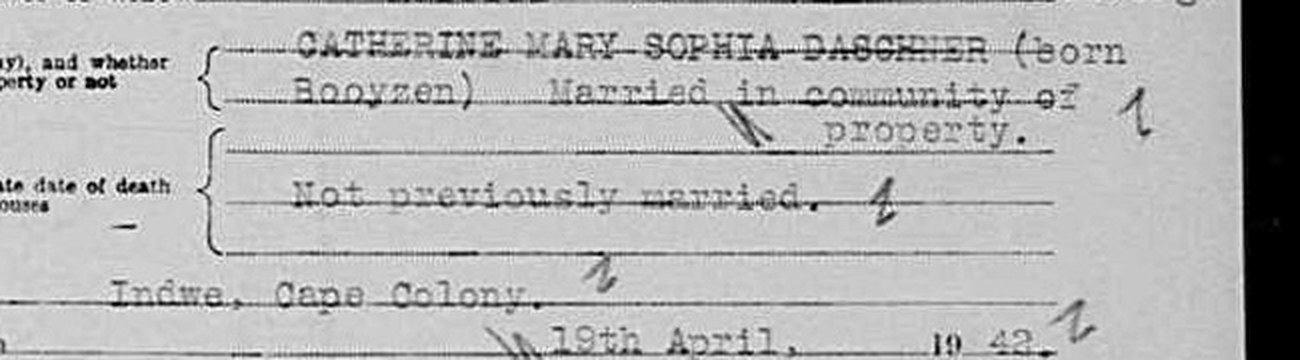
Every other official spelling this archive has read runs the other way. The Indwe clerk in 1905 wrote Booysen on Willem Hermanus's death form, and his son signed Booyzen four lines below it. The Middelburg files spell one constable both ways twice inside a single year. The Johannesburg registrar typed Booysen on Anna Pretorius's 1944 death registration.
Here, thirty-seven years after Indwe, a Johannesburg typist taking down a widow's account of her own maiden name types Booyzen — and there is no signature anywhere on the page to have copied it from. The only source for the z was her saying it.
Set this beside the constable files and the position is stable in both directions: a clerk's s proves nothing about the family, and a clerk's z proves nothing either. What it does show is that by 1942 the z was what a Booyzen daughter said out loud when asked her name — which is a claim about the family, not about the archive. The document →
And a caution that belongs on this page. There is a Johannesburg suburb called Booysens, two miles from where this family lived in the 1940s. Any index search for the name in that city collects people whose only tie to the word is a street address — this archive met one, a miner called Rennie, before it recognised what it was looking at. Booysens →
The family could not spell it either
These four spellings all appear inside this one family's records, sometimes among brothers and sisters.
| Spelling | Where it appears here |
|---|---|
| Booysen | the parent name; used by Gerthardus Lodewikus, both Petrus Jacobuses, and most of the nineteenth-century siblings |
| Booyzen | Willem Hermanus from the name change onward; the whole line since — and typed by a Johannesburg clerk in 1942, from a daughter's dictation |
| Booÿsen | Frederik Fortsenatus Booÿsen, b. 1899 — with the diaeresis, the older Cape Dutch orthography, in the year the war began |
| Kolbe-Booysen | a compound recorded for Maria Jacoba Smit, who married David Kolbe Booyzen in 1921 |
Within a single sibling group the tree records Jacobus Nicolaas Booysen (b. 1840) and Jacobus Nicolaas Booyzen (b. 1841), both dying on 17 November 1882. That is almost certainly one man entered twice under two spellings — a small demonstration of how easily this name splits. Disputed →
Sources: Forebears (Booyzen; Booysen), accessed 9 September 2026; Wikipedia, Booysen; the MyHeritage tree Defranceski Family Site (23andMe). Forebears figures are modelled estimates from name-frequency data, not a census, and should be read as orders of magnitude.