The Kolbes
A German tailor's family in Bond Street, a boy married at sixteen and a settler at seventeen, a missionary's circuit through the Orange Free State, and a Karoo farm named for a country its owner had never seen.
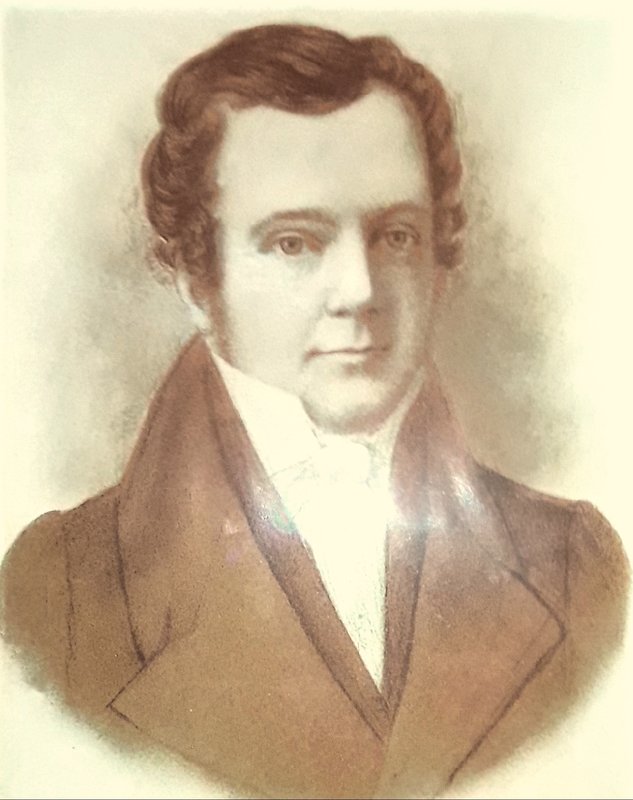
George Augustus Kolbe, 1802–1844 — an 1820 Settler
The family's research notes wonder whether John Augustus Barry was born at sea with the 1820 Settlers. He was not. But the family does have a documented settler, on the other side of that marriage, and his record is unusually complete.
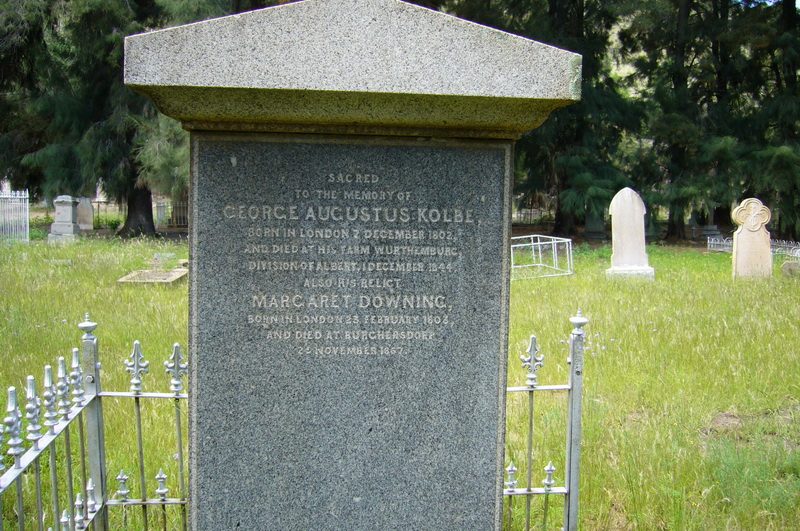
| Born | 7 December 1802, Westminster St Anne, London |
| Christened | 2 February 1803, St Anne's, Soho — the register names his parents John Gottlob & Mary, and gives his birth as 7 Dec 1802, matching the Burgersdorp gravestone to the day. The register → |
| Married | 20 January 1819, St Leonard's, Shoreditch — Margaret Georgina Elizabeth Downing, on a sworn oath that both were "of the age of Twenty-one Years and upwards". He was sixteen; she was fifteen. The allegation → |
| Sailed | Gravesend, 3 December 1819, on the ship Nautilus, in Thomas Owen's party |
| Landed | Algoa Bay, 14 April 1820 |
| Trades | Reverend Missionary, London Missionary Society · Chemist · Tailor — but his death notice calls him simply an Agriculturist |
| Died | 1 December 1844, the farm "Wurtemburg", field-cornetcy of Rhenosterberg, Knapdaar, district Colesberg |
| Buried | December 1844, Burgersdorp Old Cemetery |
| Estate | 7698 — KAB MOOC 6/9/35 (1845); read, and valued at about £1000 sterling |
He was sixteen when he married at Shoreditch and seventeen when he stepped ashore at Algoa Bay. His wife was about fifteen.
And they said otherwise. The marriage allegation of 20 January 1819 has him swear on oath that he is "a Bachelor of the age of Twenty-one Years and upwards" and she "a Spinster of the age of Twenty-one Years and upwards." Under Hardwicke's Marriage Act a minor could not marry by licence without a parent's consent. Both ages are false. The document →
The voyage, confirmed at last — and they lied about their ages again
This archive has carried the Nautilus since the first day, entirely on the family tree's word. It has now been checked against the settler roll.
Confirmed
Owen's party sailed from Gravesend on 3 December 1819 in the Nautilus, reached Table Bay on 17 March 1820 and Algoa Bay on 14 April 1820. Fifty-two settlers.
Every date the tree gave is right. Open question 9, answered
And a trade nobody had
The roll enters him as:
KOLBE, George Augustus 20. Chemist. w Margaret 19.
This archive has him as a preacher and a farmer. On the ship's list, at seventeen, he is a chemist — which is to say an apprentice apothecary, and a London tailor's son reaching for a profession.
Now put the ages beside the documents.
| Document | He is stated to be | He actually was | She is stated | She actually was |
|---|---|---|---|---|
| 1819 — marriage allegation, Shoreditch | 21 | 16 | 21 | 15 |
| 3 Dec 1819 — the Nautilus settler roll | 20 | 16 | 19 | 16 |
He was born 7 December 1802 — the parish register says so — and the ship sailed four days before his seventeenth birthday. She was born 23 February 1803, which her own death notice gives to the day.
They overstated their ages twice in one year, on two different official documents, to two different authorities. The archive already knew about the marriage allegation and treated it as a single desperate act by a couple who wanted to marry. It was not single. Within months they did it again — to get on a ship.
What it does not tell us Whether the overstatement was theirs or the party's. Thomas Owen had to present a party the Colonial Department would accept, and a seventeen-year-old chemist with a sixteen-year-old wife is a less convincing settler than a man of twenty with a trade. The lie may have been written for them. Either way it was on the paper. The marriage allegation →
Settler roll: 1820settlers.com, Owen's party, accessed 10 September 2026 — the same database whose citation for James Jonathan Mountjoy this archive found to be wrong, so it is used here for what it is: a compiled transcript, corroborating dates the tree already carried, and adding one occupation.
The children are a missionary's itinerary
Not a settler farm but a circuit — and two of the stops are London Missionary Society stations north of the Orange River.
| Child | Born | Place | |
|---|---|---|---|
| John Gerson Eliezar “Jan” | 1822 | Uitenhage | |
| Catherine Maria Sophia (Joubert) | 1825 | Graaff-Reinet | |
| Margaretha Wilhelmina Elizabeth Mary (Barry) | 1826 | Graaff-Reinet | the line to David |
| Augusta Louisa “Louise” (Werdmuller Von Elgg) | 1829 | Graaff-Reinet | |
| Harriet Hachilah Machilah (Spiller) | 1831 | Philippolis, Orange Free State | mission station |
| Mary Elizabeth Margaret Willemina (Enslin) | 1833 | Burgersdorp | |
| John | 1834–1835 | — | died an infant |
| Charlotte Felicia (twin) (Snook) | 1836 | Burgersdorp | twin |
| George Augustus (twin) | 1836 | Burgersdorp | twin |
| Frederik Fortunatus | 1839 | Bethulie, Orange Free State | mission station |
| Keetor Peter Benjamin | 1840 | Colesberg | |
| Johan Casimir “Casiner” | 1844 | Bethulie | born the year his father died |
The forenames are extraordinary — Hachilah Machilah, Gerson Eliezar, Casimir, Fortunatus. They read exactly as a missionary's children's names should: scriptural, Latinate, chosen rather than inherited.
And one of them travels. Frederik Fortunatus Kolbe (1839) becomes Frederick Fortunatus Barry (1863) becomes Frederik Fortsenatus Booÿsen (1899) — one name carried across three surnames and sixty years, degrading slightly at each handover. The women →
John Gottlob Kolbe, 1765–1845 — a tailor of Bond Street
The tree leads with the German original, Johan Gottlieb. Four documents — his son's baptism register, his own will, his death certificate and his burial entry — all call him John Gottlob. That is the name he used in England, and the one this archive follows.
| Born | 1765, Württemberg, Germany |
| Trade | Tailor, of 34 Conduit Street, Bond Street, Middlesex |
| His will | written of "JOHN GOTTLOB KOLBE of Conduit Street … in the county of Middlesex Tailor" |
| Married | 1793, London — Mary Larman (1768–1814) |
| His will | signed 25 May 1842, proved at London 23 Feb 1846 in the Prerogative Court of Canterbury. A partnership business of Tailors with Richard Davies; his daughter Marian Kolbe named Executrix. Read it → |
| Died | 18 November 1845, at 34 Conduit Street, Mayfair — cause: "Decay of Nature". Not Lamb's Conduit Street, as the tree has it. Three documents say so → |
| Buried | 26 November 1845, the GERMAN SAVOY CHURCH (St John Baptist), the Strand, London — Grave 7, by Revd Dr Steinkopff. Not Leamington, Warwickshire. The register → |
He appears under three versions of his own name — Johan Gottlieb, John Gottlob, John Paul — but the documents are consistent: every one of the four read by this archive says John Gottlob. That is what assimilation looks like in a parish register. His eldest daughter married George Kottlich Kohlbeck at St Anne's Soho in 1811, which suggests the family's German original was nearer Kohlbeck than Kolbe.
A firm, not a jobbing tailor
His will, proved in the Prerogative Court of Canterbury in 1846, shows a business with capital and a partner — Mr Richard Davies — and directs that his money stay invested in the partnership for fourteen years after his death. Trustees were Timothy Duke, a gentleman of Lombard Street, Christian William Kent, a fellow tailor of Poland Street, and his own daughter Marian Kolbe, whom he appointed Executrix and who was sworn at probate as "Marian Kolbe Spinster the daughter."
For those fourteen years the profits went to such of his daughters "as shall continue sole and unmarried" — and any daughter's share ceased the moment she married, passing to her unmarried sisters. Provision and pressure in the same sentence.
Then the residue divided equally among all his children living at his death, with the issue of any child already dead taking that child's share.
George Augustus Kolbe died in December 1844; his father in November 1845. Under that clause George's share fell to his own children — at Burgersdorp, in the Cape Colony.
Inferred There is, on paper, a line of money from a Bond Street tailor's estate to the Barkly East family. Whether any of it arrived is untested. The will →
German by burial, English by baptism
The living children were christened at St Anne's, Soho — the Anglican parish. The dead were not.
At least five of them were buried at "St Marien's Children's Churchyard, The Strand" — the burial ground of the German Lutheran church in the Strand. Charles Samuel (1806–1807), Edward (born and dead on 15 November 1808), Frederick Charles (d. 1809), Frederica Carolina (1813–1814) and John Henry (d. 1832) are all recorded there — and so is their mother Mary Larman, who died at St Marien's on 2 August 1814.
A family standing in both communities at once: Anglican for the living, German for the dead.
And German for the patriarch too. The tree had him buried at St John the Baptist, Leamington, Warwickshire. The register says "St John Baptist, in the German Savoy Church, in the County of Middlesex" — the same Strand congregation, a hundred miles from Warwickshire, the ceremony performed by Revd Dr Steinkopff. He was buried with his wife's people. The correction →
The detail that ties the two continents together
A tailor's son from Bond Street sailed at seventeen, preached across the Orange River, and died in 1844 on a Karoo farm he had named Wurtemburg — after the German country his father left and he had never seen.
He died eleven months before his own father, who was still alive above the shop in Conduit Street, Mayfair. Under the old man's will, George's share of the estate fell to his own children, at Burgersdorp. The will →
The gravestone at Burgersdorp was standing about forty miles away, with both their names on it. The notice →
The line goes back further than the tree view shows
Retrieved from the tree's own card data. Kolbe reaches 1699 and Downing 1683 — four generations deeper than this archive previously recorded. None of it is yet tested against a document.
Kolbe — Württemberg to London
Johann Gottlieb Kolbe (1699 – 29 Jan 1775) m. Maria Barbara Jung (c. 1700)
→ Johann Micheal "John" Kolbe (5 Oct 1736 – 1780)
→ Johan Gottlieb "John Paul" Kolbe (1765–1845) m. Mary Larman (1768–1814)
→ George Augustus Kolbe (1802–1844)
Larman: Thomas Hall Larman (c. 1740 – c. 1800).
Downing — and three Devon surnames
Edward Downing (1700–1792) m. Mary Heard (b. 1702)
John Trick (b. 1683) m. Margaret Hooper (1691–1741)
→ Thomas Downing (1736–1801) m. Mary Trick (b. 1731)
→ John Paul Downing (1769–1839) m. Mary P King (1768–1834)
→ Margaret Georgina Elizabeth Downing (1803–1867)
Trick, Heard and Hooper are distinctively Devon surnames. Untested — and note that Margaret's own 1867 death notice records her parents only as "Both dead", naming neither.
Seven moves in seven generations
The whole route, end to end.
Württemberg (1765) → Soho and Bond Street, London (1793–1819) → Nautilus, Gravesend (3 Dec 1819) → Algoa Bay (14 Apr 1820) → Uitenhage · Graaff-Reinet · Philippolis · Bethulie · Burgersdorp · Colesberg (1822–1844) → Barkly East (1859–1907) → Johannesburg (1900s) → Brisbane