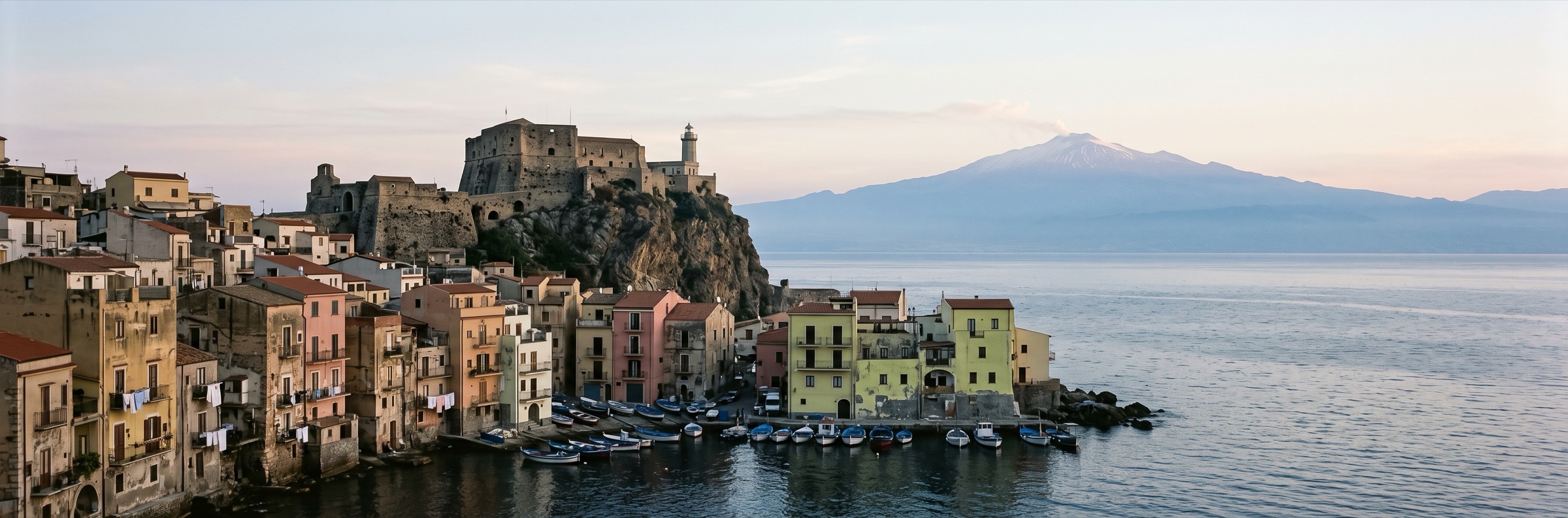
Three towns, one strait, and a suburb of Brisbane.
Piedimonte Etneo · Briatico · Scilla · New York · Buenos Aires · Brisbane — a family assembled from three corners of the Italian south, and the ships that carried it.
This is an archive of the Mazza of Brisbane — and of the three southern Italian towns they came out of, none of which had heard of the other two. It is not a pedigree: of the 596 people recorded here, all but a handful never continued the line. Only 68 of them have a death recorded anywhere — which is a measure of how much of this tree is still undated rather than of who is still alive.
This archive opened with the Mazza name reaching back four generations and stopping at a man with no dates at all. One day in the Sicilian registers took it to seven generations and Mariano Mazza and Maria Catalano, and joined a hundred and ten cousins to the line — every step a document.
The same day cost the archive its other headline. The Calabrian Prostamo were said to run nine generations to 1697. Audited, they are documented to a sailor dead before 1886, and asserted for four generations above him.
Where they came from
Four grandparents, three towns, and about six hundred kilometres of coast between the furthest two. Nothing in the Italian record joins these families to each other. They were joined in Queensland.
Prostamo, Melluso, Anile, Barbuto, Ventrice. A comune on the Tyrrhenian coast that sent people to New York, to Buenos Aires and to Brisbane in three separate departures.
Arena, Polistena, Donato. The rock and the fishing quarter at the northern gate of the Strait of Messina — the whirlpool of the Odyssey.
Mazza, Nicotra. Literally the foot of the mountain: a town on the north-east flank of Etna, and the origin of the surname this archive is named for.
Where the four lines met. Thirteen of them lie at Nudgee — the same cemetery as the Falco.
Four things this archive has established
A claim, tested
The Prostamo were said to reach 1697. They are documented to Domenico Prostamo, a sailor of Briatico dead before 1886 — and asserted, by a tree already shown to be six years out elsewhere, for four generations above him. The audit →
Four plots in a row
All four of Michael Rocco Mazza's grandparents — born in three towns six hundred kilometres apart, arrived on four different sailings — lie in consecutive plots V-1026 to V-1029 at Nudgee. The register →
Nine ships, named
The family tree recorded eighteen crossings and not one vessel. The National Archives passenger index named nine of them — the Toscana, the Surriento, the Roma, the Palermo. The crossings →
The hundred and ten, joined
The export arrived as fourteen disconnected pieces, the second holding 110 Piedimonte Etneo Mazza attached to this family by nothing. Five register acts proved them the descendants of Salvatore's brothers. The argument →
Fifty-eight names it refuses to merge
Four men called Rosario Mazza, four called Giuseppe Arena, none with a date between them. The archive keeps them apart rather than inventing a descent. The method →
Elsewhere in the archive
Sixty-two people across ten generations — counted against the 2,046 there ought to be. Complete for grandparents, five per cent complete by the seventh generation, and one thread at the tenth.
The archive's largest open question, answered on the day it was built: a hundred and ten Piedimonte Etneo Mazza who turned out to be the families of Michael Rocco Mazza's great-great-uncles.
Four generations this morning, seven tonight — from Mariano Mazza, born about 1815, to two children born in Brisbane.
Thirty-nine Arena of Scilla in a single unbroken family — the counter-example, and the reason a surname tells you least about a family.
Michael Rocco Mazza has four grandparents and they came from four different places. Three towns in the south of Italy, and the shipping line that brought all four to one suburb of Brisbane.
The archive's largest claim, audited: two Prostamo generations proved, four shown to rest on nothing, and a family of sailors the tree had recorded as farmers.
The Calabrian coastal comune that sent its people to New York, to Buenos Aires and to Brisbane in three separate departures.
The town on the north-east flank of Etna that gave the family its surname — and the shallowest line of the four.
Homer's Scylla, and a fishing village on the Strait of Messina. The Arena and the Polistena came from here.
Eighteen recorded arrivals and departures, in two distinct waves fifty years apart: New York before the Great War, Fremantle and Brisbane after the second.
Thirteen of this family are buried in one Brisbane cemetery — the same ground that holds five of the Falco.
Mazza is one of the commonest surnames in Italy, and it was coined many times over. What that means for anyone searching it.
What this archive does not know, written down — including the one identification that would add six generations and a hundred and eleven people.
Dates are withheld for anyone 80 or younger
Everyone in this tree is written up in full — name, places, family, photographs, records. But 133 people who would be 80 or younger today, and whose death is not recorded, have their dates withheld. Those dates are stripped in the build, not hidden by the page: they are not in the HTML and not recoverable from this site. A removal request is honoured within days, without argument and without requiring a reason. The method →