Twelve generations, and two claims too far.
Berkeley · Madeley · Hanley · Chatham · Parramatta · Kempsey · Boulia · Townsville · Brisbane — soldiers, a grocer and a church organist, and the two aristocratic descents this archive had to take off them.
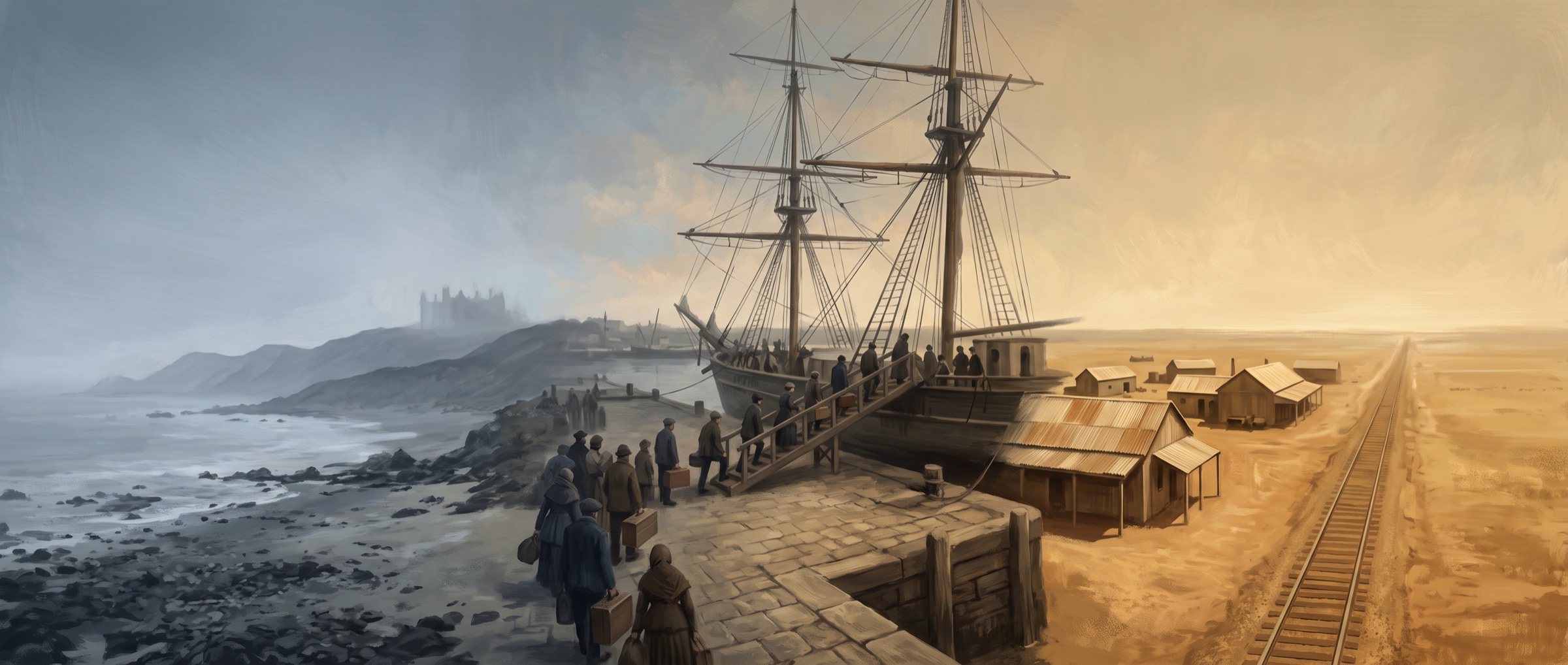
The house on the hill is faint on purpose. This archive cannot show that the family ever lived in it, and two pages here set out why — the Hornby claim and the graft that replaced it. What it can show is the middle of the picture and the right of it: a quay, a ship, and a flat gold country with a railway line running out of sight. Illustration commissioned for this archive, 2026.
This is an archive of the D'Arcys of Brisbane — and of the 13 families they married, who reached Queensland out of Limerick, Monaghan, Cork, Ayrshire, Lanarkshire, Somerset, Bristol, London and Germany. It is not a pedigree. Of the 473 people named here, most are somebody's brother or sister and continued nothing.
D'Arcy was coined twice over, and the two have nothing to do with each other: in Normandy as d'Arcy, "of Arcy", the name of a place; and in Ireland as Ó Dorchaidhe, from dorcha, "dark", the name of a complexion. There is no single founding D'Arcy family. The work here is to establish which D'Arcys are actually connected, and to say plainly where the evidence stops.
A detachment of thirty men, and a wife in the cabin
For as long as this family has had a pedigree, the interesting end of it was supposed to be the top — a castle in the North Riding, an earldom, a line back to the 1560s. The interesting end is actually the bottom, and it is provable.
What the surgeon's journal says
"Received on board a detachment of the 39th regt. of foot commanded by George Pitt D'Arcy, B. Major, consisting of 39 men … 6 women and 7 children." Cabin passengers included Mrs. D'Arcy and family. The convict ship England reached Port Jackson on 18 September 1826.
Surgeon George Thomson's journal, TNA ADM 101/26/1. This card said 30 men until 10 September 2026, from a secondary account. The correction →
What the children's births say
Charlotte Maria, Chatham, 1825 — the baby in the cabin. Catherine Maria, Parramatta, 1827. George Lindsay, Parramatta, 1829. Two years and half a world between the first and the second.
Four things this archive has established
A defensible head to the line
Major-General Robert D'Arcy, C.B. — second lieutenant of the Royal Engineers on 17 January 1776, major-general in 1819, dead at Chatham in 1827, and documented at every step by the register of his own Corps. The archive will defend him and everyone below him. Above him it will defend nothing. The spine →
Two grafts, not one
Of 243 ancestors, 71 hang on an unevidenced link in the D'Arcy line and 27 on a link in the Sneyd line that is now disproved from the parish register. Remove both and 145 remain, reaching 1654 in Gloucestershire. How far back it really goes →
A pedigree that contradicts itself
The tree says Robert was "thought to be the illegitimate" son of the 4th Earl of Holderness — and then descends him from the 3rd, through a man with two birth years sixty-nine years apart. The Hornby claim →
A gold medal, four years late
Major George Pitt D'Arcy commanded the 39th at Orthes in 1814 because his colonel was shot early in the action — and the medal he was given for it was posted to the colonel by mistake and took four years to find him. His war, and his ship →
A surveyor who helped map Melbourne
Frederick Robert D'Arcy, half-brother of the direct ancestor, was one of three surveyors sent to Port Phillip in 1836 to chart the bay and the Yarra. He died at Spring Hill and lies at Toowong. His story →
A eulogy, checked against a newspaper
Clayfield, the Union Trustee Company, a sudden death — five details of the 2010 eulogy confirmed by an obituary printed in 1936 that nobody in the family had seen, which also restores a fact they had lost: he served in France. The papers →
A voice, not just a date
Ken D'Arcy's eulogy, delivered in three parts by his three children in March 2010, runs to four thousand words and carries the African Grey parrot, the mango tree, the cigarettes at nine, and Cyclone Althea. Brisbane →
What changed, most recent first
57% of this archive's records now come from Australian sources. The brief was always the British ancestry.
Robert D'Arcy's promotions are in the government's own gazette, issue and page, where this archive has been citing a printed roll compiled from them.
Three of the four Sneyd links are now documented, and the missing one is a baptism of 1746. The line runs weaver, servant, gaol governor.
What it holds, and what it will not claim
166 of them from a document this archive has read; the other 473 from the family tree
and 2,034 living people absent from this build entirely
witnesses, constables, a surgeon, convicts, comrades — each with a page
28 of them read and found empty, which is knowledge
out of 473. A family tree is a set of assertions until somebody opens a document
each still on the page where it was made
Elsewhere in the archive
The tree runs this line to a Yorkshire earldom. The tree also admits, in its own note, that the join is only 'thought to be' — and then contradicts itself about which earl. Set out in full.
The oldest claim in this archive is a yeoman born in 1654. Somebody finally went and read the parish register instead of another family's website — and found forty-four Saingers, three Williams, and a transcript that stops eighteen years too early.
The Royal Engineers lived at Chatham and so did this family, and nobody had read its register. It holds a general’s burial, his wife’s, his brother officer’s — and a christening eight days before a convict ship sailed.
All 556 Saniger records in Gloucestershire opened one by one and assembled back into 81 households, to answer one question: is Hannah in any of them? She is not — and the census says why.
All 551 Staffordshire Sneyd records assembled into households, which finally produces the weaver the tree has been pointing at — and moves one of its dates by twelve years.
One page of the 1841 census holds the entire family this archive's oldest claim depends on — James and Hannah Wakefield at St Paul, Bristol, with Miriam aged one, and a seventy-year-old Sinegar widow nobody expected.
The tree reaches the kings of Denmark. This archive reaches a Gloucestershire yeoman in 1654. The difference is two grafts and about a hundred people — one unevidenced, one now disproved.
D'Arcy was coined twice: once in Normandy as a place, once in Ireland as a colour. The apostrophe is a hint and not a proof.
Eight wives of the direct line who bore sixty-seven children between them, and are recorded in a marriage line and a burial plot apiece. The most valuable document in this archive is one of their testimonies.
A major of the 39th Foot, his children born at Chatham in 1825 and Parramatta in 1827, and a regimental history that confirms both without ever having heard of him.
Four generations in one city: a boy born at Parramatta who went to the California diggings, a railway clerk found dead in his kitchen, a father dead at forty-three, and the widow who took in boarders.
An obituary from 1936 confirms five details of a eulogy delivered in 2010. Two other headlines look damning and say the opposite — the man in them is the witness, not the accused.
Four men out of one family: a sergeant who married nine weeks before he sailed; his wife's brother, killed at Pozières with no grave; her other brother, a stretcher-bearer with the Military Medal and Bar; and a cousin who came home on a hospital ship to die.
Six men were asked what happened to a private of the 9th Battalion at Pozières, and gave six answers. One of them, his closest friend, was still trying to find his grave thirteen months later, from a lecture room at New College, Oxford.
A coroner's file nobody in the family knew existed. It records how Ivy Sneyd's grandfather died in Victoria Park — and, in his widow's sworn evidence, it names his father and settles a generation the archive had been unable to prove.
An organist christened in Limerick Cathedral who emigrated in 1862 and, two years later, installed the first organ in All Saints' Wickham Terrace — and then played it.
Seven lines reached Australia seven different ways — a garrison posting, a convict ship, a free passage, a paid one, and three nobody has dated. Running the assisted-immigration index across every family returns the Wakefields and nobody else.
The archive knew this family reached Queensland. It did not know how, when, or on what. The passenger register gives all three — and a fourteen-year-old Miriam Wakefield shipped as a domestic servant.
Sneyd, Atkinson, Murdoch, Atwell, Blum, Keeling, Creech, Matson, Wakefield, Wright — out of Limerick, Monaghan, Cork, Ayrshire, Somerset, Bristol and Germany.
One box over the whole archive — people, register entries, places and every page. It knows that Saniger, Sainger and Sinnegar are the same family, and that D'Arcy is also Darcy.
Every source this archive has opened, including the ones that gave nothing. Four of the null results are load-bearing: they are why the Hornby claim is called unevidenced rather than disputed.
A living descendant tested. Cutting both rejected grafts — 98 people, thirteen generations, four royal houses — moves her predicted ancestry by 0.39 of a percentage point.
Lives against the state that governed them. In an archive built almost entirely out of government paper, the state is not background — it is the reason the records exist.
Nine jobs that need a login, a card or a human being in a reading room. The first is a will, digitised, about £3.50, and it might name Robert D'Arcy's father.
The seventy-five people this archive met in documents and had nowhere to put: the constable who recovered a body, the six men who gave six accounts of one death, the convicts who broke open a major's crate.
Where this family lies — and two cemetery plot references that two different people are each supposed to occupy.
Every named individual this archive has met anywhere — 586 entries, with the source printed beside each one. Only 113 of them rest on a document. The other 473 come out of the family tree, and 98 of those hang above a graft the archive has already rejected.
Every person the archive can name and publish — 473 of them, most of whom never continued the line.
170 places, from Hornby Castle to Boulia. Read the Australian list in order and you can watch a family spread along the Queensland railway.
This is one of six, kept to the same method. The D'Arcy line married Defranceski; the Defranceski line had married Falco. All three meet in a living generation that none of the archives publishes.
Seven mistakes this site published and then corrected, with the cause of each. Five of the seven are the same failure: a number taken from a secondary source and not checked against the record.
What 'documented' means here, what 'family lore' means, and the rule that keeps living people out of the build entirely.
What is still missing
Who Robert D'Arcy's parents were. Not disputed — unknown. His own life is now on paper from his commission to his grave, and not one of those documents names a father: officer rolls do not record parentage, no baptism is indexed anywhere in England, and the Gentleman's Magazine did not notice his death. Every avenue reachable from a desk has been tried, and the remaining ones need an archive: the Board of Ordnance records, and the will of the 4th Earl of Holderness.
Below that: whether the Atkinsons of Limerick and the Murdochs of St Quivox can be pushed past the emigrant generation at all, and what killed Lindesay Atkinson D'Arcy at forty-four. The queue, in priority order, and the nine letters drafted →
Of the direct ancestors, 4 are living and excluded from this build entirely — not hidden, not gated, not present in the output. Across the whole tree the rule withholds 2,034 people. The rule →