The Sicilian Registers
Nine annual indexes and six acts, hunting one man. He is still missing — and in looking for him the archive found Rosario, and a generation above him nobody knew was there.
The family tree says Salvatore Mazza was born at Piedimonte Etneo in 1879, son of a Rosario Mazza about whom exactly one thing was known: that he existed. Finding Salvatore's act of birth was supposed to name Rosario and settle everything.
Salvatore is not in the register — not in 1875, 1876, 1877, 1878, 1879, 1880, 1881 or 1882 at Piedimonte Etneo, nor at Mascali or Giarre in 1879. But the five Mazza births that are there, and two marriage acts, have between them built three documented households, proved two of the men brothers, and reached a generation the family tree does not contain at all.
Innocenzio Mazza and Domenica Cavallaro
A birth act names a father. A marriage act names both fathers and both mothers — which is why two marriages were worth more than five births. Two of them, two years apart, name the same couple:
Salvatore and Antonino are brothers — born about 1841 and 1843, both braccianti of Piedimonte Etneo, both sons of Domenica Cavallaro. Two independent acts, two years apart, naming the same mother. Innocenzio Mazza and Domenica Cavallaro are the earliest Mazza this archive can name from a document — a couple of the 1810s or 1820s — and nothing in Michael Mazza's family tree reaches them.
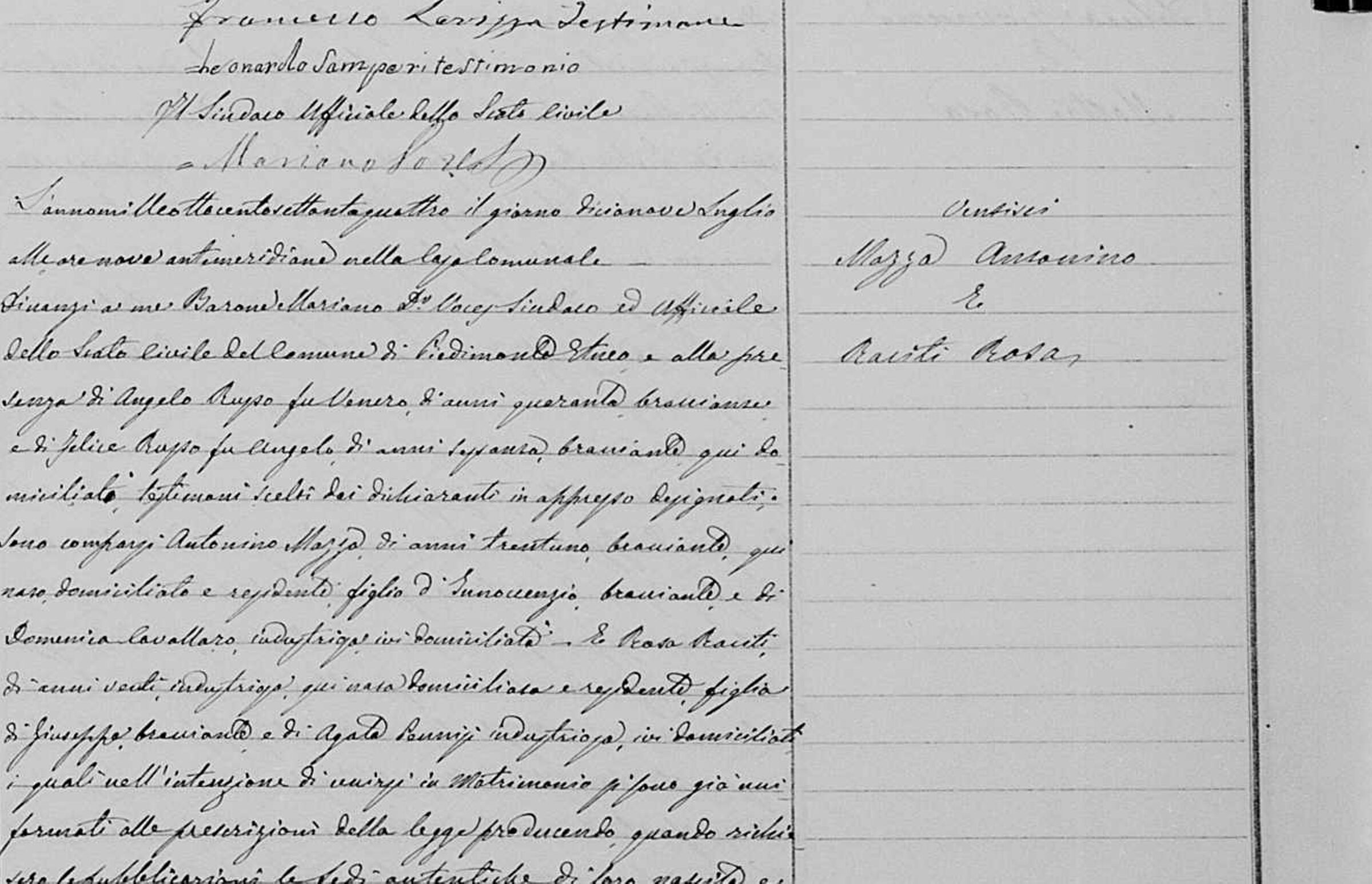
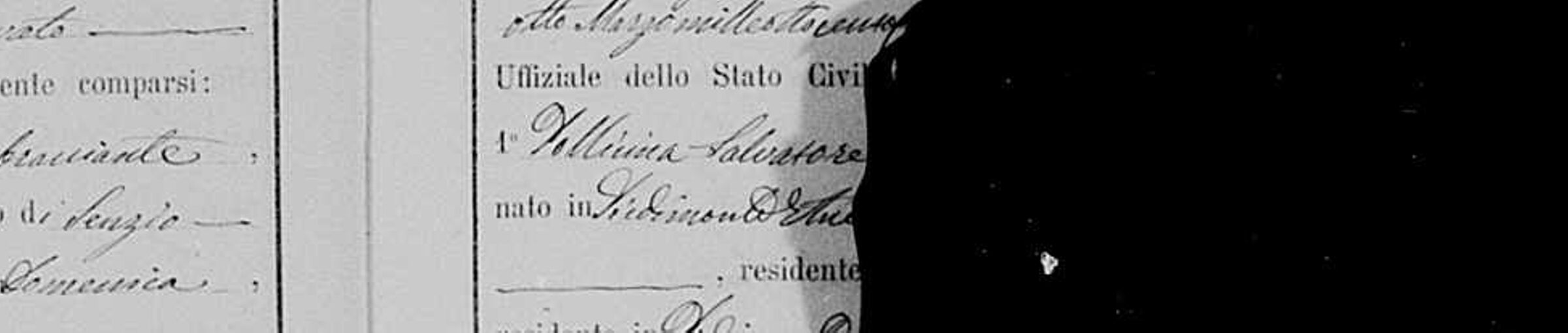
This page said «Venerio» for six hours, and it was wrong
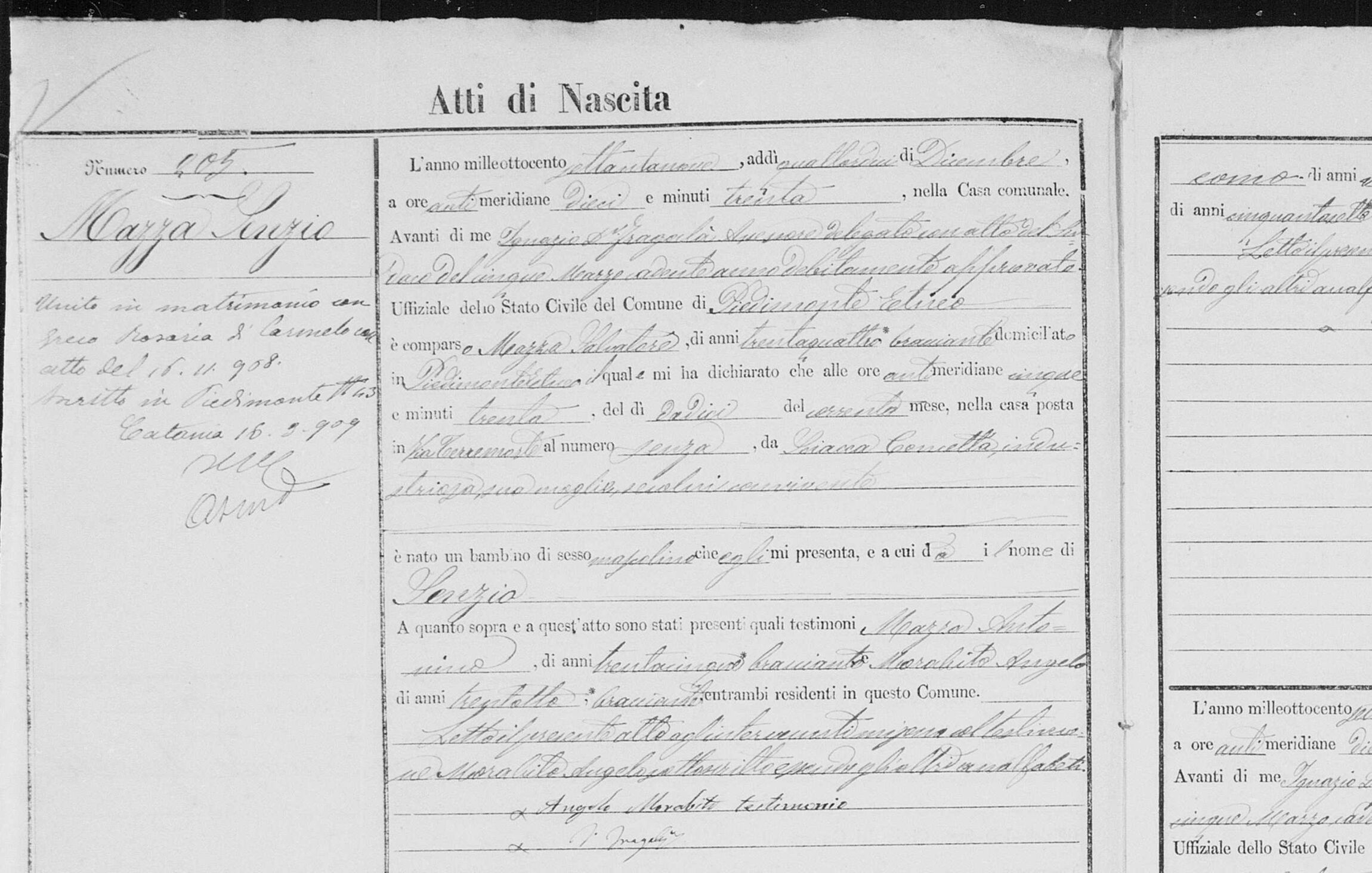
Reading act 5 alone, this archive rendered the father's name as Venerio — and then built an argument on it: that Salvatore's son of 1879, christened Venerio, was named for his paternal grandfather in the ordinary Sicilian way, so custom and document agreed. It was a satisfying piece of reasoning and it was built on a misreading.
Act 26 of 1874 spells the same man's name out in full: Innocenzio. Magnified, act 5 says «Senzio» — the standard Sicilian contraction of Innocenzio, not Venerio at all.
So the naming inference is withdrawn. Venerio Mazza, born 1879, is not named for his paternal grandfather, and where the name came from is now an open question — the Cavallaro side, a godparent, or a great-grandfather nobody has reached yet.
The lesson is the one this archive keeps relearning: a single document read once is a hypothesis. It took a second act, and a magnified crop, to catch it — and the elegant inference is exactly the kind that stops you looking.
The Mazza of Piedimonte Etneo, 1877–1880
All of them braccianti — day-labourers — and all within a few streets of each other.
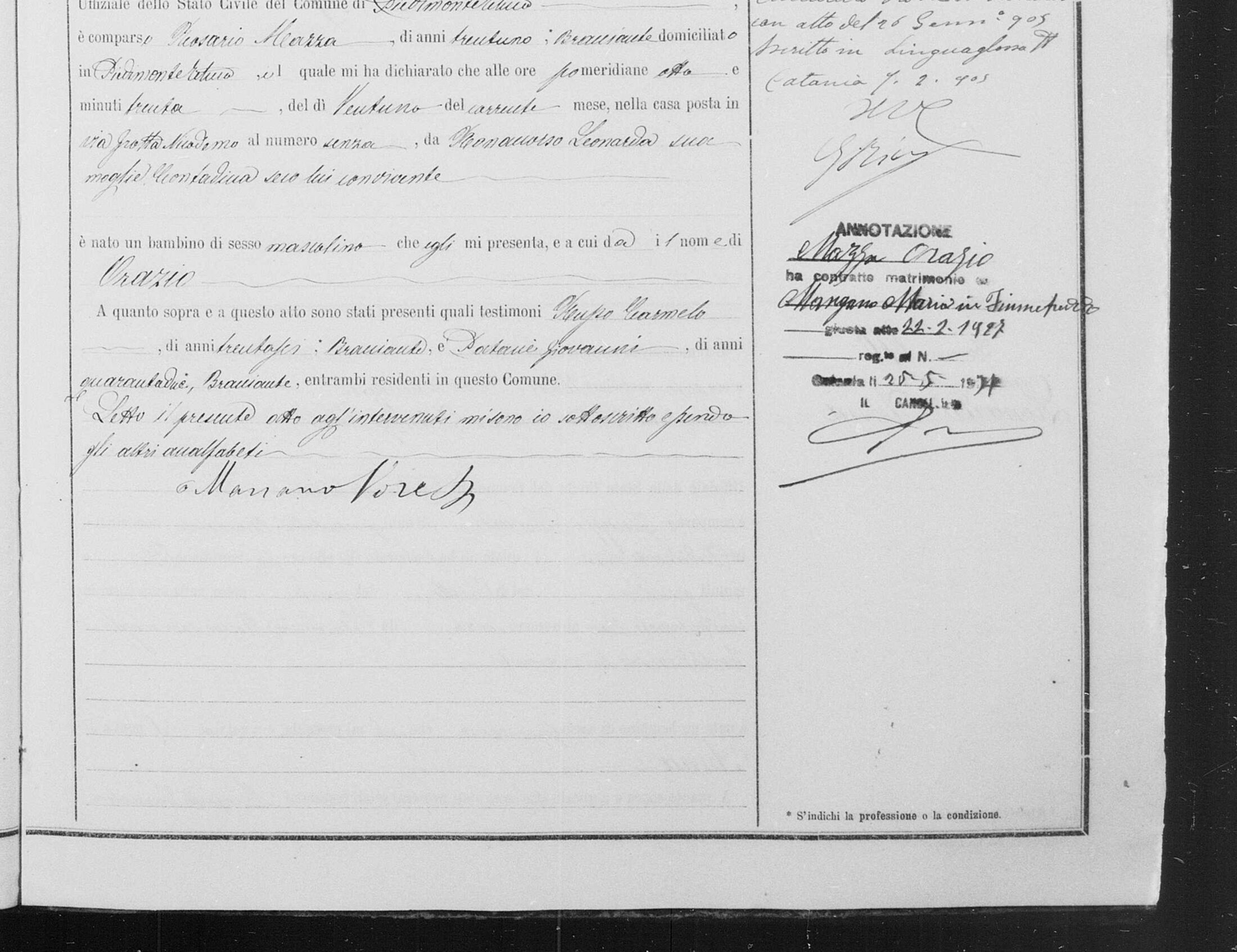
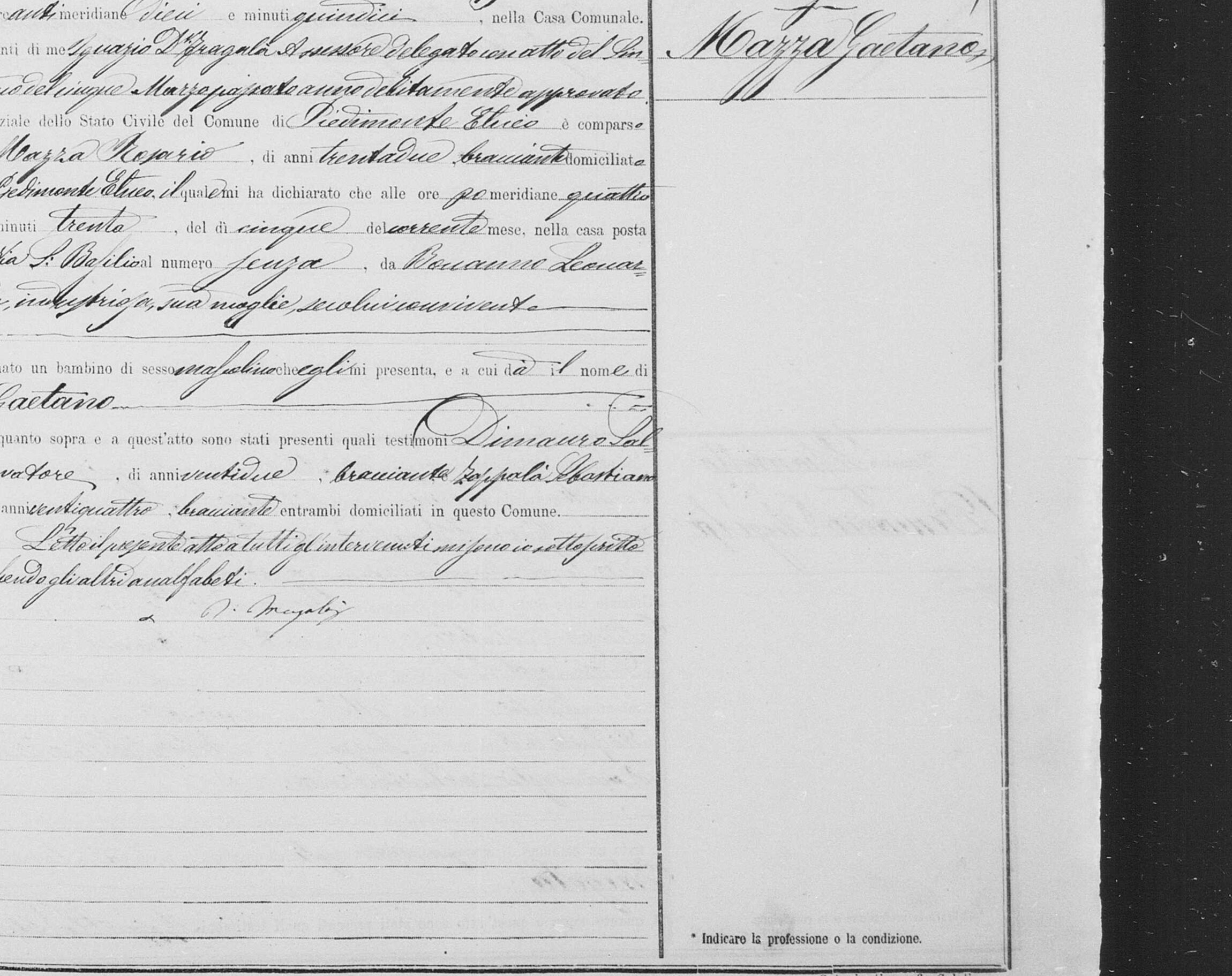
Rosario is real, and he is here. Aged 31 in October 1877 and 32 in May 1880 — born about 1846–48 — a bracciante, married to Leonarda Bonaccorso, with sons Orazio and Gaetano. The archive has carried him as a name with a single asserted fact attached. He now has an age, a trade, a wife, two children and three streets.
The join, and what still holds it open
The second component of the family tree — a hundred and ten Piedimonte Etneo Mazza joined to this family by nothing — is headed by a Rosario Mazza born 1850, and among his children the tree lists an Orazio.
The register gives a Rosario Mazza born about 1846–48, of the same small town, whose son is Orazio. That is a far better correspondence than a shared surname — the right man, the right decade, the right town, and the right child's name. It is still not proof. The tree dates Orazio to 1883; the register to 1877. Two Rosario Mazza with two sons called Orazio in one town is unlikely, but this archive has already been burned once by assuming that unlikely means impossible.
What would close it: Rosario Mazza's own marriage act. It would give his parents — and if they are Venerio Mazza and Domenica Cavallaro, then Rosario and Salvatore are brothers, the whole Via Terremorte kindred is one family, and the tree's hundred and ten hang off a documented couple. It is not in the 1875 or 1876 marriage registers, both of which have been read, so it is 1874 or earlier.
What was read
| Year | Comune | Act | Mazza birth | Father | Mother |
|---|---|---|---|---|---|
| 1879 | Giarre | — | no Mazza in the index | — | — |
| 1879 | Mascali | — | no Mazza in the index | — | — |
| 1875 | Piedimonte Etneo | 64 | Mazza Giovanni | — | — |
| 1876 | Piedimonte Etneo | 41 | Mazza Grazia | — | — |
| 1876 | Piedimonte Etneo | 142 | Mazza Domenica | — | — |
| 1877 | Piedimonte Etneo | 164 | Mazza Antonino | — | — |
| 1877 | Piedimonte Etneo | 168 | Mazza Grazia | — | — |
| 1878 | Piedimonte Etneo | — | no Mazza in the index | — | — |
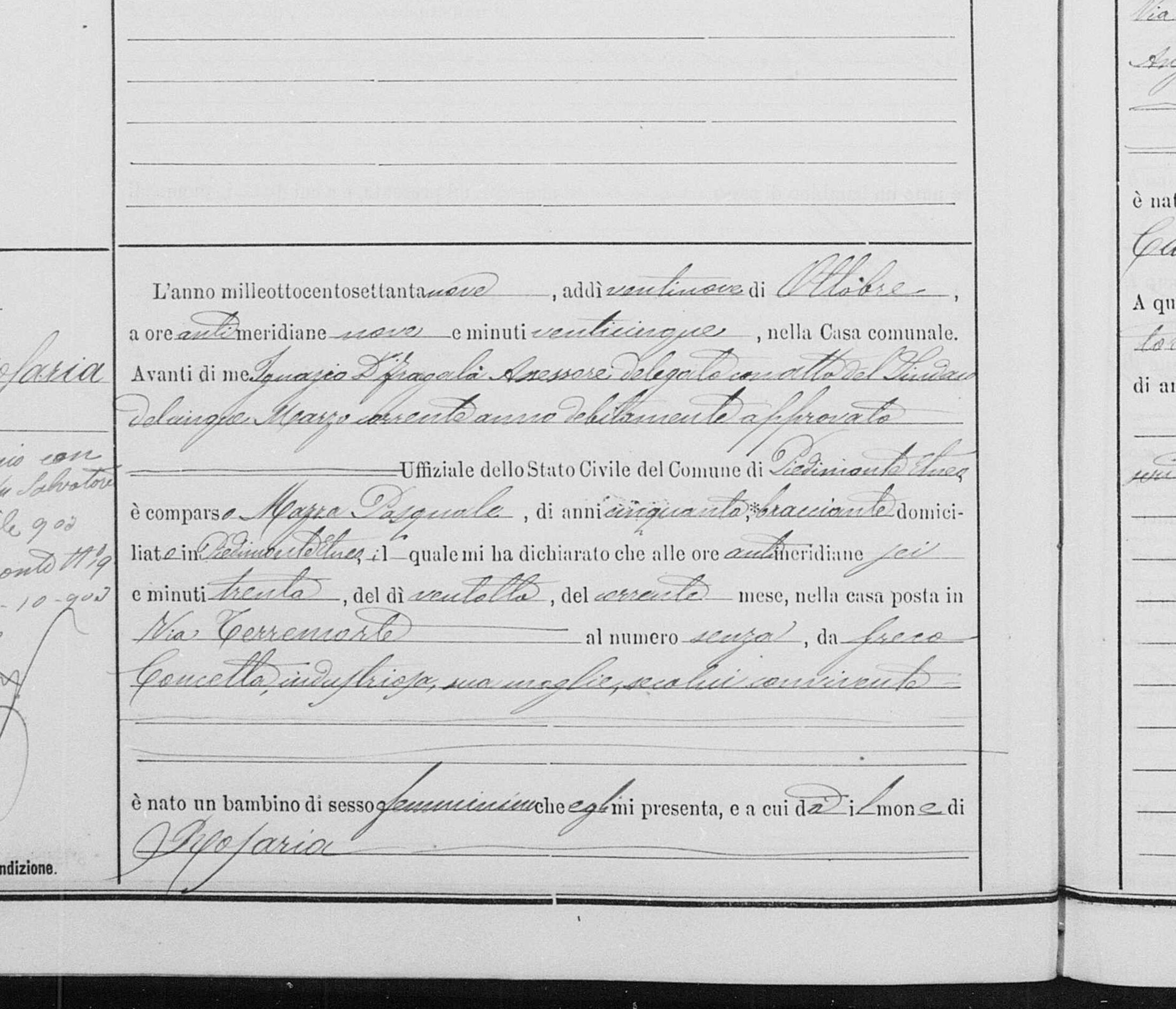
| 1879 | Piedimonte Etneo | 167 | Mazza Rosaria | Mazza Pasquale, 50 | Greco Concetta |
| 1879 | Piedimonte Etneo | 205 | Mazza Venerio | Mazza Salvatore, 34 | Greco Concetta |
| 1880 | Piedimonte Etneo | 66 | Mazza Gaetano | — | — |
| 1881 | Piedimonte Etneo | — | no Mazza in the index | — | — |
Piedimonte Etneo births 1877–1882 and the 1879 supplement; Mascali 1879; Giarre 1879; Piedimonte Etneo marriages 1875 and 1876. Archivio di Stato di Catania, Stato civile italiano, via Antenati. Every volume carries an alphabetical Indice Annuale in its last pages — which is how twelve volumes were checked without reading one of them through.
The acts
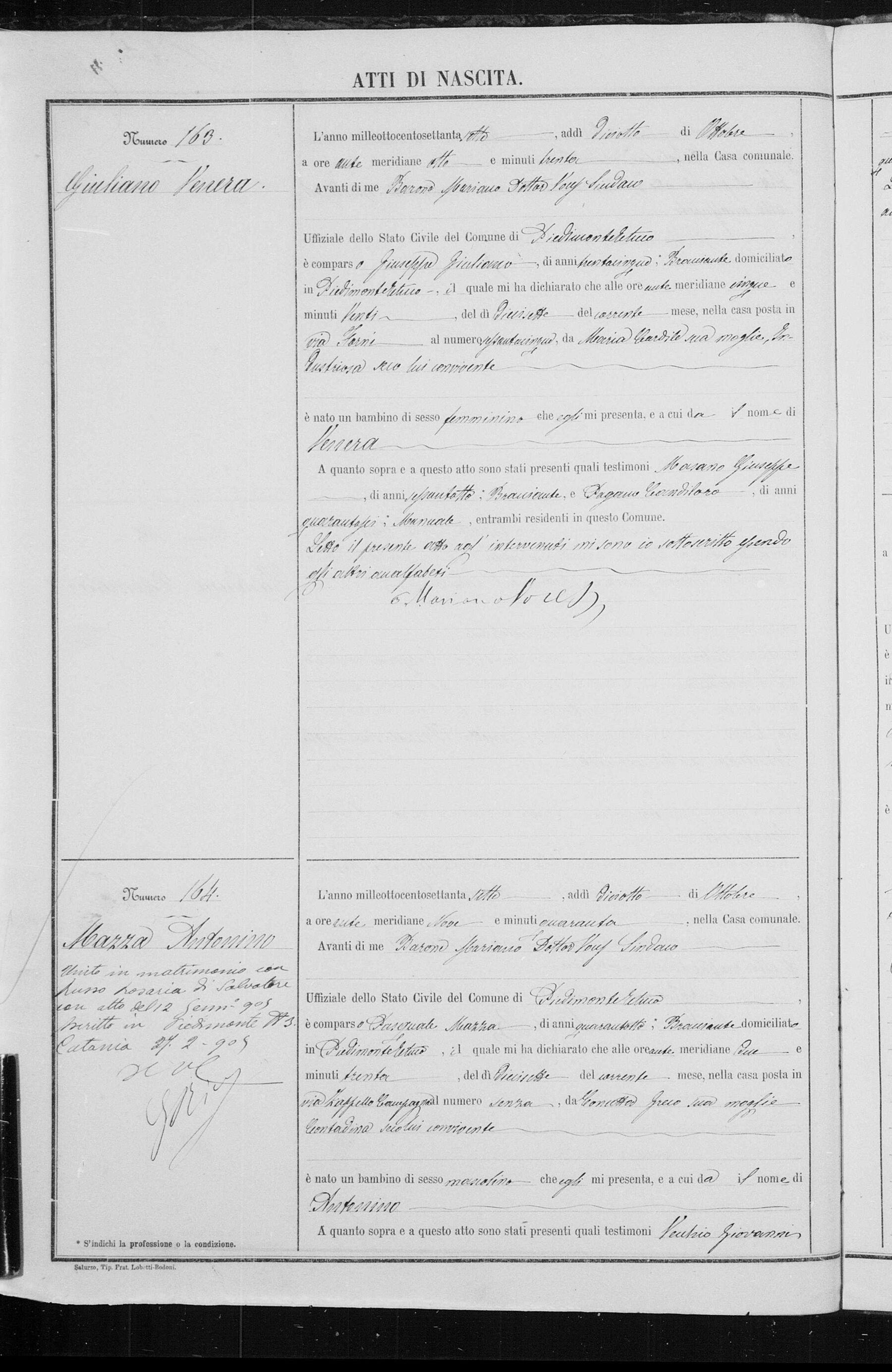
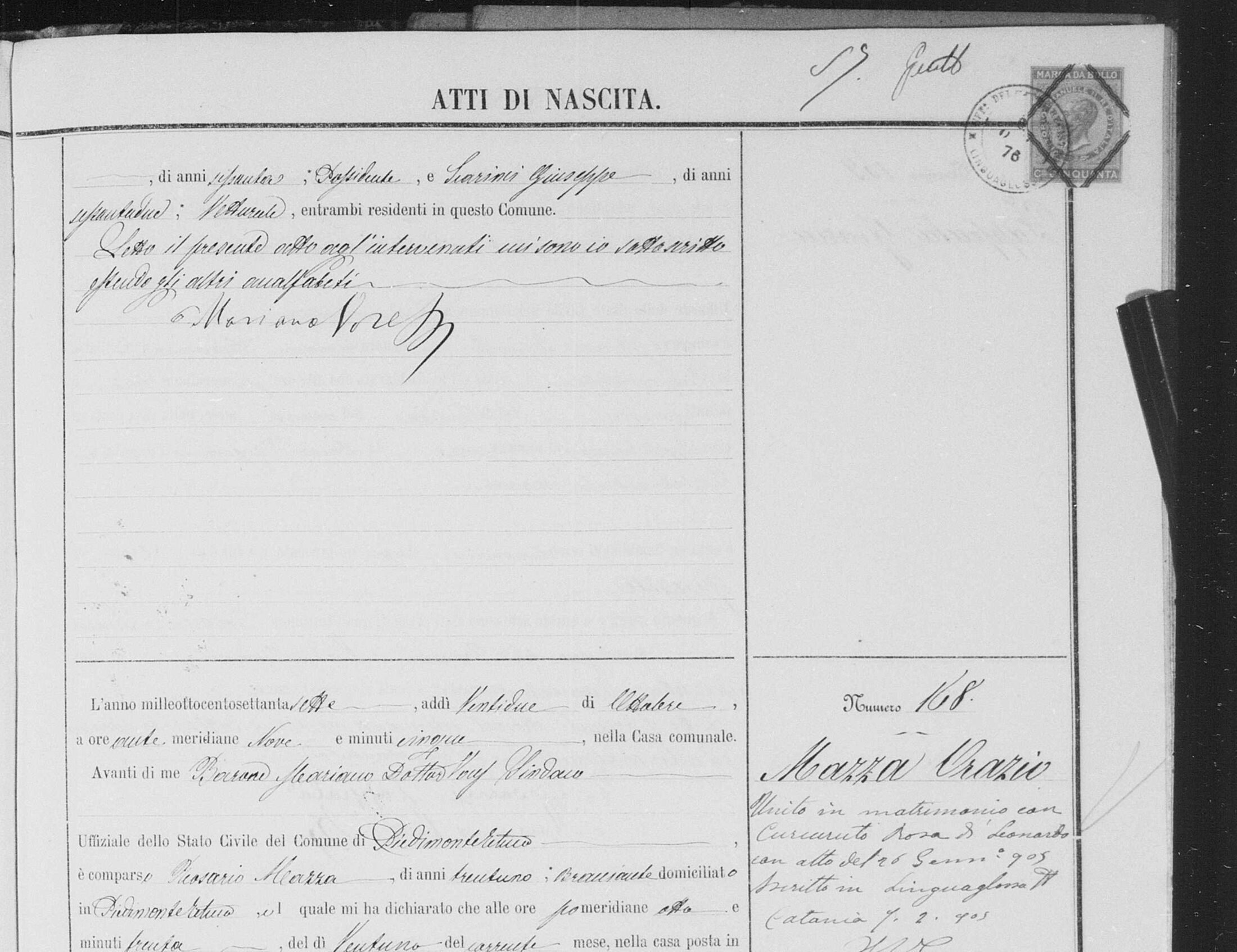
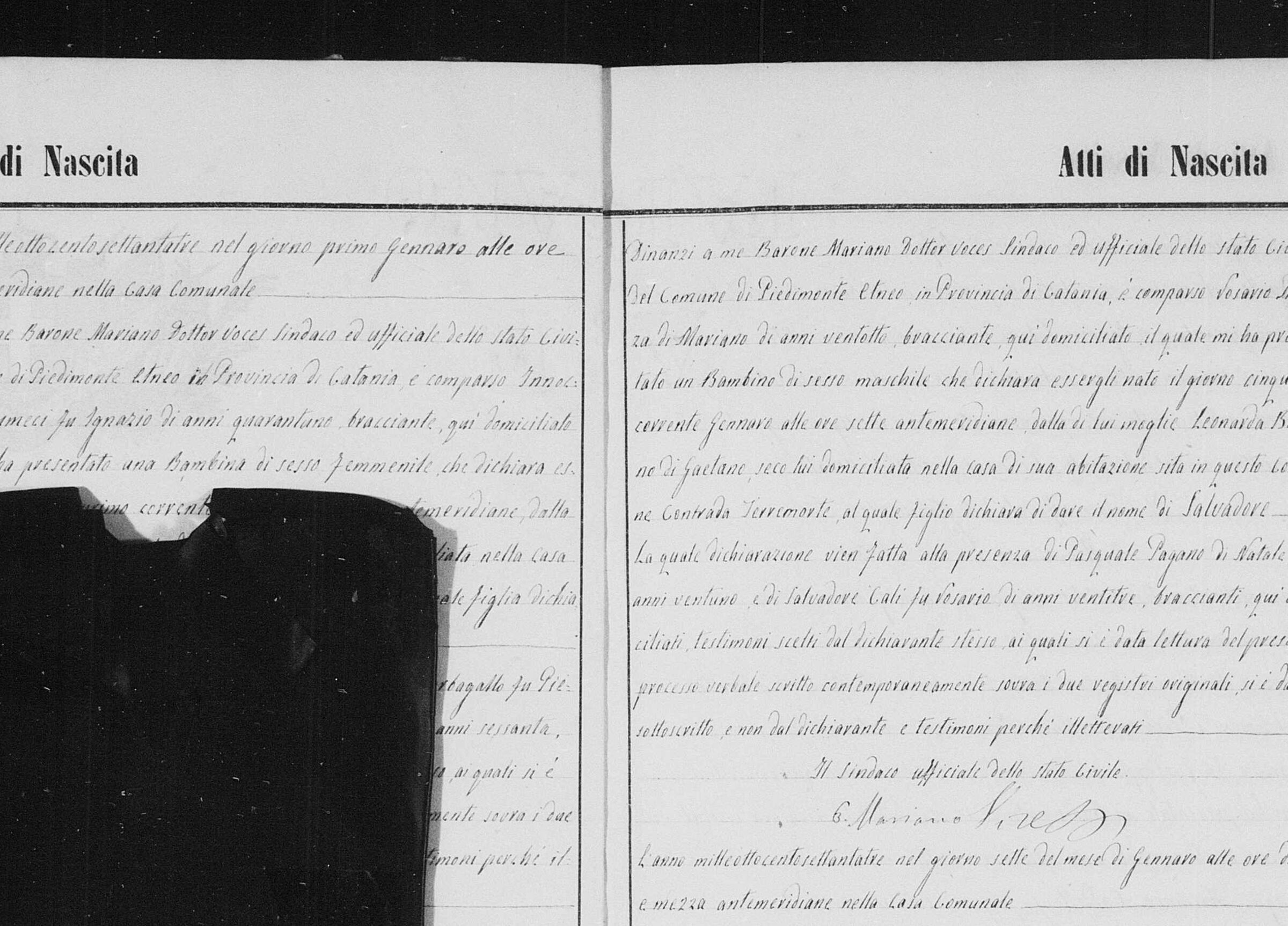
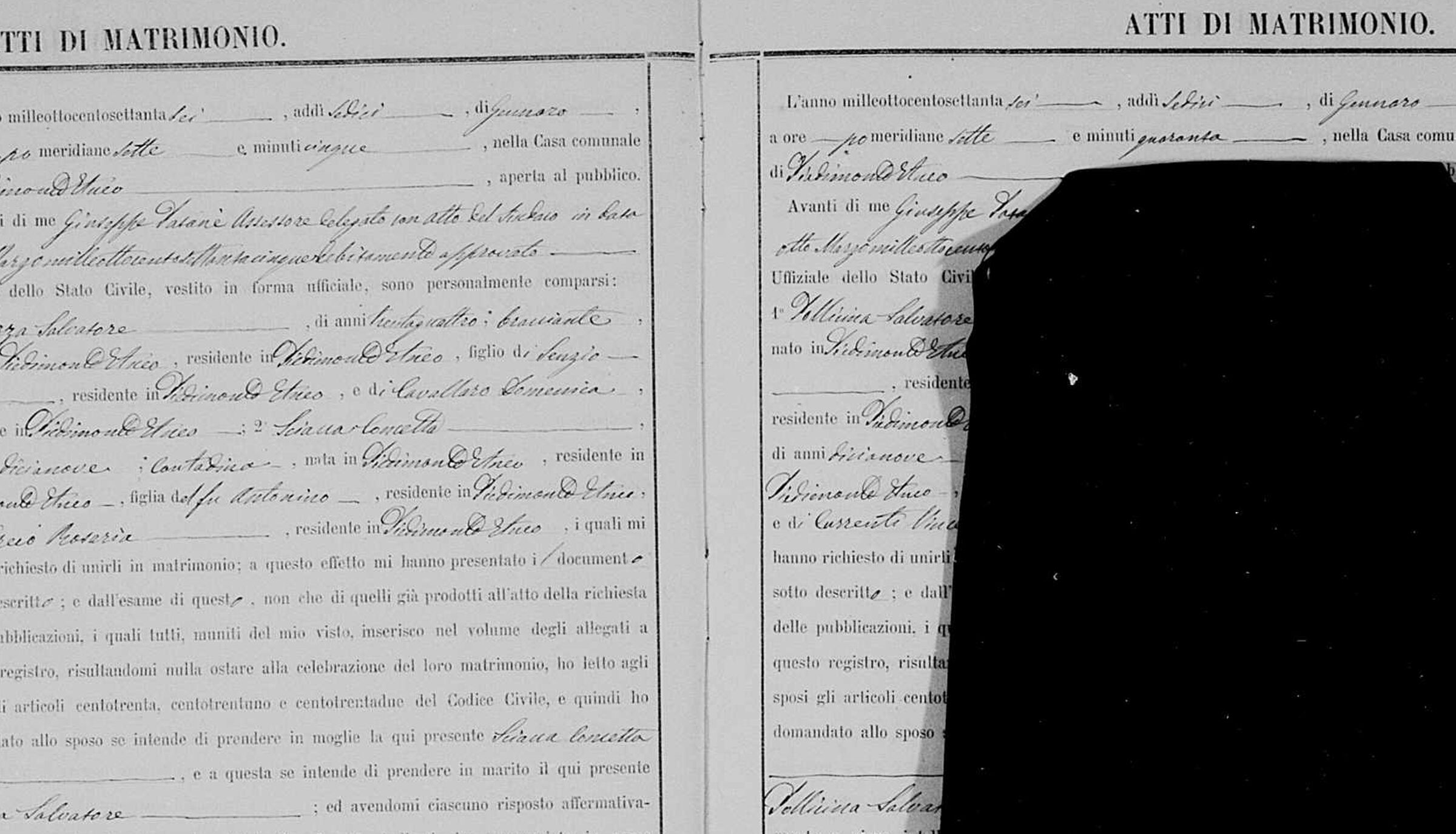
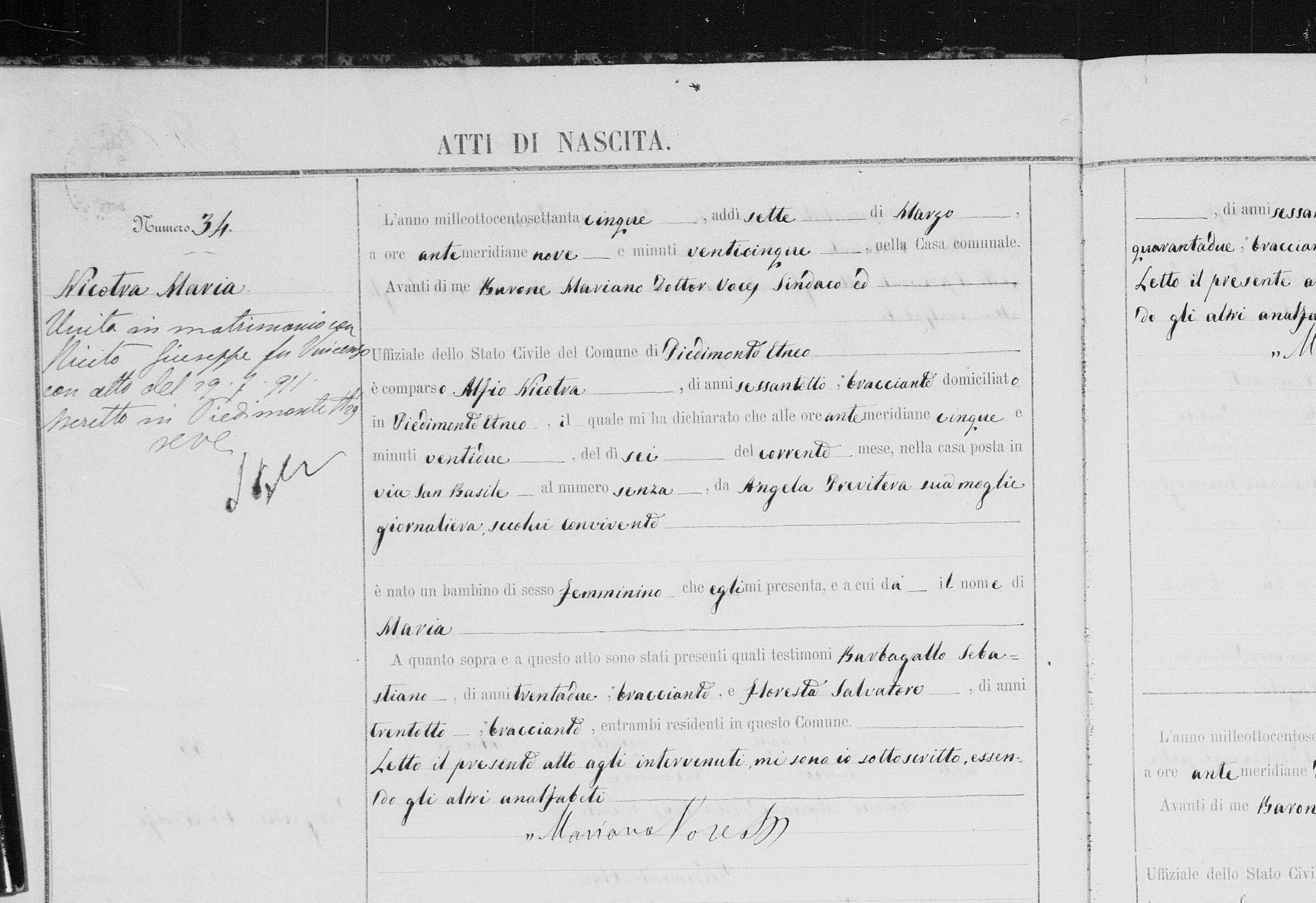
Two corrections this made
The index is not the act. The 1877 annual index lists act 168 as Mazza Grazia. The act itself says Orazio — a boy, not a girl. An index is a clerk's abstract and it can be wrong; the act is the record.
And a misreading of my own, corrected by a second document. Reading act 205 alone, this archive gave Salvatore Mazza's wife as Greco Concetta — which produced an absurdity, two women of that name on one street bearing children six weeks apart. The 1876 marriage index settles it: Salvatore married Concetta Sciacca. It is Pasquale whose wife is Concetta Greco, and that is confirmed twice, in 1877 and 1879. Two documents beat one, and the absurdity was the tell.