The Defranceschi Archive
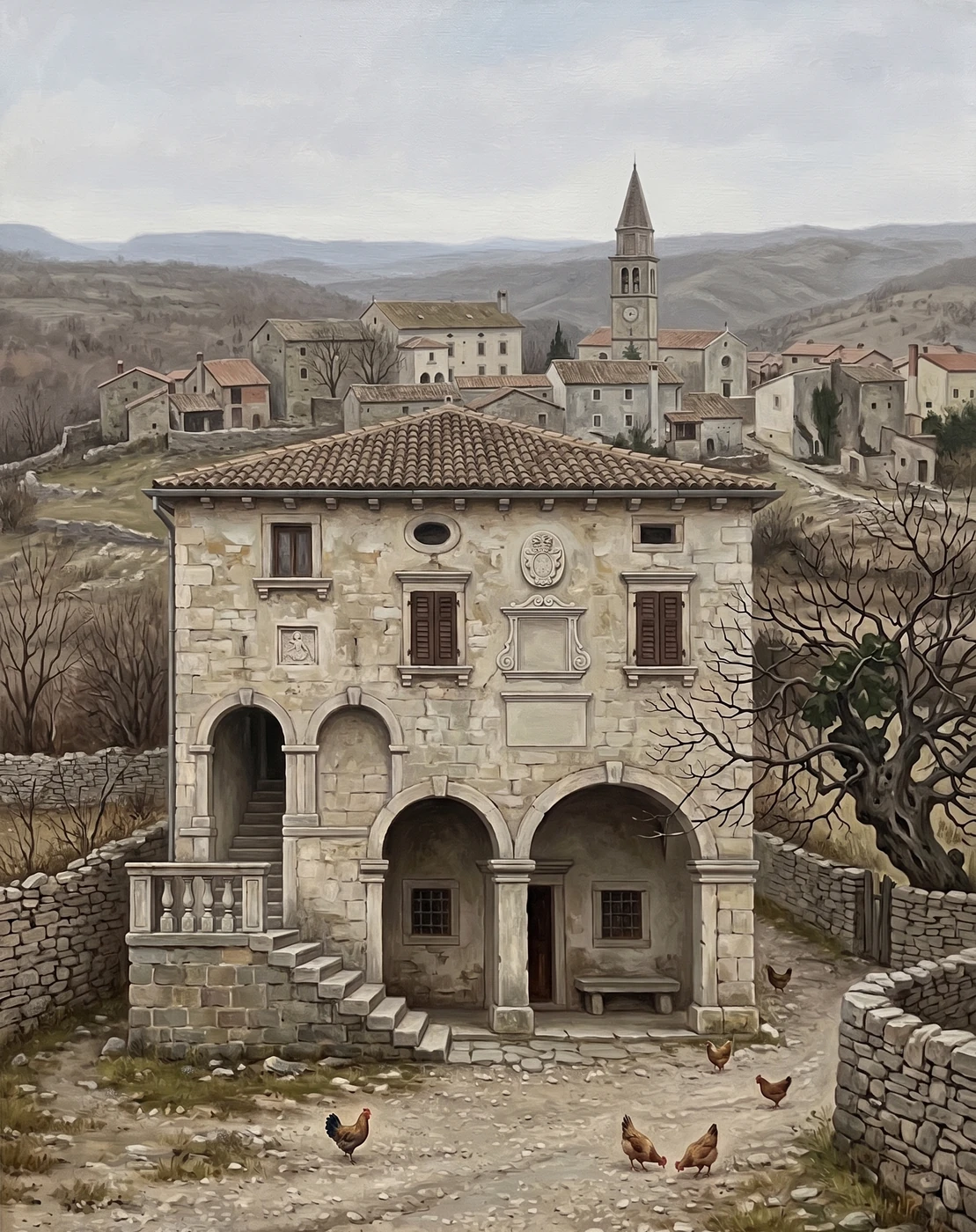
The house at Gologorica, built in 1711, with the builder's tablet over its door.
A family history, kept honestly

Six generations back, a stonemason on an Istrian hill.

Istria · Kvarner · Carnia · and the diaspora — a family written down under eight sovereigns, in four languages, and spelled at least nine ways.

This archive was built by David Defranceski, born in Johannesburg, living in Brisbane — and it runs backwards from him: to Senj, where his grandfather Ivan is buried; to Crikvenica, where the household came ashore; to Gračišće in Istria, where in 1863 a stonecutter's son called Josephus was baptised; and to the mountains of Carnia, where the family says it began and where the documents run out.

It is a public archive with one rule: the living are left out — omitted, not hidden. And a second rule, which is harder: every claim says how well it is known. Documented Inferred Family lore

Six families, one surname

Where each of them came from, and where each of them went

They are not one family and they never were. They arrive from different directions for different reasons — one for work, one as soldiers paid off in ruined land, one as refugees off a wrecked fleet. And the fifth, drawn dashed at the bottom, never came to Istria at all: a fully documented family of the same name that runs from a poor cape in Corsica to the Caribbean, put beside the others so it can be told apart from them.

Six families of one surname, and the road each of them took Out of Carnia, for work documented Nine chapters → Senj — Antonio's brother's line, up the coast. Nine graves in the town cemetery and a shipping family — the same Carnian stock as Crikvenica, one headland further north. Senj Germany — Pfullingen — Ivan, born Crikvenica 1925, taken to work in the Reich and issued papers at Pfullingen in Württemberg. The line's hinge: everything after 1945 leaves from here. Germany — Pfullingen Australia — The post-war emigration out of Yugoslavia, and the one destination where the surname is still spelt three different ways inside one family. Australia South Africa — Johannesburg. Thirteen of the seventeen people on earth who spell it «Defranceski» are here — an English clerk's spelling that became the family's own. South Africa United States — Two separate arrivals: the Eleven of Gračišće sending Basilio to Jackson Heights, and the older Istrian emigration to the mines. United States Argentina — Rotilio, eighth of the Eleven, is said to have gone to Buenos Aires with two daughters. Searched in September 2026 and not found — and the album’s one supporting detail, his wife’s name, turns out to be his sister’s marriage. The register has him at Gračišće, marrying, in 1928. Weaker than it was. Argentina Mione · 1679 — A De Franceschi of Mione on the headmen's list, working in the County of Pazin. The roster also holds eight people of the name at **Paluzza**, one valley east in the same Carnia — unworked, and the nearest thing this archive has to a second door into the Val di Gorto Mione 1679 Moncalvo · 1661 — The surname enters the Moncalvo di Pisino baptism book Moncalvo 1661 Gologorica · 1711 — ANNO · DOMNI · 1711 cut over the door of the house Gologorica 1711 Gračišće · 1787 — Joannes Baptista, farmer of house 5 — the line's earliest dated ancestor Gračišće 1787 Poreč · 1800s — Named in this line's own route description for a year before it was ever drawn on it: ten register entries, eight of them accepted, and twenty-one more people on the roster. Parenzo is where the inland parishes reach the western coast. Poreč 1800s Crikvenica · 1892 — The stonecutter's son comes down to the coast between 1892 and 1894 Crikvenica 1892 Out of Venice, as soldiers documented The Imotski page → Opačac — The spring at the head of the Vrljika, and the mills the Republic paid Zuane with in 1717. Franceschi property into living memory. Opačac Split — Where the Dalmatian family is today, the particle stripped off by Napoleonic decree — which is why the descendants of a count are called Franceschi. Split Venice — Cittadini originari of the Republic Venice Zadar · 1359 — Louis I grants «nobiles regni Croacie»; the family is at Zadar from the 14th century Zadar 1359 Omiš · 1584 — Francesco the Venetian lays the foundations of his house on 18 June 1584 Omiš 1584 Imotski · 1717 — Zuane takes the town and is paid in ruined land on the Vrljika Imotski 1717 Perinuša · 1722 — The mills: six wheels, then eleven, then fourteen Perinuša 1722 Out of Crete, as refugees documented The Seget page → Umag — The town the Seget estate belongs to, the parish church with the arms on a canvas of 1650, and the family tomb with its ironwork dated 1890. Umag Brtonigla — Verteneglio. The second of the western-Istrian holdings, and part of the same estate world as Seget. Brtonigla Koper — Capodistria — where a Venetian war pension out of Crete was ordered to be drawn in 1730, «probably because the family was already living at Seghetto». Koper Candia · 1500 — Nicolò castellan of Castel Milopotamo; the family noble in Crete Candia 1500 Wrecked · 1669 — Candia falls; Morosini's galleys take them off and the fleet is wrecked in a storm Wrecked 1669 Zante · 1670s — Zorzi de Franceschi goes from Candia to Zante Zante 1670s Šibenik · 1674 — and from Zante to Sebenico, drawing a Venetian war pension Šibenik 1674 Seget · 1720 — Marc'Antonio buys the estate; 1724 on the portal, 1732 on the cistern Seget 1720 Out of southern Istria — origin unknown documented from 1667 · origin not found The Ližnjan page → Zagreb — Grga died here, and thirteen graves of the name are in the city's cemeteries — the largest single concentration in Croatia. Zagreb Monheim — A line drawn on a map years ago from Ližnjan to Monheim, with no note, no date and no name. Corrected in September 2026: the coordinates point at Bavaria, but the town that matters is Monheim am Rhein — and the only private listing of «Defranceski» in the whole German directory is five kilometres away at Langenfeld. Still lore. No longer sourceless. Monheim United States — Southern-Istrian emigration, separate from the Gračišće one and never yet joined to it. United States France — Two born at Barban in 1924 who died in France — the clearest documented exit from this cluster. France Svetvinčenat · 1657 — Corrected in September 2026: the entries this archive read as «Pula 1667» are from the Svetvinčenat register, DGS 005497884. That parish carries the surname from 1657 under twelve different fathers — and everyone who has studied it calls its De Franceschi Carnian. Svetvinčenat 1657 Fažana · 1810s — Baptisms and deaths at Fasana through the 1810s, 1840s and after Fažana 1810s Premantura · 1809 — A Maria Defranceski at Premantura, and again in 1859 Premantura 1809 Barban · 1924 — Two born here who died in France Barban 1924 Ližnjan · 1931 — Gregorius «Grgo», born at Ližnjan and dead at Zagreb — the last address, not the origin Ližnjan 1931 Vodnjan — five generations, read by eye documented · marriage register indexed nowhere The Vodnjan page → The Poreč hinterland — Kaštelir, Vižinada, Šterna, Tar and Draguč — five parishes in the country behind Poreč and Buje, carrying the name between them on about sixty entries across the register and the roster, with Kaštelir the densest at twenty-seven. No lane on this chart runs through any of them. It is the largest piece of Istria the archive can document and cannot yet explain. The Poreč hinterland Rovinj — «Ob.to di Matt.o de Franceschi da Dignano», buried at Rovinj on 27 December 1728 — and in the 1840s Bona Defranceschi, daughter of Dominicus and Oliva Dorligurro, marrying there. The town-name is written down only from outside the town. Rovinj Šišan — A wedding at Sissano in January 1824 witnessed by «Pietro De Franceschi di Gio., da Dignano, Tessitore». Šišan Svetvinčenat — «Ant.o De Franceschi fu Vittorio» witnessing at a wedding held by the archpriest at Sanvicenti in 1826. Recorded as a coincidence of the page and not claimed as a link. Svetvinčenat Pietro · 1770s — Named only in his son's patronymic — «Gio. Maria De Franceschi fu Pietro». The oldest man in the line, standing behind a marriage of the 1770s Pietro 1770s Gio. Maria · by 1818 — × Michiela Zambaletta fu Cristoforo. Both dead by 1830, and neither appears in any baptism register on any film this archive can reach Gio. Maria by 1818 Pietro · 1818 — Born about 1776; widower of Veniera Francin, remarries Lorenza Tesser on 30 March 1818 — the first entry this archive found in the book Pietro 1818 Gio: Maria · 1821 — Born about 1799; marries Lucia Bonassin on 9 June 1821, and the entry names his father, grandfather and great-grandfather Gio: Maria 1821 Giuseppe · 1833 — The other household: Giuseppe × Lucia Tromba, parents of Don Stefano the priest, Pietro the ploughman, Cristoforo the weaver and Maria Francesca Giuseppe 1833 Out of Corsica — never in Istria documented · not this family The namesakes → Puerto Rico — Where Napoleón Franceschi's own history takes the Cap Corse family. Not ours, and the page says so. Puerto Rico St Thomas — The Danish West Indies leg of the Corsican trading diaspora. St Thomas Trinidad — The same movement again — Cap Corse to the Caribbean, by sea and by trade. Trinidad Venezuela — Where the Corsican line ends up, and where its own historian wrote it down. No contact with Istria at any point. Venezuela Ersa · 1694 — Pietro Franceschi, 29 June 1694 – 12 February 1771, the first generation on Cap Corse Ersa 1694 Gasparo · 1721 — Gasparo Franceschi, 1721–1799, the second generation Gasparo 1721 Francesco M. · 1750 — Francesco Maria Franceschi, 1750–1828 Francesco M. 1750 Simone · 1826 — Simone Franceschi, born and dead at Ersa, 1826–1907; married Caroline Mattei Simone 1826 Real households of the name — not yet placed on any of these lines Rijeka — Fiume, Vitipolis — The largest concentration of the name this archive holds outside Vodnjan, and it was hidden in plain sight: the index writes this one city under three different names — «Fiume» (52 records), «Vitipolis» (45) and «Rijeka» (9). Vitipolis is Latin for the city of Saint Vitus, after «Terra Fluminis Sancti Viti», the river of St Vitus whose cathedral stands there. 106 records in all, 22 of them accepted — though 65 are spelt Francetich and only 20 Defranceschi, so most of the pile is a Croatian surname that may be nobody's. Kobler found three separate stocks in the civic registers and refused to join them to one another. One — Valentino, «venuto dalla Carnia», a citizen in 1739 — is almost certainly the Carnian family. The other two are not placed. Rijeka — Fiume, Vitipolis Svetvinčenat — 142 records from 1666, the second-largest concentration in the sweep. Kandler's list of the Carnian families settled at Sanvincenti names Defranceschi among Lupieri, Fiorencis, Fabris and Crosilla — so the origin is Carnian, but whether it is our Carnian household or another one out of the same valleys is not shown. Svetvinčenat Bakar — Twelve people, one household across three generations, from before 1772 to a death in 1819 — Dominus Giovanni Battista son of Dominus Francesco, styled Dominus, a citizen-class family. Nothing on the page ties them to Gologorica, to Gračišće, or to Kobler's Fiume stocks, and this archive will not join a fourth household to them on the strength of two common Christian names. Bakar Rovinj — The earliest dated Istrian record this archive holds — «morì ser Piero di Franceschi da Pola», 27 May 1619 — plus a Rovinj household across three generations from Giacomo to Piero Anto in 1736. Neither is joined to any lane. It is also where Carlo De Franceschi was married at his own bedside in 1852. Rovinj Attached to no line here — a different stock of a very common name Brazil — The largest cluster of the surname anywhere — Rio Grande do Sul, Santa Catarina, São Paulo. Veneto and Trentino, not Istrian: the in-law names are Marcato, Busatto, Poletta, Raminelli, Barbiero, Negri, Catteri, Facco. Brazil Ticino — Italian-speaking Switzerland, over the border from Lombardy. A different stock of the same ordinary patronymic. Ticino Michigan — Domme De Franceski, born in Italy 1880, at the Penn Iron Mining Company at Norway, Michigan, with a wife born in Switzerland. Nothing joins him to Istria. Michigan — the commonest patronymic in Italy
Click or tab any dot — the stops tell you what the document behind them says, and the destinations on the right tell their own story and link to it. Click a second time to go there.
The teal river is the one this archive descends from, and the only one that arrived on foot looking for work. The green river at the bottom is drawn dashed because it never came to Istria at all — a fully documented family of the same name that goes from Cap Corse to the Caribbean, put here so that a Franceschi found in Puerto Rico or Caracas can be seen for what they are. A dotted end-point means the attachment is family lore, not a document — Argentina hangs off Carnia only on the word of a reunion album, and Monheim is a pin on a map. Below the rule are the households this archive will not pretend to have placed: Fiume, Svetvinčenat, Bakar and Vodnjan are real, documented families of the name that belong to nobody yet, and Brazil, Ticino and Michigan are somebody else's entirely. The table under this diagram gives every one of them a verdict.

The four families, the households still unplaced, and which diaspora belongs to whom →

Eight hundred years, four countries, one family

What they were living under, and what they were up against

The ancestral places do not share a past. Gologorica was Habsburg from 1374 and Italian between the wars; Senj was never Italian at all; Mione was Venetian for three hundred and seventy-seven years. Red above the lanes is this family. Ochre below is the wars, plagues, treaties and regime changes they were lived through. Hover or tab any marker and it tells you what it is.

Family events 1185 — Mione first recorded, 15 June 1199 — Gračišće first recorded 1288 — Vinodol Law codified at Novi 1412 — Frankopan grants the Crikvenica monastery to the Paulines 1486 — Bishop Paskazije of Pićan consecrates the Gračišće chapel in his birthplace 1511 — A Gorto man buys a share in a weaving shop at Motovun 1540 — Carlevariis of Luincis dictates his will at Pićan 1582 — Pazin baptisms begin — the oldest register in the county 1590 — Gaspar de Franceschi, warship owner at Omiš 1617 — Uskoks expelled from Senj 1644 — Gologorica baptism register begins 1667 — Gračišće baptism register begins 1679 — Zuane De Franceschi of Mione, weaver in the County of Pazin 1711 — De Franceschi house built on the Gologorica square 1715 — Zuane Ivan Franceschi shelters 600 Imotski refugees 1717 — Imotski taken; the Perinuša estate granted 1739 — Valentino Defranceschi, from Carnia, made a citizen of Fiume 1740 — Giovanni Battista Defranceschi arrives from the County of Pazin 1775 — First Gračišće status animarum 1786 — Joseph II dissolves the Pauline order at Crikvenica 1806 — Napoleonic decree strips the nobiliary ‘de’ in Dalmatia 1809 — Carlo De Franceschi born at Moncalvo, 16 October 1848 — Carlo elected deputy for Pisino to the Imperial Constituent Parliament 1854 — Carlo expelled from the imperial magistrature as 'a known apostle of Mazzini' 1868 — Camillo De Franceschi born at Parenzo, 3 August 1890 — Camillo sentenced to two years for irredentist activity 1920 — Treaty of Rapallo — Istria to Italy 1945 — 25 Defranceschi families counted in Istria, 1 October 1956 — The exodus is largely complete Central Istria Gologorica, Gračišće Aquileia · Gorizia Habsburg — County of Pazin Austria–Hungary Italy Yugoslavia Croatia Southern Istria Vodnjan, Pula, Rovinj, Svetvinčenat Patriarchate of Aquileia · communes Republic of Venice Austria — Küstenland, diocese of Pola Italy Yugoslavia Croatia Senj & Vinodol Senj, Crikvenica Frankopan lords Croatian crown → Habsburg Military Frontier Yugoslavia Croatia Carnia, Friuli Mione, Ovaro Patriarchate of Aquileia Republic of Venice Austria Kingdom of Italy → Italian Republic Dalmatia Omiš, Imotski Croatian–Hungarian crown Republic of Venice Austria–Hungary Yugoslavia Croatia scale expands → 12001400160018001850190019502000 What they were up against 1348 — The Black Death reaches Istria and Dalmatia. Whole villages of the interior are abandoned; the depopulation is what later pulls in settlers from the mountains and the Balkans. 1382 — Trieste puts itself under the Habsburgs. The line between Venetian and Austrian Istria begins to harden into the border this family will spend four centuries either side of. 1420 — Venice takes Friuli and coastal Istria from the Patriarch of Aquileia. Carnia becomes Venetian; the County of Pazin stays Habsburg. 1463 — The Ottomans take Bosnia. Raiding parties begin to reach Istria within a generation. 1493 — Krbava Field. In the same year Imotski falls to the Ottomans, and stays theirs for 224 years. 1508 — The War of the League of Cambrai. Venice and the Habsburgs fight it out across Istria itself, village by village. 1511 — Plague, earthquake and war together. Venetian Istria is so emptied that the Republic begins organised resettlement. 1615 — The War of Gradisca — the Uskok War. Venice against Austria, fought on precisely the frontier that runs between Gologorica and Svetvinčenat. 1630 — The great plague of northern Italy. Manzoni's plague; it reaches the head of the Adriatic. 1669 — Candia falls. Crete is lost after twenty-one years of siege, and refugees come west — the migration the Umag family's own tradition claims. 1714 — The Ottomans declare war on Venice. The Republic loses the whole Peloponnese in a hundred days. 1717 — The Venetian offensive in Dalmatia. Imotski and Vrgorac are taken. 1718 — Passarowitz. The Dalmatian frontier drawn now is, with adjustments, the Croatian–Bosnian border today. 1788 — Joseph II suppresses the bishopric of Pedena. The lease the Gologorica family had held from every bishop since about 1700 simply ceases to exist. 1797 — Campoformio. Venice is extinguished after a thousand years, and Istria and Dalmatia pass to Austria. 1806 — The French. The Illyrian Provinces; the nobiliary «de» struck off by decree; conscription, land taxes and roads. 1815 — The Congress of Vienna restores Austria. It will hold this coast for a hundred and three years. 1848 — Revolution across the Empire. An Istrian Diet is convened; Carlo is elected to Vienna and comes home a marked man. 1866 — Austria loses Venetia. Italian irredentism sharpens, and the Adriatic lands become the object of it. 1882 — The Oberdan affair at Trieste. Irredentist politics turns to conspiracy, and the police files thicken. 1914 — The First World War. The Isonzo front is fifty miles from Gologorica; Istrian conscripts go to Galicia and to Salonika. 1918 — Austria–Hungary dissolves. Italian troops occupy Istria and the Kvarner within weeks. 1920 — The Treaty of Rapallo. Istria, Zadar and the islands become Italian; Sušak and the coast do not. 1922 — Fascism. From 1927 Croatian schools in Istria are closed and Slavic surnames are Italianised by decree. 1943 — Italy capitulates in September. The Germans occupy the Adriatic Littoral; the partisan war and the first reprisals follow. 1945 — Yugoslavia takes Istria. Summary killings, the foibe, and the beginning of the exodus. 1947 — The Paris peace treaty gives Istria to Yugoslavia. The Free Territory of Trieste is created and does not work. 1954 — The London Memorandum settles Trieste. By 1956 the exodus of the Italian-speaking population is largely complete. 1991 — Croatian independence, and war. The last political frame this family's places have lived under.

Hover or tab through a marker — red above for this family, ochre below for the world around it.

Aquileia · Gorizia · FrankopanRepublic of VeniceHabsburg / Austria–HungaryNapoleonic 1805–15ItalyGerman occupation 1943–45YugoslaviaCroatia

The full timeline, with lives and pressures →

The archive in numbers

Every one of these is a link to the page that earns it.

Recently found

What the last stretch of work turned up. The research log has the rest.

The research log →

There is no single Defranceschi family

De Franceschi means only ‘of the Franceschi’ — the household of a man called Francesco. The name was therefore invented independently, many times over, wherever an Italian-speaking clerk needed to tell one Francesco's sons from another's. Six families are followed here and five of them have an origin in documents. The newest, Vodnjan, was a number in a 1945 cadastre until its marriage register — indexed nowhere on earth — was read by eye in September 2026 and gave up five generations. Beside them sit four clusters of real households that must belong to one of the others and cannot yet be told which — and a great many people who simply share the commonest patronymic in Italy.

That is this archive's organising idea rather than its disappointment. And it means being strict about three different things: a family is an origin; a station — Gologorica, Crikvenica, Senj, Pfullingen — is a stop on one family's road, not a family of its own; and a namesake in Corsica or Brazil is not a relative until a document says so.
The five families, and everything that is not one →