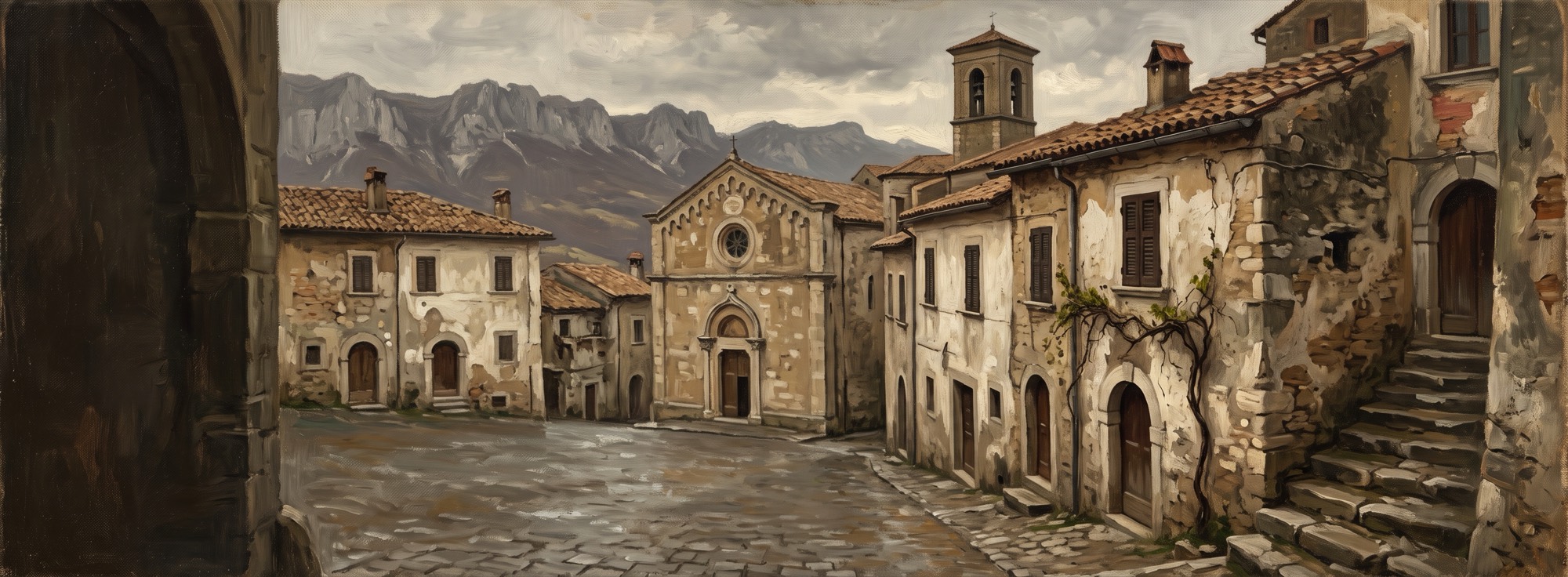
Nine generations, on one street in Campania.
Arienzo · Arpaia · Forchia · Benevento · Brisbane — written into the parish books of Sant'Andrea from 1767, and into the civil registers of four regimes after that.
This is an archive of the Falco of Arienzo — a parish, a street and the families on it — and of the one branch of them that reached Brisbane. It is not a pedigree. Of the 549 people named here, 541 are not in the direct line.
Falco is the Latin for falcon, and it became a surname twice over: as a Lombard personal name handed down as a patronymic, and as a nickname for the quick, the sharp-eyed, or the falconer. It was coined independently, many times, in many places. There is no single founding Falco family. The work here is to establish which Falco are actually connected, and to say plainly where the evidence stops.
Where each of them came from, and what joins them
A shared surname in one small town is suggestive and nothing more. Two Falco households on the same street may be brothers, cousins, or unrelated men who happen to carry a common Campanian name. This archive joins two of them only when a record says so — and draws the rest apart, even where joining them would make the better story.
1 October 1834, five in the morning
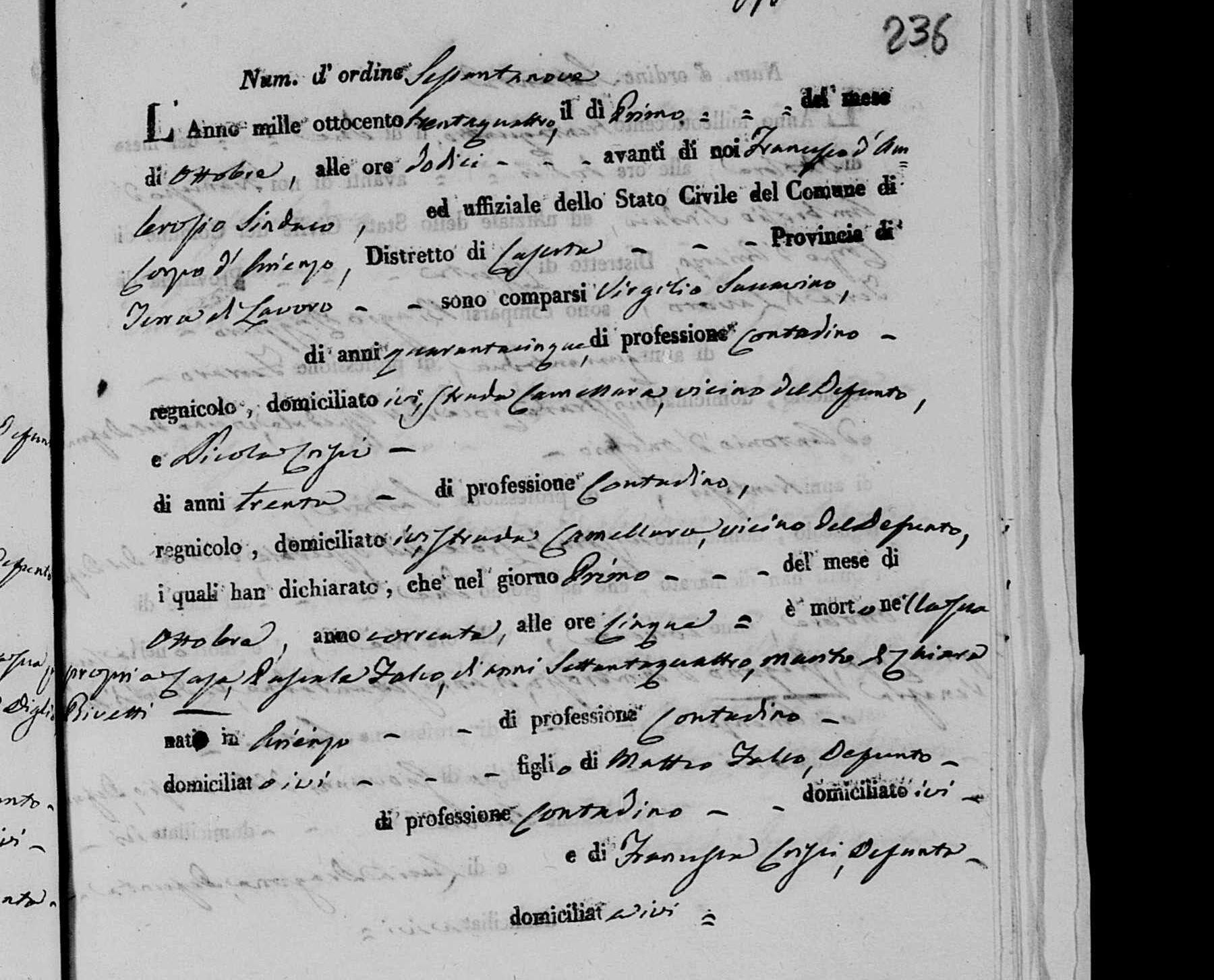
For as long as this family has had a pedigree, the head of it was a guess. Then two neighbours from strada Camellara walked to the town hall at Arienzo and reported the death of the man next door.
…è morto nella sua propria casa Pasquale Falco , d'anni settantaquattro, marito di Chiara Rivetti , di professione contadino, figlio di Matteo Falco, defunto… e di Francesca Crisci, defunta.
One act names his wife, both his parents, his trade and his street — and confirms, from the civil register, what a parish baptism of 1767 had said sixty-seven years earlier. How it was found →
Four things this archive has established
A head to the line
Matteo Falco and Francesca Crisci , whose children were baptised at Arienzo from 1767 — replacing an ancestor who was never there. Two of those children's death acts name them again — Rosa's in 1830, Pasquale's in 1834. The spine →
An address
Strada Camellara. Six Falco householders on one short street, all contadini or coloni, and the neighbours who reported each death lived a few doors along. The street →
549 people, not eight
53 households and 209 register entries, most of them belonging to somebody who never continued the line. The wider family →
One kinship, proved
In 1831 Vincenzo Falco declared a neighbour's death as parente — a kinsman — joining the line to a second Camellara household. Three others remain unjoined. What joins them →
Elsewhere in the archive
Spanish viceroys, Austrians, Bourbons, the French, then Italy — and why a Napoleonic filing rule is the reason this archive can go back past 1809 at all.
Eleven annual registers read page by page, including the three that held no Falco at all — because a null is a result, and it stops the next person repeating the search.
Crisci, Morgillo, Rivetti, di Guida, Arricale, Maione, Annecchino, Zampiello — ten families in their own right, three of which married in more than once.
The home parish, and the Collegiate Church of Sant'Andrea, which holds baptisms from 1672.
From 1762 to 1775 the bishop of Sant'Agata de' Goti kept his second seat beside this church, and he was Alfonso Maria de' Liguori.
Three villages four kilometres apart in two provinces, and the marriage pool that moved the family north.
A surname with about 123 bearers in the world, four sisters who reached Queensland, and a war decoration found in the family's own papers.
Two brothers who married two sisters, the ship, and four Falco graves at Nudgee.
Falco was coined independently many times over. What that means for anyone searching it.
The six places that carry this family, and the four kilometres that crossed a border.
What is still missing
Eleven questions this archive cannot answer, and five doors that need a person rather than a machine — the unread Brisbane immigration files, the restricted Caserta scans, two volumes at Benevento that were never digitised, the marriage supplements, and the DNA matches. All of it, with the searches that have already failed, is set out at Open questions.
Nothing here is taken on trust because it appears in a family tree. Where a record has been seen, it is cited; where it has not, the claim is marked. See Method.