The Great War
A sergeant of the Army Service Corps who married nine weeks before he sailed — his wife's brother, killed at Pozières with no grave — her other brother, a stretcher-bearer decorated twice for bravery — and a cousin the archive has only just found.
This page began as two men. It is now four. A wedding at Albion Church in March 1916 tied together a family that had already sent its sons — and the deeper the records went, the more of them turned up. One is the reason this archive exists at all. One is the reason it has a name on a memorial in France. One came home with the Military Medal and Bar and told his family, apparently, nothing. And the fourth was found this week and is barely known yet.
Lindesay Atkinson D'Arcy, Australian Army Service Corps
| Service number | 11335 |
| Rank | Sergeant |
| Unit | 12th Australian Depot Unit of Supply, Australian Army Service Corps |
| Born | South Brisbane, Queensland |
| Enlisted | 13 December 1915 · Brisbane |
| Married | 18 March 1916 · Albion Church, Brisbane |
| Embarked | 18 May 1916 · Sydney · HMAT Demosthenes A64 |
| Next of kin | his wife, Ivy Miriam D'Arcy |
| Returned to Australia | 7 July 1919 |
| Records | AWM8 25/109/1 · NAA J34, C34558 |
The family remembered only that he "served with the Australian Forces in France during the Great War" — the phrase in his 1936 obituary, and the sum of what his children knew. The rank, the number, the unit, the ship and the three and a half years are recovered here. The obituary →
His name is spelled Lindesay on one AWM record and Lindsay Darcy on the other, which is why both had to be searched. The name →
His service dossier could not be found — and something else was
This page previously said that a fourteen-page B2455 dossier for him "is known to exist". That was an overclaim, and it is withdrawn. The National Archives catalogue was searched directly under Lindesay Atkinson and under Lindsay Atkinson, and in the World War I name index under D'Arcy and Darcy. No B2455 item came back under any of them. The search method was verified by running the same query for his brother-in-law, which returned Arthur Sneyd's dossier immediately — so the tool works, and the absence is real. not found
The National Archives itself warns that "not all items from the series may be on RecordSearch", so this is a null result rather than a proof of absence. It now needs the National Reference Service rather than a search box. Queued →
He died on 10 November 1936. Within months his widow had a repatriation pension file open in her own name. inferred A file's existence is not a finding about his death — it does not say the claim was made on those grounds, or that it succeeded — but it does say that the family's dealings with the Repatriation Commission did not end when he came home in 1919, and it is the one document that might explain a death at forty-four. It is not digitised. What it would take →
Arthur Hartley Sneyd, 9th Battalion
Ivy's younger brother. Born at Rockhampton on 11 October 1893, schooled at Eagle Junction State School. His service dossier has now been read — thirty digitised pages, NAA B2455, item 8088453 — and it corrects the record in several places, starting with his trade. He was not a clerk. He was a typist.
| Service number | 5050 |
| Attested | 16 September 1915, Brisbane, before Capt. R. L. Higgins |
| Age at enlistment | 21 years 11 months |
| Trade | Typist |
| Description | 5 ft 7½ in · 118 lb · fair complexion · blue eyes · dark brown hair · vision 6/6 both eyes · distinctive marks nil |
| Religion | Baptist |
| Next of kin | Father — Mr A. W. H. Sneyd, first of Toowong, later of James Street, Wooloowin |
| Unit | 7th Depot Battalion, then 16th reinforcements, 9th Battalion |
| Ranks held | Private → Corporal (16 Jan 1916) → Sergeant → Private again |
| Embarked | 31 March 1916 · HMAT Star of Victoria A16 |
| To France | Marched out from 1st A.D.B.D., Étaples, 26 July 1916 · taken on strength 29 July 1916 |
| Joined the battalion | 29 July 1916 — three weeks before he was killed |
| Killed in action | 20 August 1916 · in the field, France |
| Age | 22 |
| Grave | None known. Commemorated on the Villers-Bretonneux Australian National Memorial to be confirmed |
The family said the same thing in their own words. The Roll of Honour particulars they filled in for the Australian War Memorial record that he "gave up this rank in Egypt in order to get across to France" — and so, independently, did a stranger in a convalescent depot at Étaples four months after he died. The search for him →
The same page carries the words "(prev. reported wounded)" beside the killed-in-action stamp, and the entry "Wounded in action — see later report — 20.8.16". The family in Wooloowin were told first that he had been wounded. The correction came afterwards.
The report of death
Regiment or Corps: 9th Battalion A.I.F. · Regtl. No. 5050 · Rank Private · Name Sneyd, A. H.
Died — Date 20-8-16. Place In the field, France. Cause of death Killed in action.
Nature and date of report: Army Form B.213 dated 1-9-16, by the Commanding Officer, 9th Battalion A.I.F.
Burial — Place: "Not yet to hand." Date: — . By whom reported: — .
Whether he leaves a will: in Pay Book, "Not yet to hand."
"Not yet to hand" is the form's way of saying nobody could tell the War Office where he was. It never came to hand — but it was not for want of looking. Six men were asked, and one of them, his closest friend, was still trying thirteen months later. The search for Arthur →
Everything he owned
Inventory of Effects of — 5050 Sneyd, A.H., 9th Btn. A.I.F.
Forwarded to — Father, Mr A.W.H. Sneyd, James Street, Wooloowin, Brisbane, Queensland.
Effects. Ex Kit Store, Book No. 16.
Scarf, Letters.
Per "Barunga" 20.6.18. In Case No. 1224.
A scarf and some letters, in case number 1224, twenty-two months after he died.
inferred That the case was still aboard is an inference, not a document: the form records the ship and the date of despatch, and nothing in the dossier says what became of the case. But a case shipped on the Barunga on 20 June had no other way home. On the evidence, the scarf and the letters went to the bottom of the Atlantic, and the family at James Street, Wooloowin got neither a grave nor a parcel.
The family tree records "buried in France". On the evidence that is probably wrong in a particular and poignant way: Australians who fell in France with no known grave are named on the Villers-Bretonneux memorial — 10,773 of them — and the Pozières Memorial, which stands among Australian graves, deliberately carries no Australian names for that reason. Every indication is that Arthur Hartley Sneyd is one of the 10,773.
The Villers-Bretonneux commemoration still carries inferred, because the Commonwealth War Graves Commission is the authority on it and its site has now blocked automated access twice. It is supported by the AIF Project's compiled record and by the fact of the lost grave, and it needs one CWGC page to become documented. Queued →
Vivian Claude Sneyd, 3rd Australian Field Ambulance
Ivy's other brother, two years younger than Arthur — and until 9 September 2026 this archive had four words about him: "Salesman (listed as occupation on a death notice)". He was decorated twice for bravery under fire.
| Service number | 1696 |
| Rank | Lance-Corporal |
| Unit | 3rd Australian Field Ambulance — a stretcher-bearer |
| Enlisted | 16 July 1915 · Brisbane, aged 19 years 7 months |
| Birthplace | Windsor, Brisbane — not Rockhampton, as the tree has it |
| Trade | Salesman · Baptist · unmarried |
| Embarked | 21 September 1915 |
| Decorations | Military Medal (awarded 1 March 1917) and Bar (recommended 12 October 1917) |
| Also entitled to | the 1914/15 Star — and the Brisbane press says why: Gallipoli |
| Discharged | 30 July 1919 |
| Records | NAA B2455, item 8087524 (21 pp.) · AWM 28 · NAA J26 M17540 |
Westhoek, east of Ypres
During the operations at WESTHOEK, East of YPRES 4th October 1917, and succeeding days L/Cpl. Sneyd, while in charge of a squad of bearers showed exceptional bravery, endurance and cheerfulness, despite the heavy work, mud, rain, and fire from the enemy. Stretchers and rations were urgently needed for the forward squads — the weather being wet and bitterly cold and fires being unobtainable — this man volunteered to go back during the barrage fire of an evening counter attack, and returned with rations and stretchers for the R.A.P's. There was very considerable danger of being lost owing to the poor tracks and the darkness. The enterprise and resource of this bearer, and his personal disregard of danger, undoubtedly very materially helped in the difficult task of clearing the R.A.P's on this boggy and dangerous road. ( Awarded Military Medal 1/3/17. )
R.A.P. is a Regimental Aid Post. "Clearing" one means carrying the wounded out of it. The date places him in the Battle of Broodseinde, in the Passchendaele mud.
"On Honour's Roll" — and a face
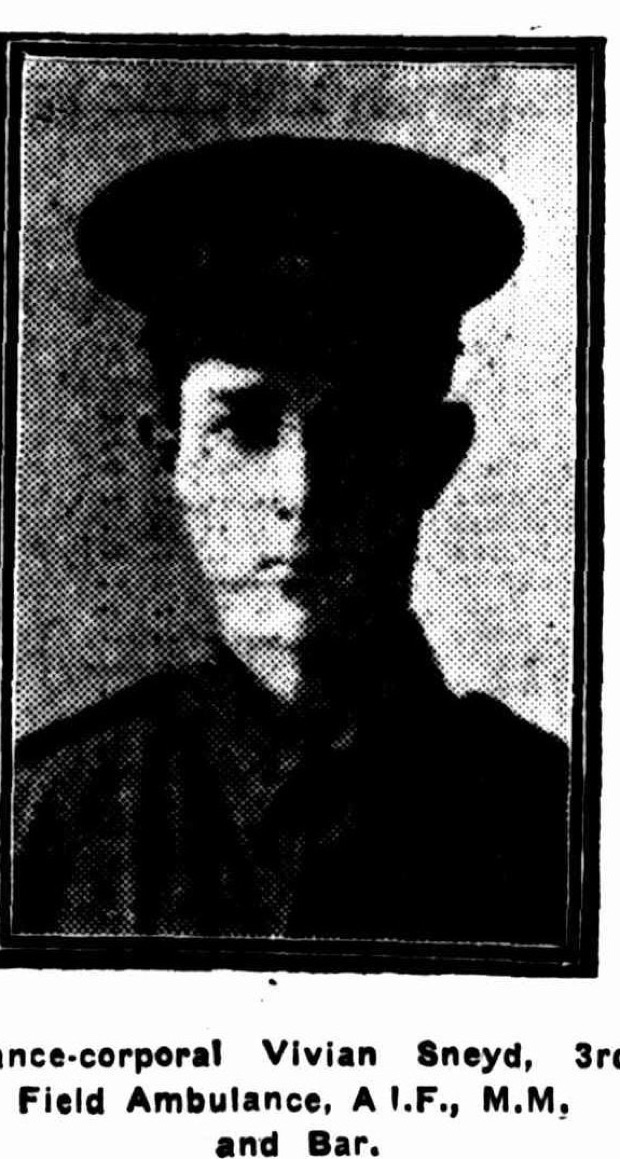
The paper ran his photograph, and beside it the photograph of the man he had gone to war with.
Lance-corporal Vivian Sneyd, 3rd Field Ambulance, A.I.F., M.M. and Bar.
Private Vivian Maynard, 3rd Field Ambulance, A.I.F., M.M.
Lance-corporal Sneyd and Private Maynard are mates who enlisted together in 1915, saw service on Gallipoli, went to France together, and are still together somewhere in France or on the Rhine. Lance-corporal Sneyd is a son of Mr A. Sneyd, of James street, Wooloowin, and Private Maynard is a son of Mrs Maynard, of Bowen Bridge road, Brisbane.
The address — James street, Wooloowin — is the same house the Kit Store was posting Arthur's scarf to.
Fourteen months later his younger brother was decorated, for the second time, for doing exactly that job — going forward under a barrage to bring stretchers up and carry wounded men out. Neither the archive nor, as far as anyone now living knows, the family had connected the two. The search for Arthur →
Ernest Vivian William Sneyd — the cousin
Searching the National Archives for Vivian turned up a third Sneyd soldier the archive had no idea existed. His attestation paper settles who he was in one line: next of kin, "FATHER, THOMAS GEORGE SNEYD, Landsborough, Queensland". Thomas George was William Hartley Sneyd's eldest son — so this man is first cousin to Arthur and Vivian. documented
| Service number | 3891 |
| Unit | 9th reinforcements, 31st Battalion |
| Attested | 4 December 1915 · Brisbane, aged 25 years 2 months |
| Trade | Labourer · Church of Christ · unmarried |
| Birthplace | Rockhampton, Queensland |
| Previously rejected | Yes — on height |
| Embarked | 19 September 1916 · Brisbane · A49 Seang Choon |
| Disembarked | Plymouth, 9 December 1916 |
| To France | 5 April 1917 · joined the 31st Battalion in the field 14 April |
| Wounded in action | late September 1917 · contusions · rejoined 5 October |
| Invalided to England | 17 November 1917 · bronchitis |
| Invalided to Australia | 5 January 1919 · hospital ship, per the Kanowna |
| Died | 16 February 1920, Brisbane — registration 1920/B/31382 |
| Records | NAA B2455, item 8087517 — 92 pages |
The length of the file is the story. Ninety-two pages — where his cousin Arthur's, for a man killed in action, runs to thirty. Almost all of it is medical. He was with the 31st Battalion in the line for a total of about five months across two years, and in hospital for most of the rest.
| Date | What the form records | Where |
|---|---|---|
| 4 Dec 1915 | Attested, aged 25 years 2 months. Labourer. Previously rejected as unfit — "YES. HEIGHT." | Brisbane |
| 19 Sep 1916 | Embarked, A49 Seang Choon | Brisbane |
| 9 Dec 1916 | Disembarked | Plymouth |
| 10 Dec 1916 | Marched in from Australia, 8th Training Battalion | Hurdcott |
| 30 Dec 1916 | Sick to hospital | Fovant Military Hospital |
| Jan 1917 | Discharged, rejoined the training battalion | Fovant → Hurdcott |
| 5 Apr 1917 | Proceeded overseas, France | via Folkestone |
| 7 Apr 1917 | Marched in from England, 1st Aust. Divisional Base Depot | Étaples |
| 14 Apr 1917 | Taken on strength, 31st Battalion | the field |
| 19 May 1917 | Sprained ankle; discharged to duty next day | the field |
| 15 Jun 1917 | To hospital, sick — fever; through 8th Aust. Field Ambulance and the 5th and 3rd Divisional Rest Stations | France |
| 23–27 Jun 1917 | Discharged to duty; rejoined unit ex hospital | France |
| 26 Sep 1917 | Wounded in action | the field |
| 27 Sep 1917 | Admitted — contusions, thigh — 5th Aust. Field Ambulance, thence 5th A.D.R.S. | France |
| 1 Oct 1917 | Admitted and discharged to duty | 5th Aust. Rest Station |
| 5 Oct 1917 | Rejoined the 31st Battalion from wounded | the field |
| 9 Nov 1917 | To hospital, sick — 8th Aust. Field Ambulance | the field |
| 13 Nov 1917 | Admitted, bronchial catarrh, 57 General Hospital | Étaples |
| 17 Nov 1917 | To England — bronchitis. Admitted the same day | France → Epsom |
| 21 Dec 1917 | Furlough, to report to No. 4 Command Depot | England |
| 23 Dec 1917 | Admitted, N.Y.D. ("not yet diagnosed"), 2nd Aust. Auxiliary Hospital | Southall |
| 5 Jan 1918 | Discharged, granted the balance of his leave | Southall |
| 9 Jan 1918 | Admitted, venereal disease, while on furlough, 1st Australian Dermatological Hospital. The form totals it: "Total V.D. period 71 days." | Bulford |
| 21 Mar 1918 | Marched in from Bulford to No. 1 Command Depot; classified B1A3 | Sutton Veny |
| 27 Mar 1918 | Re-classified A3 — fit again | Sutton Veny |
| 28 Mar 1918 | To the Overseas Training Brigade | Longbridge Deverill |
| 24 Apr 1918 | Proceeding overseas, France, a second time | via Folkestone |
| 29 Apr 1918 | Rejoined ex U.K., Australian Infantry Base Depot; marched out to unit | Étaples |
| early May 1918 | To hospital sick while on the way to rejoin the battalion; subsequently evacuated | the field |
| 5–6 May 1918 | Admitted albuminuria, 9th Aust. Field Ambulance → 61st Casualty Clearing Station → ambulance train | the field |
| 7 May 1918 | Admitted nephritis, 1st Canadian General Hospital — for England | Étaples |
| May 1918 | Embarked for England, hospital ship Ville de Liège | France |
| 12 May 1918 | Admitted albuminuria, 1st Southern General Hospital, King's Heath | Birmingham |
| 19 Jun 1918 | Transferred, 3rd Australian Auxiliary Hospital | Dartford |
| 30 Jun 1918 | Discharged to hospital ship for return to Australia | Dartford |
| 9–23 Oct 1918 | Furlough and reported back — still at Dartford, four months later | Dartford |
| 5 Jan 1919 | Discharged to hospital ship for return to Australia. The unit box carries, in red, "Kanowna" and "100%" | Dartford |
| 16 Feb 1920 | Died — thirteen months after landing. Cause not established here | Brisbane |
The file's own dates disagree by a few days across the May 1918 evacuation — a records office logging three hospitals and a ship out of order — and are reproduced as they stand rather than reconciled.
The 31st Battalion was in the 5th Australian Division, which attacked at Polygon Wood on 26 September 1917 — the date of his wound. the battle is inferred from the date; the form gives a date and "wounded in action", not a place.
He died thirteen months after he landed. The Queensland death index gives the date exactly — 16 February 1920, registration 1920/B/31382 — and names his parents as Thomas George Sneyd and Annie Spalding, which confirms the cousinhood a second time, from the civil register rather than the army's paperwork. documented The tree had only "between 1919 and 1921".
This archive does not name a cause of death without the certificate itself, and that has not been obtained. What would settle it →
Two corrections to the tree, which gives him only "b. between 1890 and 1892, d. between 1919 and 1921": his age of 25 years 2 months on 4 December 1915 puts his birth at about October 1890, and his death is 16 February 1920. His service is now dated to the day throughout.
March, May, August
18 March 1916 — Lindesay Atkinson D'Arcy marries Ivy Miriam Sneyd at Albion Church, Brisbane.
18 May 1916 — he sails from Sydney on the Demosthenes.
20 August 1916 — her brother is killed at Pozières, aged twenty-two.
And around those three dates stand the others. Vivian Claude Sneyd had been in uniform since July 1915 and had two more years of the Western Front to come. Their cousin Ernest Vivian William Sneyd sailed that September, was wounded at the end of the following one, and came home on a hospital ship in January 1919 to die.
In the last week of September and the first week of October 1917, two Sneyd cousins were in the same few miles of the Ypres salient. One was carried out of Polygon Wood with contusions on the 27th. The other, eight days later and a little to the north, was going forward through a barrage with stretchers, and was given a Bar to his Military Medal for it. There is no sign that either family knew.
Lindesay came home in July 1919 and died at forty-four in 1936, leaving Ivy with five children. Arthur did not come home at all. Ivy outlived them both by decades and is buried at Mt Thompson. The Sneyds →