Mascali
The town Etna swallowed whole in 1928 — and, ninety years before that, the comune where Maria Nicotra was born on a December night in 1875.
Fourteen years were read in the wrong town
Maria Nicotra is the woman at generation four — Salvatore Mazza 's wife, buried at Nudgee, and the mother of the man who brought the name to Queensland. The family tree says she was born at Piedimonte Etneo. This archive read fourteen consecutive Piedimonte birth indexes, 1870 to 1883, looking for her, and the Nicotra are in them the whole time and never produce her.
The explanation was six words in an act nobody had opened. Her parents' marriage — Piedimonte, Matrimoni 1872 atto 20 — puts Giovanni Nicotra «domiciliato e residente a MASCALI» and Venera Cassaniti «qui domiciliata». A wife went to her husband's comune. The children were registered here.
Born at half past nine in the evening
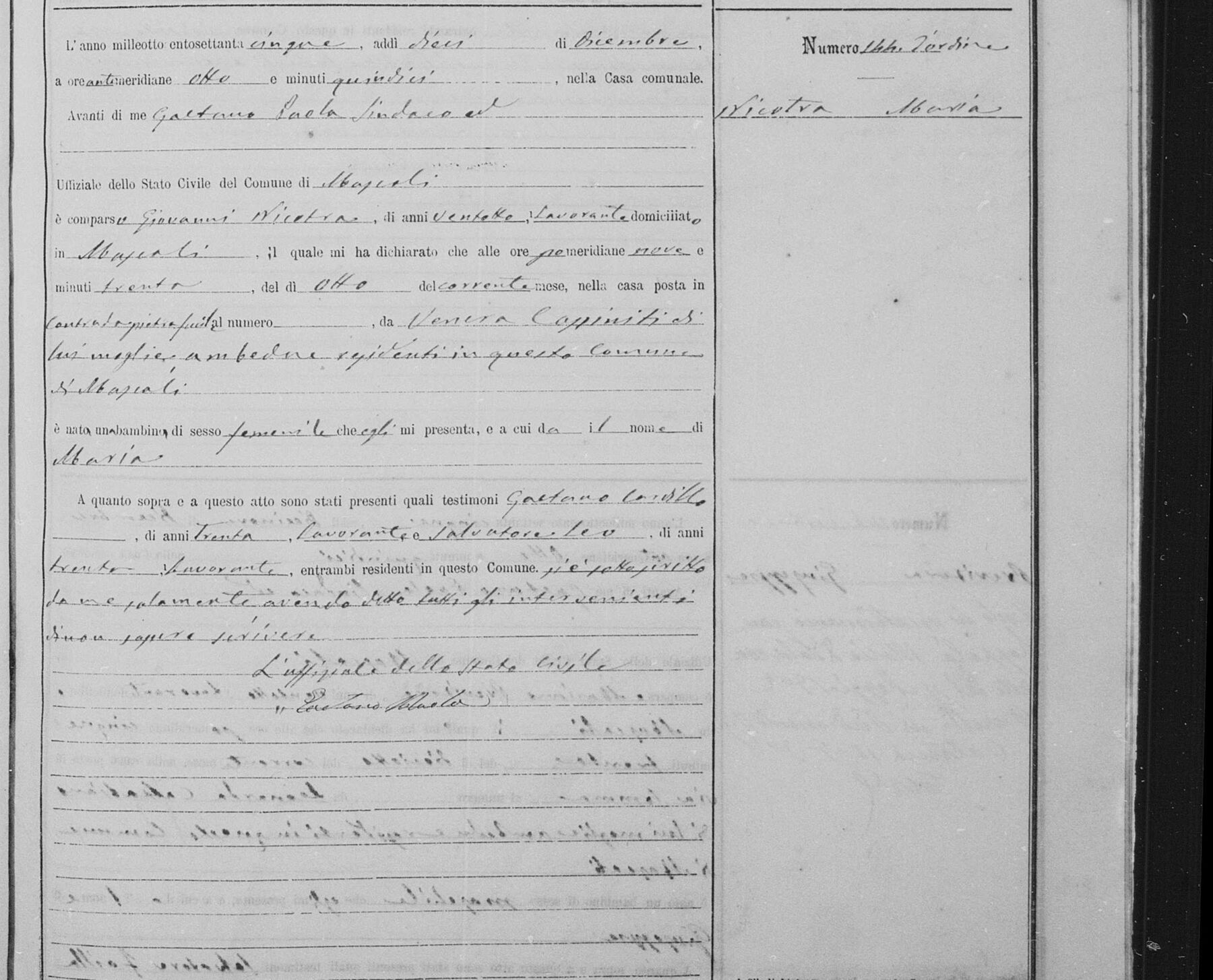
She died at Brisbane in 1963 aged eighty-eight, which this date fits exactly. The tree's «Piedimonte Etneo» is her mother's town, not hers — and the correction is on her own page and the corrections list, beside what the tree says, because this archive does not overwrite what it was given.
Nine years of births read, and only one Nicotra household
Having found her, the obvious question was whether her father's household was here too — because if it was, his own birth should be. Every surviving birth Tavola from 1839 to 1848 was read at the N section, every entry, each one checked into the next letter before anything was written down. 1844 does not exist in this series at all, and 1842 is torn, its M-to-P run on the lost side.
The answer is that Rosario Nicotra's household was not at Mascali in the 1840s. The only Nicotra here in the whole decade is Alfio Nicotra and Carmela Sudieri, who appear in 1840 and again in 1847. Giovanni's own certificate says he was born at Giarre, and the search moved there.
That negative is weaker than it was written, and this comune is the reason. Each of those nine years was read by checking the N section into the next letter — which assumes the sections are in order. At Mascali they are not: see below. What was found stands; what was not found is provisional until each Tavola has been read end to end. It is on the work list →
The alphabet is not in alphabetical order
Mascali's marriage Tavole were swept next, because the marriage index names both spouses, all four parents and the comune each came from — one row would have carried a whole generation. Eight years, 1835 to 1847. No Nicotra in any of them.
What the sweep turned up instead is a caution. The 1847 clerk wrote his sections in the order C, then N, then M. 1841 and 1835 put V before S. These are not slips in one volume; they are how this office worked.
So at Mascali, «the alphabet runs M straight into P» proves nothing. The N may be sitting three headings earlier. The only safe reading of a Mascali index is the whole table, first heading to «Fine» — which is how all eight years below were read, and which is why they can be trusted.
| Year | N entries | What is there |
|---|---|---|
| 1835 | none | the whole Tavola read A to Z — A, C, D, G, M, V, S, V again, Z. No N section anywhere in it |
| 1836 | none | whole Tavola: A, B, C, D, G, L, M, M, P, T. No N section |
| 1837 | none | whole Tavola, ending in «Fine»: C, E, F, G, L, M, R, S, T. No N section |
| 1838 | none | whole Tavola: B, C, G, L, M, S, T, V. The alphabet jumps M straight to S |
| 1839 | none | whole Tavola: A, C, G, M, P, S, T, V. No N section |
| 1840 | one | the one N entry is NICOLOSI Francesco × Mercurio Francesca, atto 10, 2 June 1840 — not a Nicotra at all |
| 1841 | none | whole Tavola under its printed heading «Tavola Alfabetica annuale della solenne promessa pell'anno 1841»: A, C, G, L, M, P, P, V, S, T, Z. No N |
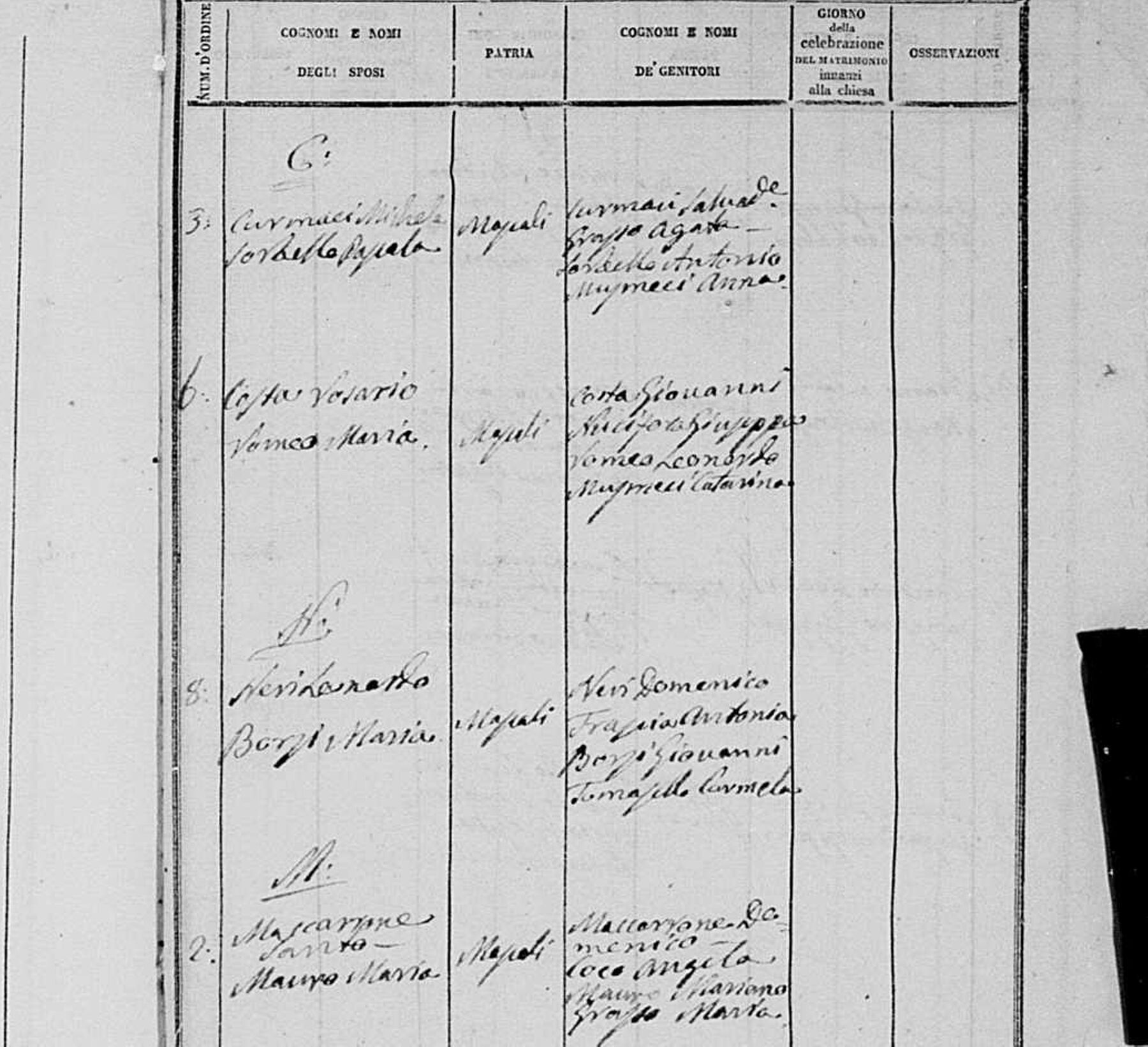
| 1847 | one | the one N entry is NERI Leonardo × Borzì Maria, atto 8 — his parents written NERI Domenico and Antonia Fraggia. Not a Nicotra. AND THE N SECTION SITS BEFORE THE M: this clerk's headings run C, N, M |
What Mascali holds
498 volumes, listed whole and verified against the result facets — not a sample sitting at the ceiling.
| Fondo | Record type | Years | Volumes | Openable |
|---|---|---|---|---|
| deputazione del Regno | Riveli di anime e di terre | 1714–1752 | 40 | — |
| italiano | Cittadinanze | 1866–1893 | 28 | — |
| italiano | Matrimoni | 1866–1893 | 29 | — |
| italiano | Matrimoni, allegati | 1866–1893 | 24 | — |
| italiano | Matrimoni, pubblicazioni | 1866–1893 | 28 | — |
| italiano | Matrimoni, pubblicazioni allegati | 1866–1893 | 24 | — |
| italiano | Morti | 1866–1893 | 29 | — |
| italiano | Morti, allegati | 1880–1880 | 1 | — |
| italiano | Nati | 1866–1893 | 28 | 5 |
| italiano | Nati, allegati | 1875–1875 | 1 | — |
| restaurazione | Diversi | 1820–1865 | 25 | — |
| restaurazione | Matrimoni | 1820–1865 | 46 | 8 |
| restaurazione | Matrimoni, memorandum notificazioni ed opposizioni | 1841–1865 | 25 | — |
| restaurazione | Matrimoni, processetti | 1841–1865 | 24 | — |
| restaurazione | Matrimoni-Morti, annotazioni | 1853–1893 | 1 | — |
| restaurazione | Morti | 1820–1865 | 49 | — |
| restaurazione | Nati | 1820–1865 | 45 | 9 |
| restaurazione | Nati, esposti | 1820–1865 | 45 | — |
| tribunale del real patrimonio | Riveli di beni e di anime | 1616–1678 | 6 | 1 |
Two things in that table are worth stopping at. The civil registration runs 1820 to 1893 and there is no 1844 — a hole in every series at once, not a gap in one. And the volumes held at Palermo are not civil registration: they are riveli, household returns made to the Sicilian parliament, and the earliest is 1616. That is a century before Piedimonte's earliest and the oldest source of any kind in this archive. The first volume is now open, and what it is matters more than what is in it — below.
Two centuries older than anything else here, and it has an index
The riveli di beni e di anime are household returns made to the Sicilian parliament — who lived in the house, and what they owned. The 1616 volume runs to 546 images, and this archive expected to have to read all of them.
It does not. The book opens with an alphabetical name index, and the letter tabs are cut into the fore-edge of the pages — B, C, D, E, F, G, I, L, M, N, P, R, S, T, V, still there four hundred years on. Every line gives a name and a folio.
And then the catch, which decides how this gets searched. The index is ordered by forename, not by surname. Its A pages run Antonino lo Xuto, Antonio Barbagallo, Adamo Mangano, Aloisia lo Castro, Agata Grasso, Alfio Musumeci. So the N tab leads to the Natales and the Nicolòs, not to the Nicotra, and looking for a surname means reading the index through. That is about twenty images instead of five hundred and forty-six, which is the difference between an errand and a wall.
The surnames on a single opening are already the ones the 1840s registers are full of — Barbagallo, Musumeci, Finocchiaro, Grasso, Gagliano, Pinnisi, Strano, Arcidiacono. That says the population of this town is continuous across two hundred years. It does not draw a line of descent and nothing here ever will: there is no bridge between 1616 and 1875. What the riveli can answer is whether a surname was in Mascali before the registers begin, which is a smaller question honestly asked. Work list, row 182 →
People this archive places at Mascali
Added from a register read here, and absent from the family's own export.
| Who | Gen | Trade | Named in |
|---|---|---|---|
| Rosario Nicotra | 6 | bracciante | Piedimonte Etneo, Matrimoni 1872 atto 20 (7 October 1872), read in the original |
| Venera Murabito | 6 | contadina | Piedimonte Etneo, Matrimoni 1872 atto 20 (7 October 1872), read in the original |
What is left here
- The other six children of Giovanni Nicotra and Venera Cassaniti. The family's export names seven — Maria, Rosa, Venera, Nina, Angela, Rosario and Antonina — and two are placed: Venera, 12 December 1873, and Maria. 1876 and 1877 hold Nicotra entries whose indexes carry no paternità column, so they are read and unresolved, which is not the same as absent.
- The deaths. Not opened here at all. Rosario Nicotra and Venera Murabito were both alive in October 1872 and no death has been sought for either, in any of the four towns. The marriages, by contrast, are now swept for 1835–1841 and 1847.
- The riveli of 1616. Forty-six volumes at Palermo that this archive knows how to read — it has used the Piedimonte ones — and has not touched.
The Nicotra line → · What has been read → · Giarre → · Riposto →
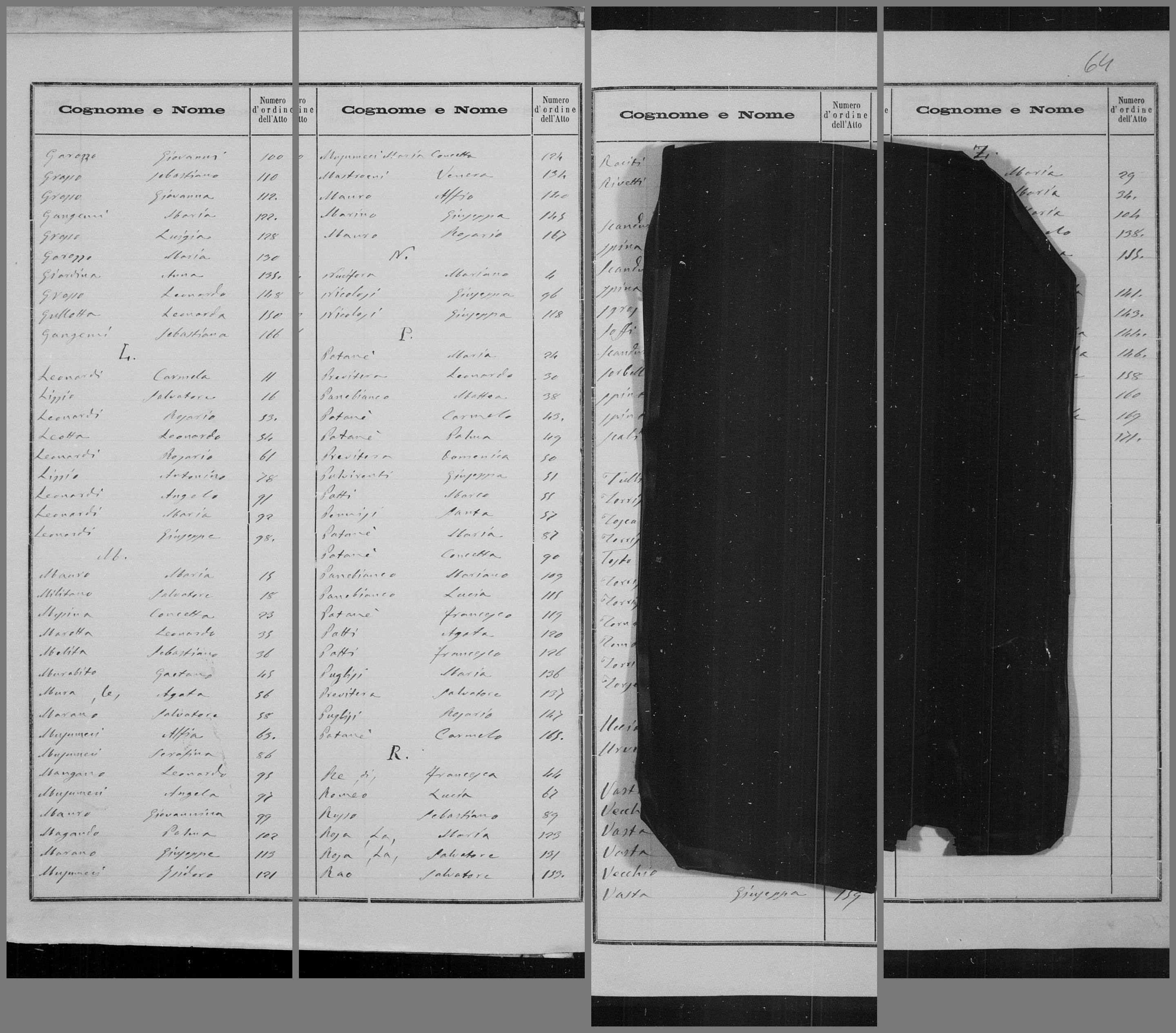
The index that taught the layout
1 scan read off the films and cited elsewhere on this page.