Blažević
A mountain village built on purpose, a port killed by a railway, and one family name spelled in three different alphabets.
Blažević means “son of Blaž” — and Blaž is the Croatian form of Blaise. Like most Croatian names ending in -ić, it just tells you whose child you were.
From you, all the way back
Start at the bottom. Every step up is one more generation into the past — a real person, in a real place, written down in a real book.
What do the numbers mean? “2× great-grandpa” is just a short way of writing great-great-grandpa. Once you get past three or four greats it is quicker to count them than to say them. So your grandpa’s grandpa is your 2× great-grandpa, and his grandpa is your 4× great-grandpa, and his grandpa is your 6× great-grandpa.
Look at them
Real photographs of real people you are related to. Some are more than a hundred years old.
Things they actually did
They died on the same day, six years apart.
Your great-grandpa Ivan died at Senj on 30 October 1995. Your great-grandma Hedviga died in Johannesburg on 30 October 2001 — six years later, to the very day.
Your great-grandma was a singer.
Before Africa, Hedviga sang at the Hotel Therapia in Crikvenica — the big grand hotel on the seafront, the one people came to from all over the empire. There is no record of her singing anywhere. It is only the family remembering her, which is the only place a voice can be kept. But the hotel is still there. It is called the Kvarner Palace now.
Her grandfather carried things over a mountain.
Josip Papić was a trhonoša — one of the carriers of Senj. They loaded packhorses and took goods up the Vratnik pass, over the Velebit mountains and into the interior, then brought grain and timber back down. The whole town existed because that was where the sea met the road.
Packhorse to factory in one generation.
His daughter Milka went to work in the Senj tobacco factory, rolling cigars — and so did the man she married when she was twenty-one. Her father was still leading horses over a mountain. She was on a production line.
A girl who came down off the mountain road.
Antonija — everybody called her Tonka — was born up on the Velebit road at Krivi Put, house 136, on 12 May 1859. She came down off that road into the town, and the family has been in Senj ever since.
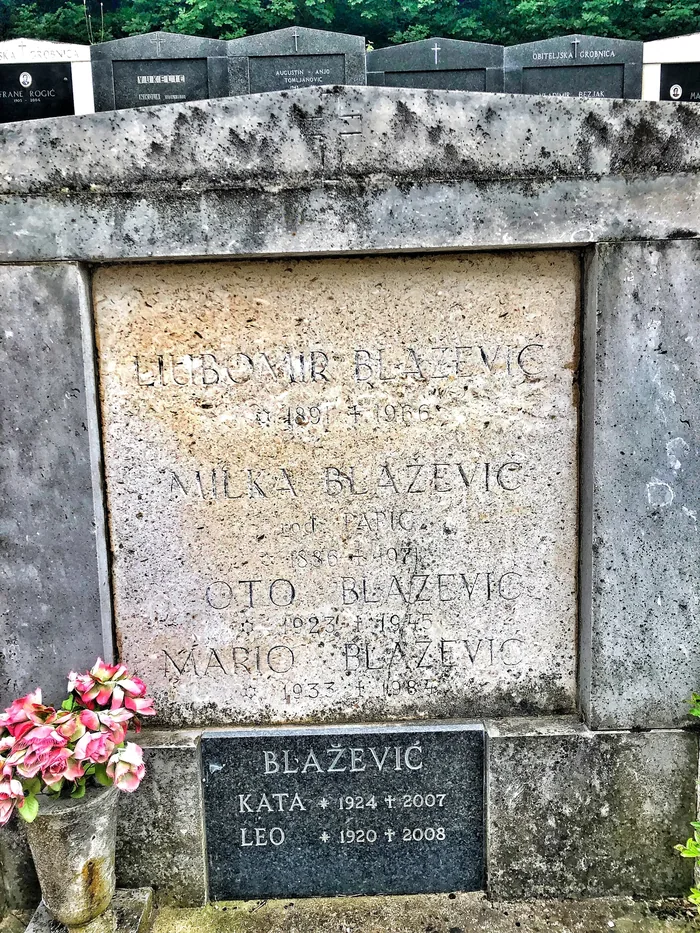
A gravestone nobody could read — until somebody found an older photo.
The family photographed this stone in hard, flat sunlight and could not make out the top panel at all. The plan was to go back with a special light. They never needed to: somebody found a picture taken at the very same wall on 5 June 2019, in soft even light, and the whole thing read perfectly.
Their village was built on purpose.
Smokvica Krmpotska and Krivi Put were not old villages that grew slowly. They were founded — settled between about 1605 and 1647 by families called the Bunjevci Krmpoćani, who fled the Ottoman armies and were planted in the Senj mountains on purpose, to hold the frontier.
A railway went somewhere else, and the town died.
In 1873 the new Karlovac–Rijeka railway bypassed Senj. Everything that had come over the mountain on packhorses now went by train, somewhere else — and the port simply died. Almost every job in this family afterwards is downstream of that: day labourer, porter, sailor, and then the tobacco factory.
One family name, three alphabets.
A name in this family is written Žubrinić in Croatian, Xubrinich in the old Venetian-Italian way — where an X was used for the sound Ž — and Zubrinich in the German-Latin office hand. One of them sailed to Port Pirie in South Australia around 1884, and the spelling he arrived with stuck there for good.
Nobody knows how Oto died.
Hedviga’s brother Oto was twenty-two in 1945. The family remembers two completely different endings: a snakebite on the hill above the town, and the war away in Slavonia. There is no grave. His name was cut into his grandparents’ stone instead — which is what people do when somebody does not come home from far away.
🔎 The bit we still can't solve
The three names at the very top — Mateša, Grgica and Ilija — used to be a separate list that nobody could join onto ours. Now they are joined on. But be careful with them: they come from other people’s family trees, not from a church book. The oldest Blažević anybody has actually found written down in a register is Toma, in 1838. Everything above him is still a promise rather than a proof.