The Arolsen Cards
Three German index cards, attached to Hedviga's husband in the family tree and never read, place him in a factory in Württemberg at the age of sixteen.
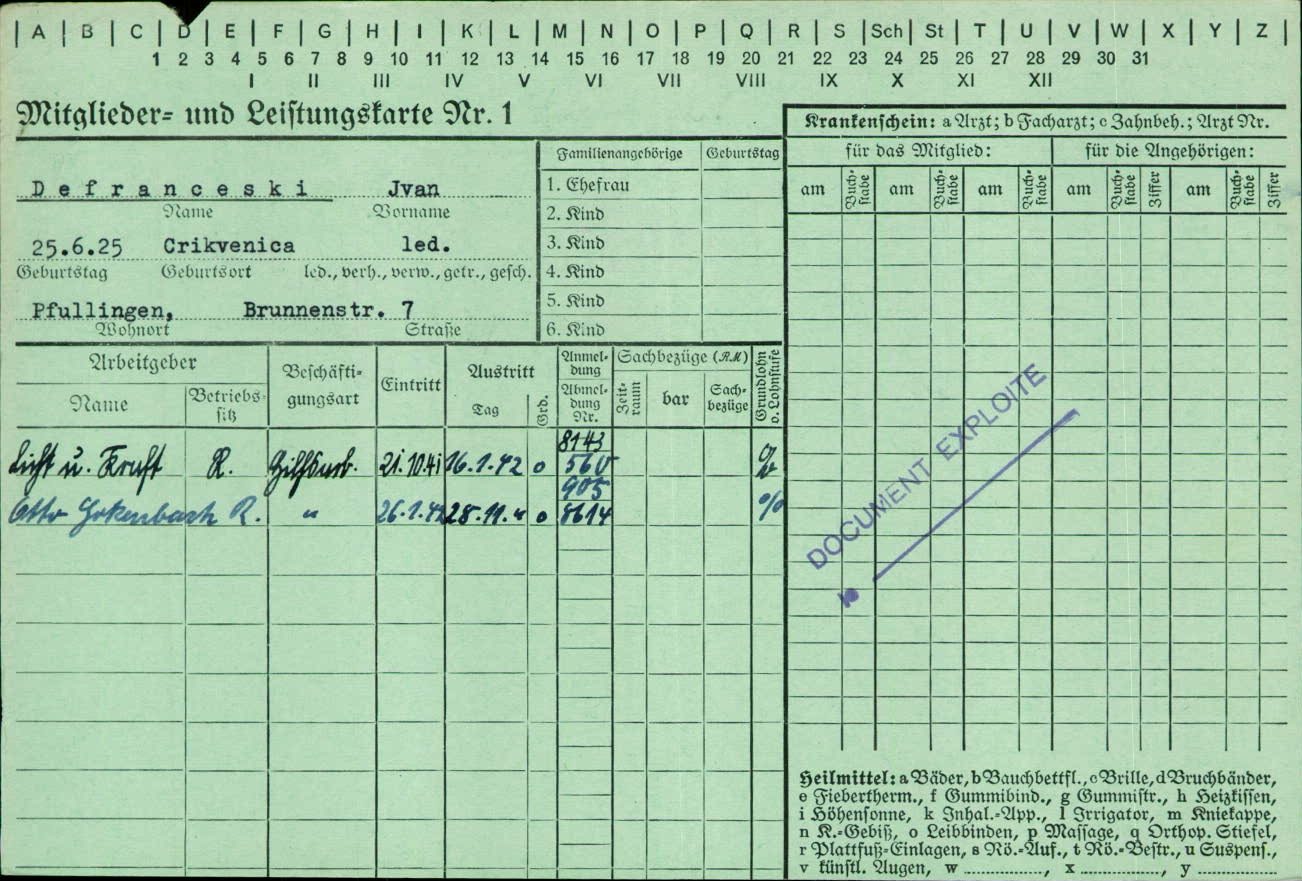
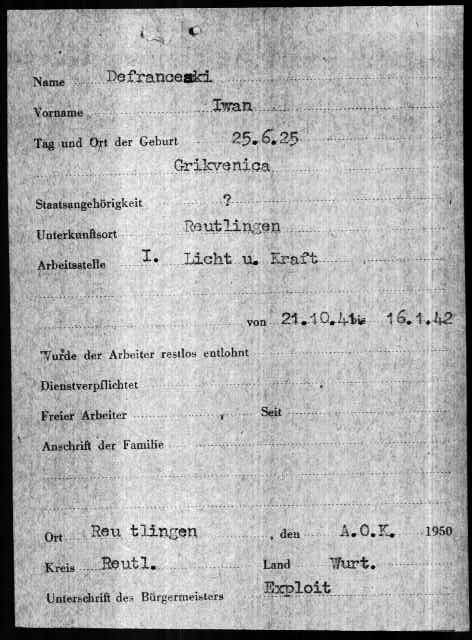
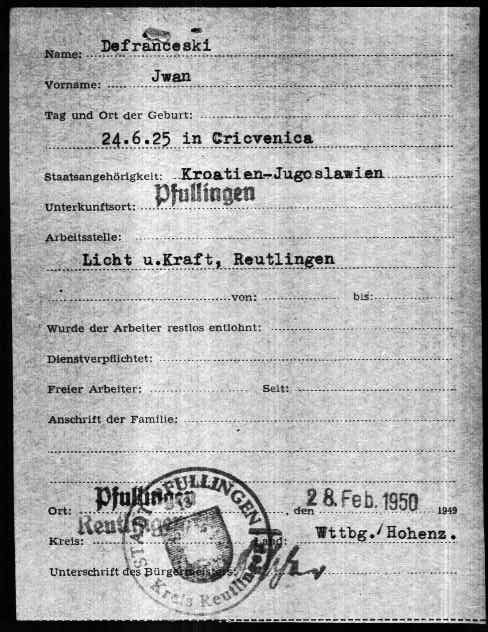
The media sweep turned up three record images filed under Ivan Anton Defranceski (1925–1995) from the Arolsen Archives — the International Tracing Service, the central archive of Nazi persecution. The previous build of this archive listed them as an open question because nobody had looked at them. This page is what they say.
What the cards record
| Name | Defranceski, forename written Iwan and Jvan — German renderings of Ivan |
|---|---|
| Born | 25 June 1925, Crikvenica — spelled Grikvenica and Cricvenica by two different clerks |
| Nationality | Kroatien-Jugoslawien on one card; ? on another |
| Status | led. — ledig, single. No wife and no children are entered on the insurance card, and every family line is blank. |
| Lodging | Pfullingen, Brunnenstraße 7; the Reutlingen card gives the Unterkunftsort simply as Reutlingen |
| Employer 1 | Licht u. Kraft, Reutlingen — apparently the electricity and power undertaking. Category Hilfsarb. — Hilfsarbeiter, unskilled labourer. 21 October 1941 – 16 January 1942. |
| Employer 2 | A second Reutlingen employer, same category. The name is written in an old German hand and this archive cannot read it confidently — it begins with what may be Otto. 26 January 1942 – 28 November 194? — the final digit of the year runs into the column rule and is illegible. It is 1942 or 1944, and the difference is ten months against nearly three years. |
| Insurance | Registration and deregistration numbers 8143 / 560 for the first post, 905 / 8614 for the second |
He turned sixteen in June 1941 and started at Licht und Kraft that October.
Three blank lines
The 1950 municipal questionnaires exist precisely to establish what kind of worker a foreigner had been. Three printed lines do that job. On both cards, all three are empty.
| Wurde der Arbeiter restlos entlohnt? | “Was the worker paid in full?” — blank |
|---|---|
| Dienstverpflichtet | Compulsorily assigned to service — blank |
| Freier Arbeiter … seit | Free worker, since — blank |
So the record establishes that he was there and what he did, and is silent on the one question everybody asks first. This archive does not claim he was a forced labourer, and does not claim he went voluntarily. The boxes that would settle it were left empty by a German town clerk in 1950, five years after the fact.
The context, stated as context
Yugoslavia was invaded on 6 April 1941 and partitioned; the Independent State of Croatia was declared on 10 April 1941 under Axis supervision, and sent workers to the Reich under labour agreements. German recruitment of labour from the region hardened through late 1941 and 1942 as the war in the east stalled and the demand for workers became acute.
Ivan's first registration — 21 October 1941 — sits early in that sequence, before the openly coercive round-ups documented from 1942 onward. That is a reason to be careful in both directions: it does not make his going voluntary, and it does not make it forced. A sixteen-year-old from an occupied country working in a German power undertaking is not a free labour market in any case.
Reutlingen and Pfullingen are neighbouring towns in Württemberg. After 1945 they fell inside Württemberg-Hohenzollern, the French occupation zone administered from Tübingen — which is why a Croatian teenager's wartime employment was surveyed by French-zone municipalities in 1950 and why the insurance card is stamped DOCUMENT EXPLOITÉ.
The cards
Where it sits in the life
This is the earliest documented event in Ivan Defranceski's life after his birth, and it reframes the man Hedviga married.
| 25 June 1925 | Born at Crikvenica |
|---|---|
| 21 Oct 1941 | Aged 16 — begins at Licht und Kraft, Reutlingen, as an unskilled labourer, lodging at Brunnenstraße 7, Pfullingen |
| 26 Jan 1942 – 28 Nov 194? | A second Reutlingen employer |
| 1948 | Back in Croatia: his daughter Ladislava is born at Crikvenica |
| 17 Dec 1951 | His son Ivan born at Senj hospital; the birth extract gives his trade as electro-mechanic — which is what a boy who spent the war in a power undertaking might well become — and his nationality as Italian |
| 1954 | That extract is drawn and translated for the Supreme Court of South Africa |
| 30 Oct 1995 | Dies at Senj. Hedviga dies at Johannesburg on the same date, six years later. |
What would settle the rest. The Arolsen Archives online collections hold these cards and may hold more under the same name — a direct search for Defranceski, born 25.6.1925 would show the full file and resolve the illegible year. Arolsen answers enquiries from families without charge. Open questions →