The Brother
Hedviga's brother died at twenty-two in the last year of the war. The family preserves two accounts of how, they cannot both be true, and there is no grave to ask.
This page exists because the record contains a contradiction that has been kept rather than tidied away. Both accounts are written into the same note on Oto's entry, attributed to two different people, and this archive reproduces them exactly as they stand.
The first account
Bitten by snake — attributed in the tree to Ivan Defranceski
Ivan Anton Defranceski (1925–1995) was Hedviga's husband and Oto's brother-in-law — two years younger than Oto, and alive in the same town at the time. The Velebit has the horned viper, Vipera ammodytes, Europe's most dangerous snake, and a shepherd or a labourer on that mountain was genuinely at risk.
The second account
The late Otto Blažević was the brother of Ljuba, Leo, Aunt Karma, Aunt Seka … he died in the war somewhere in Slavonia, his grave is unknown, so they put his name in his grandmother's and grandfather's grave — and now Leo is there, and Katica. — attributed in the tree to Nives Blažević
This one names his siblings correctly, including “Aunt Seka” — Hedviga's own nickname — which is a good sign that the speaker knew the family well.
What the second account fits
The war in Slavonia in 1945 is not a vague setting. It is one of the best-documented killing grounds of the European war's last months.
The Syrmian Front ran from 21 October 1944 to 12 April 1945 across Syrmia, Slavonia and Baranja. The Yugoslav Partisans lost more than 13,500 killed covering roughly 140 kilometres between Belgrade and Vinkovci over nearly six months of winter fighting. When the front broke on 12 April, the 1st and 3rd Armies advanced west through Slavonia.
He had already seen the war close up. He was twenty when German aircraft destroyed about half of Senj on 7–8 October 1943, killing thirty of the town's residents — among them, on the second day, his uncle by marriage Pavao Kosina.
A man born in 1923 was twenty-one or twenty-two in that campaign — precisely the cohort mobilised into it, much of it from newly-liberated Croatia with minimal training. And an unknown grave is the ordinary outcome, not the strange one: thousands of those dead were buried where they fell.
The grave says she was right about the grave
A photograph of the Blažević plot at Senj — recovered from the MyHeritage media library, where it had been sitting untouched — can be checked against Nives Blažević's account line by line. It matches.
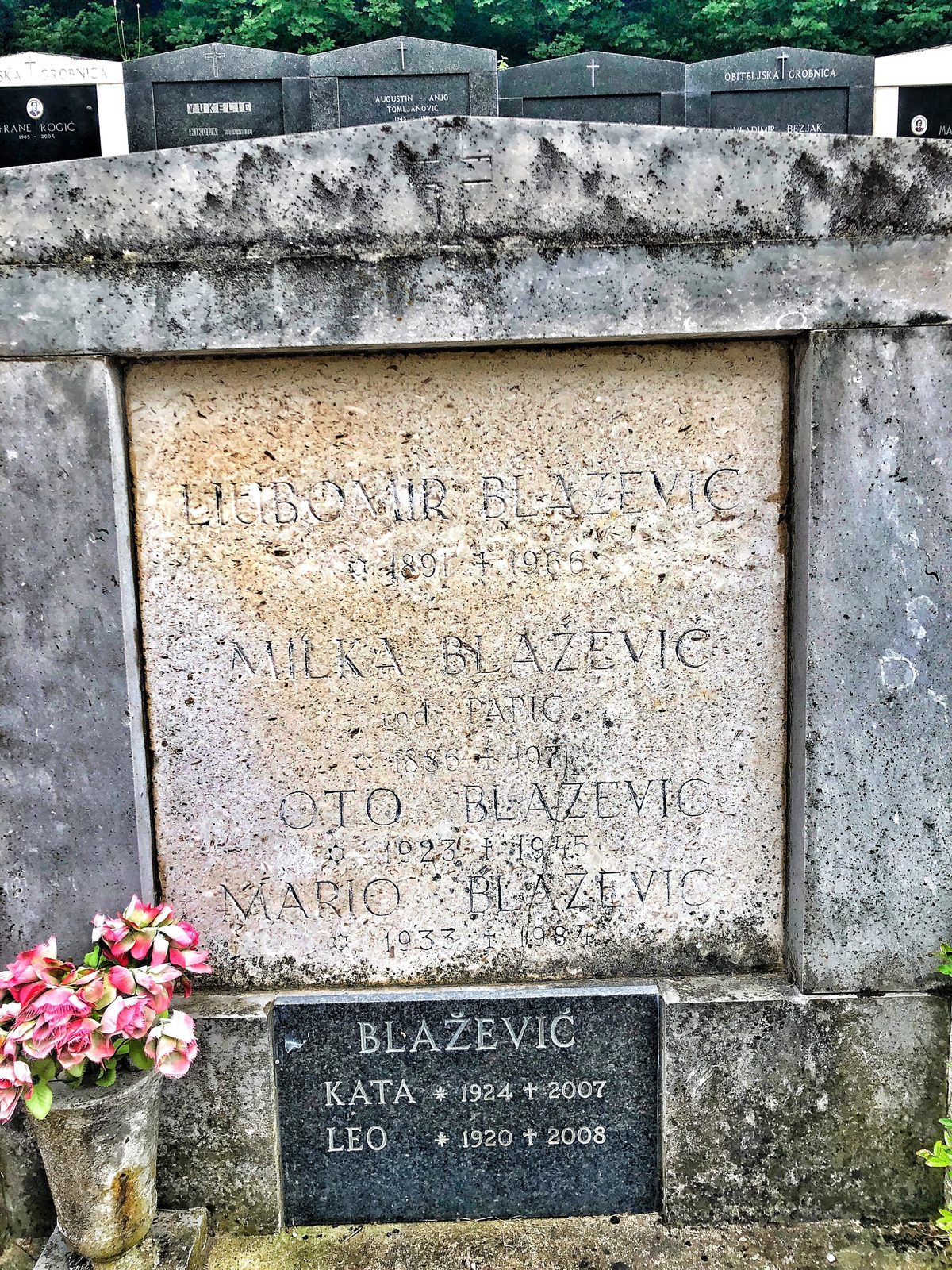
| She said | “they put his name in … [the] grave” |
|---|---|
| The stone | OTO BLAŽEVIĆ ✳ 1923 † 1945 is cut into it, between his mother and his brother Mario. |
| She said | “and now Leo is there, and Katica” |
| The stone | A separate, later, black plaque below reads LEO ✳ 1920 † 2008 and KATA ✳ 1924 † 2007 — Katica. |
| She said | “his grandmother's and grandfather's grave” |
| The stone | The names are Oto's parents. But Nives Blažević was born in 1953 — Ljubomir and Milka were her grandparents. She is describing the grave from where she stands in the family, which is what people do. |
How this archive leaves it
| Documented | Born 1923, Senj. Died 1945, with the death place entered in the tree as Senj. Son of Ljubomir Blažević and Milka Papić; brother of Leo, Karmela, Hedviga, Ljubomir, Mario and Anton. |
|---|---|
| Family lore, first | Snakebite. Attributed to Ivan Defranceski, who was there. |
| Family lore, second | Killed in the war in Slavonia, no known grave, name added to his grandparents' plot. Attributed to Nives Blažević. |
| Corroborated | Nives's account, in its checkable parts: his name on the family stone, and Leo and Katica added to it later. The grave → |
| Contradiction | Still unresolved as to cause. The tree's own death place of Senj agrees with neither account cleanly — it contradicts Slavonia outright, and it is also exactly what a family would enter when the real place was unknown. |
What would settle it. The Croatian State Archives hold Second World War military and civil death records, and the Yugoslav war victims register (Popis žrtava rata) is searchable by name and birth year. A single entry for Oto Blažević, b. 1923, Senj would end the question in either direction. Nobody has yet looked. Open questions →
Both accounts are kept because pretending otherwise is how family myths become family history — and because one of these two people was right. Method →