Senj, 1943
Half the town was destroyed in two days. Hedviga was seventeen and living in it, and her aunt lost a husband and two daughters that year.
This archive had Senj as an economic story — a port that the railway killed in 1873. It is also a war story, and the war reached the family directly. Nothing in the family tree says so; the dates do.
What happened
Italy capitulated on 8 September 1943, and the Italian occupation zone along the Adriatic collapsed. Senj, with its harbour and its road up to Lika, became one of the most important Partisan ports on the coast: weapons and war material were concentrated in the town and ships lay in the harbour.
On 7 and 8 October 1943 German aircraft bombed the town and the port.
Figures from the Croatian scholarly literature on the German bombing of Senj in 1943. Sources →
Anka Blažević's household
Anka Blažević (1893–1953) was Ljubomir's sister — Hedviga's aunt, and the radnica who worked the floor of the tobacco factory alongside her sister-in-law Milka. On 20 November 1919 she married Pavao Kosina, born at Senj on 15 March 1894.
| Pavao Kosina | b. 15 March 1894, Senj — died 8 October 1943, the second day of the bombing |
|---|---|
| Otilija Kosina | b. 1920 — died 1943, no day recorded |
| Antun Kosina | b. 1921 — died 2003. A priest: his cross reads vlč. — velečasni, Reverend |
| Oskar Kosina | b. 4 September 1922, Senj — died 1954, Buenos Aires |
| Neda Kosina | b. 1924 — died 7 September 1943, a month before the raid |
| Križan Kosina | b. 1940 — died 1941, an infant |
Anka outlived them by a decade and died in 1953.
The stone says it outright
This page first said Pavao Kosina was probably one of the thirty, and was careful to add that the date came from the family tree rather than from any record. Then his grave was found in the media library.
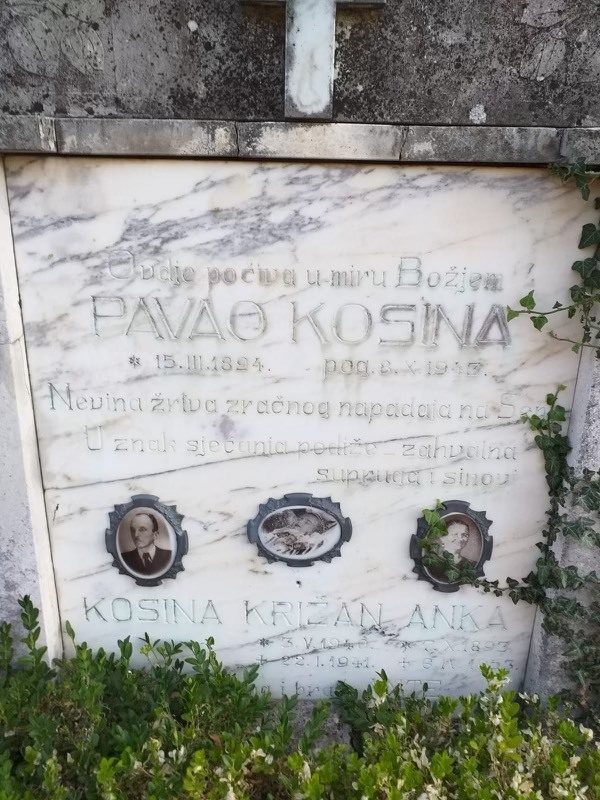
Ovdje počiva u miru Božjem
PAVAO KOSINA
✳ 15.III.1894. · pog. 8.X.1943.
Nevina žrtva zračnog napadaja na Senj
U znak sjećanja podiže — zahvalna supruga i sinovi
“Here rests in God's peace Pavao Kosina, born 15 March 1894, killed 8 October 1943. An innocent victim of the air raid on Senj. Raised in memory by his grateful wife and sons.”
Pog. is poginuo — killed, the word used for a violent death rather than an ordinary one. The family did not merely record the date; they recorded the cause, and their judgement of it. Nevina žrtva — an innocent victim.
The plate below also carries Križan (1940–1941), the infant, and Anka herself, who outlived them all to 1953.
A marriage in a front room, 1857
Pavao Kosina's mother was Angelika Boras (1857–1902), and the Boras reach this archive through her. Their own beginning is one of the more human entries in it.
Senj marriages, 9 February 1857, entry 52 — Caelebs Josephus Boras, filius Denatorum Josephi et Annae Boras natae Butvalz — cum Vidua Maria … in domo privata copulate fuere. Ages 32 and 28.
They married in a private house, by dispensation of the bishop — a departure from the parish church that usually means illness, urgency or irregularity. He is entered as a bachelor, she as a widow. And they already had three children: Ana and Anton in 1854, Ivan in 1855. Angelika follows the marriage, later in 1857.
It is a legitimation — a union of some years put right in a front room under episcopal licence. Her brother Ivan Boras (1855–1926) went into the carinska služba, the customs service, a state post in a port town; her grandmother's name was Anna Butvalz, German, as Ana Untersinger is in the Žubrinić line. Two German surnames marry into this family in the Frontier century, which is what an imperial administration leaves behind.
Angelika died in 1902. She did not see her son marry Anka Blažević in 1919, and she did not see 1943.
What is claimed, and what is not
| Documented | German aircraft bombed Senj on 7–8 October 1943, killing 30 local residents and 22 others and destroying about half the town. |
|---|---|
| Documented in the tree | Pavao Kosina died on 8 October 1943. |
| Documented | That he was one of them — the stone says so. See below. |
| Not claimed | That Otilija (1943, undated) or Neda (7 September 1943) died in the bombing. Neda's date is a month before it — and the day before Italy's capitulation. Three deaths in one household in one year is not one event until something says it is. |
Where it leaves the rest of the family
Hedviga was seventeen
She was born in Senj in 1926 and her children were born there and at Crikvenica in 1948, 1951 and 1953 — so she was in the town, or near it, when half of it came down. Her brother Oto was twenty, and had two years to live.
The first version of her page here said she was “fifteen when the war reached the coast”. It reached her street.
And then Argentina
Her cousin Oskar Kosina (1922–1954) died at Buenos Aires. That is the second documented destination of this family after Port Pirie — and it matches the surname statistics exactly: of the sixty-nine people in the world spelling the name Zubrinic, twenty-nine are in Argentina, the largest group anywhere. The names →