The Grave
Six names on one family plot — and one of them belongs to a man who is not buried in it. Two further graves, found since, say something consistent about what a stone is good for and what it is not.
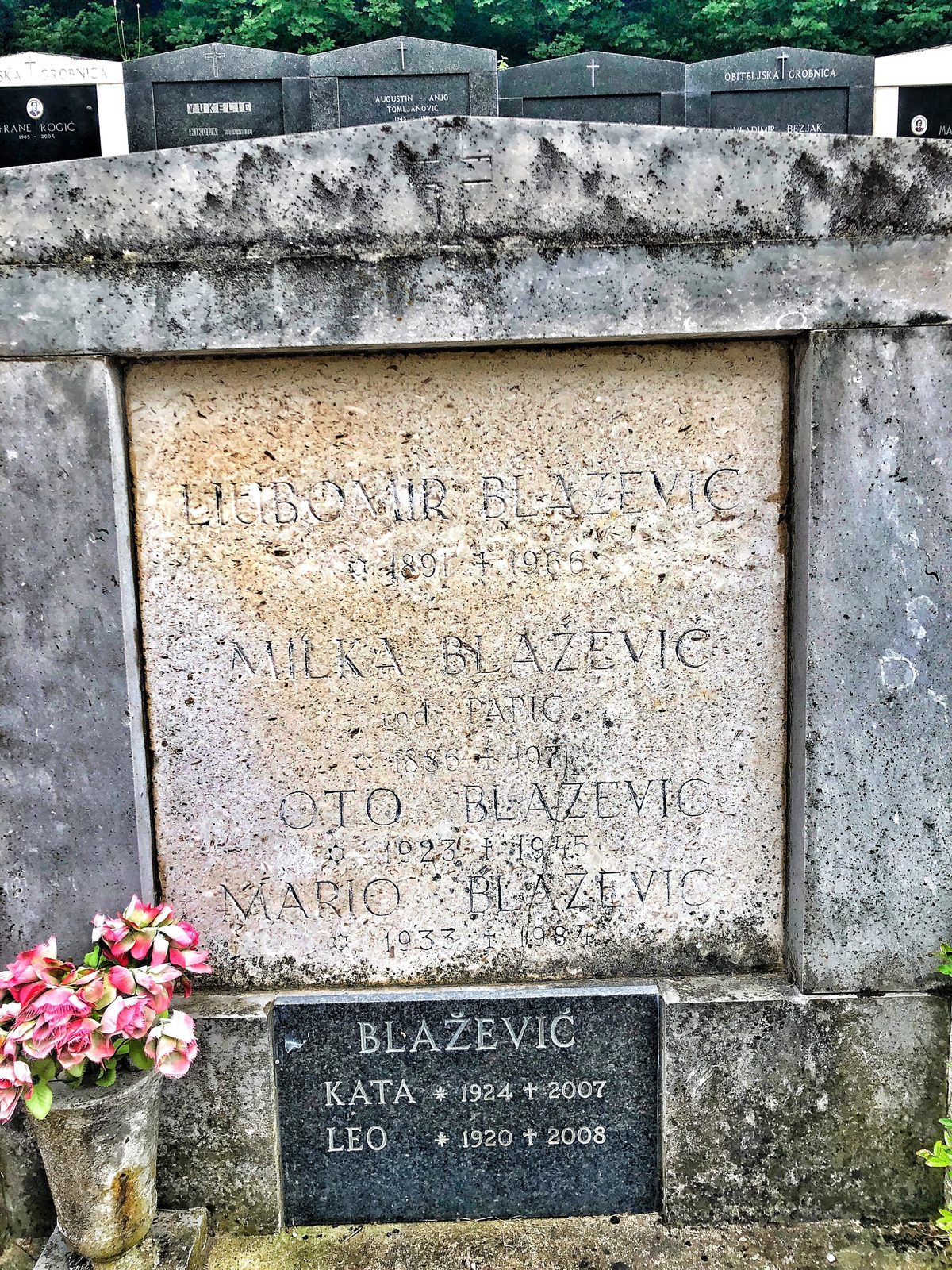
What is cut into it
| Upper stone | LJUBOMIR BLAŽEVIĆ ✳ 1891 † 1966 MILKA BLAŽEVIĆ rod. PAPIĆ ✳ 1886 † 1971 OTO BLAŽEVIĆ ✳ 1923 † 1945 MARIO BLAŽEVIĆ ✳ 1933 † 1984 |
|---|---|
| Later plaque | BLAŽEVIĆ — KATA ✳ 1924 † 2007 · LEO ✳ 1920 † 2008 |
rod. — rođena, “born”, the Croatian equivalent of née. The stone therefore records Milka's maiden name, Papić — and not the Vukelić name she married under in 1920.
It corroborates the account of Oto's death
OTO BLAŽEVIĆ ✳ 1923 † 1945 is on this stone. The family record carries two irreconcilable accounts of how he died — a snakebite, and the war in Slavonia — and the second one, from Nives Blažević, said this:
…he died in the war somewhere in Slavonia, his grave is unknown, so they put his name in his grandmother's and grandfather's grave — and now Leo is there, and Katica.
The stone shows exactly that. Oto's name is on the family plot; and the later plaque below carries LEO (1920–2008) and KATA — Katica — (1924–2007), added afterwards, precisely as she described.
One wrinkle resolves easily. Nives calls it “his grandmother's and grandfather's grave”, but the names on it are Oto's parents. Nives Blažević was born in 1953: Ljubomir and Milka were her grandparents. She is describing the grave from her own position in the family, which is what people do.
And it contradicts the register
The stone gives Ljubomir's birth as 1891. The 1920 marriage register, written in his lifetime from his baptismal certificate, gives 1 March 1892. This archive follows the register.
It is a useful reminder in a family whose evidence is mostly stone and memory: a gravestone is a secondary source. It is cut after the fact, paid for by the bereaved, and carved by someone who never met the person.
Two more graves, and the same lesson twice
When that last paragraph was written it rested on one stone. Sweeping the family's photo library turned up two more, in two more cemeteries — and one of them repeats the error exactly, while the other corrects the tree.


Crikvenica gets a birth date wrong, exactly as Senj does
The stone gives Ana de Franceschi, born 19 September 1863. Her baptism survives and does not agree: Anno Domini 1864, no. 2 — Anna, legitima, Josephus Kalanj et Rosalia nata Perković ejus uxor, at Klenovica N° 22, born 3 January 1864 and baptised three days later. The death on the stone, 28 May 1936, is exactly right; the birth is out by three and a half months.
So both stones this archive can test get the birth wrong and the death right — which makes sense. The death is what the family had just lived through. The birth is what somebody remembered, seventy years later.
Every name on the Crikvenica stone is in the tree
Read against the record it resolves into one household over three generations, and the dates agree throughout:
| On the stone | In the tree | Who |
|---|---|---|
| ANA DE. FRANCESCHI ✻19 IX 1863 ✝28 V 1936 | Ana Kalanj, 3 Jan 1864 – 28 May 1936 | born Kalanj of Klenovica 22 — the birth date on the stone is wrong |
| JOSIP DE. FRANCESCHI | Josephus “Josip” de Franceschi | her husband |
| RUŽA JARMACKI rođena DEFRANCESCHI ✻1903 ✝1939 | Ruža de Franceschi, 10 Dec 1903 – 29 Mar 1939, m. Miro Jarmacky | their daughter |
| ANT… 1890 · URSULA 1895 | Ante Defranceski, b. 20 Jan 1890, and Ursula Kovačina, 1895–1975 | their son and his wife |
| PEPE 1911–1980 · BOŽICA 1911–1994 | Josip Petar “Pepe” Defranceski, 1911–1980, and Božica Blašković | grandson and his wife |
| TONI 1937–1984 | Anton “Braco” Defranceski, 16 Nov 1937 – 17 Jan 1984 | great-grandson |
Only one of the seven is published here. This archive publishes nine surname groups and Defranceski is not among them, so the stone is almost entirely the sister archive's material — reached, as it happens, through a Kalanj girl from Klenovica who married into it.
And reading it caught a fault in the tree. Božica Blašković is entered as born 3 December 1911 and dying 18 May — the same day and month as her husband Pepe, in both cases. Two people do not share a birthday and a death-day. Her years, 1911 and 1994, match the stone; the days and months have been copied across from his record. She is not published here, so this is noted rather than corrected — but it is worth the sister archive's attention.
Klenovica corrects the tree instead
The four names on the Kalanj stone are all in this archive — and all four are in it twice. Because the duplicated parents are spelled Lovro in one copy and Lovre in the other, the duplicate check rejected the two sons as different people. The photograph is what overruled it: one family, one plot, four names. The same person, twice →
A stone is a poor witness to a birth and a good witness to a household. It was cut by people who knew exactly who was buried together.