The generation that came down off the Istrian hills to the Kvarner coast, the four children the registers give them, and the four brothers of the next generation — three of whom left, one of whom came home. With the family's own photographs.
A stonecutter's son from Gračišće married a girl from a hamlet in the Vinodol and settled on the coast below it. That is the hinge of this whole archive, and until this week it was a sentence with one document behind it. It now has six, and eleven photographs.
Klenovica house 22, then Crikvenica
Josip Defranceski
the stonecutter's son, down from Gračišće to the coast between 1892 and 1894
WifeAna Kalaj-KučaricaWhereKlenovica house 22 → Crikvenica
Wife
Ana Kalaj-Kučaricaher full style comes from a burial entry
Children in the house
Anton Rudolf20 January 1890, baptised 9 February
Marija Stjepanka8 December 1892 – 29 September 1905
IvanNovember 1894 – March 1896
Zorica14 December 1896
Marijaabout 20 October 1905 – 4 February 1906
The teal box is the line this archive descends from. Anton Rudolf, born at Klenovica house 22 on 20 January 1890, is the man on the Pfullingen list of foreigners in 1947.
Josip and Ana
Josip Defranceschi, born 22 March 1863, at Gračišće, son of Antonius the lapicida of house 19. Ana Kalanj, born 3 January 1864, at Rijenovica in the Vinodol, daughter of Josip Kalanj and Rosalia née Perković.
Named as the mother in all four of their children's register entries; the 1905 burial entry writes her Ana Kalaj-Kučarica, adding the house-name. The 1896 death entry for their son Ivan calls her «Anica», the diminutive — the only place in the registers where she is named the way her household would have said it.
Four separate register entries — the baptisms of 1890, 1892, 1894 and 1896 and the burial of 1905 — name her the same way. That matters, because the family's own genealogy file records Josip's wife as an Ana Grubišić, born 19 September 1863 and died 28 May 1936, and holds a photograph of her gravestone. The registers and the stone cannot both be describing the same woman: their birth dates are nine months apart and the maiden names differ.
Documented The mother of these four children was Ana Kalanj. What the Ana of the gravestone was to this family is an open question, and a tractable one — the Crikvenica death register for 28 May 1936 would name her, and the marriage register would say whether Josip married once or twice.
Their four children
All four recovered from the indexed Croatian registers this week, by searching the parents rather than the place.
Child
Born
Died
What the entry gives
Anton Rudolfthe line
20 January 1890, baptised 9 February
—
The line runs through him. Married Ursula Kovačina. On the Pfullingen list of foreigners in 1947 and certified by that town's mayor in 1950.
Marija Stjepanka
8 December 1892
29 September 1905, buried at Crikvenica the next day
Dead at twelve. The burial entry is the one that gives her mother's full style — Ana Kalaj-Kučarica.
Ivan
November 1894
March 1896, buried 28 March, aged two
The name Ivan enters the family here — and goes out again eighteen months later. Entry 13 of the Crikvenica death register for 1896 records the death of Ivan De Franceschi, «Dvie /2/ godine», son of «Josip De Franceschi klesar i Anica rodjena Kalanj» — Josip Defranceschi, stonemason, and Anica née Kalanj. The cause is entered in one vernacular word, «Dobrac», which this archive has not been able to translate with confidence. No sacraments: he was two. He was buried on 28 March in the local parish cemetery by Carl Aleksander, the same priest who would bury his baby sister ten years later. Zorica was born on 14 December that year — conceived, by any ordinary reckoning, in the month her brother died.
Zorica
14 December 1896
—
A Croatian name, and a plain one — the family had been on this coast six years.
Marija
about 20 October 1905
4 February 1906, aged three months and fifteen days
Dead of pneumonia — «upala pluća» — and buried on 6 February 1906 by Carl Aleksander, parish priest. Her elder sister Marija Stjepanka had died on 29 September 1905. This child was born about three weeks after that and given her name.
Anton Rudolf and Ursula
Anton Rudolf Defranceski, born 20 January 1890, married Ursula, born Kovačina. Her photograph shows a young woman in the drop-waisted dress of the early 1920s, the print worn through to the emulsion at every corner. A second, in colour, shows her forty years later among the stacked chairs of a seafront café with a small child against her knee.
Between them they produced the men on the Pfullingen list.
A sister, Anka, is named in the family's file with no dates. Felix, born 14 January 1908 at Crikvenica, stands on the Pfullingen list beside these men and appears in no register this archive has found and in no family file — he is either a late child of Josip and Ana, or an early one of Anton Rudolf. Poldo, or Pauldo, born 1901 at Crikvenica and dead in 1971, is photographed playing the accordion; the family's MyHeritage file places him instead among the nine children of the Imotski Franceschi, and which coast he belongs to is the one question at that seam still genuinely open.
The four brothers
Pepe
Born1911, at CrikvenicaDied1980, at Crikvenica
Photographed in naval uniform with four other ratings, and again in shirtsleeves on a sea wall with the ZORA photographer's blindstamp in the corner. Married Božica Blašković, 1911–1994, also of Crikvenica; their son Toni lived 1937–1984. Pepe was born and died in the same town, and the archive had no dates for him at all until the family's MyHeritage file supplied both.
Petar
Born15 June 1913
Ship's engineer with Jugoslav Lloyd at Split; left for Germany in April 1939; married Luise Salzer at Neuhausen in February 1942; applied in November 1947 to be resettled in California. The family's own caption on one photograph calls him a pilot in the war.
Zdravko
Born1 April 1921Died22 December 1979, aged 58, at Horsham, Victoria
Taken by the Partisans in 1943 and held three or four months, then straight to Germany; motor mechanic at Reutlingen. Married Ruža Hreljac of Fužine. Resettled to Australia in 1949.
Ivan
Born25 June 1925, at CrikvenicaDied30 October 1995, at Senj
Entered a Reutlingen factory on 21 October 1941, aged sixteen, as an unskilled hand. He went home. Married Hedviga Blažević of Senj, born 8 March 1926 — she died on 30 October 2001 at Johannesburg, six years to the day after him. He is buried on his own coast under a plain granite slab cut IVAN DEFRANČESKI.
And the two who lie in Australia
Ruža, born Hreljac
13 February 1922, at Fužine — 30 January 1996
Zdravko's wife. Buried at Horsham, South 2-D-23.
Anton
22 August 1944, at Reutlingen — 28 June 1999
The child entered on the French camp card with the single word enfant across the fingerprint boxes. The family's MyHeritage file fixes the birth on the 22nd, settling a date the camp papers left as the 21st or 22nd. Married Marion Bain. Died 28 June 1999 and buried at Warrill Park, Willowbank, in the City of Ipswich, Queensland — and it is his death year, carried up a generation, that put 1999 on his father's entry in the family's file.
Anton Rudolf married Ursula Kovačina, and until now that was the whole of it — a surname with no family behind it. Two entries in the same Crikvenica death register give the household.
Petar Kovačina
Died at Crikvenica on 3 November 1904, aged 55, of pulmonary tuberculosis; sacraments administered; buried the next day by Carl Aleksander. The register gives his standing in full: «umirovljeni c. kr. financijski Nadstražar» — a retired Imperial-Royal financial senior guard, the Habsburg customs and excise service. He was born at Draga, in the kotar of Sušak, and lived at Crikvenica house 119.
Uršula, called Ursa, née Stojčić
His wife, entered as «kućarka» — housekeeper — and, by the time the clerk wrote the entry out, as «žena pokojnog Petra Kovačine Nadstražara», wife of the late Petar Kovačina. The name Uršula is standing in this family a generation before Anton Rudolf's wife carried it.
Josipa Kovačina
Entry 49 of 1898: dead at Crikvenica on 10 September, aged one year and six months, of «Tuberculosis pulmonum», buried on the 12th. Her parents are given as Petar Kovačina, son of Petar, «stolar» — a joiner — and Marija née Car, at house 119. The same house number as the financial guard, and the same first name; whether the joiner is the guard under an earlier trade, a brother, or a son, the register does not say and this archive will not guess.
What can be said is that Crikvenica house 119 was a Kovačina house through the 1890s and 1900s, that consumption was in it twice, and that the name Ursula was already there. Ursula Kovačina, who married Anton Rudolf and bore Pepe, Petar, Zdravko, Ivan, Anka and Pero, is very likely a daughter or granddaughter of this household — but the marriage entry that would prove it has not been found, and the link is inference, not record.
What to ask for: the Crikvenica marriage register for the 1900s and 1910s, for Anton Rudolf Defranceski and Ursula Kovačina; and the Crikvenica birth register around 1890 for a daughter of Petar Kovačina and Uršula Stojčić. Draga in the kotar of Sušak is a new place for this archive — nobody in the family has come from there before.
One sentence in the family's own file about this house
“He built this house himself, for his family, but was lost due to family greed.”
It is entered against Josip — «Josip Bepo de Franceschi» in the family's spelling — in the MacFamilyTree database the family has kept since at least 2021, and it is the only free-text note about him in the whole file. Everything else in the entry is a date or a place. This is somebody sitting down and typing what they had been told.
Two things follow. The first is that it agrees with the documents: the Crikvenica death register of 1906 calls him «vešti klesar sada tvorničar», a skilled stonemason now working in a factory, and his father at Gračišće was a lapicida. A stonecutter's son building his own house is exactly what the record says he was equipped to do. The second is that the house did not stay in the family, and the reason the family gives for it is a quarrel over the inheritance. This archive has no document for that and is not going to look for one; it is recorded here because it is the family's own account of how it lost the building this page is about.
«Defranceski Family Tree1», the family's MacFamilyTree database, last written 18 November 2021. The note is a user description attached to a fact record on Josip.
The family grave at Crikvenica, and what is left of it
This archive already holds a photograph of it standing. An upright stone with a cross and two oval porcelain medallions — a woman, and a man in a fedora — and cut across it: «Ovdje počiva u miru Božjem — ANA DE. FRANCESCHI — ✱ 19.IX.1863 ✝ 28.V.1936». Here rests in God's peace. It is on the gallery page of this site. It is also, it turns out, a photograph of something that is no longer there.
What is on the plot now
The plot was visited again this year. What stands on it now is a black polished monument cut with OBITELJ JOVANOVIĆ, and a wide grey slab over the ground. Propped at the foot of it, resting on the edge of the slab beside a jar of flowers, is a small plaque of grey marble. It reads OBITELJ DEFRANCESKI — the Defranceski family — and carries three oval porcelain portraits: an older man in a suit and tie, the picture badly spotted; a young bearded man in a white polo-neck, smiling; and a woman in a dark jacket with a small cross at her throat. That plaque is the whole of what remains of the family's monument.
Family lore
The family's account of how that happened, recorded here as the family's own and not as a document: the plot was sold by a member of the family to the Jovanović family, and the Defranceski grave was taken apart. What is not in dispute, and is the reason this is on the page at all, is what is underneath. The family's dead were never moved. They are still in that ground.
Two reasons to write it down rather than leave it. The first is evidentiary. Ana's stone is the single object at the centre of the oldest open question in this archive — whether Josip's wife was the Ana Kalanj of four Crikvenica baptismal entries or the Ana Grubišić, 19 September 1863 to 28 May 1936, whose name is cut on that stone. The stone is gone. The photograph of it is now the record, and this site holds it. The second is simpler. A family archive that only records what survives is a catalogue, not a memory. This one has already had to write down a house that Josip built and the family lost, and a chapel and a floor slab at Rijeka that may or may not still be standing. A grave taken apart belongs on the same page as the rest of it.
Photographed by the family at the Crikvenica cemetery, 2026. The earlier photograph of the intact stone is plate «ana-grave» in this archive's gallery, from the family's own files. The account of the sale is the family's.
The Kalanj of Klenovica
The oldest open question on this archive's log is whose daughter Josip married. Four Crikvenica baptismal entries name Ana Kalanj, and her own baptism survives at Ledenice — 3 January 1864, daughter of Josip Kalanj and Rosalia née Perković, at Rijenovica house 22 in the Vinodol. Against that, the family holds a photograph of a gravestone for an Ana Grubišić. The family has now walked the cemetery at Klenovica, and it is full of Kalanj.
Monument
Names and dates
Note
Obitelj Grge Kalanj
Marija 1869–1957 · Grga 1885–1966 · Josip 1895–1938 · Paula 1896–1960 · Vonko 1927–2002 · Živko 1929–2005 · Branko 1931–1988 · Ljubica 1933–2007 · Marina 1936–2021 · Mira 1938–2019
Ten on one monument, over three generations, with porcelain portraits for every one of them. The oldest, Marija, born five years after the archive's Ana Kalanj.
Obitelj Kalanj
Albert 1895–1945 · Ana 1899–1996 · Ivica 1926–1959 · Milan 1932–1981 · Marija 1941–1977 · Eduard 1937–2012
An Ana Kalanj, 1899–1996 — a different woman, born thirty-five years after ours, and a reminder that the given name runs in the family too.
Kalanj Vinko 1901–1961 and Kalanj Paulina 1904–1984
Obitelj Kalanj
Mate 1909–1997, with a slab beside him: Kata 1861–1943, Luka 1893–1944, Ivan 1895–1955, Marija 1901–1985
Kata, born 1861, is the closest in age to the archive's Ana — three years apart.
Obitelj Kalanj-Rebrović
Marija 1922–2000 · Slavica 1934–2000 · Duško 1935–2004
Obitelj Kalanj
Marijan 1927–1986 · Marija 1934–2000
Obitelj Kalanj
Judita 1934–2000 · Marijan 1930–2023
Obitelj Kalanj
Tomislav 1935–2006
Obitelj Kalanj
Franjo 1933–2004
Kalanj
Đorđo 1904–1983 · Ana Kalanj · Ivo Kalanj
Worn and read at an angle; the dates for the second and third are not legible here.
None of these is Ana. The earliest of them, Kata born 1861, is three years older than the Ana Kalanj the registers give Josip, and every other stone is later. What the cemetery does establish is the thing the argument actually needs: the Kalanj are not an incidental name in a register. They are one of the standing families of this stretch of coast, buried ten to a monument at Klenovica — the village where this archive's generation 5 lived at house 22. A Gračišće stonecutter's son who came down to the Kvarner and married a Kalanj married into the place, and the place is still full of them.
And it sharpens what to ask for. The Klenovica and Ledenice parish books will hold the Kalanj as a connected series, not as isolated entries. Ana's parents — Josip Kalanj and Rosalia Perković of Rijenovica house 22 — should be findable in them, and so should her marriage.
Photographed by the family at the Klenovica cemetery, 2026. Fourteen monuments carrying the name were recorded; the transcriptions above are from those photographs, and where a stone is worn or read at an angle that is said.
Where the photographs came from
All of them were inside a MacFamilyTree package in the family's own files — 247 images, catalogued against 281 people in a database nobody had opened for this project. The captions are the family's own. Two of them are gravestones, one at Horsham in the Victorian Wimmera and one on the Kvarner coast.
What is not here
Everyone still living, and everyone whose dates are unknown and who could still be living. That takes out the whole of the generation after Ivan and Zdravko, and it takes out Anka, who is named in the family's file with no dates at all.
Zorica, aged eighteen, in a nurse's apron
Of Josip and Ana's six children, Zorica is the one this archive has known least about. Born at Crikvenica on 14 December 1896, conceived the month her two-year-old brother Ivan died, and then nothing — not a marriage, not a death, not a line. A Zagreb illustrated weekly has now given her a day.
“…s predsjednikom Crvenog križa msgr. A. Riginiem, liječnikom drom Čubelićem i bolničarkama gospojicama Zorom Defranceschi i Maricom Car.”
…with the president of the Red Cross, Monsignor A. Rigini, the doctor Dr Čubelić, and the nurses Miss Zora Defranceschi and Miss Marica Car.
What the notice is
«Ilustrovani list», Zagreb, 6 March 1915, page 5: the reception of wounded soldiers at Crikvenica, seven months into the war. The town's Red Cross committee is named, and two young women are named as its nurses.
Why this is almost certainly her
Zora is the ordinary short form of Zorica. The place is Crikvenica, where she was born and where her family lived. The surname is spelled Defranceschi, which is how her father's household is spelled in that town's registers. And in March 1915 she was eighteen years and three months old — the age at which a girl in a small coastal town goes to help with the wounded. This archive records it as inferred rather than documented, because the notice gives no age, no address and no father's name; but the alternative is a second Zora Defranceschi of Crikvenica of exactly the right age, and the town's registers show only one household of the name.
And the other nurse's name is a neighbour
«Marica Car». The Car are the family standing immediately beside the Defranceski plot in the Crikvenica cemetery — Toma Car-Ćokovan, 1860–1941, and Štefa Stenner née Car, 1909–1991, both photographed by the family this autumn. Two girls of neighbouring families, nursing together in the first winter of the war.
What would settle it: the Crikvenica parish registers after 1896, for her marriage or her death. She is the only one of Josip and Ana's children whose life this archive cannot follow past the font, and one notice in a picture paper has now put her in a room.
«Ilustrovani list», Zagreb, 6 March 1915, p. 5, from the digitised Croatian newspapers of the National and University Library, dnc.nsk.hr. Read September 2026.
Bakar · reconstructed from the parish indexes
Joannes Baptista Defranceschi
styled «Dominus» — son of Dominus Francesco
Marriedbefore 1772, to Catharina Akačić, by dispensationChildren baptisedBakar, 1773 and 1776LineNot attached to any of the five
Wife
Catharina Akačićperhaps the Catharina who died at Bakar 7 Apr 1819, aged 85
Children in the house
Maria Dorotheabapt. 6 Feb 1773
Antoniabapt. 8 Jan 1776
The generation above is Franciscus, named as the father in the marriage entry. Elsewhere in the same books: an Ivana Defranceschi heading her own entry, whose child Antonia died 9 March 1775; a Nodburga who married Joannes Verks on 27 February 1794; and a Petrus, born 1772, dead at Bakar 2 November 1818. Twelve of the name in the Bakar country across three generations — and nothing joining them to Gologorica, to Gračišće, or to Kobler's Fiume stocks.
Bakar — a family question, answered wrongly twice, and then properly
«Have you got anything on the families from Bakar? There were a lot of Defranceschis there.» This archive has now given three answers to that, and the first two were wrong. The record of getting it wrong is left standing below, because how a thing was got wrong is part of what an archive is for.
The first answer: nothing, from the newspapers
The two Bakar papers, «Galeb» and «Kvarner», were searched in every spelling of the surname across their whole runs. Zero. And the negative was controlled — «Galeb» returns 107 hits for «Bakar», «Kvarner» 102 for «narod», so the text layer works and the absence is real. The one apparent hit is Istrian election news reported from Bakar, and the Italian in question is Carlo, of Gologorica. All of that is still true. It was simply the wrong instrument: a newspaper is a poor census, and a family of seamen and farmers can live in a town for a century without once being printed.
The second answer: one record, from an under-powered search
A sweep of the indexed church books then produced a single entry — Petrus Defranceski, born 1772, died at Bakar 2 November 1818 — which, with the marriage of Nodburga Defranceschi at Bakar in 1794 that this archive already held, made two. That was published as «the family was there around 1800 and had gone by the 1870s». The reasoning was sound and the evidence was thin, and the evidence was thin because the search was badly built: it scanned only the first couple of hundred records per spelling and matched place-names against a short extracted string instead of the whole record.
The third answer, and this one is a family
Run properly — every spelling, deep paging, the whole of each record searched — the Bakar country gives eight entries, and they are not scattered strangers. They are one household across three generations.
The Defranceschi of Bakar, as the registers give them
The oldest generation
«Francisci Defranceschi», named as the father in his son's marriage entry — and indexed as a person in his own right. His son «Joanem Bap. Defranceschi» marries «Catharinam Akacich», with an Antonius Akacich named beside her. A separate entry has a «Joannem Defranceschi» marrying «Catharinam Sablich» — either the same man remarried, or a brother.
An Ivana, and a child
«Antonia Defranceschi», dead 9 March 1775, is entered as the child of «Ivana Defranceschi» — a woman heading her own entry, and the only one of that name in the set.
The children baptised at Bakar
«Mariam Dorothæam Defranceschi», baptised 6 February 1773, and «Antoniam Defranceschi», baptised 8 January 1776 — both daughters of Joannes Baptista Defranceschi and Catharina.
And Nodburga now has a husband
This archive has carried «the marriage of Nodburga Defranceschi at Bakar on 27 February 1794» from its own scans for months, with no groom attached. The index gives him: «Nodburgam Defranceschi» and «Joannem Verks». A name this project has never seen, and the first Bakar in-law it has.
The deaths
Antonia, 9 March 1775. Maria Anna Defranceschi, 26 May 1785. Petrus Defranceski, born 1772, died 2 November 1818. And Catharina Defranceschi, born 1734, dead 7 April 1819 at eighty-five — old enough to be the Catharina of the marriages, and she outlived nearly everyone here.
Twelve people, and how far the search was pushed
Twelve of the surname in the Bakar country, from a Franciscus at the head of it to a death in 1819. The search was run out to fourteen hundred records deep on the query, and the count stopped moving at eight hundred — six hundred consecutive records with nothing new, which is about as good a sign of saturation as this index gives. Two further Bakar entries in the same result set are Franchini, not Defranceschi, and are left out.
A note on that search result, because the number is misleading. Asking FamilySearch for the surname with Bakar as the birthplace returns something like a hundred and twenty-five pages, and it is tempting to read that as a hundred and twenty-five pages of Bakar Defranceschi. It is not. The reported total for that query is over three hundred thousand, and it is identical whether the place is set to Bakar, to a death place, or to nothing at all — the place is a relevance signal that ranks results, not a filter that restricts them. The genuinely Bakar records sit in the first few hundred and then stop. What the long tail contains is every Defranceschi in the index, loosely sorted.
So the family's memory was right, and it was older than the newspapers could reach. The right correction is not «there were Defranceschi at Bakar after all» but something more useful: they were there through the eighteenth century, and the two instruments this archive reached for first — a nineteenth-century local press, and a hastily built database query — were each incapable of seeing them. And an index is still only an index. It holds what a volunteer typed off a film; it does not hold the columns beside the name, the trades, the house numbers, or the entries nobody has indexed yet. The parish registers of Bakar themselves have never been opened by this project. Twelve indexed people are a reason to go, not a substitute for going.
«Galeb» and «Kvarner» (Bakar) searched in full at dnc.nsk.hr with control tests, September 2026. The register entries are from the FamilySearch indexes of Croatian and Delnice-deanery church books, swept across every spelling with deep paging and whole-record place matching after the first attempt was shown to be inadequate. The Nodburga marriage of 1794 is from the family's own scans.
And then the page behind one of those rows
That section ends by saying an index is only an index — that it holds what a volunteer typed off a film, and not the columns beside the name. The family has now supplied the film. This is the register opening the index row came from, and it turns one line of names into a dated event with a dispensation, an officiant and two witnesses.
What the page says
Fourth entry down the left-hand column: «Die 20 9bris per dispensationem [D]omi… Nuptijs in facie Ecclesiae contractis inter D. Joannem Bapt. filium D. Francisci Defranceschi et Catharinam filiam Def[uncti] Antonij Akacich benedixit D. Can[onicu]s Georgius Akacich, praesentibus Ill[ustrissi]mo DD. Antonio Viviani Vicario et Fiscali et Andrea Zergolech.» On 20 November, by dispensation, a marriage contracted in the face of the Church between Dominus Giovanni Battista, son of Dominus Francesco Defranceschi, and Catharina, daughter of the late Antonio Akačić; blessed by Canon Georgius Akačić, in the presence of the Most Illustrious Antonio Viviani, Vicar and Fiscal, and Andrea Zergolech.
The year, and how it is fixed
The entry itself gives no year — parish books of this kind head a year once and then run on by day and month. The year is fixed by the page: the right-hand column ends the sequence with a ruled line and «Anno 1773» before starting again in January. Everything above that line is 1772, and 9bris is November, not September — the old Roman numbering where the year begins in March, so 7bris is September, 8bris October, 9bris November, 10bris December. 20 November 1772.
What it adds to the household
The index gave this archive «Joanem Bap. Defranceschi» marrying «Catharinam Akacich» with «Antonius Akacich» beside her, and a «Francisci Defranceschi» as the father. The page adds that Antonio Akačić was already dead — *Def[uncti]* — that the couple needed a dispensation, which in a town this size usually means they were within the prohibited degrees, and that the priest who blessed them was a canon of the bride's own surname. It also puts a «D.» in front of both Defranceschi men. Dominus is not decoration in a Kvarner register: it separates the citizen and gentry households from the *seljaci* who fill the other entries on the page.
And it dates the household
Their daughters follow in the same books — Maria Dorothea baptised 6 February 1773, fourteen weeks after the wedding, and Antonia on 8 January 1776. A Catharina Defranceschi died at Bakar on 7 April 1819 aged eighty-five, so born about 1734: thirty-eight at this marriage, and eighty-five at the end of it. If she is the bride, this page is the beginning of a marriage that lasted into the reign of the last Habsburg but one, and she buried nearly everyone on the household list.
What is still not known
Nothing on this opening ties the Bakar Francesco to Gologorica, to Gračišće, or to Kobler's Fiume stocks. Kobler's «presente famiglia Defranceschi» has a Giovanni Battista come from Pisino about 1740 and made a citizen of Fiume in 1746, with sons Giuseppe, Vincenzo and Giovanni — no Francesco, and no Bakar. Kobler declined to join his three Fiume stocks to each other and this archive is not going to join a fourth household to them on the strength of two common Christian names. What the page does is make the Bakar family older and better attested than an index row, and give it a first dated event.
Supplied by the family, September 2026: one photographed opening of a marriage register, carrying entries of November 1772 and the head of 1773. The archival label taped to it reads FADED DOCUMENT / IZBLIJEĐENI DOKUMENT. Read enlarged; uncertain letters are bracketed above.
The Crikvenica death register for 1943, and why it is not simply readable
Everything else about Anton Rudolf is documented and his death is not. The year 1943 comes from the family and from no paper this archive holds. So: where is that book, and can it be read? The answer is that it exists, it is one specific volume in one office twenty minutes from the house, and it is closed — but not to him.
The hundred-year rule
Croatian state registers — matice rođenih, vjenčanih and umrlih — pass to the state archives only once the last entry in the volume is more than a hundred years old. Until then they stay with the registry office, the matični ured, and are not open to public research. The death register for Crikvenica for 1943 will therefore not be publicly accessible until the 2040s. That is why it is not on FamilySearch, not at the Rijeka state archive, and not in any index this project can search.
But a descendant is not the public
The law provides for extracts to be issued to interested parties, and a direct descendant is one. Two documents are worth asking for and they are not the same thing: an izvadak iz matice umrlih, the standard extract, which gives the fact, the date and the place of death; and a prijepis, a full transcript of the entry, which reproduces what the register actually says — including, where the registrar recorded it, the cause and the circumstances. For a death in 1943 the second is the one that matters, and it has to be asked for by name.
And there is a second book, under different rules
The parish kept its own death register alongside the civil one, and a parish book is church property, not bound by the state's hundred years. The parish office at Crikvenica may hold an entry for the same death with the priest's own note on it. This archive has already used the Crikvenica parish books for the burials of 1896, 1905 and 1906; the same series continues through the war.
If he died in the war rather than merely during it
There is a third place. The 1964 census of war victims, the Popis žrtava rata 1941–1945, at the Croatian State Archives, recorded the war dead of the whole country household by household twenty years after the fact. If Anton was killed rather than simply died, he is likelier to be there than anywhere. It is a separate request and worth making at the same time.
What is already known that narrows it
He was at Pfullingen from 1 March to 13 June 1942 and then went home; so he died on the Kvarner, not in Germany. His son Zdravko was seized by the Partisans in 1943 and held three or four months. Italy collapsed in September 1943 and the German occupation of the Littoral followed, with fighting in the hills behind Crikvenica. Whatever happened to Anton happened in that year, in that place, and the register will say on what day.
Zakon o državnim maticama (Croatia), on the hundred-year transfer to the state archives and on extracts. The FamilySearch indexes of Croatian church books were searched for an Anton Defranceski dying 1941–46 and return nothing, which is consistent with the register being closed rather than with the death not having happened.
The monument, entire
The monument, entire — a photograph of something that is gone
The photograph this archive has used for years shows the shaft of the Crikvenica monument and cuts off four lines below Ana's dates, at the word «suprug». A second frame has now come out of the family's MyHeritage album, taken further back and in better light, and it carries the whole thing: the obelisk, both curved wings, and the portrait medallions. The plot itself was revisited this year and what stands on it now is a black polished stone cut OBITELJ JOVANOVIĆ. So this is not a better photograph of a monument. It is the record of one.
The shaft, whole
«Ovdje počiva u miru Božjem — ANA DE. FRANCESCHI — ✻ 19.IX.1863 ✝ 28.V.1936 — suprug — JOSIP DE. FRANCESCHI — ✻ 19.III.1863 ✝ 1950». Here rests in God's peace Ana De Franceschi, and her husband Josip. Then two more names, both worn nearly out of the stone, each with a birth year and a death year that spalling has taken: ZO…, 1894–19— and POLD…, 1901–19—.
Which sharpens the birth date rather than settling it
Josip's birth is cut 19.III.1863, and the MyHeritage tree gives the same day. Both books of the Gračišće parish — the baptismal register and the Status Animarum — give 22 March. This is where the family's date comes from: a stone cut at Crikvenica after 1936, seventy-three years and four hundred kilometres from the register, by people remembering rather than consulting. This archive prints 22 March and keeps the nineteenth here, in the place it was actually written down.
And it disagrees about the year he died
The stone gives Josip's death as 1950, with no day and no month — the mason left the line short, which is what a mason does when the family does not have the date to hand. The tree gives 19 January 1951, from an index. A month either side of New Year is exactly the interval in which a family remembers the wrong year, and it is also the interval in which an index mis-transcribes one. Neither is preferred here; the Crikvenica death register for the winter of 1950–51 would settle it in a single line.
Two names this archive did not have
Josip and Ana's children on this site are Anton Rudolf (1890), Marija Stjepanka (1892), Ivan (November 1894, dead at two), Zorica (14 December 1896) and Marija (about October 1905). The shaft adds a ZO… born 1894 and a POLD… born 1901 — Zora or Zorica, and a Leopold or Leopolda. Neither year matches a known child: 1894 is the year of the Ivan who died in infancy, and 1901 falls in the five-year gap between Zorica and Marija where this archive has nothing at all. The monument is proposing people the registers have not yet been asked for.
The left wing: Ruža
«Ovdje počiva RUŽA JARMACKI rođena DEFRANCESCHI ✻ 1903 ✝ 1939.» A Defranceschi daughter born in 1903 — again inside the gap — who married a Jarmacki and died at thirty-six. She is not on any list this archive holds, and she is not the Ruža née Hreljac who married Zdravko and is buried at Horsham. She is a third child for the empty years, and the plainest single thing to look for next in the Crikvenica books.
The right wing: the generation after
«PEPE 1911–1980 · TONI 1937–1984 · BOŽICA 1911–1994», with three oval porcelain portraits set into the stone — a man in a suit and tie, a younger bearded man, and an older woman. Pepe is Josip «Pepe» Defranceski, eldest of Anton Rudolf's four sons, born and dead at Crikvenica, and this archive already had both years for him. Božica, born the same year as him, is his wife; Toni, born 1937, is of their generation's children. Of the four brothers, Pepe is the one who never left, and this is where he is.
Why the 1901–1903 baptisms are not online, and will not be
The three names sit in 1901–1903, so the Crikvenica baptisms for those years are the thing to read. With a signed-in FamilySearch session the question is now settled, and the answer is not a paywall. The Crikvenica holding is catalogue item 522842, «Matična knjiga, 1798–1908», filmed from the originals in the Hrvatski državni arhiv. Its own film notes read: Rođeni 1859–1896. Vjenčani 1859–1908. Umrli 1859–1892 and 1893–1908. The births stop in 1896 while the marriages and deaths run twelve years further — and the same cut runs along the whole coast. Senj: births end 1894, marriages to 1920, deaths to 1907. Bribir: births end 1886, marriages to 1900. Grižane: births end 1886, deaths to 1894. That is not a gap in the books; it is the hundred-year rule as it stood when the microfilming was done, applied to births and relaxed for the other two series. The family's own photographs of the Crikvenica baptismal register stop at page 289 and the year 1896 for exactly the same reason: they were taken from the film. FamilySearch's full-text search, which does reach unindexed images, holds no Croatian church-book collection at all — Italian civil registration, a Zadar-only Dalmatian series, and the Americas. So the 1901–1903 baptisms are not online anywhere, and no login will produce them. But that is not the end of it. A second collection — HR-HDA-1448, the Croatian State Archives' supplementary microfilm collection, which filmed the *civil registry offices* as well as the archives and so is not bound by the same cut — holds the Crikvenica books further forward: births 1909–1948, marriages 1909–1947, deaths 1909–1928, and a twentieth-century Status animarum of the parish, all of them digitised. Crikvenica births 1897–1908 are missing there too, and may simply not survive. But a Status animarum lists a household with every child and a birth date beside each name — it is the book that gave this archive the whole of Gračišće house 24 in one opening — and the marriage register of 1909–1947 must contain Ruža's own wedding. The rolls are named on the Parish Books page of this site. They are ordered, not searched.
What the signed-in index did give, which is the month the family moved
Signed in, the index returns five entries for this household and no more. Four of them are the children, and one of the four has been carrying a place this archive never noticed: Marija Stjepanka, born 8 December 1892, was baptised at LEDENICE on 22 December — not at Crikvenica. Ivan, born November 1894, was baptised at Crikvenica. So Josip and Ana were still up at Klenovica in the Ledenice parish at the end of 1892, and were down on the coast at Crikvenica within two years. The move that turned a Gračišće stonecutter's son into a Crikvenica factory hand happened between December 1892 and November 1894. The fifth entry is Zorica, born 14 December 1896 and baptised in July 1897 — seven months later, which for a Catholic parish in 1896 is a long time, and usually means the child was baptised privately at birth and only entered in the book afterwards.
Photograph from the family's own MyHeritage album, exported September 2026 (Photo0018). Read enlarged; the worn lines on the shaft are given only as far as they can be read, with the illegible parts marked. The plot at Crikvenica was revisited in 2026 and the monument is no longer standing.
A correction
The face this page used to carry, and why it is gone
Until 9 September 2026 this page opened with a hand-tinted portrait of a bearded man in a bow tie, captioned as Josip Defranceschi, born at Gračišće on 22 March 1863 — the stonecutter's son, David's great-grandfather. It was the only likeness the direct line had.
It is not him
David identified it: the photograph comes from the Imotski side of the family collection. The sitter is a Josip of that branch — a family this archive has already had to unpick once, because the retired 2018 GEDCOM spliced Imotski onto this line and had to be pulled apart by hand.
So the same seam caught this archive twice: once in a pedigree file, and once in a photograph.(family identification — David holds the originals)
How it happened, stated plainly
Two branches' pictures sit in one family collection. A card carried the name Josip Defranceski, this line has a Josip Defranceschi, and this archive matched the face to the name without asking which Josip. The register plates on this page were checked against Gračišće and Ledenice; the portrait was never checked against anything at all.
It is exactly the failure the portraits page was built to warn about — «a face on a concordance page is a warning as much as an illustration» — and it happened here anyway.
What is true now
No likeness of the Crikvenica Josip is known to this archive. He is documented down to the wording of his trade — «vešti klesar sada tvorničar» — and his birth entry is certified out of Pazin. But there is no face.
The companion portrait of a young woman, published here as his wife Ana, is also withdrawn: its only identification was that it matched the man beside it. Both are still in the gallery, under what is actually known about them.
If a photograph of this Josip exists, it is in someone's album and not in this archive.
Correction of 9 September 2026, on David's identification of the plate's provenance.
Stateless
Stateless — one sheet of paper, and the two graves at either end of it
Of Anton Rudolf's four sons, Zdravko went to Australia, Petar to Germany, Pepe stayed at Crikvenica, and Ivan went to Senj. The family has now supplied the certificate of Ivan's own son's birth, sworn into English years later for South Africa, and one line of it says more about what happened to this family than any other document in this archive.
The certificate
An extract from the register of births, Region Senj, National Board of Senj Municipality, register 152/1954, page 252, ordinal 110. Defranceski Ivan, male, born 17 December 1951 at 11h50 in Senj Hospital, entered on 22 December. Father: Defranceski Ivan, born 25 June 1925 at Crikvenica, electro-mechanic. Mother: Blazevic Hedviga, born 3 August 1926 at Senj. Certified by a sworn translator to the Supreme Court of South Africa — which is how a Senj birth entry ends up in Johannesburg.
And the column that matters
The form has two columns beside each parent, citizenship and nationality. Against the mother: FNRJ and Croatian — a citizen of the Federal People's Republic of Yugoslavia. Against the father, in the same hand, on the same sheet, in his own country, six years after the frontier moved: STATELESS, and nationality Italian. Ivan Defranceski was born at Crikvenica in 1925 under the Kingdom of Italy. In 1947 Istria and the Kvarner passed to Yugoslavia, and those who did not or could not resolve their status became *apolidi* — stateless — in the place they had never left. His brothers' displaced-persons files in Germany carry the same French word, *apatride*, stamped across them. Here it is in Croatian officialese, at home.
Where he is buried
Polished dark granite at Senj, a gilt cross, and the name in Croatian orthography: IVAN DEFRANČESKI, 1925–1995. The camera original the family has now sent is six times the size of the copy this site had, and the dates are legible for the first time. He entered a Reutlingen factory at sixteen in October 1941 as an unskilled hand, went home, married Hedviga Blažević of Senj, and stayed. He died on 30 October 1995; she died on 30 October 2001 at Johannesburg, six years to the day.
And where his brother is
«IN LOVING REMEMBRANCE OF ZDRAVKO FRANK DEFRANCESKI — DIED 22ND DECEMBER 1979 AGED 58 — BELOVED HUSBAND OF ROSA», then two children and four grandchildren who are living and are not named here, and «RESTING IN GOD'S LOVING CARE». A bronze plaque set flush in concrete in a lawn cemetery at Horsham, in the Victorian Wimmera. Aged 58 in December 1979 puts his birth in 1921, which is what the family says. Two brothers, born four years apart in the same house on the same coast: one under a granite slab within sight of the Velebit, one under bronze in a wheat district sixteen thousand kilometres away.
The birth certificate and the two cemetery photographs were supplied by the family in September 2026. The certificate is a sworn English translation of the Yugoslav extract; the Croatian original has not been seen here.
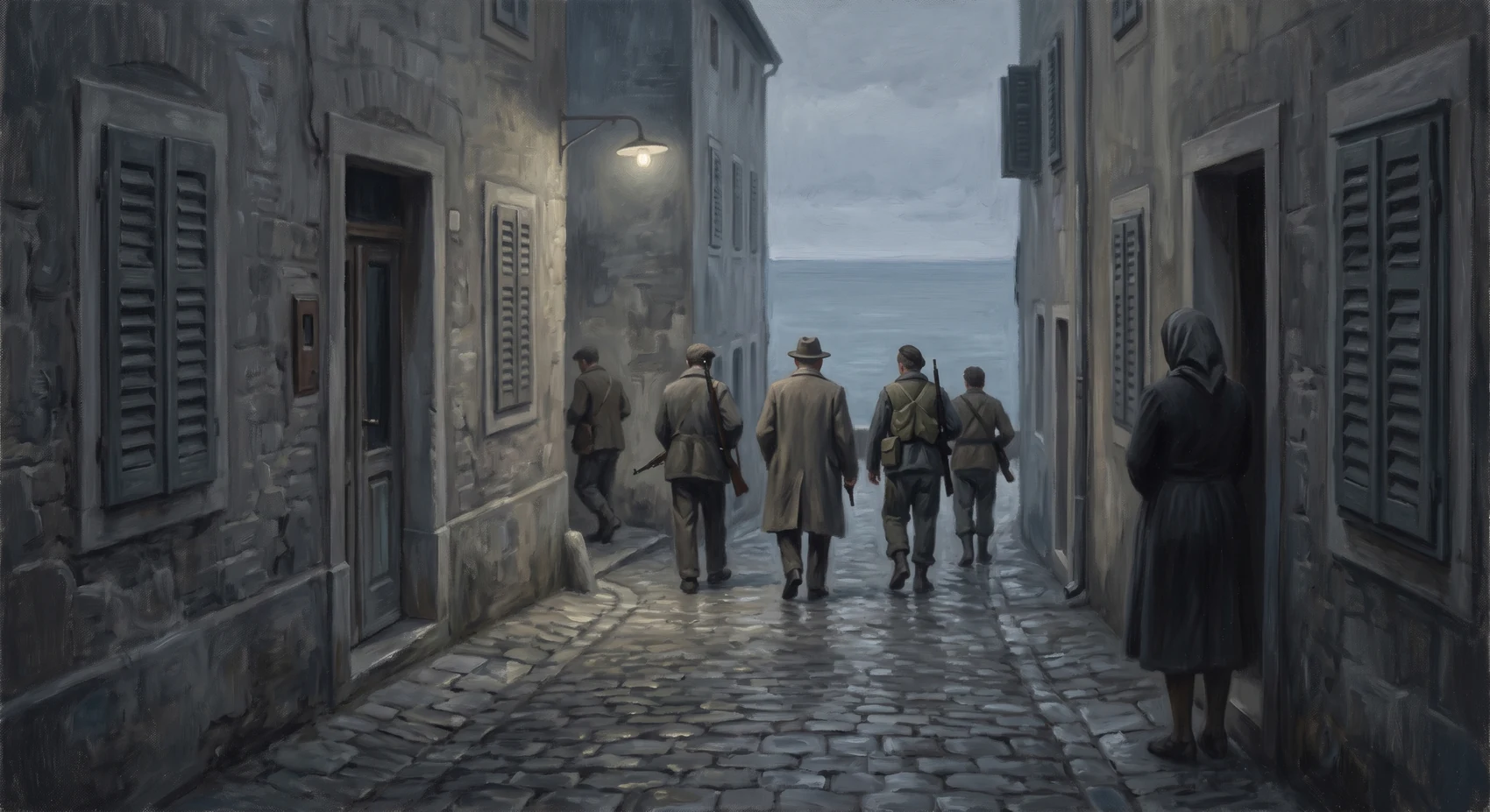
Crikvenica, the winter of 1943. A constructed illustration, made for this archive by an image model
working from a written brief. It is illustration and not evidence. Nobody in it has a face, and that is deliberate:
an invented face put beside a real name would be a forgery, and this is the family's worst day.
What the archive holds is a memory, not a document — that Anton Rudolf Defranceski, born at Klenovica on 20 January
1890, was taken by the partisans, and that the family gives 1943 for it. The 1943 Crikvenica death register is closed
under Croatia's hundred-year rule and open to a direct descendant on request; until a page from it is in front of
this archive, the date and the manner stand as family lore and are marked as lore wherever they appear.
So the picture shows nothing happening. No weapon is raised, no insignia is legible, no violence is depicted. A wet
lane at dusk, the sea at the end of it, a woman in a doorway with her back turned, and men walking away. That is as
much as anyone can honestly say.
Klenovica, photographed
Klenovica and the coast, photographed
Thirty-eight frames from the cemeteries of Crikvenica, Klenovica, Novi and Senj. What they show, once you read the stones, is that this archive has been looking at the wrong surname. There is one Defranceski grave. There are at least nine Kalanj.
«OBITELJ DEFRANCESKI»
One stone, three portrait medallions, and the surname in its Croatian spelling. The household that came down from Gračišće is in this ground under the name it took on the coast.
And the Kalanj are everywhere
Marija 1889–1970. Josip 1930–1985, Franjo 1902–1991, Zora 1923–1996 on one stone. Rozalija, Anton, Marija and Milan on another. Vinko 1901 and Paulina 1904–1964. Marijan and Marija. Milan, Albert, Anka, Marija, Zvija and Edgard. Tomislav 1927–2006. Franjo 1913–2004. Marija, Slavka and Duško Kalanj-Perković. Anton Rudolf's mother was Ana Kalanj, born at Klenovica house 22 on 3 January 1864 — and her family, not his, is the one that stayed.
And a star in the rubble
A partisan memorial laid in white stone among the graves, photographed at dusk. This archive holds a family memory that Anton Rudolf was taken by the partisans and that the year was 1943, and it holds no document for it, and the Crikvenica death register for that year is closed for another seventeen years. The photograph is not evidence of anything. It is what the cemetery looks like.
Photographed by the family on the Kvarner coast, 2026. Inscriptions read from the images. Living people appear in some frames and are excluded from this archive.