Generation 1
Francesco Franceschi 1520–1598
The tree's earliest Dalmatian generation, at Zadar.
A second Franceschi family, Venetian nobility on the Vrljika, which a widely-copied online tree has joined to this one by mistake. Here is what they actually are, where the seam is, and what the same file gave us that nothing else had.
This page exists because of an error, and the error is instructive. The family's MyHeritage tree — 8,286 individuals, 254 of them carrying this surname — descends the Crikvenica household from Zuane de Franceschi, a Venetian commander who was made governor of Imotski after the town was taken from the Ottomans in 1717. It is a magnificent pedigree and it is not ours. Setting out what the Imotski family actually is, and where the join was made, is worth more than quietly deleting it: the same tree has been copied outward through Geni and MyHeritage's Smart Matching since 2017, and anyone else who finds it will hit the same seam.
As the tree gives it. None of this is register-cited; it is a compiled noble pedigree, and it is recorded here as theirs, not verified as ours.
The tree's earliest Dalmatian generation, at Zadar.
Married Grofica Zaron.
Married Maria Dešković. The by-name Perin has been read here as his, and that was wrong: Perinuša is named after the Perinović of Zadar, whom the Franceschi brought in as estate managers at the beginning of the eighteenth century. See below.
Married Lukrezia di Venezia de Franceschi.
Married Elena Coltroni.
The head of the Dalmatian house. Venetian commander at the taking of Imotski from the Ottomans in 1717, then governor of the town. The Republic rewarded him with large estates on the Vrljika, houses, a mill, and the tower of the arcibeg Čaušević at Perinuša.
Born at Omiš, died in the Proložac district. Married Francesca.
Born at Omiš. Married Contessa Maria Cambi.
Born at Omiš, died at Proložac. Married Katarina Dorić.
Landowner at Perinuša. Married in 1892 Ana pl. Grubišić of Omiš, born 19 September 1863, died 28 May 1936. Nine children. He rebuilt the house and the mills at Perinuša shortly before he died; a great lover of horses, he is said to have kept them overnight on the house terrace, up a laid ramp, out of the river damp.
Two of these lives are worth the visit on their own.
Photographed in 1932 in one of the first motor cars in Imotski, waiting outside the elementary school at Poljica for his wife — Marija Dijaković of Dubrovnik, 1907–1953, a schoolteacher. Family tradition says he drove fast enough to reach Split in under three hours.
Born at Perinuša; the first trained seafarer from Imotski and its hinterland, and a ship's captain. In the summer of 1946, commanding the small steamer Hercegovina in the southern Adriatic, he came on a rowing boat that looked empty and was not: inside were a dead woman and a barely living man, Slovenes who had bought or stolen the boat at Dubrovnik and set out to row to Italy. Their baby had died first, then the wife. He fed the man, and telegraphed the parents to meet the ship at Rijeka. For years afterwards they came from Slovenia to thank him whenever the ship was in port, which annoyed him — he held that saving a man was a captain's plain duty — and he eventually asked the company to stop telling them which ship he was on.
Born at Perinuša. Educated at the lyceum of St Dimitrije in Zadar, the first private girls' high school for noble families, where the teaching was in Italian. A gifted painter all her life, in many techniques, and an embroiderer and designer. Buried at Gospa od Anđela, Imotski. Her photograph was taken at the Zita studio in Split in 1918.
Also at the Zadar lyceum. In the winter of 1925, coming home to Perinuša, the Vrljika was up and could only be crossed by cart; she would not wait for the driver and went barefoot through the cold water. The pneumonia that followed did not clear, and her mother sent her to the lung clinic at Davos in Switzerland — her brother Toni drove her. She died in September 1926, aged twenty-six. Four white horses drew her to the cemetery at Proložac.
Entered in the tree at Crikvenica, and photographed playing the accordion. One of the two individuals the tree places on both sides of the seam.
The tree makes Anton Toni de Franceschi of Imotski, 1893–1941, the husband of Ursula Kovačina and the father of the Crikvenica children — Pepe, Zdravko, Ivan, Anka and Pero. He was neither.
Three of the four people at the seam are entered with question marks inside the name field: «Ursula Kovačina?», «Ana Nana Grubišić?», «Ana Kalaj-Kucarica ? (Kalanj??)». The compiler could not decide and wrote the uncertainty down. That is honest work, and it is the thread to pull.
Josip Bepo is given two wives. Ana Nana Grubišić, born 19 September 1863, died 28 May 1936. And Ana Kalaj-Kucarica ? (Kalanj??), born 1863, died 1936 at Crikvenica. Same birth year, same death year, no children on the second. They are one entry split in two — the Crikvenica Ana Kalanj and the Omiš Ana Grubišić, held apart by a question mark because the compiler suspected they were not the same and joined the families anyway.
The Imotski account says Josip Bepo married Ana pl. Grubišić of Omiš in 1892. Our Ana Kalanj had already borne Anton Rudolf at Klenovica in January 1890 and Marija Stjepanka in December 1892. She cannot be a bride of 1892 at Omiš.
The Imotski Anton Toni was born in 1893 at Imotski and married Marija Dijaković of Dubrovnik, a schoolteacher, with whom he is photographed at Poljica in 1932. Our Anton Rudolf was born on 20 January 1890 at Klenovica house 22, baptised on 9 February, and married Ursula Kovačina. Three years and four hundred kilometres apart.
The Klenovica baptism of 1890 names the parents' place of origin as «Gallignana u Istriji» — Gračišće in Istria. The 1863 Gračišće baptism gives Josip's father Antonius as a lapicida, a stonecutter, and the 1906 death entry gives Josip himself as a «vešti klesar sada tvorničar». This is a family of stonemasons coming down off an Istrian hill, not Venetian landowners on the Vrljika.
What the tree got right is that both families exist and both are well recorded. What it got wrong is the join — made, as these joins usually are, on a shared given name and a shared surname in a country where both are common. The Imotski Franceschi keep their governor. This archive keeps its stonemasons.
Below the seam the same file is the best source this archive has for the Crikvenica generation — dates carried in the family's own knowledge, off gravestones and the backs of photographs, for people the registers here do not reach.
| Who | Born | Died | What the file adds |
|---|---|---|---|
| Josip, called Pepe, Defranceski | 1911, Crikvenica | 1980, Crikvenica | Photographed on the pier at Crikvenica. |
| Božica Blašković | 1911, Crikvenica | 1994, Crikvenica | Pepe's wife. |
| Toni Defranceski | 1937, Crikvenica | 1984 | Their son. |
| Poldo, or Pauldo, de Franceschi | 1901, Crikvenica | 1971 | An accordion player. Placed by the tree among Josip Bepo's Imotski children, but born and working at Crikvenica — the second individual sitting across the seam. |
| Ivan Defranceski | 25 June 1925, Crikvenica | 30 October 1995, Senj | Worked at Senj. Buried there — the family holds the gravestone photograph. |
| Hedviga Blažević | 8 March 1926, Senj | 30 October 2001, Johannesburg | Ivan's wife, of the Blažević of Senj and Krmpote. She died in South Africa, six years to the day after her husband died in Senj. |
| Zdravko, called Frank, Defranceski | 1921, Crikvenica | 22 December 1979, Horsham, Victoria | The tree says 1999; two cemetery memorials at Horsham say December 1979. See below. |
| Ruža Hreljac | 13 February 1922, Fužine | 30 January 1996, Horsham, Victoria | Zdravko's wife. Her Horsham memorial gives 1 February — the interment. Fužine confirms the Belnica origin the archive had from the displaced-persons papers. |
| Anton Defranceski | 22 August 1944, Reutlingen | 28 June 1999, Ipswich, Queensland | Born in Germany to Zdravko and Ruža while they were there, and the exact date the Arolsen child-tracing papers were opened on. This is the single most valuable line in the file. |
| Ursula Kovačina | — | — | Anton Rudolf's wife and the mother of all of them. The tree gives her no dates, and neither does anything else this archive has found. |
Living people are omitted from this archive, and several of this generation's children are living. They are not listed above, and their absence is not an oversight.
The family's file and the MyHeritage tree both give Zdravko Defranceski's death as 1999 at Horsham. Two memorials in Horsham Cemetery give December 1979 — one reading «Zdravko "Frank" Defranceski, 1921 – 22 Dec 1979», the other, plot Central 2-J-10, entered under the garbled forename «Zorafko Frank De Franceski» and dated 27 December 1979. A death on the 22nd and an interment on the 27th is an ordinary week.
The 1999 has a source, and the same file supplies it: his son Anton died on 28 June 1999 at Ipswich. A father's death year taken from the son's is one of the commonest slips in a compiled tree, and it is what happened here. Zdravko died in 1979, twenty years before the date the family has been carrying — and sixteen years before his wife Ruža, who outlived him and is buried in a different section of the same cemetery.
The memorials are on the graves page. Zdravko and Ruža's road to Horsham is on Pfullingen.
Because it is going to be found again. The tree has been public since 2017 and its Smart Matching has pushed the join outward into other people's trees ever since; anyone researching this surname on the Kvarner coast will meet a governor of Imotski and a Venetian pedigree back to 1520, and will have no reason to doubt it. The seam is only visible if you hold the Klenovica baptism of 1890 and the Gračišće baptism of 1863 in the other hand.
And there is a second reason. Strip out the join and the file is excellent — it dates nine people this archive could not date, it puts Anton's birth at Reutlingen in August 1944, and it moves Zdravko's death twenty years. A source can be wrong at the top and right at the bottom. Most compiled trees are.
The Crikvenica death register for 1980 would confirm Pepe, and the same book for 1971 would settle whether Poldo belongs to Crikvenica or to Perinuša — the one individual whose side of the seam is genuinely open. For the Imotski family, the parish of Proložac holds the burials, and the Vrljika mills at Perinuša are still standing.
This page has existed to correct a mistake — a widely-copied tree that grafts the Crikvenica household onto the Venetian nobles of Imotski. It has never told the Imotski family's own story. It is worth telling, because a local historian has now set it out from the archives at Zadar and Omiš against three centuries of it being deliberately left out.
On 11 January 1715 Zuane Ivan Franceschi took onto his estate at Dobrče, today Pisak on the coast below Omiš, the whole flight of the Imotski Franciscans: fifteen friars out of the monastery at Proložac, and with them about two hundred families — some six hundred people — and their livestock. They stayed two and a half years, until July 1717. He went to the Provveditore Generale of Dalmatia, Alvise Mocenigo III, and got them permission to build a monastery at Skalice in Omiš, where until then there had only been a chapel. That monastery carried the by-name «imotski» until the Imoćani went home.
Three brothers — Zuane Ivan, Frane and Matija — recruited a company of 250 men and carried the cost out of their own pockets. Pay ran two months late and was halved: ten soldi a day for a foot-soldier and a piece of ship's biscuit. Zuane alone went with them as commander. He took the town of Imotski before the main Venetian army arrived, and when the fortress was stormed he was the first man through the outer wall, where he raised the flag of St Mark.
General Emo, reporting to Venice on 1 August 1717: «…ostavio sam taj predjel i… nađoh se u Imotskom… našao sam zauzet Varoš zaslugom Zuane Franceschija» — I found the town already taken, by the merit of Zuane Franceschi. It is in the Venetian dispatch, not in family tradition.
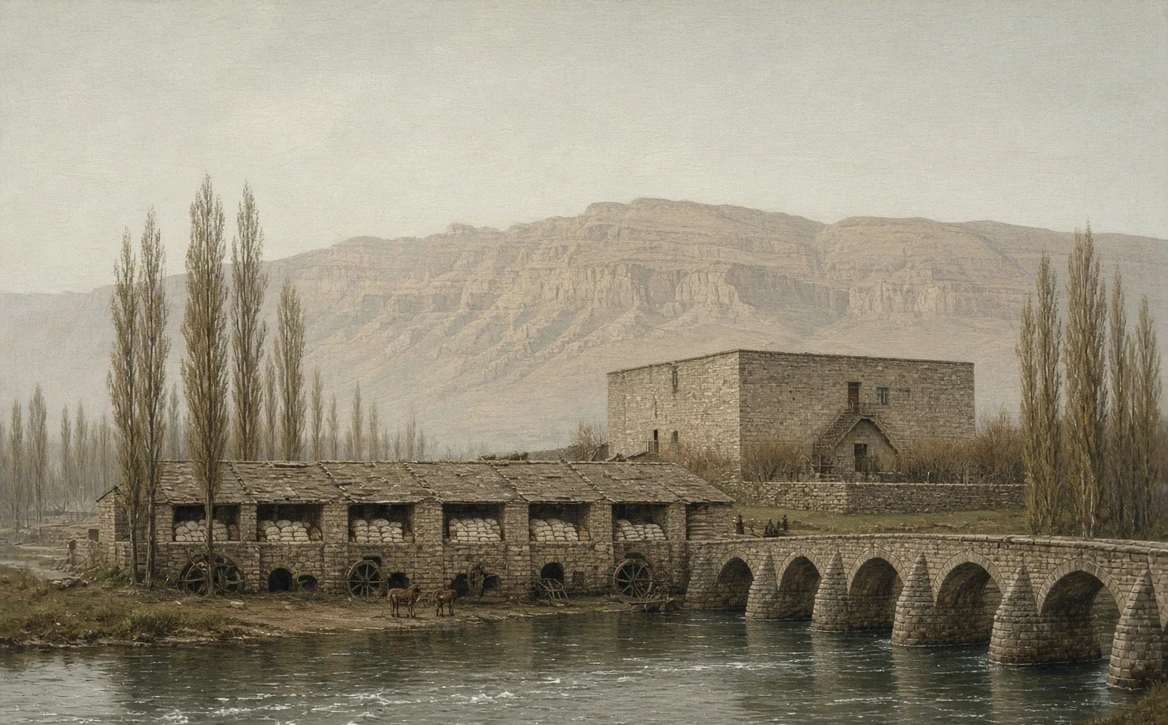
The reward was the begluk of the arci-beg Čaušević on the Vrljika — a house, a Turkish defensive tower, and eight mills. It was wrecked: the population had fled, the mills barely turned, and grain could not come down from the Bosnian hinterland across a new and skirmishing frontier. Zuane Ivan Franceschi went bankrupt on the campaign. He had no choice but to take a Venetian war galley, and off the Albanian coast near Durrës the Turkish galleys caught the fleet and destroyed it. He got away on the flagship with the war chest aboard — which is the only reason Venice did not imprison him for life for the loss of the ships. They interned him instead on his own estate at Pisak, forbidden to leave it. He never saw Omiš again and never returned to Perinuša. He died at Pisak in 1741 and lies in the little church of St Mark of 1564. Corrected, September 2026: Mocenigo's charter names the previous owner of every parcel it grants and does not name Čaušević at Perinuša; it records the house and mill as ruined. The attribution to the arci-beg appears to be family tradition, not the document. See below.
This archive has had this wrong and now corrects it. Perinuša is not from a Franceschi called Perin. It is from the Perinović — Perin — a Zadar family the Franceschi brought in at the start of the eighteenth century as estate managers and overseers, and who followed them to their other properties. The by-name attached itself to the place and then to the owners, so that Andrija Kačić Miošić, writing his «Razgovor ugodni naroda slovinskoga» — the Pismarica, first printed 1756 — sings of the taking of Imotski and calls the commander «Perinović Ive». A Venetian officer entered Croatian epic verse under his steward's name. Corrected again, September 2026: the Perinović were real and they did manage the estates, but the by-name was the man's own first. The bishop of Makarska's decree of 18 July 1730 names him «Joannes Franceschi alias Perinovich», and fra Stipan Vrljić, writing in 1716 about the flight of 1715, calls his host «gos(podin) Ivica Perinović». See the sources section below.
After the Second World War it was put about that the Franceschi were simply Italianised Perinovići — a claim that served to question a landowning family's loyalty to Yugoslavia. The genealogy runs unbroken from the fourteenth century and the two families are distinct. The other standing slander is that an ancestor rode round the estate in a day and took whatever he could enclose; in fact the land was a begluk that had belonged to Ottoman lords for two centuries, and it was assigned, not seized.
Zuane's son Antonio, by his third wife, of the Cambi of Split, took over the estate and got Venetian permission to build six more mills. A Venetian cadastral sheet of 1777 draws the Ponte di pietra and the «Molinari di Franceschi» with eleven grindstones; fourteen were built in the end. Horses went up a laid stone stair to the first floor to be kept out of the river damp — a habit the family kept from the arci-beg before them. The mills ran until the end of the twentieth century. The earthquake of 29 December 1942, whose epicentre seems to have been at Perinuša itself, brought down the extension and the stone-slab roofs.
Josip pl. Franceschi, 1844–1904, landowner at Perinuša, married Ana pl. Grubišić of Omiš in 1892 and had nine children. He rebuilt the house and the mills shortly before he died. His name is cut in stone on the churchyard gate of St Michael at Proložac, built 1897–1901, beside those of Alfonso Bitanga and the Dalmatian governor Alfons Pavich — three men who paid for it. And his son Frane, «Frane Franceschi pok. Bepa», municipal engineer, designed and supervised the two bridges over the Vrljika begun in 1938.
Of the seventy Venetians living at Imotski after 1717, only the de Franceschi settled permanently. The «de» was struck off by decree of the Napoleonic administration. The Ministry of Culture has begun restoring the old house; the mills and the bridge await money. Tin Ujević was a frequent and welcome guest at Perinuša, and wrote «Visoki jablanovi» there.
Vesna Kljajić-Grbavac (attrib.), «Obitelj de Franceschi u Imotskom od 1717. do danas», Poskok.info — built on Ante Ujević's «Imotska krajina», fra Karlo Jurišić's doctoral thesis (1972), fra Andrija Nikić's work on the Zadar state archive, and the Zadar, Omiš and Franciscan holdings. Read September 2026.
David sent a photograph posted by the Jagul wine cellar at Imotski. Jagul is not a brand name; it is a family nickname, and the family it belongs to married into this one.
Dr Augustin Bitanga, 1841–1912, took his medical degree at Padua in 1868 and was appointed municipal physician of Imotski in 1870. He drove out several times a week by carriage over bad roads to the villages of the Krajina, and the people shortened «gospodar Jago» to Jagul. The name stuck to the family, to their house, and to several places in the district. From 1919 the family took back its older surname: Radovinović.
Josip Bepo's daughter Marija Franceschi, 1899–1968, born at Perinuša and educated at the lyceum of St Dimitrije in Zadar, is entered on this page as «Marija, married Radovinović». Radovinović is the Jagul family's own name from 1919. The wine cellar posting photographs of Ana pl. Franceschi is run by Anamaria Marušić Tonković, great-granddaughter of Dr Augustin Bitanga. The two houses of Imotski are joined by a marriage, and the archive that holds the photographs is a family archive on the other side of it.
The library at Jagulovi dvori was assembled over more than two hundred years «uglavnom izravnim naručivanjem te nasljeđivanjem od rodbinski povezanih obitelji Lusnik, Franceschi, Carminatti, Nonveiller, Mladinov» — largely by direct order and by inheritance from the related families, Franceschi among them. Medicine, law, politics, agronomy, history; dictionaries, letters, documents, diplomas — many signed by the member of the family who owned them. If any Imotski Franceschi library survives anywhere, it is on those shelves.
Augustin built Jagulovi dvori between 1891 and 1893, with his surgery in it. Behind it are farm buildings and a wine cellar, and in the cellar a small ice room with an oak door where blocks of ice were stored, brought down from Biokovo by mule. In 2012 the family found in that room the sabre the outlaw Andrijica Šimić gave the Bitanga in 1902 — hidden in 1945 when the militia came round collecting weapons, and then forgotten. Šimić had once robbed Augustin's brother Frane of the commune's tax money and given it back when Frane begged, saying he would lose his post and his sixteen children would suffer; the family held itself in his debt for thirty-one years while he sat in the prison at Koper, and when the imperial pardon let him out in 1902 they had him to lunch.
Augustin forbade his daughter Zorka to see Antun Toni Colombani, of the neighbouring house — a Piran family settled at Imotski since 1690 — because the Colombani had quarrelled with him over the new house blocking their view of the Imotsko polje and Biokovo, and because Toni had a reputation. Zorka married the sea-captain Niko Cerezin of Viganj in the church of St Francis in 1911. The wedding photographer caught, standing to the left of the door in a white suit with his hand in his pocket, Antun Toni Colombani, who had slipped in during the service. She kept his photograph, and a lock of his hair, all her life. He kept another picture from her wedding until he died.
The family tree this archive works from gives Josip Bepo's wife as Ana pl. Grubišić of Omiš, born 19 September 1863, died 28 May 1936. The Jagul caption gives her as «Ana pl. Franceschi (1876 – 14.07.1945)», photographed in 1892. Those cannot both be right, and the difference is thirteen years at birth and nine at death. If the marriage was in 1892 and she was born in 1876 she was sixteen at it; if 1863, she was twenty-nine. This archive has no register entry for either, and will not choose between them until it does. What would settle it: the Omiš baptismal register for 1863 and for 1876 under Grubišić, and the Imotski or Proložac death register for 1936 and for 1945.
Zaboravljena Dalmacija, «Jagulovi dvori u Imotskom», built on the archive of the Bitanga–Radovinović family and Anamaria Marušić Tonković's research; and the Jagul Wine Cellar page. Read September 2026. The Facebook post David sent is behind a login and was not circumvented; its own caption reads «Omišanka Ana pl. Franceschi (1876 – 14.07.1945), supruga Josipa (Bepa), snimljena 1892. godine».
Everything above was built from one article on a news site and a family tree. In September 2025 a master's thesis was accepted at the Faculty of Philosophy in Split that does the work properly: **Matea Kaćunić, «Uloga obitelji Franceschi u mletačkom osvajanju Imotskog»**, supervised by Marko Rimac, seventy-seven pages, open access. It reads the Venetian donation charter, the bishop's decrees, three censuses of Omiš, the Franciscan chronicle and the conservation surveys against one another. It corrects this page six times, and it hands the family two things it did not have: an origin with dates, and a second estate.
Venetian cittadini originari. The earliest named is Nicolò Franceschi (1318–1362), who in diplomatic service at the Holy See acted as go-between and envoy for Guillaume Grimoard, afterwards Pope Urban V, in the negotiations between Louis I of Anjou, king of Hungary and Croatia, and the Republic of Venice. The Austrian herald Heyer von Rosenfeld, in *Der Adel des Königreichs Dalmatien* (Nürnberg 1873), has Louis I raise Nicolò to the nobility on 8 May 1369; the family's own account gives 8 March 1359; and Josip Celić, working on the Zadar nobility, has Louis grant the privilege «nobiles regni Croacie» on 5 October 1359, which let them use the old medieval law of the twelve Croatian tribes. On the strength of that charter the Council of Zadar issued, on 22 August 1778, a certificate that the families of Petar and Ivan Krševan Franceschi were original nobles of the Croatian kingdom. The dates disagree; the shape does not. Zadar from the fourteenth century.
The first firm trace at Omiš is Francesco Franceschi (1520–1598), sent from Zadar by the Venetian authorities to sit in the city senate. His house is gone — the Benković house stands on it — but its foundation plaque survives, and this archive did not know it existed. A host-shaped medallion cut IHS, ringed by «SVB VMBRA ALARVM TVARVM SPERABO», under the shadow of thy wings I will hope, out of Psalm 56. And beside it: «M DLXXXIIII DIE XVIII MENSIS IVNII AD OMNIVM CREATORIS LAVDEM HVIVS FVNDAMENTA DOMVS FRANCISCI VENETI IMPENSIS FOELICITER IACTA SVNT» — on 18 June 1584, to the praise of the Creator of all, the foundations of this house were happily laid at the expense of Francesco the Venetian. Three houses of this surname on this coast cut their date over the door: Omiš in 1584, Gologorica in 1711, Seget in 1724. They are three different families and they had the same instinct.
His son Gasparo Franceschi (1562–1609, or 1611) carried on the building and in 1600 engaged Stjepan Bokanić, a stonecutter of Pučišća on Brač whose family owned the quarries — ordering arches four metres wide, pilasters, a cornice and capitals. They sued each other repeatedly. In 1607 Gasparo sued him for building the tower beside the house in Korčula stone instead of the better Pučišća stone. A week after one such quarrel Bokanić contracted for more work. Gasparo kept a shop, was received among the Omiš nobility — «al presente Nobil di questa terra» — served with Luka Voine as commissioner for the building of the new parish church of St Michael, where he was to make two models of it, owned an armed vessel, and is entered in the parish books in 1611 as admiral. His father had been sued in 1590 for helping himself to another man's worked stone. It is a family of builders, merchants and litigants, two generations before it is a family of soldiers.
Giovanni «Zuane» Franceschi, 1673–1741, of the Omiš branch, son of the landowner Girolamo (1622–1695) and Elena Coltroni — the two names this page already carried from the family tree, now confirmed with dates — and husband of Francesca Cvitanović. His title in the sources is colonnello governatore, colonel-governor: military command and civil authority at once, over Zagvozd, Župa, Cista and Lokvičići. His brothers were the elder Matteo (1670–1739) and the younger Francesco (1675–1725). Francesco appears recruiting for the Oltramarini; Matteo is linked to the captaincy of the fort of Vrlika, which was surrendered to the Ottomans in 1715. Neither can be put in the siege itself. Zuane can, and the evidence is Provveditore Mocenigo's own report: what he took was the varoš, the town outside the walls.
Among the Omiš knights of the Second Morean War, Andrija Kačić Miošić's *Razgovor ugodni naroda slovinskoga* names «Ivan Franceschi Perinović» as colonnello and lord of Zagvozd and Župa, and vojvoda Frane Franceschi — Zuane and his brother, under Croatian forms of their Italian names. Of Zuane he wrote: «Leti soko k gradu Imotskomu / Po imenu Perinović Ive, / I opali varoš oko grada… / Na juriš je prvi udario / Prid junacima mladim krajišnicim: / Pod njime je konjic poginuo, / A njega su rane dopanule. / Al' je Ive srca junačkoga, / Rane zavi, a na juriš trče… / Njemu bane za junaštvo daje / Dvi kolajne od suhog zlata.» — The falcon flies to the town of Imotski, by name Perinović Ive, and burns the varoš about the fort… He was first to the assault before the young frontiersmen; his horse was killed under him and wounds came upon him. But Ive has a hero's heart: he bound his wounds and ran to the assault again… And the ban gives him for his valour two medals of pure gold.
This page says the reward was «the begluk of the arci-beg Čaušević». That comes from family tradition by way of the article this page was built on, and it does not survive the document. Mocenigo's charter of donation names the previous owner of every single parcel it grants, and it does not name Čaušević at Perinuša. Cvitanić and Zelić conclude the error entered through oral transmission of the charter's contents down the generations. Mocenigo records the house and mill as in ruins, which suggests the Ottoman owner had gone long before. Corrected here: Zuane was given a ruined tower, mill and bridge on the road from Šumet to Imotski, and their previous owner is not known.
This page has already corrected itself once here, saying Perinuša is named not for a Franceschi called Perin but for the Perinović, a Zadar family brought in as estate managers. That is half right and it misses the better half. The bishop of Makarska, Nikola Bijanković, in a decree of 18 July 1730, names the owner of the church at Opačac as «Joannes Franceschi alias Perinovich». Kačić calls him Perinović Ive. And fra Stipan Vrljić, writing his chronicle in 1716 about the flight of the year before, says the friars lodged in the house of «gos(podin) Ivica Perinović» at Pisak. Three independent sources — a bishop's decree, an epic and an eyewitness chronicle — give the man himself the by-name, in his own lifetime. Perinuša is named after him, under the name his neighbours actually used.
Not «the monastery at Proložac». The Franciscans of the Imotska krajina had been in three places. First at Opačac, at the source of the Vrljika, in a house the archaeology dates to the fourteenth century and which is first named about 1390 in fra Bartolomeo of Pisa's *Conformitates*; the Ottomans destroyed it in 1493. Then the old church at Kamenmost. Then the islet called Manastir in Prološko blato — and fra Karlo Jurišić dates their arrival there to between 1600 and 1605, arguing from silence with unusual care: the Imotski house is missing from the 1553 letter of the Herzegovinian sanjak-bey Sinan, which lists Mostar, Ljubuški, Zaostrog and Makarska; missing from the later sixteenth-century letters; missing from the Franciscan general Gonzaga's *De origine Seraphicae religionis* of 1587; and missing from bishop Baličević's report of 1591. What fixes it is the death of the first known guardian, fra Ivan, in 1605. The 1964 excavation found a long plan with no cloister and no portico, a small chapel and a well — a monastery built by people with a bad site and no money.
Fra Stipan Vrljić began his *Arkivalna knjiga* in 1716 and never finished it. Later friars added to it, which is why it is untidy. It is written in bosančica on 416 leaves and bound in sheepskin, and it is kept at the Skalice friary in Omiš. There is a printed edition and translation: fra Bruno Pezo, «Fra Stipan Vrljić — svjedok, učesnik i tvorac sudbonosnih događaja imotskoga samostana od 1715. do 1738.», in *Čuvari baštine* (Imotski–Makarska, 1989). So it can be read without going to the friary, and this archive is going to.
This page has never mentioned Opačac, and it was half of what Zuane was given. At the north-west edge of the Imotski field by Donji Proložac, where the Vrljika rises, the family was granted the right to build a votive church after the war — in 1719, or 1718 depending on the author. Snježana Tonković's excavation found that the little church stands partly on fourteenth-century architecture: they built on the ruins of the Franciscan house the Turks had destroyed in 1493. A family letter to the episcopal office at Makarska of 9 December 1790 says the church of Our Lady «was founded, raised, and visibly diminished and reduced» — they had found something older and larger and built smaller. And the letter is a complaint, because the Imotski Franciscans, on the strength of their own history at Opačac, were saying Mass on the family's ground and taking the pilgrims' alms. The family's title was Bijanković's decree of 1730, printed as a broadsheet — «Stampa Delli Fratelli Franceschi qu. Antonio» — because they had to prove ownership in public. The bishop found for Antonio Franceschi and his sons as founders and owners; the quarrel only ended when the parish priest fra Karlo Grančić built a new church at Durmišovac, and the family gave that one vestments, a bell and a chalice anyway. In 1932 the church and its land were bought by the family of Fabijan Grbavac and are theirs still. The building: one nave, a long rectangle east–west, a side door of monolithic jambs under a lintel cut with a Gothic cross whose arms end in trefoils, low windows, and loopholes. Stone slabs for the roof and the floor. The pilgrimage on the feast of the Assumption has never stopped.
Ujević, Vrčić and Nikić all read Opačac as evidence of a Benedictine house before the Franciscan one, from *opat*, an abbot. Damir Zorić rejects it on linguistic grounds: the name is from the adverb *(na)opako*, backwards — because the water at that spring runs the wrong way.
They found a round tower, a mill and a bridge. Round is the point: Cvitanić and Zelić note that the towers of the Imotski and Vrgorac krajina, the Neretva valley, the Makarska littoral and Bosnia in the seventeenth and eighteenth centuries are square or rectangular, so a circular one is probably older — possibly sixteenth-century. Family tradition puts the mill's enlargement at 1722; the Venetian cadastre of 1728 shows it schematically; the cadastre of 1777 draws «ucrtanu kulu (tore) okrugla oblika… pravokutna zgrada mlinice (molini di Franceschi) s 11 mlinova… kameni ponte di pietra». The mill grew from six wheels to eleven and finally to fourteen. The low bridge stood on about twenty arches and was late medieval or early modern; the flood of 1928 took it, and traces of two arches are all that is left. A wooden bridge replaced it that year, further south, which moved the road from the north side of the mill to the south; in the 1950s that became reinforced concrete, for lorries going to a new winery, and the balcony on the south front was cut off because it was in their way. Perinuša has been protected as a cultural good since 2011, and the mill registered as a monument since 1976.
Zuane's heirs used Perinuša only part of the year; permanent habitation begins only in the middle of the nineteenth century. The earthquake of 1942 ended the active life of the house. Frane Franceschi (1900–1984) and his wife repaired it and lived there until they died, he in 1984 and she in 1999. Nobody has lived there since 1999. The mills went by sale or as daughters' dowries, part of the land was nationalised after the second war and part sold, and only a small share of the estate is still the family's.
Josip Celić's work on the Omiš censuses settles a thing this page never asked. The Omiš nobility held its status from the reign of Béla IV and admitted new members itself, through its Magnifico consiglio. The Franceschi are listed among the new nobility, admitted near the end of Venetian rule — 15 January 1783 more veneto, that is 1784. Sixty-seven years after Imotski. The census of 1799 counts 596 souls in the Omiš commune and names the households of Ivan, Nikola son of the late Ante, and Vicko Franceschi, of whom Ivan and Vicko «lived nobly», holding land in Omiš, its district and in the Imotski country — eighty-two years after the conquest, still in possession. The French census of 1806, taken by the parish vicar don Toma Cvitanović, styles them nobil signor and lists them house by house: the widow Katarina with sons Antonio and Giuoanni, daughter Gioanna and servants Margian and Mattia; the widow Kornelija with sons Giuseppe, Gierolimo, Antonio and Pietro, daughter Margietta and a servant Antonio; and an unmarried Katarina. Two further Franceschi households are entered as citizens rather than nobles — the widow Maddalena with her daughter Vincenza, and Nicolò, who is written de Franceschi, with his sisters Maria and Gioanna. This page says the Napoleonic administration struck the «de» off. In the French administration's own census of 1806, one household still has it.
Heyer von Rosenfeld draws the Franceschi shield party per fess, couché, with a lion rampant to the dexter, tongue out; a helm with visor and a medallion at the throat; a crown above, and out of the crown a second lion issuant, the same as the one below. In colour: azure over or, the lions brown, the crown gold, the mantling azure and or. A version in the family's own house at Perinuša sets the shield upright, drops the crown for a torse, and enlarges the mantling — otherwise the same beast in the same posture. Cvitanić and Zelić note it resembles the arms of the Imotski Colombani, and say a lion in that pose is one of the commonest things in heraldry. This archive has argued on its Lines page that the Seget house and the Gologorica house bear different arms and meant it — Seget a lion, Gologorica a Greek cross with two arrows and a pomegranate. The Dalmatian family bears a lion too. That does not join Seget to Omiš, and the caution above is exactly why. But it is worth saying out loud that of the three arrivals, two bear lions and one does not, and it is the one this archive descends from that does not.
Matea Kaćunić, «Uloga obitelji Franceschi u mletačkom osvajanju Imotskog», diplomski rad, Sveučilište u Splitu, Filozofski fakultet, Odsjek za povijest, September 2025; mentor izv. prof. dr. sc. Marko Rimac, commission chaired by Tonija Andrić. Open access, URN:NBN:hr:172:388600, 77 pp., read in full 8 September 2026 and now in this project's library. Its own principal sources, quoted here at second hand and named so they can be gone to directly: Katarina Cvitanić and Maja Zelić, «Stambeno-gospodarski sklop Perinuša — uvod u istraživanje», in *Imotski 1717: zbornik radova s međunarodnog znanstvenog skupa u povodu 300. obljetnice oslobođenja Imotskog od Osmanlija*, ed. Marko Rimac and Ivan Alduk (Split: Književni krug, 2024); Josip Celić on the Omiš censuses of 1799 and 1806 and on the Zadar nobility; Vanja Kovačić, *Omiš — utvrđeni grad na vodama* (Split 2021) and her chapter in *Omiš i Poljica* (2006); Karlo Jurišić on the founding of the island monastery, in *Kačić* 5 (1973) and *Katolička crkva na biokovsko-neretvanskom području* (1972); Bruno Pezo's edition of fra Stipan Vrljić, in *Čuvari baštine* (1989); Snježana Tonković on the Opačac site and church; Damir Zorić, «Opačac i Perinuša» (Rijeka 2022); Vjeko Vrčić, *Plemena imotske krajine*; Carl Georg Friedrich Heyer von Rosenfeld, *Der Adel des Königreichs Dalmatien* (Nürnberg 1873); Viktor Anton Duišin, *Zbornik plemstva*, vol. 1 (Zagreb 1938); Cvitan Milas, *Mlinice na vodama rijeke Vrljike* (Zagreb 2011). The Franciscan province of the Most Holy Redeemer's own histories of the Omiš and Imotski houses were read alongside it.
The index gave a row of fields. The register page gives a woman. This is the first Imotski Franceschi document this archive has read rather than queried, and it is quoted here column by column as the Austrian form sets them out: LIBRO degli Atti di Morte, Parrocchia di Imoschi, terzo trimestre 1845, entry 17.
«Franceschi Domenica» · età 48, *quarantotto* · religione Cattolica · condizione «Moglie di q.m Giovanni Vucemilovich» · patria «Nata in ALMISSA, domiciliata in IMOSCHI» · parents «q.m Vicenzo Franceschi, q.m Antonia Cappelletti» · died «10 dieci Agosto 1845 mille ottocento quarantacinque alle 3 ant. merid., in casa di suo Marito» · «11 di detto, visitata dal Chirurgo Distrettuale D. Ravlin» · «11 di detto, tumulata nel Cimitero Locale di Imoschi» · cause «Gastrite cronica». Signed, as every entry on the page is, fra Bernardino Brajković, parroco.
Almissa is Omiš. The register does not merely record a Franceschi at Imotski; it records one born at Omiš and living at Imotski, with both her parents named and both already dead. That is the join this page has never had. The Omiš branch and the Imotski household are the same family, in a parish register, in 1845 — a hundred and twenty-eight years after Zuane went through the wall, and eighty years before anybody drew the pedigree this page prints.
It does not name her descent from Zuane, and this archive is not going to supply one. Vincenzo and Antonia Cappelletti are her parents and nothing here places them in the pedigree. What is now certain: a Franceschi woman born at Omiš about 1797, married into the Vučemilović of Imotski, dying in her husband's house at three in the morning of 10 August 1845 of chronic gastritis, seen by the district surgeon Ravlin the next day and buried the same day in the town cemetery.
Because a register page is a place and not a list. Entry 13, Sebastiano Piesna, 25, a soldier of the first company of the Imperial-Royal 5th Chasseur Battalion. Entry 14, Ellena Cuzman, 50, widow of Antonio Villa and wife of Giovanni Tomašević. Entry 15, Bianca Turich, 58, wife of Nicolò Vanmiller. Entry 16, Anna Dittanga, 31, wife of Stefano Bušić, dead of «cangrena dell'utero». Entry 18, Giovanni Mandeš, one year old, «fanciullo contadino». A garrison town in the Austrian Dalmatia of the 1840s, and one Venetian-descended household in the middle of it.
FamilySearch, «Croatia, Church Books, 1516–1994», image ark 3:1:3QS7-899X-FCD7, Imotski-Glavina, LIBRO degli Atti di Morte, third quarter 1845, entry 17. Read on 8 September 2026 by fetching the Deep Zoom tiles of the 6180 × 4247 master image and composing them at full resolution — see the note on method on the Parish Books page. Indexed persona 1:1:XQMX-KBCN.
This page has been built almost entirely from a family tree and a local historian's article. Neither cites a parish register, and this archive has never opened one for Imotski. Both parishes are in fact photographed and online, and one of them goes back to 1731. Here is what exists, and the first four entries it gives up.
| Volume, as the waypoint names it | Open |
|---|---|
| Births 1742–1816 · Deaths 1743–1817 · Marriages 1749–1795 · Births 1731–1761 | 9R28-7MC |
| Births 1773–1859 · Marriages 1731–1825, 1829–1857 | 9R2W-GPJ |
| Church census — Stanje duša 1841 | 9R24-K66 |
| Deaths 1731–1764, 1762–1851 · Church census — Stanje duša 1742–1811, 1825, 1841 | 9R24-PY8 |
Imotski-Glavina, Stanje duša 1742–1811 — a church census of the parish, on the same film as the deaths, 587 images, film 1924277, and carrying no index at all. A Stanje duša lists a house, its head, his wife and every soul under the roof. This one begins twenty-five years after Zuane Ivan Franceschi took the town, and it runs through the whole of the generation that inherited the *begluk* on the Vrljika. If any single volume in Dalmatia holds the Imotski Franceschi as a household rather than as a pedigree, it is this one. A second census of 1841 survives separately.
The deaths and some of the baptisms of Imotski are indexed, and searched signed-in they return a Franceschi household nobody on this page has ever named: Domenica Franceschi, female, aged 48, born 1797, died 10 August 1845 and buried on the 11th at Imotski; father Vincenzo Franceschi, mother Antonia Cappelletti, husband Giovanni Vučemilović. Antonia Catharina Vučemilović, born 1 March 1820, baptised at Imotski 25 March 1820, daughter of Joannes Vučemilović and Dominica Franceschi — Domenica's own daughter. Nicolò Miroššević, born 1811, son of Gasparo Miroššević and Ivanna Ivaniššević, in a record that also names Cattarina Vučemilović born 1820 with her parents Giovanni Vučemilović and Domenica Franceschi — the marriage of that daughter. Vicentius, born 1812, son of Joannes Franceschi, died 5 April 1817 and buried on the 7th at Imotski, aged five. And a baptism of a Joannes, son of Vicentius Franceschi and Dominica, with Georgius Vučemilović standing godfather.
Four or five records, two households, and an alternation of Vincenzo and Giovanni across them that is the ordinary Italian habit of naming a boy for his grandfather. It is enough to say that a Franceschi family was living in the town of Imotski from at least the 1790s to the 1840s, was marrying into the Vučemilović — one of the large Imotski families — and was standing godparent to them. It is not enough to draw a line from any of them to Zuane, and none is drawn here. What can be said is that not one of these names — Vincenzo, Antonia Cappelletti, Domenica — appears anywhere in the eleven-generation chain this page prints from the family tree, and that chain has no register citation behind its Dalmatian reaches at all. These four entries are the first documentary Imotski Franceschi this archive has ever held.
Cappelletti is not a Dalmatian name. In the Venetian Dalmatia of the eighteenth century it is doubly Italian: a Veneto surname, and also the name of the Republic's light frontier cavalry raised in Dalmatia and Albania. A Franceschi marrying a Cappelletti at Imotski in the 1790s is a marriage inside the small Venetian colony the conquest left behind — and the Imotski account says that of the seventy Venetians living in the town after 1717, only the de Franceschi settled permanently. Antonia may well be of a family that did not.
Everything else. The Proložac books — births from 1783, marriages from 1783, deaths from 1783 — carry no name index, and neither does either Stanje duša. A search for the surname returns nothing from them while the pages may be full of it. That is the same condition this archive found at Gologorica and Gračišće, where the answer was to read the volume rather than query it.
FamilySearch, «Croatia, Church Books, 1516–1994», collection 2040054, image waypoints for Imotski-Glavina and Donji Proložac, enumerated from a signed-in session on 8 September 2026. The four indexed entries are arks 1:1:XQMX-KBCN, 1:1:X31Y-ZF7Y, 1:1:X31Y-QZ7L, 1:1:XQMX-V5XQ and 1:1:X31Y-4V2G, with the Domenica burial page at image ark 3:1:3QS7-899X-FCD7. The microfilm rolls that carry these parishes forward to 1949 are listed on the Parish Books page of this site.
The family walked the churchyard at Donji Proložac, four kilometres north-west of Imotski, and photographed a grave of the name. It is the oldest thing this page has that is not a document — and Proložac is not an incidental village here. It is the place the whole Imotski story starts.
On 11 January 1715 Zuane Ivan Franceschi took onto his estate at Dobrče — today Pisak, on the coast below Omiš — the entire flight of the Imotski Franciscans: fifteen friars out of the monastery at Proložac, and with them about two hundred families, some six hundred people, and their livestock. They stayed two and a half years. He went to the Provveditore Generale of Dalmatia and got them leave to build at Skalice in Omiš, and that monastery carried the by-name «imotski» until the Imoćani went home in July 1717 — the month he raised his company and took the town. Proložac is where the people he sheltered came from, and where they returned.
A low table-tomb or ledger slab of local limestone, set flush among paving in the churchyard, with a heavy moulded surround, a raised inner panel with a bell-shaped ogee head, and a small carved cross standing above it. Roman capitals, four or five lines, cut shallow. The whole surface is under black and ochre lichen and the letters are nearly gone.
One word is certain, and it is the one that matters: FRANČESKI, in the fourth line, the Croatian spelling the family took after the Napoleonic administration struck the «de» off the name. Above it a shorter line ending in what may be …SIE or …STE, and above that a line beginning with a letter that could be P. The first line and the last are gone. No given name and no date can be read from these three frames, and this archive is not going to supply either from expectation. What is published here is a stone of this surname, in this churchyard, and nothing more until it is read properly.
Flat overcast light is the worst possible light for a shallow-cut inscription, because it fills the letter troughs with the same brightness as the face. Three things would work, in increasing order of trouble. Raking light: the same frames taken within an hour of sunrise or sunset, or after dark with a hand torch held almost flat against the stone and moved through three or four directions — one exposure per direction, which can then be combined. Decorrelation stretch, the technique used on rock art, which pulls apart colour differences the eye cannot see and is unusually good at separating lichen from stone; that only needs the original full-size files, not a return visit. And, oldest and still the best, a paper squeeze or a soft-pencil rubbing, which records the cut rather than the colour and ignores the lichen entirely.
Whoever this is, the parish that buried them kept registers, and they survive. The Croatian State Archives' supplementary microfilm collection holds Proložac births 1853–1940 and deaths 1859–1949, unbroken — the earlier rolls at the Državni arhiv u Splitu, and everything from 1892 onward digitised, filmed from the Matični ured at Imotski. The rolls are listed by signature on the Parish Books page of this site. A surname index does not exist for any of it; but a single legible date off this stone would turn several hundred pages into one.
Because the stone had to be tested against something, the Donji Proložac register of deaths for 1837–1859 was read from end to end: film 005494056, item 2, images 61 to 111, every page, the name column of each. There is no Franceschi and no Frančeski among the dead of that parish in those twenty-two years. What there is: Šegarić over and over, and Prlina, Ćurić, Grizinić, Zorko, Martinis, Vlašanović, Smoljan, Dujmović, Babajko, Točina, Fazinić, Kosulić, Šimac, Marinović, Rosulić, Šinožić. A Croatian peasant parish with not one Italian household in it. The register even changes language partway through — the entries are kept in Italian on the Austrian printed form into the late 1840s and in Croatian by the middle 1850s — and the names do not change with it. One near miss, checked and discarded: at image 74, «Maria Martinna Franinacich», two years seven months, «nata e domiciliata in Šito». Franinačić, not Franceschi.
A negative that covers the whole register tells you where to look next. The Franceschi were not parishioners of Donji Proložac — so the stone in that churchyard is either later than 1859, or belongs to someone who died elsewhere and was brought there. And there is a reason they would be brought there. Their own church is four hundred metres away. The votive church of Our Lady at Opačac, which Zuane's family was granted the right to build after the war and which the 1790 letter shows them defending against the Franciscans, stands at the north-west edge of the Imotski field «u neposrednoj blizini Donjeg Prološca» — in the immediate vicinity of Donji Proložac. A family that fought a seventy-year lawsuit to keep a church there is a family that would bury in that ground whatever parish register it appeared in. So the next books are the Imotski deaths after 1851, where the family's own parish would enter them, and the Proložac deaths from 1859 onward — which are not on FamilySearch at all but are on the Croatian State Archives' rolls listed on this site's Parish Books page, digitised, 1859–1949.
Photographed by the family in the churchyard at Donji Proložac, and supplied in September 2026. Three frames: one oblique in colour, one from directly above, and one converted to high contrast. The reading above is from those three and is deliberately partial. The register holdings are from HR-HDA-1448 as searched on 8 September 2026.
The full bibliography, with what each source gave and where it is weak →