The Gologorica Line
Read off the parish register itself, page by page, from microfilm of the Gologorica books held by the Pazin Records Office. This is the ancestral line, and it is the only part of this archive built from the pages rather than from an index.
Two Defranceschi households sit in the 1780s baptism register, both headed by a Joannes Baptista, both with a wife called Mariana, living in different houses — casa 31, carrying the byname “detti Leonardi”, and casa 36, recorded as son of the late Josephus. By 1826 the household census shows three heads of that generation: Jacobus (b. 1761, a bachelor), Josephus (b. 1763) and Leonardus (b. 1766).
Above them stands Dominus Josephus Defranceschi and his wife Helena, who appear through the 1760s and 1770s as godparents — the title Dominus marking the family's standing. And the parish priest of the 1780s was himself one of them: he signs “Ego Joannes Mathias Franceschi Parochus.”
The pedigree
Two branches, drawn from their earliest recorded couple down. The register knows them apart by house and byname long before it knows how they join.
Carlo, in his own register
The historian is here, with his full baptismal name and the exact dates the printed accounts give: Carolus Josephus Defranceschi, born 17 October 1809, died 8 January 1893, second son of Dominus Josephus de Franceschi and Lambertina née Peschle, house 17, class Civilis.
His parents married on 3 February 1807 and had ten children. The 1808 baptism of his elder brother Josephus Lambertus is the entry that fixes the generation above: it names the father as “Dnus Josephus de Franceschi defuncti Josephi filius” — son of the late Josephus — which is what joins this household to Dominus Josephus at the top of the tree.
Lambertina's census row carries the word Volosca, the town near Opatija, which is exactly where every printed biography of Carlo says his mother came from. Her own godmother-kin appear too: an Eugenia Peschle stood godmother at the 1808 baptism. She died on 16 July 1863, aged 76.
One of the ten was born abroad. Aloysius, 4 May 1832, is recorded natus Polonia — born in Poland. Four of the children were not baptised at Gologorica at all, which fits a household that moved.
What the registers could not give
Three limits are worth recording, because they define what is left to do.
No Defranceschi child was baptised at Gologorica between 1764 and 1770, and there is no earlier baptism book in these films. The 1760s cohort — Jacobus, Josephus, Leonardus — were therefore born before 1764 or in another parish, so their own baptisms cannot be recovered here. The links from Dominus Josephus down to them rest on naming patterns and the “detti Leonardi” byname, not on a decisive entry.
No Defranceschi married at Gologorica between 1771 and 1789. The whole marriage section was read. The surname appears only as witnesses — Dominus Jacobus de Franceschi in 1784, and an Antonio with a Margarita de Franceschi in 1782. The men married in their brides' parishes, which is the ordinary practice, so those records are at Gračišće, Lindar, Pićan or Pazin.
Gologorica marriages from about 1790 to 1849 are missing from these films entirely. The 1790 marriage of Leonardus and Matthea, which the 1826 census dates to 23 November, falls in that gap. So does the 1807 marriage of Josephus and Lambertina — the record that would name Lambertina Peschle's father.
And a stonemason at Gračišće
One certified record, ordered from the Pazin archive by name in 2021, sits slightly apart from everything above — and may matter more than any of it.
| Baptised | 23 March 1863 | Gračišće |
| Born | 22 March 1863 | the register says «n. heri» — born yesterday |
| Name | Josephus | Josip |
| Sex, status | male, legitimate | |
| Baptising priest | Matthias Zimmermann, cooperator | |
| Father | Antonius Defranceschi | his condition is given as «lapidarius» — a stonemason |
| Mother | Maria | surname not confidently read from this reproduction |
| Godparents | two named, one a Domenico | |
| Later annotation | a marginal note added in 1951 by the civil registry office | the kind of note that records a later marriage or death |
This is the record the Pazin archive was asked for by name, and it is the one that anchors the family in Gračišće rather than Gologorica.
The father's condition matters. «Lapidarius» — stonemason. Not the «Dominus» of the Gologorica gentry two villages away, and not a landholder: a man who cut stone.
A Defranceschi household was still counted at Gračišće in the census of 1 October 1945, eighty-two years after this baptism.
And the 1951 marginal note means the civil registry came back to this page in the Yugoslav period — so the same person is traceable forward into records this archive has not yet opened.
Certified copy from MKR Gračišće 1841–1899, folio 108, entry 23, issued by the Državni arhiv u Pazinu to David Defranceski, 26 April 2021 (KLASA 053-02/21-02/195), signed by the director Mirela Mrak.
The village, as its priest saw it — 1892 to 1918
Ljudevit Žváček was parish priest of Gologorica from 1892 to 1923 and kept a chronicle. He was a Czech from Moravia, recruited because the bishop of Trieste and Koper had advertised in a Prague newspaper in 1885 for young Czechs willing to serve in Istria, where priests were short. He was a Pan-Slav. He arrived in a village dominated by an Italian-national gentry family of the same surname as this archive's, and he wrote down what he saw. Stipan Trogrlić published his chronicle in the Vjesnik istarskog arhiva; it is open access, and it is the closest thing that exists to a description of the family's own village from inside.
Grajani and poljani
The village called itself in two halves. The «grajani» — townspeople, those inside the old walls — and the «poljani», or «campagnoli», the people of the surrounding hamlets, whom the townspeople named with a certain contempt. The line was social before it was national. Then it became national.
“Građani, iako etnički Hrvati, pod utjecajem moćne furlansko-karnijske obitelji De Franceschi, koja se naselila u Gologoricu još u 17. st., postaju politički Talijani.”
The townspeople, though ethnically Croats, become politically Italians under the influence of the powerful Friulian-Carnian family De Franceschi, which settled at Gologorica back in the seventeenth century. They voted for the Italian Liberal Party — and went on speaking Croatian to one another. The poljani, conscious of being Croats, voted for the Croatian Party, and the quarrel between the two became part of the village's ordinary week.
A third witness for Carnia — and this one is not the family's own
«Furlansko-karnijske obitelji De Franceschi, koja se naselila u Gologoricu još u 17. st.» — the Friulian-Carnian family De Franceschi, settled at Gologorica in the seventeenth century. That is Croatian scholarship, following Miroslav Bertoša, stating the origin as established fact and dating it a century earlier than Carlo did.
This archive has held the Carnia claim at arm's length because it rested on one document — the headmen's list of 1679 — and on Carlo's private testimony about his own family. There are now three independent things: the 1679 list; Kobler's record that Valentino Defranceschi came from Carnia and was made a citizen of Fiume in 1739; and a modern Croatian historian describing the Gologorica family flatly as Friulian-Carnian, settled in the seventeenth century. None of them joins this line to that one. But the road itself is no longer in doubt.
How he came to be there at all
| When | What | As the chronicle has it |
|---|---|---|
| 9 April 1892 | The wrong friend | Pravdoslav Filiplić of Lindar was appointed administrator of the parish, and an agitation started at once against his being confirmed. It was led by the sitting mayor, Antun Ivić, and the reason Ivić gave was Filiplić's close and friendly relations with the family of Francesco De Franceschi, the former mayor. Filiplić had the backing of most heads of households. The bishop moved him «stanta pede» — that instant — to Grdoselo. |
| 8 August 1892 | A Slav priest, foisted on them | Žváček was appointed instead. Now it was the Italians and the Italianised townspeople who bristled: they took badly to having a Slav priest, a Czech out of Moravia, put over them. |
| 1908 | A threat to kill | Žváček complained to the district authority at Pazin about one Leonardo De Franceschi, who had repeatedly disrupted the singing in Croatian in the parish church — conducted by the village schoolmaster, Josip Monas. He asked the authority to protect Monas, because De Franceschi had once threatened to kill him. |
And the one tradesman in the town was a weaver called Leonardo De Franceschi
Žváček's survey of the trades is short. «U gradu osim nekoliko samoukih zidara i postolara te jednog izučenog tkalca, Leonarda De Franceschija, podrijetlom Krnjela, drugih zanatlija nema.» — In the town, apart from a few self-taught masons and cobblers and one trained weaver, Leonardo De Franceschi, of Krnjeli origin, there are no other craftsmen.
Three things meet in that sentence and this archive did not put them there. The Carnia argument is that the family came down into Istria as weavers — the cramars of the Ovaro parishes, out in autumn and home in spring. The one De Franceschi household reconstructed at Mione has as its head in the nineteenth century a «tessitore contadino», a peasant weaver. And here, at Gologorica, in the family's own village, the single trained weaver in the place is a De Franceschi — named Leonardo, which is the name Carlo gives to his own great-great-great-grandfather.
It is a convergence, not a proof of descent. Leonardo is a common enough name in this family that it means little on its own, and Žváček's Leonardo came to Gologorica from Krnjeli. But one leg of it has since stopped being an assumption: Giorgio Ferigo, quoting the 1679 headmen's return in full, states that the men in it are tessitori — weavers — and that in Istria «dire cargnel equivaleva a dire tessitore», to say Carnian was to say weaver. The trade is now in the source, not only in the pattern. See the Carnia page.
20 December 1918
A company of a hundred and fifty-four Italian soldiers came into Gologorica with three officers — the Compania mitraglieri Fiat — on eight carts drawn by sixteen mules, two to a cart. Tenente Giacomo Sechio was billeted in the house of Giulio De Franceschi; sottotenente Antonio Defassio in the house of Luigi De Franceschi; tenente Emilio Galizzi in the guest room of the parish house.
The military command asked Žváček to tell the congregation that after the ten-thirty mass the soldiers would raise the Italian flag on the church tower. After mass, with all three bells rung in celebration, the tricolour went up. The soldiers formed up on the square in full kit, and a schoolmaster from Trieste, Josip Celentich, addressed them from the low wall, celebrating «great mother Italy, who after such long slavery has taken her daughter Istria under her protection».
«Narod je šuteći odslušao govor. Neki su u znak prosvjeda stisnuli šake. Kad je govornik završio i uzviknuo: Eviva Italia! — nitko mu nije odgovorio osim vojnika.» The people heard the speech out in silence. Some clenched their fists. When the speaker finished and shouted «Long live Italy!», nobody answered him but the soldiers.
What a day was worth
| An unskilled labourer | 60–70 novčića a day in summer, 50 in winter |
| A craftsman | 1 florin 20 in summer, 1 florin in winter |
| Anyone fed by the employer | half of the above, whatever the trade |
| A woman labourer — a «težakinja» | half a man's wage |
Gologorica had been a fortress and had two town gates. The one at the entrance still stands; the other, on the south side beside the parish house, had long been pulled down — and the priest still stopped at the place where it had been when carrying the viaticum to the sick, as did the funeral processions coming up from Gologorički Dol on their way to the cemetery.
Stipan Trogrlić, «Gologorica u Kronici Župe (1892.–1918.) prema zapisima župnika Ljudevita Žvačeka», Vjesnik istarskog arhiva 32. Open access on Hrčak, with Croatian, English and Italian summaries.
Both sides of the Istrian quarrel used this village as their first exhibit
This archive has been reading the Italian press of Istria and has heard, so far, only the Italian side. «Naša Sloga» — Our Concord, the Croatian paper of Istria, printed at Trieste and then Pula from 1870 — is the other side, and its whole run is in the Austrian National Library's newspaper archive. Searching it for this family turned up something better than a mention of a De Franceschi. It turned up the two sides using the same page of the same book, and the same three place-names, to prove opposite things. One of the three is Gologorica.
What Carlo wrote, in 1879
“…mentre sino al 1000 tutti i nomi dei luoghi che si trovano indicati nei diplomi, sono italiani, cento anni più tardi incomincia a comparirne taluno di slavi, come nel 1102 si trova Golgoriza, e Cernogradus e Bellegradus, in mezzo a molti altri luoghi citati tutti di nome italiano. Dal che si deve inferire che appena dal 1000 al 1100 incominciarono quei parziali trasporti nell'Istria interna di slavi…”
…whereas up to the year 1000 all the place-names that appear in the diplomas are Italian, a hundred years later some Slavic ones begin to appear — as in 1102 one finds Golgoriza, and Cernogradus and Bellegradus, among many other places all cited under Italian names. From which it must be inferred that only between 1000 and 1100 did those partial transplantings of Slavs into inner Istria begin…
Carlo's argument is that the Slavic names are late and that the Slavs were brought in, in stages, to repopulate country emptied by war and plague. The document he is reading is the donation of 1102, by which Count Ulric (Voldarico) and his wife Adelaide gave their Istrian possessions to the church of Aquileia. He describes it himself on page 143. And the first Slavic name in his list is the name of the village he was born in.
What the Croatian paper did with it, thirty years later
“Za velikih seoba narodâ nastanili su se Hrvati sigurno i u labinskom kraju, oko Raše, u Buzeštini i Pazinštini. Neka Vam dokaze dadu sami Talijani: mjesta Gologorica, Cernogradus i Bellegradus spominju se u listini od 1102 (v. De Franceschi str. 351.) Da tamo nije bilo Hrvata već davna prije u velikom broju, ne bi ta mjesta mogla imati u 11. stoljeću onako liepih hrvatskih imena.”
At the time of the great migrations of peoples the Croats certainly settled in the Labin district too, around the Raša, in the Buzet and the Pazin country. Let the Italians themselves furnish you the proofs: the places Gologorica, Cernogradus and Bellegradus are named in a charter of 1102 (see De Franceschi, p. 351). Had there not been Croats there long before, and in great numbers, those places could not have borne such fine Croatian names in the eleventh century.
The citation is exact. Naša Sloga has gone to page 351 of Carlo De Franceschi's own book, taken his three names and his charter, and reversed the inference: for Carlo the Slavic names mark the arrival, for Naša Sloga they mark a presence that must already have been long and large. «Neka Vam dokaze dadu sami Talijani» — let the Italians themselves give you the proofs — is aimed at the Italian side, and the Italian it names is this family's own historian.
The paragraph ends with the complaint that gives the village its two names: the Italians «su u novije vrieme odlučili, da potalijanče sva imena» — have lately decided to Italianise all the names. Gologorica is the bare hill in Croatian; Moncalvo is the same thing in Italian. Which of them a man wrote told you where he stood — though on which came first, see the section below, where a third party disagrees with both of them.
A third voice, from Kraków, that neither side had
“…w 1102 r. pojawia się nazwa Cernogradus i Bellogradus w miejsce dawniejszych Nigrignanum i Albinianum; w tym też mniej więcej czasie spotykamy po raz pierwszy nazwę Gologorica zamiast dawniejszej Moncalvo.”
…in 1102 the names Cernogradus and Bellogradus appear in place of the earlier Nigrignanum and Albinianum; and at about the same time we meet for the first time the name Gologorica in place of the earlier Moncalvo.
A Polish Slavist with nothing at stake in Istria, working forty years after the quarrel, takes the same charter and the same three names — and on the philology he sides with Carlo. The Slavic names replace older Romance ones; they do not underlie them. Moncalvo is the older name of this village and Gologorica the newer, which is the reverse of the order this archive assumed and stated a few paragraphs above, and the correction belongs here rather than quietly in the earlier text.
But Małecki does not give the Italian side its conclusion either. He dates Slav settlement in Istria to Duke John and the assembly on the Rižana in 804 — well before 1102 — and argues the colonies grew steadily afterwards, helped by the plagues of 954–8, 1010, 1073, 1080 and above all 1098, which thinned the native population until «ludność romańska cofnęła się w obręb murów miejskich, ludność słowiańska stała się jedynym panem wsi» — the Romance population drew back inside the town walls, and the Slavic population became the sole master of the countryside. So: Carlo was right that the name is late, Naša Sloga was right that the people were not, and the village where this family lived for three hundred years was the exhibit for both.
And the correction has itself been corrected
Within the same day's work, a second source contradicts Małecki on which name came first — and the weight is against him. The «Atti» of Rovigno, volume 3 of 1972, warns that Istrian and Italian historiography has been running two villages together: Gologorica (Italian Gologorizza) in the Pisino district, which is this family's, and Golaš (Italian Moncalvo) near Valle, which is not. For the family's village it says flatly: «Nei documenti del periodo veneto non viene citato il termine Moncalvo, per indicare Gologorizza, perché è sorto probabilmente appena nel XIX secolo» — in the documents of the Venetian period the term Moncalvo is not used for Gologorizza, because it probably arose only in the nineteenth century. Its evidence is a man of this surname: in 1795 Pietro De Franceschi of Gollogorizza, marrying at Valle, gives only the Croatian name, «perché il nome italiano Moncalvo sembra non esistesse ancora».
Camillo De Franceschi — Carlo's son, and the historian of the County of Pisino — is quoted in the same footnote calling Gologorizza «una delle prime località abitate dell'Istria che abbiano avuto nome slavo», one of the first inhabited places in Istria to have borne a Slavic name. So the family's own second historian, and the Rovigno scholarship, both make Gologorica the old name and Moncalvo a nineteenth-century Italian coinage. Małecki, writing in Kraków without the Venetian registers, appears to have carried the Nigrignanum-to-Cernogradus pattern across to a village it does not fit. This archive published his version this morning and is correcting it here rather than deleting it, because the disagreement is itself the point: three scholars, three readings, and the family's village in the middle of all of them.
Why this belongs in a family archive and not only in a history of Istria. The village these people came from was, for two generations, a piece of public evidence — quoted in print, in two languages, by people arguing about who Istria belonged to. Carlo De Franceschi led the Italian side and is buried in the village. His Croatian neighbours read his book and turned it round. The family's «Gologorica» and «Moncalvo» are not two spellings of a place; they are two positions, and the records of this family use both.
Naša Sloga of 25 March 1909 was located through ANNO's search endpoint and its pages fetched from the library's IIIF image service; the passage was enlarged on the page image and read against the type, not taken from the OCR. Carlo's page 351 was read in the Internet Archive's scan of the 1879 first edition, which this archive has in full text.
What the village actually sounded like, recorded in 1930
The same Kraków monograph is a dialect atlas, and both of this family's parishes are survey points in it. Małecki went round Istria with a notebook and wrote down what people said. Gologorica is point I, 3; Gračišće is point I, 2, a — different groups, five kilometres apart.
Not to the central Istrian group its neighbours belong to. Małecki puts it in a north-western wedge running out from the Čepić lake — with Gradinje, Cerovlje, Novaki and Zarečje — which is «odciętego przez wioski rumuńskie od swego centrum», cut off from its own centre by the Romanian villages: Nova Vas, Šušnjevica, Brdo and Grobnik, the Istro-Romanian settlements. The village's speech came from the other side of a Vlach-speaking barrier and was then worked on from all sides by the central dialects.
«ne znamo, mala, bárka, jedán» · «trukińu» for maize, «susêd», «na pütu», «dotaju» · «stiéna, ceno» for cheap, «tiesto, drién, pedestiét, piet» · «jabuka, vuk, puna, vuna, dužni» · «venac, pisak» for sand, «ždribac, sirak» · «nevêste, žene, kozé». That is a page of the family's own village speaking, taken down by a stranger who wanted nothing from it but its vowels.
«besêda, dretva, léto, koleno, člověk» · «kral', pole, l'udi, vol'a» · «klenémo, zet, žetva» · «soka, srieda» · «gnizlo». A different set of reflexes, and Małecki assigns it a different code. The two parishes this line runs through — one where the family married, one where it lived — were, to a dialectologist, two dialects.
This is not decoration. It is the only record this archive has of how the people in it spoke. The registers give their Latin names and the newspapers give the Italian argument about them; Małecki gives eleven words of the Croatian they used at home in the village where the family had lived since the seventeenth century, in the decade before the last of them left.
Mieczysław Małecki, «Przegląd słowiańskich gwar Istrji» (with six maps), Prace Komisji Językowej nr 17, Polska Akademja Umiejętności, Kraków 1930 — read from the Toruń university library copy at the Internet Archive, September 2026. The index entries are «Gologorica (Moncalvo di Pisino I 3)» pp. 27, 49, 60, 68–9, 72, 130 and «Gračišće (Gallignana I 2a)» pp. 6, 18, 51, 60–3, 65–6, 131.
The band, the stones, and the grave they tried to refuse
Six issues of «Il giovine Pensiero» of Pola, found by pairing the family's own fused spelling with the village's Italian name, carry one continuous story out of Gologorica between 1893 and 1895. It is told entirely from the Italian side and should be read that way; it is also the only close-up this archive has of the village in the years just after Carlo's death, and a Defranceschi house and a Defranceschi witness are both in it.
Twice in 1894 the paper refers back to it as a known thing. In July: «il rappresentante comunale di Moncalvo, certo Ivić, è quello stesso che negò la sepoltura alla salma del nostro illustre storico Carlo De Franceschi» — the communal representative of Moncalvo, one Ivić, is the same man who refused burial to the body of our illustrious historian Carlo De Franceschi. In August: «colui che già un tempo volle negare la sepoltura alla salma dell'illustre storico istriano Carlo Defranceschi». This archive already had the line about him resting in the humble cemetery of Moncalvo. It did not have the fact that his getting there was contested.
«Invitati gentilmente dall'intera popolazione di questo villaggio, la banda dei dilettanti e molti cittadini di Pisino vennero domenica scorsa alle 4 pom. qui, nel luogo natio dell'illustre storico istriano Carlo Defranceschi» — invited by the entire population of this village, the amateur band and many citizens of Pisino came last Sunday at four in the afternoon, here, to the birthplace of the illustrious Istrian historian Carlo Defranceschi. The whole village went out to the entrance to meet them, and the women and girls had brought a great vase of flowers in the visitors' honour.
Five men from Dol, an hour off, wanted to start something; the village's own people talked them down. Then a large stone landed on the musicians' table and smashed the flower vase, and a second crushed a trumpet. Nobody was found, but «le parve che le pietre fossero state scagliate dal campanile» — it seemed to them the stones had been thrown from the bell tower.
The band formed up to leave and came back at a run: stones were falling at the village exit from every side. Children were got to safety and a second attempt made, and «ci vedemmo assaliti da una decina di contadini, che da una parte con sassate dall'altra colle daghe sguainate ci si slanciarono contro» — about ten peasants came at them, stones on one side and drawn blades on the other. Fifteen wounded, twelve from Pisino and three from the village, two of them seriously. «Una vera carneficina.» One assailant was disarmed of a large flick-knife.
The party went back to Pisino «ad eccezione dei due colpiti gravemente, che rimasero uno nella casa della famiglia Peschle e altro in quella Defranceschi» — except the two badly hurt, who stayed, one in the house of the Peschle family and the other in the Defranceschi house. Four gendarmes came out from Pisino the same night with the district doctor, Dr de Beden.
The paper reports that against Ivić, «causa la sua intemperanza, le sue villane e rozze maniere, il suo interessato odio contro l'elemento italiano si ribellò quasi tutta la popolazione di quel paesello, la quale volle destituito dal posto di delegato comunale» — almost the whole population of that little place rebelled and wanted him removed from the post of communal delegate.
«Il giovine Pensiero» of 15 June 1895 prints the trial, plainly of the same affair — the band, the departure, the stones. Among the witnesses: «Entra Vittorio Defranceschi fu Francesco, Gollogorizza d'anni 23.» Vittorio Defranceschi, son of the late Francesco, of Gologorica, aged twenty-three. He is named in other men's evidence too — one witness says «Vittorio Defranceschi mi diede un calcio», Vittorio Defranceschi gave me a kick; another says the Defranceschi came out of the inn and dragged him off to drink with them. The shouts the court was trying to pin down were «crepa i taliani, bastonemoli» and «živio», and the advocate Dr Trinajstić addressed the bench in Croatian.
Vittorio Defranceschi, son of a Francesco already dead, aged twenty-three in June 1895, living at Gologorica. Born about 1872. That is a person, with a father, a place and a date, and he was not in this archive before Friday.
Read the framing with care. «Il giovine Pensiero» was an Italian-national paper reporting an Italian-national grievance, and everything above is its account: it is the side that calls the priest furious and the delegate brutal. But it also says two things that cut against the simple picture. The invitation came from «l'intera popolazione di questo villaggio», and the paper is at pains to record that of the attackers «nessuno nativo di Moncalvo» — not one was a native of Moncalvo. By its own telling this was not an Italian family against a Croatian village. It was a village welcoming a band, and men from Dol an hour away coming in to break it up.
«Il giovine Pensiero», Pola: 26 July 1894, 16 August 1894, 15 June 1895 (pp. 3–4), with further mentions on 21 December 1894, 15 March 1895, 3 October 1896 and 10 April 1897. Found in ANNO by pairing the fused spelling «Defranceschi» with «Gallignana», downloaded through the library's IIIF image service, located by OCR; the two passages quoted at length above — the refused burial and Vittorio's entry — were enlarged on the page image and read against the type.
A marriage at Valle, 22 January 1795
Found in the «Atti» of the Centro di ricerche storiche di Rovigno, volume 3 of 1972, in a study of the parish registers of Valle (Bale) on the west coast — a hundred kilometres from Gologorica, and the last place this archive would have thought to look. The author quotes the entry whole.
“Adi 22 Genaro 1795. Essendo stati dispensati delle trine solite publicazioni da Monsig.r Ves.uo di Parenzo come da Lett.e de dì etc., io D. Angelo Can.co Mitton Piou.o di questa Collegiata Diocesi di Parenzo hò interrogato il Sig.r Piero De Franceschi da Gollogorizza, e la Sig.ra Anna figlia del N. Sig.r Tommaso Bembo, et avuto il loro mutuo consenso per parole de p.nti l'hò congiunto in Mat.nio alla presenza di molti, e specialm.te del sig.r Pietro Basan da Lindar, e di d.no Damian Fiori Testj.”
22 January 1795. The three usual publications of banns having been dispensed with by the Lord Bishop of Parenzo as per his letter of etc., I, Don Angelo, canon Mitton, parish priest of this Collegiate church of the diocese of Parenzo, questioned Signor Piero De Franceschi of Gollogorizza and Signora Anna, daughter of the noble Signor Tommaso Bembo, and having their mutual consent in words of the present tense, joined them in matrimony in the presence of many, and especially of Signor Pietro Basan of Lindar and of Damian Fiori, witnesses.
Anna, daughter of «N. Sig.r Tommaso Bembo» — Nobil Signor. Bembo is a Venetian patrician name, and there were Bembo at Valle. A De Franceschi of the bishop of Pedena's village marrying into that, in 1795, is a step this archive had no evidence of.
«il Sig.r Piero De Franceschi» — not a plain name in the register but a title, and the same title the parish priest gives the bride's noble father a line later. It sits with what the Gologorica registers already show: a Dominus Josephus Defranceschi standing godparent through the 1760s and 1770s, and a Defranceschi signing as parish priest in the 1780s.
All three publications set aside by letter from the bishop of Parenzo. That happens for haste, for distance, or for people whose business the bishop takes an interest in. Piero was marrying a hundred kilometres from home, in another diocese, which alone would explain a good deal of it.
The named witness is «il sig.r Pietro Basan da Lindar». Lindar is the next parish along from Gologorica, inside the same small diocese of Pedena. He travelled to the far coast with a man from home.
And one line in the article's own voice, worth more than the entry: the family is described, in passing and as established fact, as «una conosciuta famiglia di Gologorizza (emigrata dal Friuli verso il 1700)» — a well-known family of Gologorizza, emigrated from Friuli about 1700. That is a fourth independent witness to the Carnian arrival, after the 1679 headmen's list, Kobler's note on Valentino, and Bertoša and Trogrlić.
No link to the direct line is established, and none should be assumed. This archive's generation 1 is a Giovanni Defranceschi who moved from Gologorica to Gračišće; Piero is a different given name, and the article calls him a member of «una conosciuta famiglia di Gologorizza», a well-known family of the village, which is a household, not a proof of descent. What the entry does is put a dated, quoted, archivally-located Gologorica De Franceschi into the 1790s — the generation before the one this archive's line starts with — with a title, a wife of patrician family and a witness from the next parish.
«Atti del Centro di ricerche storiche di Rovigno», vol. 3 (1972), in the study of the registers of the castle of Valle. The entry itself is in the Historijski arhiv Pazin, «Libro de' Matrimoni del Castello di Valle 1737–1815». Read from the copy at the Internet Archive, September 2026. The register itself has not been seen.
There is a coat of arms on the front of the house
Radmila Matejčić's survey of Baroque architecture in Istria, in the «Atti» of Rovigno for 1979, comes to the Habsburg county and describes what happened there in the eighteenth century. Her sentence about who was building is the sentence this archive has been trying to prove for a year. Her next sentence is a thing nobody here knew existed.
“Appena a decorrere dal XVIII secolo la nobiltà impiegatizia reclutata per lo più da Fiume e dalla Liburnia, quindi gli artigiani sopraggiunti dalla Carnia e dal Friuli, nello spirito dei tempi, cominciano ad erigere nei sobborghi di Pisino le proprie abitazioni. […] A Moncalvo di Pisino la famiglia Defranceschi innalza il proprio palazzetto con portico ad arcate e blasone sulla facciata, il che testimonia la penetrazione barocca nell'interno dell'Istria.”
Only from the eighteenth century do the office-holding gentry, recruited mostly from Fiume and Liburnia, and then the artisans arrived from Carnia and Friuli, begin in the spirit of the times to raise houses of their own in the outskirts of Pisino. […] At Moncalvo di Pisino the Defranceschi family raises its own little palace, with an arcaded portico and a coat of arms on the façade, which testifies to the penetration of the Baroque into the interior of Istria.
«gli artigiani sopraggiunti dalla Carnia e dal Friuli» — the artisans arrived from Carnia and Friuli. Matejčić is not writing about this family; she is explaining who was building in the Pisino country in the eighteenth century, and the Defranceschi are her example of it. That is a fifth witness to the Carnian crossing, from a discipline that has no stake in the question.
Not a house. «il proprio palazzetto con portico ad arcate» — their own small palace with an arcaded loggia, in the modest but harmonious Zopf manner she describes going up around Pisino castle in the same decades. Carlo told Kobler that his great-great-grandfather Giambattista del fu Leonardo built the Gologorica house in 1711; the style Matejčić describes belongs to the later part of the century. Either the house was rebuilt or enlarged, or Carlo's 1711 is the older core of it.
«blasone sulla facciata» — a coat of arms on the front. This archive has an arms page and a problem on it: Carlo describes his family's arms in a private letter to Kobler — a Greek cross crossed above by two arrows, a pomegranate below, a plumed helm over the shield — and the description matches nothing in any armorial consulted here. There is, on the front of the family's own house at Gologorica, a carved shield. Whether it is that one is a question a photograph would answer.
Three things to ask for at Gologorica, and they are the same errand: a photograph of the front of the Defranceschi palazzetto, a photograph of the shield on it, and whether the Croatian conservation service has it on the register of protected buildings. The village has fewer than a hundred people and one road.
And a Defranceschi was running the parish in 1788
This archive knew that the parish priest of Gologorica in the 1780s was one of the family, because he signs the register «Ego Joannes Mathias Franceschi Parochus». The Spiritual Visitation of the diocese of Pedena of 1788, edited by David Di Paoli Paulovich in the «Atti» for 2012, names him from the other side and gives the date: «A Gollogorizza, mentr'è parroco Mattia Defranceschi (relazione del 7.4.1788)».
“…insegna alla gioventù e agl'adulti in ogni giorno festivo doppo mezzo dì la Dottrina Christiana e doppo di questa si recitano le Litanie di tutti i Santi colle orazioni prescritte e cinque pater, Ave infine e successivamente dà la benedizione col Ciborio; nella mattina poi della festa si dice la Messa verso le 11 ore con l'Esposizione del S.mo, spiega il Vangelo, e dà la benedizione terminata la Messa.”
…he teaches the young and the grown, every feast day after midday, the Christian Doctrine, and after it are recited the Litanies of All Saints with the prescribed prayers and five Our Fathers and a Hail Mary at the end, and thereafter he gives the blessing with the ciborium; and on the morning of the feast Mass is said towards eleven o'clock with the Exposition of the Blessed Sacrament, he explains the Gospel, and gives the blessing when the Mass is over.
A Sunday at Gologorica on 7 April 1788, hour by hour, run by a man of this family. He is one of only two Defranceschi this archive can put in the village in the eighteenth century by name — the other is the Dominus Josephus who stands godparent through the 1760s and 1770s — and until now he was a signature. Now he has a working week.
Radmila Matejčić, on Baroque architecture in Istria, Atti del Centro di ricerche storiche di Rovigno vol. X (1979), p. 244; David Di Paoli Paulovich, «Pedena. Aspetti storici, rituali e musicali», Atti vol. XLII (2012), pp. 161–242, quoting the Visita Spirituale alla Diocesi di Pedena of 1788. Both read from the Internet Archive copies, September 2026.
Casa 31, and a birthday that matches to the day
The two Gologorica microfilms have been in the family's own files for years and were worked through in an earlier round of this project. They were opened again this week to check a single date, and the page turned out to say three things it had not been credited with.
The register names her four times and always the same way: «Theresia Defranceschi nata Grach». She is the mother at the baptism of Franciscus Antonius on 13 April 1785 and at the baptism of Joannes Baptista on 13 August 1787, and she stands twice as a godmother in the same book. This archive had her as Marianna, carried forward from a first pass over the film. Theresia is what the page says, in a clear hand, in four places. Corrected here and in the people records.
At the 1785 baptism the godfather is the «Archipresbyter Grach[ich] Cherbunensis» — the archpriest of Krbune, the next parish over, and of her own surname. The other godparent is a Catharina Defranceschi. The status column for the whole household reads «Cives»: townspeople, not rustics.
Folio 3 of the book is headed 1785; the earlier reading had it as 1788. The consequence is that Franciscus Antonius was born three years before this archive thought.
The page carrying the 13 August baptism is headed «1782», in a hand that writes its 7s plainly enough elsewhere. It cannot be 1782: its entries run from 13 April to 7 October, folio 5 before it is headed 1786, and folio 7 after it opens on 16 October 1787 and closes with the record of the spiritual visitation of Gologorica on 8 April 1788. The year is 1787 and the heading is the parish priest's slip. It is worth saying out loud, because a heading is the first thing a reader trusts.
What the date does
«Idem — 13 August — 31 — Joh: Bapt: Defranceschi ex Loco — Joh. Bapt. — Theresia nata Grach — Math. Ortiz ex Novacco, Maria vidua Math. Orlich, Pisinenses — Cives — Civ. — Maria Chrismanich.» A Joannes Baptista Defranceschi baptised at Gologorica, house 31, on 13 August 1787, son of Joannes Baptista and Theresia née Grach.
The Status Animarum of Gallignana, house 5 — which this archive already holds, and which is the evidence for generation 2 of the direct line — gives its head as «Joan. Bapt. Defranceschi», agricola, born 13 August 1787. Same name, same day, same month, same year, in two parishes eight kilometres apart, in a district where the surname occurs in three households.
If they are the same man, and the archive's reading is that they are, then generation 2 of this line was born at Gologorica in the casa-31 «detti Leonardi» house and moved to Gračišće — which is exactly the move the family's own chart has always claimed for generation 1, and which no register page has shown until now. It would give the line two more named ancestors: Joannes Baptista of casa 31 and his wife Theresia née Grach, and behind him the Leonardus whose name the branch carries.
Set against it, honestly. The Gologorica entry gives a baptism and the Gračišće entry a birth, so a same-day baptism is being assumed — usual in this register, but assumed. The Gologorica household is entered «Cives» and the Gračišće man is an «agricola»: a townsman's son who took land, or two different men. And two boys of one name born in one small district on one day is unlikely, not impossible. This is recorded as inferred, not documented, and it stays inferred until the Gračišće marriage of 1819 or a death entry names his father.
Državni arhiv u Pazinu, microfilm ZM34K-214, Gologorica baptisms 1784–1880: folio 3 (M01069015), folio 6 (M01069018) and folio 7 (M01069019), read from the family's own copies of the film in September 2026. The Gallignana Status Animarum, house 5, is DAPA ZM34K 217, M01072071, supplied by the archive on 24 June 2021.
The house at Gologorica, and the shield on it
This archive published, this morning, an architectural historian's sentence from 1979 — «A Moncalvo di Pisino la famiglia Defranceschi innalza il proprio palazzetto con portico ad arcate e blasone sulla facciata» — and wrote underneath it that somebody should go and photograph that shield, and that it had just gone from a guess to a target. The photographs came the same day.
A long white block of two and three storeys under a tiled roof carried on projecting wooden brackets, with a tall Istrian chimney of dressed stone. At the near end, exactly as Matejčić describes it, an arcaded loggia: two round arches on stone columns, a stone balustrade, and a flight of stone steps up to it from the lane. Palms and a chestnut in front of it, a dry-stone wall, and a motorbike parked under the balcony. It is a lived-in house on a village street.
Set into the wall, a plain framed tablet in Roman capitals: «[A]N.O DOMINI [17…] / GIO: BATISTA / DE FRANCESCHI / FECCE FARE PER SE / ET HEREDI SVOI» — in the year of Our Lord, Gio. Batista De Franceschi had this made for himself and his heirs. The year is worn and this archive will not put a figure on it from these photographs. The name is not worn at all.
An aedicule with scrolled volutes and a moulded cornice, framing a marble relief: a haloed woman, seated or half-kneeling, her arms flung wide, drapery falling around her. It is a devotional panel set into a private house, of the kind a family put up when it had money and meant to be seen to have it.
And at the top of the façade, the coat of arms
An oval cartouche in high relief, with curling mantling to either side and, above it, a helm with a crest and plumes. On the oval shield: in the upper part a cross, crossed diagonally by two straight objects; beneath them a horizontal band; and in the lower part a round fruit. Around the rim of the oval, cut in small capitals, a circular legend — the letters «…A DE FRANCESCHI FIERI…» are legible on the left of it and further letters on the right that this archive will not guess at from a photograph taken from below.
Now set that beside what Carlo De Franceschi wrote privately to Giovanni Kobler in about 1873, which this archive has had on its arms page for a year and could not match to anything: «Abbiamo arma: nella parte superiore dello scudo una croce greca attraversata da due frecce, nell'inferiore un pomo granato; sopra lo scudo un elmo piumato.» We have arms: in the upper part of the shield a Greek cross crossed by two arrows, in the lower a pomegranate; above the shield a plumed helm.
A cross crossed by two arrows. A pomegranate below. A plumed helm above the shield. That is what Carlo said his family bore, in a private letter to a friend, with nothing to gain by it. It is what is carved on the front of the house. This archive spent a long time noting that his description matched no entry in any armorial it could find, and treating that as a difficulty. It was not a difficulty. It was the point. He was not copying a catalogue. He was describing the stone he had grown up looking at.
This archive has been asking for the year on the builder's tablet since the day it learned the house was standing, and it has now been photographed close and read. The tablet, in a recessed panel under a moulded cornice, reads: «ANNO · DOMNI · 1711 / GION · BATISTA / DE · FRANCESCHI / FECCE · FARE · PE[R] · SE / ET · HEREDI · SVOI» In the year of the Lord 1711, Gion Batista de Franceschi had it made for himself and his heirs.
1711 is the year Carlo De Franceschi gave Giovanni Kobler, privately, in a letter of about 1873: that his great-great-grandfather Giambattista del fu Leonardo built the Gologorica house in 1711. For a hundred and fifty years that has been family tradition reported at second hand in a printed correspondence. It is cut in the wall of the house.
Said carefully, because a reading that confirms what you hoped for is the one to distrust. Four numerals are clean and unarguable — 1, 7, 1, 1 — each with the same serifed top and foot, sitting in one band. To the right of the last there is a further mark: a horizontal stroke meeting a vertical. One reader took it for the open-form 4 of an old hand and put 1714 at about one chance in three. Enlarged, that vertical runs the full depth of the panel, well above and below the digits' band, and meets the panel's inner border; the horizontal sits lower than the tops of the numerals. It reads to this archive as the border and a crack rather than a fifth digit, and 1711 is the reading published. It is one minute's work with a torch held at a low angle to settle it outright, and it is on the return list.
One correction while the tablet is in focus. This site has been printing the name as «GIO: BATISTA», an abbreviation. It is not abbreviated. The stone reads GION · BATISTA — with an N, unambiguous at magnification, and with the interpuncts that separate every word on the panel. Gion for Giovanni is the Venetian-dialect form. The man who built the house in 1711 signed himself on it in the vernacular of the coast, not in Tuscan and not in Latin — and then set the arms above with a Latin legend. Both are on the same wall.
Read in full now, from a frontal photograph, and the archive's earlier partial reading was wrong in one word. The tablet says: «IN QVESTA CASA AVITA / NACQVE E MORÌ / CARLO DE FRANCESCHI / PATRIOTTA FERVENTE / ARCHEOLOGO E STORICO / AGLI STVDI DELLA SVA ISTRIA / OPEROSO / · MDCCCIX — MDCCCXCIII ·» In this ancestral house were born and died Carlo De Franceschi, fervent patriot, archaeologist and historian, industrious in the study of his Istria. 1809–1893. Three things it gives that the archive did not have. «Casa avita» — the ancestral house, not merely the house: whoever cut this knew the building was older than the man. «Nacque e morì» — he was born in it and he died in it, which the press notices of 1893 implied and this states. And MDCCCIX again, a third independent witness for 1809 against the obituary that printed 1810. The archive had guessed «patriota istriano» from an oblique photograph; the stone says «patriotta fervente», with two t's.
And the circular legend round the cartouche is partly recovered. Two readers working independently from different photographs, each unwrapping the ellipse and re-reading it arc by arc, agree on two words and on the direction: it runs clockwise, letter-tops outward, beginning at the lower left and ending at the lower right, with the top of the oval eroded away. What survives: «… [a name ending in ‑A] · DE · FRANCESCHI · FIERI · […lost across the top…] PERMISIT …» That is Latin, not Italian, and it is the ordinary donor's formula — fieri … permisit, allowed this to be made. So the two tablets on this façade are in two languages: the builder's, in Italian, says GIO: BATISTA DE FRANCESCHI FECCE FARE PER SE ET HEREDI SVOI — had it made for himself and his heirs. The arms above it say the same thing in Latin. The name in the legend ends in ‑A, which is what a Battista would end in, but the nine or ten letters before it are worn past reading and the archive is not going to supply them.
The house is number 22. A blue-and-white enamel plate on the wall between the loggia arches, and the archive has wanted a street address for it since the day it learned the house was still standing.
What the photographs close
| The palazzetto | Matejčić described it in 1979 from the outside and this archive took her word for it. It is there, with the arcaded portico she names. |
| The 1711 house | Carlo told Kobler that his great-great-grandfather «Giambattista del fu Leonardo» built the house in 1711. The tablet on the wall says Gio. Batista De Franceschi had it made for himself and his heirs. The name on the stone is the name in the letter. |
| The arms | Carlo's private blazon — cross, two arrows, pomegranate, plumed helm — is on the façade. The description and the carving agree. |
| And the two families | The house at Seget near Umag and the tomb at Umag both carry a lion rampant with a star under a coronet. The house at Gologorica carries a cross, two arrows and a pomegranate. Two families of one surname in one province, and they never used each other's arms. |
What is still wanted, and it is small: the year on the builder's tablet, the circular legend around the cartouche, and the full text of the Carlo plaque. All three are shallow carving in flat light. A straight-on photograph in low raking sun, early or late, would give all of it.
Photographed by the family at Gologorica, 2026: the house from the lane and from the field wall, the loggia end, the builder's tablet, the memorial tablet, the Madonna relief, and the arms in close-up. Carlo's blazon is from «Lettere di Carlo De Franceschi a Giovanni Kobler», printed 1928.
«L'illustre storiografo riposa nell'umile cimitero» — and here it is
«Il giovine Pensiero» of 25 January 1893 gave this archive a line it had been looking for without knowing it: the illustrious historian rests in the humble cemetery of his own village. The family has now walked into that cemetery. The grave is not humble. It is the largest thing in it.
A stone screen wall with a cross on top and, set into it, three panels. In the middle, framed by fluted pilasters under a cornice, a slab of rose-veined marble. To either side, a grey pedimented tablet, and in the peak of each pediment a carved shield under a five-pointed coronet. In front, a broad flat slab with iron lifting rings — the vault beneath. Over the centre panel, cut in relief, a circle: a serpent with its tail in its mouth. And a few metres off, its own stone cross with a marble plate.
CARLO de FRANCESCHI / STORIOGRAFO DELL'ISTRIA / STRENVO ASSERTORE / DELL'ITALIANITÀ DELLA SVA TERRA / MDCCCIX — MDCCCXCIII
Carlo de Franceschi, historiographer of Istria, strenuous asserter of the Italianness of his land. 1809–1893.
MDCCCIX. The two Istrian papers that buried him in January 1893 both gave 17 October and one of them gave 1810; the archive published that discrepancy and left it open. The stone his family cut says 1809, which is what the reference works say. And the epitaph makes no attempt to soften what he was for: «strenuo assertore dell'italianità della sua terra» is a political sentence, chosen by his own people, and it is the same sentence this archive spent the morning documenting from Daniela Simon's monograph and from Naša Sloga.
The left-hand tablet
| Maria Micheli, wife of Carlo Pisino 1828 – Parenzo 1880 | This archive's research log has carried, as an open question, «Carlo's own marriage — which would give his wife's name, still missing from this archive». It is on the tablet. Maria Micheli, born at Pisino in 1828, died at Parenzo in 1880, thirteen years before her husband. |
| Virginia, daughter of the late Carlo Fiume 1858 – Parenzo 1876 | And this answers a second open question. The Poreč burial register holds a Virginia, daughter of a Carlo De Franceschi, buried in August 1876 aged eighteen, and the archive could not prove she was his. Born 1858, dead 1876: eighteen. She was. |
| Pietro, son of the late Carlo, magistrate Rovigno 1854 – Moncalvo 1884 | Born at Rovigno in the year his father was still an assessor there, died at Moncalvo aged thirty. A magistrate, like his father before 1854. |
The right-hand tablet
| Faustina, daughter of the late Carlo Parenzo 1864 – Trieste 1906 | |
| Giulio, son of the late Carlo, academic painter Fiume 1856 – Moncalvo 1942 | «PITTORE ACCADEMICO». Carlo's son was a painter, trained in an academy, and he came home to the village to die at eighty-six — nine years after his brother Camillo published their father's memoirs, and two years before the war reached Istria. |
| Silvia de Franceschi, daughter of the late Francesco, wife of Camillo Moncalvo 1872 – Pola 1938 | Camillo the historian married a De Franceschi — a woman of the same surname, daughter of a Francesco, born in this village. The family married back into itself. |
And the separate cross, a few metres away, with its own marble plate: «ARMELLA de FRANCESCHI / MORTA A 48 ANNI / IL 6 MAGGIO 1920 / EBBE QUI LAGRIMATA SEPOLTURA / IL MARITO GIULIO». Armella de Franceschi, dead at forty-eight on 6 May 1920, was given here a tearful burial; her husband Giulio placed the stone. Giulio is the painter on the tablet behind her, who outlived her by twenty-two years.
And now the thing that matters most for this archive. In the pediment of each of the two tablets, and again cut into the stone urn standing on the slab, is the same shield: under a five-pointed coronet, a cross with two arrows crossing it diagonally behind, a horizontal band beneath them, and under the band a pomegranate. That is Carlo's blazon exactly as he described it to Kobler about 1873 — «nella parte superiore dello scudo una croce greca attraversata da due frecce, nell'inferiore un pomo granato». It is on his house, and it is on his grave, three times over. The archive spent a year treating his description as unverifiable because it matched no commercial armorial. It matches the stone.
Two things left in the frame that are not this family's: a broken marble slab propped against the enclosure wall, in Slovene — «FLEGAR FRANJO ✱ 2.3.1872 ✝ 19.10.1940 … LAHKA IN BILA ZEMLJA», may the earth be light on them — and the modern graves of the Rabar, Sinčić and Krošnjak alongside. The village bell tower stands over all of it.
Photographed by the family at the Gologorica cemetery, 2026: the monument entire and from the side, the three panels, both pediment shields in close-up, the ouroboros roundel, the carved urn, and the Armella cross. All transcriptions above are from those photographs.
Whose village it was, from the Vatican side
Every bishop of Pićan from 1589 had to send Rome a sworn report on the state of his diocese. Ivan Grah published the whole series in 1980 from the Vatican archive, and the paper is free on the Internet Archive. Carlo De Franceschi had already told this archive that the bishops of Pedena styled themselves «Dominus Gollaegoritiae, Scopliaci et Tupliaci». The reports say what that meant on the ground — in the century before the Defranceschi came down from Carnia, and through the century they spent here as the bishop's people.
Bishop Antun Zara (1601–1621), reporting to Rome in 1606 and 1614, says he holds temporal power over the villages of Škopljak and Tupljak «a od nedavna i nad župom Gologoricom» — and lately also over the parish of Gologorica. That dates the lordship. The benefice itself had been founded in 1444 and fell to the bishops when its last holder died; by Zara's time it had become secular lordship as well, and it was still the bishop's under Maria Theresa, when the last bishop, Aldrago de Piccardi (1766–1785), writes that he obtained the Gologorica benefice from the empress herself and is «gospodar Gologorice, Škopljaka i Tupljaka».
The bishop's people were koloni — colonus tenants, held to the land. Zara reports that his koloni at Škopljak suffer beatings, break-ins, robbery and imprisonment at the hands of the inhabitants of Gračišće and of Bernardin Barbo, captain of the County of Pazin, and that being a friend and counsellor of the archduke has not helped him stop it. At Tupljak it was worse. Under Bishop Zaharija (1550–1562), who could not find sixty florins of provincial tax, the authorities carried off fifteen colonus families with their movable goods and sold them to the Lupoglav lessee Kristofor Gušić, who resold them to one Tuzler, who left them by will to his wife. A clerk of the Congregation wrote in the margin «Commendatur Nuntio». The case was never resolved.
The canons and parish priests swore in 1656 and again in 1661 that the whole revenue of the diocese did not exceed 150 Venetian scudi: thirty went to Carniola in tax, fifteen to the roof, fifty to the keeper of the bishop's palace, ten to the chancellor, fifteen to the four little churches of Pićan. Thirty scudi were left, and on that the bishops lived at Pićan for one, two or three months a year — some for a fortnight, some for eight days. They swore that within human memory no bishop had ever actually resided in the diocese. The cathedral chapter, which had once had twenty canons, had four.
The 1656 and 1661 statements are signed by the diocesan clergy in person, with their ages: Petar Gašprotić, vicar general, 75; Ivan Težak, canon, 61; Juraj Hlaj, parish priest of Gračišće, 78; Juraj Glogovac of Lindar, 56; and «Juraj Kukurin, župnik gologorički, star 52 godine» — George Kukurin, parish priest of Gologorica, aged fifty-two, so born about 1604. The report was carried to Rome by Petar Šestan of Novaki, travelling with «Zec Mihovila, gologoričkog kapelana» — Mihovil Zec, chaplain of Gologorica. Two men who served the family's church before the family got there.
Zara found that in every parish except Pićan and Gračišće the liturgy was Glagolitic — Church Slavonic in the round Croatian letters. He put a stop to it: «Sacerdotes omnes quasi, Petinensibus exceptis, Illyrico Idiomate Sacrum in meo primo adventu celebrabant, iam fere omnes Latino» — at my first coming almost all the priests celebrated in the Illyrian tongue; now nearly all in Latin. He would ordain nobody who could not manage the grammar, and sent his older seminarians to Ljubljana and Graz. Almost all his priests spoke Croatian, Italian and German. Grah adds that the Glagolitic outlived the diocese: the last Glagolitic priest died at Grimalda in 1849.
Read this next to the Carnia evidence and it stops being background. A family of Friulian-Carnian carpenters and weavers settles at Gologorica in the seventeenth century, in a parish whose lord is a bishop too poor to live in his own diocese, among tenants who could be seized and sold for sixty florins of unpaid tax, in a church that had been singing in Glagolitic within living memory. By 1739 a Valentino Defranceschi come from Carnia was made a citizen of Fiume; by 1819 the family was marrying Salomons at Gračišće; by 1848 one of them sat in the parliament at Vienna. That is the distance travelled, and this is the floor it started from.
Ivan Grah, «Izvještaji pićanskih biskupa Svetoj Stolici (1589–1780)», Croatica Christiana Periodica IV (1980), no. 6 — read in full from the copy at the Internet Archive, September 2026. The De Franceschi named in its footnotes are Carlo and his son Camillo, cited as authorities; no member of this family appears in the text.
1661 — the first time the name is written in this village
The Zagreb librarians' 2022 article on the family's book collection contains, in one clause of one sentence, the earliest dated fact this archive has about the family at Gologorica. It is not presented as a discovery. It is stated the way you state something everybody in the local literature knows.
Obitelj De Franceschi doselila se u Istru, točnije Gologoricu kraj Pazina, iz Karnije (Furlanija) sredinom 17. stoljeća u jednom od migracijskih valova… Prezime se prvi put spominje 1661. godine u knjizi krštenih župe Gologorice. U lozi je bilo članova iz različitih društvenih slojeva, zanimanja i dužnosti (ratari, trgovci, tkalci, pravnici, župani, notari, liječnici, odvjetnici i dr.)
The De Franceschi family moved into Istria, more precisely to Gologorica near Pazin, from Carnia (Friuli) in the middle of the seventeenth century in one of the migration waves. The surname is first mentioned in 1661 in the baptismal register of the parish of Gologorica. The line contained members of various social strata, occupations and offices — farmers, merchants, weavers, jurists, headmen, notaries, physicians, advocates and others.
A year and a book. Not a tradition, not a nineteenth-century recollection, not a review's round number — the baptismal register of the parish of Gologorica, 1661. That register exists, it is in the state archive at Pazin, and this project has already learned how to read that hand and that Latin. It is now the single most specific unopened target the archive has, and it is of exactly the kind it has just spent a fortnight proving it can do.
Four accounts have given four dates for the crossing: the sixteenth century, 1610, the mid-seventeenth century, about 1700. 1661 is a document, and it sits inside the mid-seventeenth-century answer. It does not overturn the others — the Rijeka fond genuinely starts at 1610, and Hauptmann in 1945 reported an inventory from the beginning of the seventeenth century in the house itself. What 1661 gives is a floor under one of them.
Farmers, merchants and weavers, before the jurists and physicians. Weavers. The 1679 headmen's list from the Val di Gorto that this archive published is explicitly a list of «tessitori», and Brhan's study of the migration says the weavers came especially from the Quartiere di Socchieve. The trade runs the whole length of the road.
The same authors, describing the Rijeka fond, state plainly: «ustanovljeno je da je u kutijama došlo do spajanja fondova dviju obitelji De Franceschi koje zajedno nemaju ništa osim istarskog zavičaja i prezimena» — it was established that in the boxes the fonds of two De Franceschi families had been merged, families which have nothing in common but an Istrian homeland and a surname. And the state archive at Rijeka holds a separate fond titled «Obitelj de Franceschi iz Šegeta» — the De Franceschi family of Seget. This site publishes both a Gologorica line and a Seget line and has always been careful to keep them apart; the carvings say the same thing, since the Seget-Umag arms are a lion and a star and the Gologorica arms a cross, two arrows and a pomegranate. But any fact this archive has taken from a Rijeka box now has to be checked against which family that box belonged to. That is a real piece of housekeeping and it is going on the research log.
The same article also names the man this archive had only as «a Belgian from the diocese of Liège». He was Charles Antoine Biotz, and it was he «koji za svog ubirača poreza postavlja Gian Pietra De Franceschija, sina Gian Battiste, gologoričkog župana» — who appointed as his tax-collector Gian Pietro De Franceschi, son of Gian Battista, headman of Gologorica. Gologorica had been a benefice of the bishops of Pićan in the seventeenth century; it became Biotz's fief in the eighteenth; and after the abolition of feudalism in 1848 it became a commune.
And it prints in full the report Ferdinand Hauptmann made on the archives at Gola Gorica, dated Zagreb, 12 August 1945 — after the villa had been used as a militia billet and the district committee at Čepić had carried off four cartloads. He found the library «za istarska pitanja upravo uzorna», exemplary for Istrian questions, and he wrote: «Plemićka porodica De Franceschi boravi, prema nađenom materijalu, bar od početka XVII. stoljeća u Goloj Gorici… Sačuvan je inventar iz početka XVII. stoljeća, koji pruža lijep uvid u te prilike.» The noble De Franceschi family has lived, according to the material found, at least since the beginning of the seventeenth century at Gologorica; and an inventory from the beginning of the seventeenth century is preserved, which gives a fine insight into those circumstances. Among the rest he lists: the protocols of the Pićan bishop Aldrago Antonio de Piccardi; «Atti di nomine e investiture dai parocci della Contea di Pisino», 1728–1776; a complete population list of Rovinj 1650–1736; the urbarium of the castle of Momiano of 1584–5 in two volumes; a Glagolitic parish register of Hum from the mid-seventeenth century; and parchments and papal bulls from 1201 onwards.
Anita Marin, Martina Jurišić and Alena Matijaca, «Zbirka obitelji De Franceschi u Nacionalnoj i sveučilišnoj knjižnici u Zagrebu – prilog istraživanju», Libellarium 13/2 (2022), pp. 3–28, open access, doi 10.15291/libellarium.3708. Read September 2026 and held in this project's source library. The Hauptmann report is their Appendix 1, reproduced from Leideck 2015.
The village in the Croatian press, which did not like them
«Naša sloga» was the Croatian national paper of Istria, and Carlo De Franceschi was among the men it existed to oppose. That makes it a hostile witness, and hostile witnesses are useful: it had no reason to flatter this family and every reason to place it precisely. Seventy mentions of Gologorica across the digitised Croatian press, and four of them are about this house.
A trial at Pazin over petards. «Medju odsudjenimi nalazi se i jedan Istran talijanske narodnosti, sin naime talijanskoga povjesničara gospodina Karla de Franceschi-a posjednika iz Gologorice (po njegovu Moncalvo) obćine Pazin.» Among those condemned is an Istrian of Italian nationality, namely the son of the Italian historian Mr Karlo de Franceschi, landowner of Gologorica — in his usage Moncalvo — commune of Pazin. A seal reading «Circolo Garibaldi sezione Pisino» was produced at the hearing. That son is Camillo, and the Trieste society's own guide says he was sentenced to two years' hard imprisonment at Gradisca after an explosion at the unveiling of a monument in 1889. Here is the other side reporting it — and note how it fixes the father: landowner, of Gologorica, «po njegovu Moncalvo», in his usage Moncalvo. Even the name of the village was contested.
«Gologorica pred sudom» — Gologorica before the court — ran in five instalments from 21 November 1895 to 2 January 1896. Two men of this surname appear in it, and not as gentry. 28 November 1895: «porinuli ga neki u konobu Antuna Defranceschi» — some of them shoved him into Antun Defranceschi's tavern. 5 December 1895: «za koju mu je kasnije Viktor Defranceschi rekao, da je Frane Rabar» — Viktor Defranceschi told him afterwards that it was Frane Rabar. Rabar is the surname on the stone standing next to the family monument in that cemetery today.
A debate about a new road: «posto bijaše cesta istočno od Gologorice izmjerena, kojom bi se dolina Raše kod stancije Defranceschi (Zamporovica) jedino zavojima dotaklo» — since a road east of Gologorica had been surveyed, which would reach the Raša valley at the Defranceschi farmstead (Zamporovica) only by hairpins. The same page also spells it Zamperovica. A stancija is a farmstead, and this one has a place-name of its own. It is a thing to look for in the cadastre, and it is the family's land under a name this archive has never seen.
A Čakavian dialogue in «Pučki prijatelj», two men arguing about the history of Lovran: «Neka zame storiju od De Franceschi, onega z Gologorice, pa će na str. 85. nać ovo ča sam ti ja rekal… Ča je oni De Franceschi pisal, to je za njih bilo od vavek sveto Pismo.» Let him take De Franceschi's history — the one from Gologorica — and on page 85 he'll find what I told him… What that De Franceschi wrote was for them always Holy Scripture. Written in dialect, twenty-eight years after his death, by people on the other side of the argument, and they are still checking him page by page.
«Naša sloga» (Trieste and Pula, 1870–1915) and «Pučki prijatelj» (Krk), from the digitised Croatian newspapers of the National and University Library, dnc.nsk.hr, searched September 2026. Every hit resolves to a stable page image and OCR text at DataServices/ImageView.aspx and TextView.aspx.
Eighty-eight people, and some of what happened to them
The Gologorica and Gračišće household books, read frame by frame, give something close to ninety distinct people of this surname between 1785 and 1945, in nine households. Most of them are a name and two dates. A few of them the priest wrote more about, and those entries are why parish books are worth reading rather than indexing.
«Joannes, Aloysius», son of Leonardus of house 8, born 4 November 1876. Against his death, aged twenty-one years eleven months and twenty-four days: «Miles Polae sclopeto se interfecit» — a soldier, at Pola, he killed himself with a gun. The household page says it in slightly different words, «ictus bolae sclopeti se interfecit», and the parish index repeats it. Two entries in two books, and neither of them looks away.
«Ersilia-Maria», of house 87, born 8 December 1878, died at thirty-five years eight months and five days, and the adnotatio reads «in nosocomio (amens)» — in hospital, of unsound mind. Nine days after the war began. That is the whole record of her.
«Mortuus Tergesti in nosocomio.» Leopoldus Antonius, of house 8, born 29 January 1884, died in hospital at Trieste two days before his thirty-eighth birthday, leaving a wife and children whose page carries a faint pencil note about emigrating.
Against four of the thirteen children of Antonius the mason, the priest wrote «degit Americae» — he lives in America. Nicephorus born 1890, Josephus born 1892, Albina born 1900, Joachim born 1907. One of those, Albina, this archive has already followed onto the Conte Rosso out of Genoa in August 1922. The other three are still to be found.
Across the nine households the conditio column runs: agricola, lapidarius, murator, sartor, civis, mercator, nauta, obstetrix — and, for Julius of house 9, «director scholae industrialis», director of the industrial school. A tailor born in 1785, a stonecutter, masons, a midwife, merchants, a sailor and a headmaster, in one surname in one village.
One thing about how this was read, because it is the reason to trust it. Where the register gives an age at death in years, months and days, that arithmetic can be checked against the birth date — and on every page where both appear, it computes exactly. Antonius of house 7 at 63 years 2 months 14 days; Leonardus at 70 years 11 months 7 days; Aloysius of house 87 at 80 years 7 months 0 days; Armella at 48 years 5 months 29 days; Julius at 86 years and 21 days. That internal check settled several ambiguous digits and corrected four readings taken from the parish index, where the household page and the index disagreed. The household page won every time.
Državni arhiv u Pazinu, Status Animarum of Gologorica and Gračišće — houses 2, 4, 5, 7, 8, 9, 11, 19, 24 and 87, the parish repertorium, and the seniority lists of 1899 and 1903. Photographed from the reading-room screens by the family, autumn 2026, and read image by image by two independent readers whose transcriptions were compared.
Gologorica before the family: six weddings, a boundary quarrel, and no De Franceschi anywhere
A document David sent had been read and filed under a placeholder name, which meant this archive had its contents and not its title. It is Robert Kurelić's doctoral thesis, «Eagle and Lion: Integration, Immigration, and Conflict on the Istrian Frontier in the Sixteenth Century» — two hundred and twenty-one pages on precisely the county and the border this family later crossed. It puts named people in Gologorica three-quarters of a century before the family appears there, and none of them is a De Franceschi.
The parish of Boljun, eight kilometres north of Gologorica, kept its registers in Glagolitic script: marriages from 1576, baptisms from 1598, confirmations from 1588. The original is in the archive of the Croatian Academy at Zagreb, III c 4, and Dražen Vlahov published it in facsimile with a Latin transliteration. Kurelić went through it to ask a political question — whether Habsburg subjects avoided marrying Venetian ones — and in doing so printed the names.
Klara Kovač and Anton Kaligarić, 1585. Grgora Matijašić and a Gašparić, 1590. Agata Ilijašić and Šimun Gašparić, 1603. Marina Sergović and Juraj Ančić, 1607. Ivana Križmanić and Ivan Gortan, 1608. Ivan Cinić and an Elena, 1608. Six households of Gologorica, named, dated, and all of them Slavic — Kovač, Kaligarić, Matijašić, Gašparić, Ilijašić, Sergović, Ančić, Križmanić, Gortan, Cinić.
No De Franceschi. Not in the Gologorica marriages, not anywhere in two hundred and twenty-one pages about the sixteenth-century county of Pazin. That is a controlled negative and it is worth as much as a positive: the family's first recorded appearance at Moncalvo is 1661, Carlo told Kobler in 1876 that «si stabilirono in Istria intorno al 1700», and the village that Gian Battista married into in the 1660s was a Slavic village of Kovači and Gašparići that had been there all along.
Kurelić lists the boundary disputes of the county, and one of them is «Gologorica and Tremaun, 19 February 1472», with the captain of Pazin sitting as one of the commissioners. The original is in the Haus-, Hof- und Staatsarchiv in Vienna; Milko Kos published a Croatian translation in «Pet razvodov», pp. 189–202. That is the earliest document naming Gologorica that this archive has found — 189 years before the family arrives in it.
In a footnote listing the oldest surviving parish registers of Istria, Kurelić gives Svetvinčenat baptisms from 1569 and marriages from 1581 — among the very oldest in the province, and all in the State Archive at Pazin. The Carnian household there was traced through a household book of 1734. The registers behind it run a hundred and sixty-five years further back than that.
Robert Kurelić, «Eagle and Lion: Integration, Immigration, and Conflict on the Istrian Frontier in the Sixteenth Century», doctoral dissertation, Central European University, Budapest — Table 1 and its map; the register footnotes at pp. 30 and 55; the boundary-dispute footnote at p. 55. Behind it: Dražen Vlahov, «Matična knjiga iz Boljuna», facsimile and transliteration of Arhiv HAZU III c 4. Held in this project's source library.
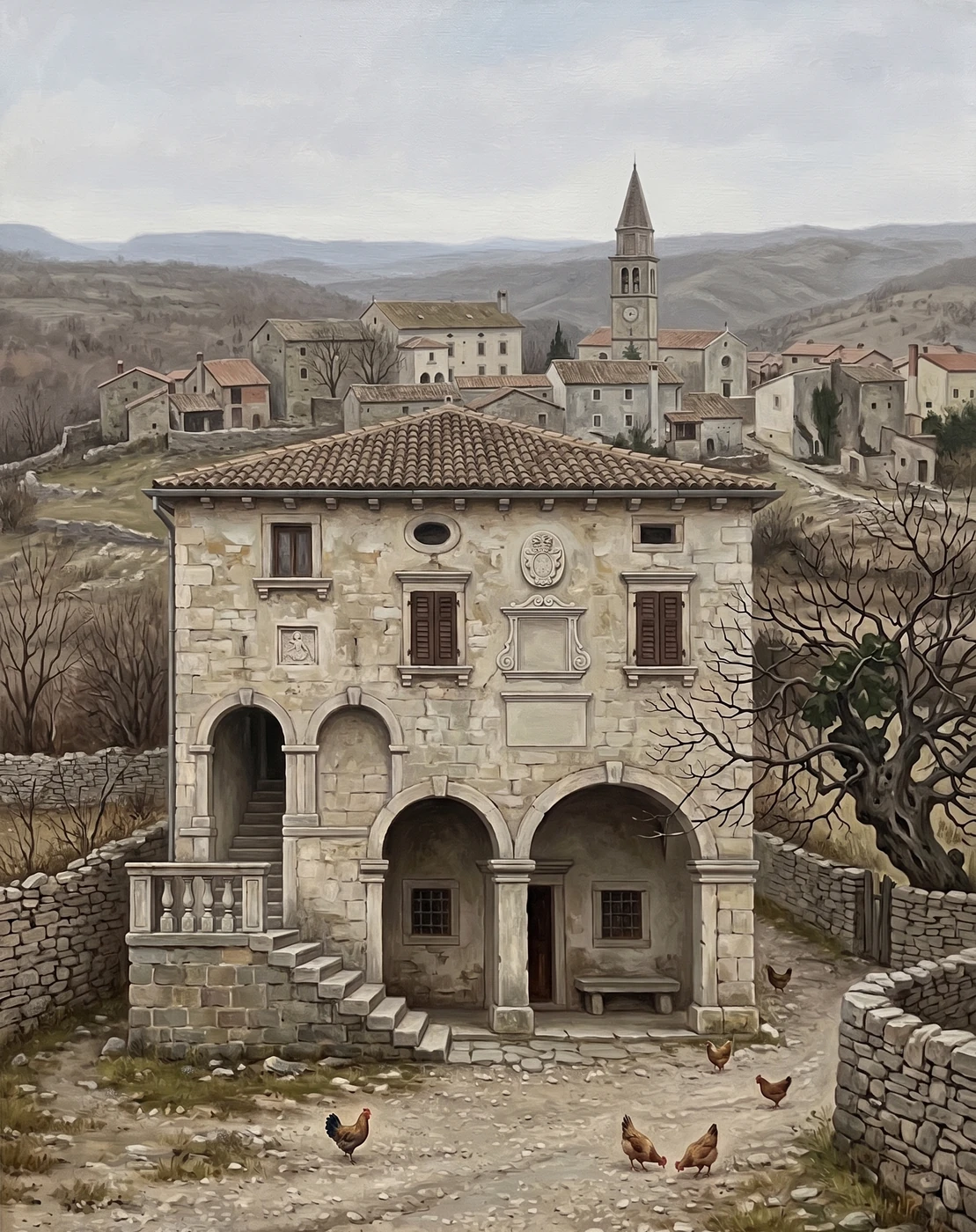
The tablet in it is blank, and that is on purpose. A first version came back with invented pseudo-Latin cut across it, and was withheld. The real tablet is the single most important stone this archive holds, read close and settled letter by letter: ANNO · DOMNI · 1711 / GION · BATISTA / DE · FRANCESCHI / FECCE · FARE · PE[R] · SE / ET · HEREDI · SVOI — in the year of the Lord 1711, Gion Batista de Franceschi had it made for himself and his heirs. A picture carrying anything else in that panel would be the one thing on this site capable of doing real damage, so the panel is empty. The oval cartouche above it is likewise left indistinct: the real arms are a cross crossed by two arrows over a pomegranate under a plumed helm, exactly as Carlo described them privately to Kobler in about 1873, with a Latin donor's legend running clockwise round the rim — and that carving is photographed, drawn and blazoned elsewhere on this site rather than guessed at here.
What the picture is good for is the shape of the thing: a long low house that is the biggest in a poor village, the loggia of two arches at one end with its steps up from the lane, the roof on projecting brackets, the dry-stone walls and the hens and the flat winter light. The house is number 22. The original file is in this project's source library.
A warning, kept here on purpose: the day an image model rewrote this stone
In September 2026 this archive began commissioning constructed illustrations from written briefs. One of them was asked, in good faith, to «enhance» the family's own photographs of the builder's tablet. What came back was not an enhancement. Image models do not enhance; they regenerate. It is being recorded here, in full, because it is the most instructive thing that has happened to this project all year.
Photographed close, in the wall, and read letter by letter: «ANNO · DOMNI · 1711 / GION · BATISTA / DE · FRANCESCHI / FECCE · FARE · PE[R] · SE / ET · HEREDI · SVOI». Italian. Arabic numerals. Five lines. And 1711 is the year Carlo De Franceschi gave Giovanni Kobler privately in about 1873 — that his great-great-grandfather Giambattista del fu Leonardo built the house in 1711. Two independent witnesses, a hundred and sixty years apart, agreeing on a year and a name.
A photorealistic marble tablet in a wall, in convincing raking light, with five lines of clean Roman capitals: «ANNO · DOMINI · MDCLXV / GLORIA · DEO · OMNIPOTENTI / DE · FRANCESCHI / PATERNO · ET · MATERNO / NOMINE · DEX · VOTO». Latin. Roman numerals. Five lines. It kept the shape of the real thing and replaced every word in it.
MDCLXV is 1665. Not 1711. A single plausible-looking image, circulated once, would put a rival date on the founding stone of this family and set it against the only two witnesses there are. It would not look like an error; it would look like a better photograph. And the Latin is not even sound — «DEX VOTO» is not a phrase; it is a machine's approximation of «ex voto».
The file is kept in this project's source library under a filename that says what it is: WITHHELD, FABRICATED, contradicts the verified 1711 reading, not a photograph, do not circulate. It is kept rather than deleted because the next person to try this — including a future version of this archive — should be able to see exactly how convincing the failure looked.
No image model is ever asked to render an inscription, a coat of arms, a signature, a document or any other carrying of text on this site. Where a real carved stone appears in a constructed illustration, its panel is left blank and the words are set in the caption underneath, where they can be footnoted. The drawn view of the house published above this section has an empty tablet for exactly that reason.
The verified reading is from the family's own close photographs of the tablet at Gologorica, 2026, checked against Carlo De Franceschi's letter to Giovanni Kobler printed in «Fiume» (1928). The fabricated version is a Gemini image generated September 2026 and archived unpublished.
Five people out of the family's own tree that this archive had nothing on
David's live MyHeritage tree was read directly in September 2026 — 459 individuals of the surname. Most of it agreed with what is published here. These did not, because this site had never heard of them.
Born at Gologorica on 31 January 1909. Died at Dachau on 7 August 1945. The camp was liberated on 29 April 1945, so a death there in August is a death among the thousands who did not survive being freed — typhus was still killing the liberated well into the summer. He was thirty-six. Nothing else about him is in this archive, and finding out how a man from this village came to be in that camp is now a piece of work in its own right.
Born at Gračišće on 12 March 1892, died in New York City on 26 April 1940, with six separate citations behind him in the tree. This site's Diaspora page has argued that the United States records held only one family it could trace back to Gračišće — Basilio and Dario, of Gallignana. Here is a second, and a much better documented one.
Born at Gologorica on 20 November 1942, died 15 January 2023. This archive has published that the surname is down to about ten people in Croatia and that the last of the Gologorica line left. A man born in that village in the middle of the war lived until two years ago.
Born at Gologorica 28 October 1860, married a Domazetovich, died at Trieste on 22 June 1941. One more of the quiet westward moves the archive keeps finding one at a time.
The tree carries a run of Gologorica deaths this site has never had: Francesco, died 13 September 1719. Gian Battista, born 1673, died 11 September 1743. Cattarina, died 28 September 1740. Gisanna, born 1684, died 20 April 1774. Antonius, born 1742, died 17 September 1802. Cattarina, born 1756, died 21 May 1792. Gian Battista, born 1753, died 23 January 1813. Set beside the 1711 tablet and Carlo's «il vecchio stipite» dead in November 1686, that is most of a century of the house filled in.
David Defranceski's live MyHeritage tree, read 7 September 2026. Dates as the tree gives them; the citations behind them, where they exist, are FamilySearch record links entered by the family.
The house and the ground, photographed
The family went to Gologorica in 2026 and came back with a hundred and seventy-five frames. Until now this archive has quoted from them and never shown them. These eleven are the ones that carry evidence: the tablet the house was built under, the arms Carlo described in a private letter, the same arms cut twice in the cemetery a century apart, and the building Radmila Matejčić described in 1979 from the outside without ever naming who lived in it.
Living people are in many of the other frames and are left out of this archive, as everywhere else on the site. What is published here is stone.
An architectural survey of the village — and a hard date for the lease
Krešimir Regan and Branko Nadilo's series on the Istrian castles ran in «Građevinar» in 2012, and the instalment on the fortified places north of the Čepić field takes Gologorica apart building by building. It is a civil-engineering journal rather than a genealogy, which is why it is useful: it has no interest in the family and describes the house as a structure. It also gives the benefice a date this archive did not have.
«Na trgu je pokraj crkve velika kamena palača obitelji De Franceschi, dvokatna građevina s balkonom i portalom iz 1711., ukrašena grbom i natpisom te reljefom s prikazom Isusa. Mnogi drže da je to jedan od najljepših primjera skromne palače seoskih posjednika, funkcionalna i jednostavna u svojim dimenzijama i ukrasima.» — On the square beside the church is the large stone palace of the De Franceschi family, a two-storey building with a balcony and a portal of 1711, ornamented with a coat of arms, an inscription, and a relief showing Jesus. Many hold it one of the finest examples of the modest palace of a rural landowner, functional and plain in its dimensions and its ornament.
When this archive first tried to have the house drawn, it said the relief panels above the door were invented by the image model, then corrected itself from the family's own photographs, which show an aedicule with scrolled volutes and a haloed figure. A published architectural survey now names it: a relief of Christ. The tablet, the arms and the figure are all real, all of 1711, and all still there.
This is the correction that matters. Gologorica changed hands until 1443, when the provost of Pazin, Andreas Schuel, bought it and with other property founded a benefice — an endowment to maintain priests bound to say Mass three times a week in St Nicholas's at Pazin. The Emperor Frederick III then took the right of appointment. The holders were, to the eighteenth century, mostly the captains of Pazin or the bishops of Pedena; then the Marquis de Prié; then Charles Antoine Biotz; and «naposljetku od 1772. obitelj De Franceschi koja je gologorički beneficij držala u zakupu do ukidanja feudalnih odnosa 1848. godine» — and finally, from 1772, the De Franceschi family, who held the Gologorica benefice on lease until the abolition of feudal relations in 1848.
This site has carried the lease from Carlo's own letter to Kobler — the «affitto fermo» of the bishop of Pedena, renewed by every bishop, which is why the village is missing from the 1498 urbarium: «perchè ne era Dominus il vescovo di Pedena». The two accounts fit together rather than contradict. The bishops were among the earlier holders of an endowment founded in 1443; the family took the lease of it in 1772 and kept it for seventy-six years, through the suppression of the see of Pedena in 1788 and out the other side, until feudal tenure itself was abolished. Seventy-six years is a long time to be the man who collects, and it is the economic fact behind everything else on this page.
The historic core sits on a narrow ridge running north to south. The walls were an elongated irregular quadrangle; only a small stretch survives with the north gate, the rest pulled down in the eighteenth and nineteenth centuries or built into the fronts of the houses. Deep ditches with drawbridges defended the north and south ends and were gradually filled in and turned into gardens and vineyards. The walls are thought to be sixteenth-century, put up after Gologorica had been taken and burned in 1463, 1508 and 1511.
The parish church of Sts Peter and Paul is a seventeenth-century single-nave baroque rebuilding of an older Gothic church, of which there survive a Glagolitic inscription of the priest Juraj Kaligarić, 1595, an Imago pietatis relief of 1446, and a fifteenth-century chalice. The bell tower was begun in late Gothic and finished in 1740 — twenty-four metres, three storeys, fine ashlar, biforate openings on the third. And above the north entrance, by the pond, the oldest building of all: the small Romanesque church of the Blessed Virgin Mary.
«Iz Gologorice potječe i plovan Mikula Gologorički, notar i pisac hrvatske glagoljaške verzije često spominjanoga Istarskog razvoda iz 1325.» — From Gologorica came the parish priest Mikula Gologorički, notary, and the writer of the Croatian Glagolitic version of the Istrian Boundary Settlement of 1325 — the great delimitation between the patriarch of Aquileia, the count of Gorizia and Pazin, and Venice. One of the foundation documents of Croatian literacy was written by the priest of this parish, three hundred and fifty years before the family reached it.
Krešimir Regan and Branko Nadilo, «Istarski kašteli: utvrđeni gradovi i naselja sjeverno od Čepićkog polja», in «Građevinar» 64 (2012) 6, pp. 515–522. Supplied by the family as a scan, September 2026, and now in this project's library. Its own first citation is Camillo De Franceschi, «I castelli della Val…» — Carlo's son, cited by the engineers as the authority on the castles of his own valley.
The Gologorica parish archive exists, and a 2024 paper has been reading it
Elvis Orbanić's study of the weeping Madonna of Sveti Petar u Šumi, in «Acta Histriae» 32 (2024), works from the Paulines' chronicle of the miracles. Two of its pilgrims come from this county, and one of them is the parish priest of Gologorica. But the thing that matters most for this archive is buried in the source list at the back.
«ŽAG, MKK – Župni arhiv Gologorice, Matična knjiga krštenih (1691–1763)» and «ŽAG, MKU – Župni arhiv Gologorice, Matična knjiga umrlih (1646–1777)». The parish archive at Gologorica — baptisms from 1691, deaths from 1646 — cited as a working source by a historian publishing in 2024. This site's Parish Books page says flatly that Gologorica has no film at all and that its registers are the great absence in every collection searched. They are not lost. They are in the parish, they are being used, and their dates are now known. Deaths from 1646 would reach a generation earlier than anything this archive holds for the village.
On 2 October 1722 the archpriest Petar Kruzila (Petrus Cruzilla), parish priest of Gologorica, walked the twenty-one kilometres to Sveti Petar u Šumi to discharge a vow. He had refused to believe the image wept. Then, riding, he came off his horse and was struck deaf where he fell, and kept his bed forty days; having made his vow to the Virgin he felt better at once, and «wished to tell everyone of his case and of his doubt». He stayed in the parish until he died there on 25 September 1731, entered in the Gologorica death register as «Reverendissimus dominus Petrus Cruzilla, protonotarius apostolicus, archipresbyter et parochus Gologoriziae».
He is the priest who was baptising at Gologorica in 1722 — the man whose hand wrote the entries for the household that had cut ANNO · DOMNI · 1711 over its door eleven years before. The paper cites him as the regular administrator of baptisms there in that year. Whoever of this family was born, married or buried at Gologorica between about 1720 and 1731 was written down by a deaf apostolic protonotary who had fallen off a horse for doubting a miracle.
The same paper, citing Camillo De Franceschi's «Storia documentata della Contea di Pisino», notes that Antonio Bartolomeo Bono, vice-captain and administrator of the County of Pazin in 1723–24, «porijeklom je bio iz riječke patricijske obitelji» — was of a Rijeka patrician family, and had read law at Padua in 1705–6. The traffic between Fiume's patriciate and the County of Pazin's administration ran both ways, and that is the same channel Kobler's «venuto da Pisino» household went along in 1740.
«Župa Gologorica spominje se 1324., a vjerojatno je postojala i ranije» — the parish is mentioned in 1324 and probably existed earlier, within the diocese of Pedena. Which is a year before Mikula Gologorički, priest of this same parish, wrote the Croatian Glagolitic version of the Istrian Boundary Settlement of 1325.
Elvis Orbanić, in «Acta Histriae» 32 (2024) 1, on the votive record of the lacrimating image at Sveti Petar u Šumi — read in full, 8 September 2026, from a scan supplied by the family. Its Gologorica citations are to the parish archive there (ŽAG), baptisms 1691–1763 and deaths 1646–1777.
Carlo, cited eleven times in 1979 — and a Roman road under the village
Mate Križman's «Antička svjedočanstva o Istri» (1979), the first volume of the «Istra kroz stoljeća» series, is an anthology of every Greek and Latin writer who mentions Istria, with philological commentary. It is a classicist's book and it has nothing to do with genealogy. It cites **Carlo De Franceschi eleven times**, and it puts Gologorica in the Roman period.
In the index: «FRANCESCHI C. de — 170, 189, 192, 193, 211, 263», with «L'Istria, note storiche, Poreč 1879» cited at pages 10–11, 38ff, 45 and 67. Križman uses him for the topography of the Istrian war of 177 BC, for the siege engines at Nesactium, for the identification of Livy's lost towns, and for the question of whether the Pontic Histri and the Adriatic Histri are one people. He sits in the text beside Kandler, Gnirs, Benussi, Zippel and Müller — which is the canon. Ninety-nine years after he published it, a professional classicist was still arguing with his book rather than around it.
«Najmanja je vjerojatnost da ćemo pogriješiti ako glede Mutile prihvatimo Kandlerovo, De Franceschijevo i Gnirsovo mišljenje koje na temelju sličnosti imena poistovjećuje Mutilu s Medulinom» — we are least likely to be wrong if, for Mutila, we accept Kandler's, De Franceschi's and Gnirs's view identifying it with Medulin; and for Faveria they propose Mutvoran. Two lost towns of Livy, placed by a man from Gologorica, still the best answer in 1979. And Medulin is one of the towns in the southern-Istrian cluster this archive has just opened.
Gnirs proposed that the ancient Alùon was a settlement of the Istrian interior, on the Veli potok between Pićan and Gologorica, at the place where the Roman inscriptions CIL V 322, 323, 424 and 425 were found. Križman indexes Gologorica at page 98 for it. This archive's story starts in 1644 with a baptism register. There were people writing on stone in that valley sixteen centuries earlier, and the stones have numbers.
The book is out of print and second-hand copies are scarce, but the full text is online, uploaded to both Scribd and idoc.pub. It was read there in September 2026. A proper library copy is still worth having, because the apparatus is the point of the book.
Mate Križman, «Antička svjedočanstva o Istri», Istra kroz stoljeća I/1, Pula–Rijeka 1979 — read in full text from the copy at idoc.pub, September 2026. Križman (1937–2015) taught classical philology at Zagreb.
The house, 12 August 1945 — an eyewitness, in full
An archivist walked into this house three months after the war ended and wrote down what he found. His report has been quoted at second hand on this site for a year. It is printed in full as an appendix to the 2022 Zagreb paper, and it is the last description of the De Franceschi library and archive standing in the building they were made in. It begins with a rumour about sabres.
«In the village of Gola Gorica (12 km from Pazin) the people's militia had, according to one report, armed itself with historic sabres. Inspection established, though too late, that the militia had been quartered in the country house of the De Franceschi family.» He adds why the name meant something to him: the family «gave good Istrian historians through two generations. Carlo (d.) and his son Camillo (aged 70), together with Benussi, have deserved most of the history of Istria.»
Camillo, the present owner, «was director of the library in Pula, and is now somewhere in Italy». The house had therefore been sequestered and put under the Administration of National Property for Istria. In 1943 the partisan hospital from Pazin was moved into it because of the bombing. After the German advance it was no longer kept up — the owners had stopped coming for the summer. After the German capitulation it served as a guardhouse for the people's militia, and the former District Committee of Čepić «carried off four cartloads of various things». Hauptmann compares it to the emptied castle of Baroness Hütterot on Sv. Andrija by Rovinj — except that here not even the thin list of removed items that Rovinj had was left behind. The Čepić committee listed only what remained, and did that post festum.
«Sorting the chaos in the house, I reassembled the library, in which all the scholarly works of the two men are now brought together.» «The library itself is, for Istrian questions, exemplary. I gave up any listing of the books, because one may safely assert that the library, as regards the historiographical questions of Istria, is complete.» He names the runs: Atti e memorie della Società Istriana di archeologia e storia patria, the Archeografo Triestino, Memorie storiche Forogiuliesi, the Archivio Veneto. Then great numbers of single issues of the most varied journals, kept for their Istrian content, and newspaper cuttings — their own and other people's. And an offprint collection sorted by subject into boxes on a register system, so that specialised literature on archaeology, or on the biographies of Istrians, or on folklore, could be found at once. The non-scholarly part: «old and new editions of Petrarch, Dante, Tasso, in general a great number of books of the most varied content — old editions of Machiavelli, bibles, the Venetian statutes.»
«The manuscripts of Carlo and Camillo are saved in fair number, though they were scattered everywhere.» He had too little time to separate published from unpublished — but a glance convinced him they all had to be kept, and his reason is a working historian's: «It happens, for instance, that in composing a work the writer used his own notes and those of his forebears, and of course did not carry the whole of that into the printed work.» He names Carlo's Gita a Cosgliaco and «a collection of biographies of famous Istrians which Pietro De Franceschi gathered fifty to a hundred years earlier» — an ancestor-collector this archive has never had a word about. And the Istrian travel accounts: Gita a Colmo, Bogliuno, Rovigno.
«The noble family De Franceschi has lived, according to the material found, at least from the beginning of the XVII century at Gola Gorica. Beside the modest manor — if the house may be called that — it possessed some land in the neighbourhood. An inventory from the beginning of the XVII century is preserved, which gives a fine insight into those circumstances.» This archive has cited that sentence at second hand for a year and treated it as a rival date to 1650 and 1700. Read whole, it is an archivist's inference from a box of papers in a house, in one afternoon, with a militia billeted in it — not a documented arrival. He is describing the same thing the Rijeka fond describes: a collecting family whose oldest paper is older than the family's presence.
Account books old and new; lists of dues from the Gola Gorica district, paid to the church or directly to the lordship, running down into Carlo's and Camillo's own correspondence. That correspondence had once been well ordered; he found it «all scattered» and could only roughly put it back. And then material from around Pazin that had strayed into the family's ownership through the historiographical enthusiasm of its two representatives: · Protocols of the circulars of the Pićan bishop Aldrago Antonio de Piccardi, about 1780 · «Atti di nomine e investiture dai parochi della Contea di Pisino», 1728–1776 · a copy of the Venetian–Istrian chronicle called the Barbara · a chronicle of Pula and its district written in 1726 by a Pula archdeacon · and «especially a complete population census of the town of Rovinj, 1650–1736» — which he calls a rich find · the urbarium of the castle of Momiano, 1584/5, in two volumes — «a small consolation for the destroyed urbarium in Pazin castle»
«The search for treasure written in Glagolitic was for the first time crowned with success. It is known that the Italians rooted out Glagolitic in stone and on paper. While some stone inscriptions are still found, on paper Glagolitic is very rare.» «For the church at Hum (Colmo) a parish register from the middle of the XVII century has now been found, written largely in Glagolitic — and likewise one for the confraternity of the church of St Roch near Hum.» So there was not one Glagolitic Hum book in this house but at least two, and the Rijeka fond's «income book of the parish church at Hum, 1610–1685» is a third description of the same small hoard. This is the answer to the question this archive asked yesterday about Vlahov's published Registro della chiesa parrocchiale di Colmo: the family had the Glagolitic books of Hum, more than one of them, and an archivist carried them out of the house in August 1945.
The last line of the inventory, and the largest claim in it: «A collection of charters — mostly parchment — rotuli, papal bulls… from the year 1201 onward, for various Istrian towns, completes the find at Gola Gorica.» Signed: Zagreb, 12. VIII. 1945. F. Hauptmann.
Three things. The house was emptied twice — by four cartloads to Čepić and then by the archivist, and only the second man wrote anything down. The «seventeenth century» date for the family at Gologorica is Hauptmann's reading of a collection, not a document, and it should never again be set against 1661 as though the two were rival records. And the family's own papers are the smaller half of what was in that house: the bishop's protocols, the Rovinj census, the Momiano urbarium and the Glagolitic books of Hum were other people's records, gathered by two historians, and they are the reason this family's archive begins two centuries before this family does.
Ferdinand Hauptmann, «Izvještaj o arhivima. Gola Gorica kod Pazina», Zagreb, 12 August 1945 — printed in full as Appendix 1 to Anita Marin, Martina Jurišić and Alena Matijaca, «Zbirka obitelji De Franceschi u Nacionalnoj i sveučilišnoj knjižnici u Zagrebu», «Libellarium» 13, 2 (2022), pp. 19–21, and published by Markus Leideck in «Arhivski vjesnik» 58 (2015). Translations here are this archive's own.
The 1610 problem, solved — and it was never a problem
The family's own archive survives, at the State Archive in Rijeka, as fond HR-DARI-254, «Obitelj De Franceschi iz Gologorice», and its catalogue dates run 1610–1934. That start date has sat awkwardly on this site for a year: every account of the family's arrival says the mid-seventeenth century or about 1700, and here was an archive apparently beginning ninety years before the earliest of them. The archive's own finding aid, read properly in September 2026, dissolves it in one sentence.
«Sadržajno je raznolika i značajna zbirka obitelji (1610-1874), u kojoj se nalazi najstarija knjiga u fondu, knjiga prihoda župne crkve u Humu (1610-1685), pisana glagoljicom, ujedno i jedina u fondu na hrvatskom jeziku.» The oldest book in the fond is the income book of the parish church at Hum — Colmo — for 1610 to 1685, written in Glagolitic, and it is the only item in the whole fond in Croatian. It sits in series 3, «Zbirka obitelji» — the family's collection, the things they gathered — not in series 1, the family's own papers.
A family archive's earliest date is the date of the earliest object in it, and this family produced a historian. The finding aid says as much: «Nema podataka tko je bio sakupljač gradiva, ali najvjerojatnije je to bio Carlo De Franceschi, a moguće je da je to činio ili nastavio sakupljati njegov sin Camillo» — no record of who assembled the material, but most probably Carlo De Franceschi, and possibly continued by his son Camillo. So 1610 is the year of a Glagolitic parish account book from a village eleven kilometres away, picked up by the man who wrote the history of Istria. It is evidence about Carlo's library, not about his ancestors' whereabouts. The four dates this archive has been juggling — 1610, the mid-seventeenth century, 1661, about 1700 — are now three, and 1610 was never one of them.
The arranged series say it plainly. 1.1 Family papers in the strict sense: probate 1794–1800, lawsuits between family members 1788–1801, papers on individual members 1791–1934. 1.2 Papers on the family's estates: 1703–1783 — contracts of sale and exchange, land let out, share-farming of livestock. 2. Miscellanea 1804–1926. 3.1 Religious bodies 1610–1805. 3.2 Secular bodies, economy and administration 1709–1874. The family's own earliest paper is therefore 1703 — three years after the arrival Carlo himself claimed, and eight years before the date cut over the door of the house.
The content note is the best short description of this family's economics anyone has written: «Kupoprodajni ugovori, ugovori o permutacijama, knjige kreditiranja i potraživanja svjedoče o intenzivnom bogaćenju obitelji tijekom 18. stoljeća, trgovačkom i financijskom aktivnošću, putem posuđivanja novca i otkupa dugova u gologoričkom kraju, ali i sve do Kastva, Mošćenica, Labina, Kranjske i drugih udaljenih mjesta.» Contracts of sale and exchange, and books of lending and of debts owed, witness the family's intensive enrichment through the eighteenth century by trade and finance — lending money and buying up debts — in the Gologorica country and as far as Kastav, Mošćenice, Labin and Carniola. That is not a farming family that prospered. It is a money-lending and debt-buying business, run out of a village, reaching a hundred kilometres. It explains the arcaded palazzetto, it explains six proprietor households by 1820, and it is exactly the Carnian merchant profile the migration literature describes.
The last sentence of the provenance note is the one this archive will be quoting for years: «Zbog nepoznavanja povijesti obitelji do sređivanja 1990. godine gradivo ovog fonda je bilo spojeno u jedan fond s gradivom jedne druge obitelji De Franceshi, onoj iz Šegeta kod Buja.» Through ignorance of the family's history, until the arrangement of 1990, this fond's material was joined into a single fond with that of another De Franceschi family — the one from Šeget near Buje. Before that there was only a temporary list, «superficial and inaccurate». The fond was separated and arranged by the archivist Ines Krota. So for forty-odd years the Carnian family and the Cretan family were one archival fond in one building, because nobody knew they were two families. This site has spent a year arguing that they are separate, against a monograph that calls them two branches of one house. The archive that holds both of them reached the same conclusion in 1990, and had to physically pull them apart to act on it.
The material was taken in in 1948, out of Pula or Poreč, with the rest of the Istrian holdings that had been prepared for evacuation, and entered in the general inventory at no. 92, page 142 — never entered in the accessions book at all. In 1950 one bundle was returned to the Naučna biblioteka in Pula along with three miscellanea fascicles, said to have come from the Financial Department of the Regional People's Committee for Istria. That bundle is somewhere in Pula, and this archive does not know what is in it. The whole fond is 0.70 metres, seven boxes, in Italian, Croatian and Latin — and open to the public.
HR-DARI-382, «Obitelj de Franceschi iz Šegeta», runs 1412–1943: 2.60 metres, twenty-six boxes and four folders, archivally arranged. Nearly four times the Gologorica fond and starting two centuries earlier — which is what an estate-owning house with a private library leaves behind, and a reminder that the two families are not comparable in anything but a surname. The 1412 start deserves the same scepticism as 1610 until somebody says what the document is.
One more thing about that Hum income book. In 1999 the State Archive in Pazin published «Glagoljski rukopis iz Huma (1608.–1639.): iz Registro della chiesa parrocchiale di Colmo», edited by Dražen Vlahov — a Glagolitic register of the parish church of Colmo, which is Hum, covering 1608 to 1639. The family's book runs 1610 to 1685. Same parish, same script, same kind of book, overlapping decades. They may be one manuscript, or two halves of one register that were separated when the family's papers went to Rijeka and the parish's stayed in Istria — or they may be two different books. The fond description and the printed edition do not cite each other, so nobody has said. The edition costs thirteen euro and is on the acquisitions list. Until then this is a question, not a claim.
Državni arhiv u Rijeci, finding aid to fond HR-DARI-254, «Obitelj De Franceschi iz Gologorice» (alt. RO-011), 1610–1934, arranged by Ines Krota, 1990; and the entry for HR-DARI-382, «Obitelj de Franceschi iz Šegeta» (alt. RO-023), 1412–1943. Read from the archive's published register of fonds, September 2026. Quotations are the register's own Croatian; the translations are this archive's.
Six households in 1820 — and one of them is «di Gallignana»
This archive has said, on this page and on three others, that nothing yet joins the Gologorica house to the Gallignana line of farmers and stonecutters two villages away. Both families believe the join exists; neither has the page. Dean Brhan, working the Catasto franceschino of 1820 in the state archive at Trieste, prints a list that puts a name in the gap.
«A Moncalvo di Pisino nel 1820 erano presenti 6 fuochi dei possidenti De Franceschi; Maria, Giuseppe, Giobatta (di Gallignana), Leonardo e Antonio. Erano la famiglia più influente dell'area in questione che comprendeva una decina di villaggi abitati compattamente da contadini croati.» At Moncalvo di Pisino in 1820 there were six hearths of De Franceschi proprietors — Maria, Giuseppe, Giobatta (of Gallignana), Leonardo and Antonio. They were the most influential family in a district of some ten villages inhabited solidly by Croatian peasants.
Every other proprietor in the list is given by first name alone, because they are of the place. One of them is qualified — «di Gallignana». The cadastral clerk needed to say which Giobatta he meant, and the way he distinguished him was by the village he came from. So in 1820 there is a Giovanni Battista De Franceschi, identified as a man of Gallignana, holding property at Moncalvo — the two villages this archive has never been able to join, in one line of one document.
It is not proof. It does not say he is our Joannes Baptista, the farmer of house 5 at Gračišće whom the register catches in 1787 and who would have been in his sixties in 1820; Giovanni Battista is the commonest name in both villages, and a De Franceschi of Gallignana holding land at Moncalvo could be a cousin, a purchaser or a son-in-law as easily as an ancestor. What it is, is the first object of any kind that puts the two names together — and it tells this archive exactly which sheet to order. The Catasto franceschino for the Comune di Gallignana, Distretto di Pisino, is at the Archivio di Stato di Trieste, and its Moncalvo counterpart with it. Brhan read them. So can we.
«The most influential family in an area of some ten villages inhabited solidly by Croatian peasants» is a much harder statement than «possidenti». Six proprietor households of one surname in one small village, in an Austrian cadastre made for taxation, is a local gentry — which is what the arcaded palazzetto with the shield on its façade was already saying, and what «da modesti possidenti» in Carlo's biography was quietly denying. Both can be true across a century: modest when they arrived, dominant by 1820, and the cadastre is the year the balance shows.
Dean Brhan, «“Stare cum loco et foco”. L'emigrazione verso l'Istria dalla Carnia e dal Friuli», published by the Amici dell'Orologeria Pesarina, Prato Carnico — read in full from the association's own open text, September 2026. Brhan's list is drawn from the Archivio di Stato di Trieste, Catasto franceschino, and his note on the family's origin cites Miroslav Bertoša, «Etos i etnos zavičaja» (Pola–Fiume, 1985).
The full bibliography, with what each source gave and where it is weak →