Eight generations, and for four of them a page of the Gračišće parish books that names the household, the wife and the trade. Two entries from the Status Animarum carry the whole eighteenth- and nineteenth-century descent; the twentieth century is carried by wartime paper from Württemberg.
Most of this archive works outward — every Defranceschi it can find, in every spelling, across every parish. This page works the other way. It follows one line down, and it stops at each generation to ask what document says so.
The turning point was a pair of pages from the Status Animarum, the parish book of souls, obtained from the Državni arhiv u Pazinu in June 2021 and unread until now. A book of souls is not a register of events; it is a register of households. One ruled row holds a man, his condition, his birth, his marriage, his death — and beneath him his wife and every child, each with a date. Two such rows, house 5 and house 19 of Gallignana, contain four generations between them, and the second is tied to the first by three Latin words: q. Joannis — son of the late Giovanni.
Carried on the family's own descent chart. The Status Animarum entry for his son calls that son Joan. Bapt. Defranceschi, and the next generation is styled q. Joannis — son of the late Giovanni — so a Giovanni stands at the head of the line. The 1750–1829 dates come from the family chart, not yet from a register page. What is no longer in doubt is the place: the Klenovica register of 1890 records Gallignana as this family's zavičaj, its inherited commune, four generations downstream. There is now a candidate for him too, and he is not simply Giovanni: the Joannes Baptista Defranceschi who headed casa 31 at Gologorica, husband of Theresia née Grach, whose son of the same name was baptised on 13 August 1787. If that identification holds, the family chart's Giovanni is a Giovanni Battista, and behind him stands the Leonardus who gives the casa-31 branch its byname «detti Leonardi».
Generation 2
Giovanni Battista Defranceschi
Joan. Bapt. Defranceschi
Born13 August 1787Married1819Died1 September 1846Tradeagricola — farmerWhereGračišće (Gallignana), house 5Documented
Wife
Francisca Salomonb. 17 March 1797
Children in the house
Raymundus9 October 1823Antonius20 September 1825Joannes30 June 1833Franciscus26 January 1840
Status Animarum of the parish of Gallignana, house 5. Name, condition, birth, marriage and death in the ruled columns; wife and four sons beneath him. And a candidate for his baptism has now been read off the Gologorica film: a Joannes Baptista Defranceschi baptised at Gologorica, house 31, on 13 August 1787, son of Joannes Baptista and Theresia née Grach — the same name and the same day. It is an inference, not a proof, and it is set out with its objections on the Gologorica line.
DAPA ZM34K 217, M01072071
Generation 3
Antonio Defranceschi
Antonius Defranceschi q. Joannis
Born20 September 1825Married25 November 1856Died4 August 1894Tradelapicida — stonecutterWhereGračišće (Gallignana), house 19Documented
Wife
Maria née Fernasarb. 17 October 1832
Children in the house
Antonius6 August 1856Josephus22 March 1863Leopolda6 November 1865Catharina3 February 1869Modestus15 June 1875
Status Animarum, house 19, with the cross of death before his name. He is styled q. Joannis, which welds this household to house 5. His trade comes from the 1863 baptismal entry for his son, where he is entered as lapicida. His eldest son Antonius, born 6 August 1856, is the man at the head of the chart the American branch printed for its first reunion in 2012 — the same date, to the day. That family's eleven children went to New York, Buenos Aires, Tuscany, Slovenia and Croatia.
Born22 March 1863Died1951Tradevešti klesar sada tvorničar — skilled stonemason, later a factory workerWhereGračišće → CrikvenicaDocumented
Wife
Anna Kalanjb. 3 January 1864, at Rijenovica in the Vinodol
Children in the house
Anton Rudolf20 January 1890Marija Stjepanka8 Dec 1892 – 29 Sep 1905IvanNovember 1894Zorica14 December 1896MarijaOct 1905 – 4 Feb 1906
Baptised at Gallignana on 23 March 1863, born the day before, son of Antonius the stonecutter. He is the generation that leaves Istria for the Kvarner coast: his son is born at Crikvenica in 1890. The family identifies his wife as Anna Kalanj, and her own baptism survives — Ledenice register, entry 2 of 1864, daughter of Josephus Kalanj and Rosalia née Perković, at Rijenovica house 22, in the Vinodol valley directly above Crikvenica. That is very probably the reason a Gračišće stonecutter's son ended up on that stretch of coast: he married into it. The 1951 death date is the family's. The Crikvenica death register of 1906 gives his trade: «vešti klesar sada tvorničar» — a skilled stonemason, now a factory worker. His father Antonius was a lapicida at Gračišće. The stone came down to the coast with him.
The marriage itself has still not been found. And the family's own genealogy file gives Josip a wife Ana Grubišić, 1863–1936, whose gravestone it photographs — a different birth date and a different maiden name from the Ana Kalanj the registers name in all four children's entries. The registers govern here; the stone is an open question worth a letter.
Born20 January 1890, baptised 9 FebruaryDied1943WhereKlenovica, house 22 → PfullingenDocumented
Wife
Ursula, born Kovačinab. about 1890
Children in the house
Pepe—Petar15 June 1913Zdravko1 April 1921Ivan24 or 25 June 1925Ankadates unknown
Entry 9 of the Klenovica baptisms for 1890: Anton Rudolf, legitimate, son of «Josip Defranceschi i žena Ana Kalanj rodjena», at house 22 — and in the column for the parents' place of origin, «Gallignana u Istriji». That is the zavičaj, the inherited Austrian commune of legal settlement, and it is the register itself stating that this coastal household's home commune was Gračišće. Fifty-seven years later he is on the Pfullingen list of foreigners, and a certificate of 1950 gives his birth as 20 January 1890 at Crikvenica — the same day, the same man, the coastal parish named by its market town rather than its village.
The mayor's certificate is dated seven years after the death year the family carries. Retrospective certificates of this kind were commonly obtained by a surviving son for a pension or restitution claim, but the point is open.
Klenovica baptisms 1890, entry 9 · Arolsen Archives, ITS
Generation 6
Ivan Defranceski
Born24 or 25 June 1925Died30 October 1995WhereCrikvenica → Pfullingen → SenjDocumented
Wife
Hedviga, born Blaževićdates withheld
On the Pfullingen list as Iwan, born 24 June 1925 at Crikvenica. His own German sickness-fund card gives 25 June and puts him at Brunnenstraße 7, Pfullingen, entering work on 21 October 1941 as an unskilled hand. He was sixteen. He went home, married Hedviga Blažević, and is buried on his own coast under polished granite cut with a plain cross and the name in Croatian orthography: IVAN DEFRANČESKI, 1925–1995.
Dates withheld. The same name in three languages: Ivan in Croatian, Giovanni in Italian, John in English — one man, three registers.
Generation 8
David
WhereJohannesburg → BrisbaneLiving — withheld
Dates withheld. Keeper of this archive.
What the two rows say, side by side
The book of souls for the parish of Gallignana. Left, the household of the farmer; right, the household of the stonecutter who was his second son.
On the last two generations
This archive omits living people rather than hiding them — it does not build a page and lock it. The seventh and eighth generations are therefore given as names and journeys only, in the form the family itself publishes them, with no dates and no collateral relatives. The line does not stop at 1925; the record of it does.
What would settle generation one
Giovanni, 1750–1829, is carried on the family's chart and implied by q. Joannis, but no page has yet been put in front of him. The Gračišće registers begin earlier than 1841 — the volumes for the second half of the eighteenth century are the ones to ask Pazin for next, by name and by year, the way the 2021 requests were made. See Parish Books for what survives and where.
The town the line came from, and a palace called Salamon
Irma Huić's study of the urban development of Gračišće — «Prostor» 23 (2015) — is the first anybody has written, and it puts a shape around the two houses this archive's spine runs through.
There was a bishop's palace in the village
Gračišće was a residence of the bishops of Pedena. Huić locates the palace by the wall of the episcopal building and a large parcel that matches its footprint; the entrance to the bell tower survives and was part of the same complex. And the bishop of Pedena is not a distant figure in this story: he was the lord of Gologorica, and Carlo's family held the lease on his «affitto fermo» there — collecting it, not paying it — renewed by every bishop until the see was suppressed in 1788.
And facing it, the palace of the Salamon
«Gotovo istovremeno nasuprot biskupskoj rezidenciji gradi se palača Salamon» — almost at the same time, facing the bishop's residence, the Salamon palace is built. Huić places its masonry in the fifteenth century; the Istrian Encyclopedia dates the building to 1570.
Which matters, because generation two married one
The Status Animarum of Gallignana gives Joannes Baptista Defranceschi of house 5 married in 1819 to Francisca Salomon, born 17 March 1797. This archive has never had anything on her but a name. She was of a family with a palace on the square, facing the bishop's. And in the De Franceschi archive at Zagreb, folder 6, there is a wedding piece printed at Pola: «Nelle fauste occasioni delle nozze Maria De Franceschi — Luigi Salamon, Pola, 25 ottobre 1897.» The two surnames marry twice, seventy-eight years apart.
Salamon is not a rare name in Istria and none of this is proof of anything about Francisca herself. What it does is turn her from a surname into a household with a known address, which is a thing that can be looked up.
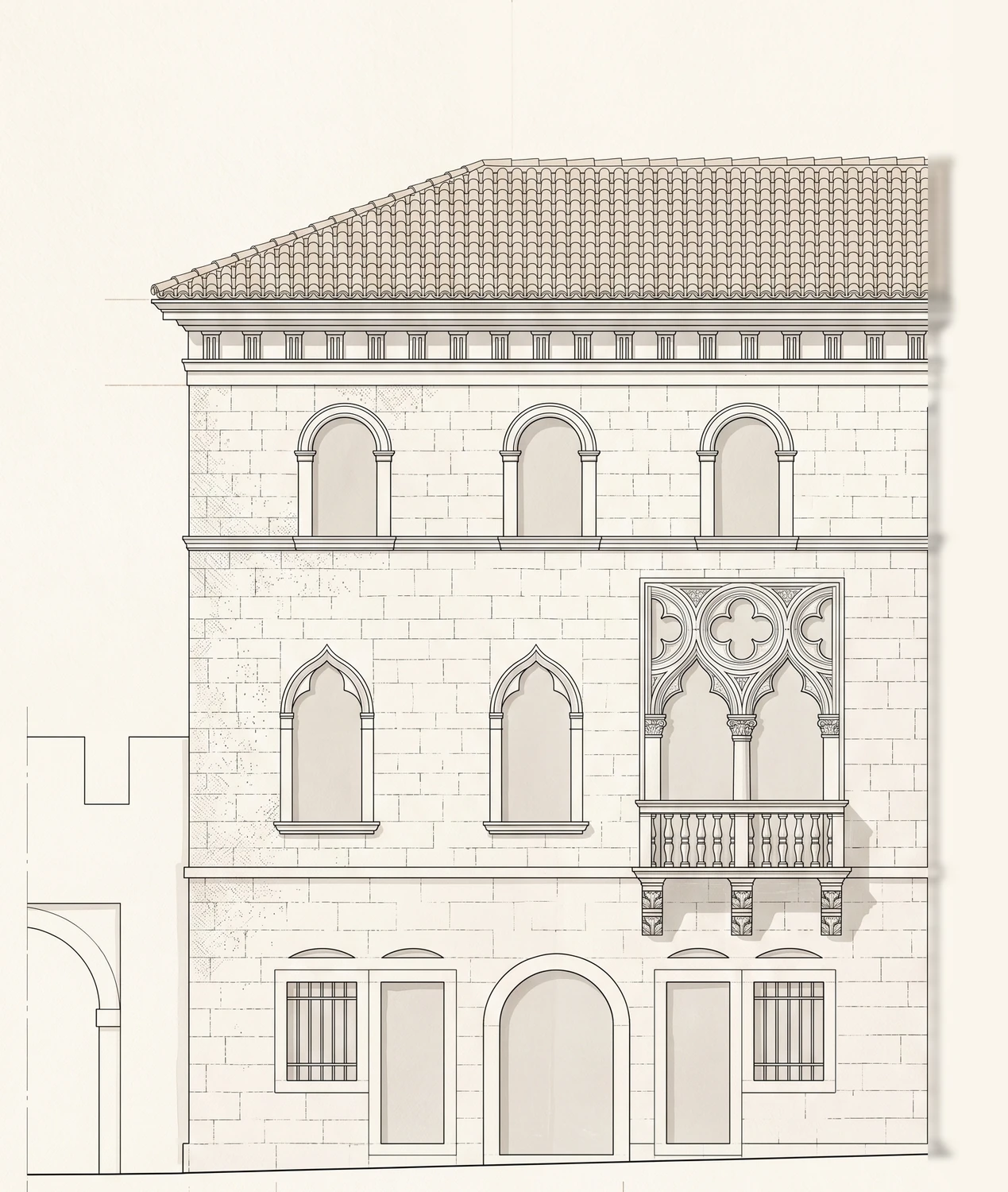
The Salamon palace, drawn
Generation two of this line married a Salamon of Gračišće in 1819, and the Salamon had a palace on the square. It is still standing and it is falling down. This archive has no photograph of it that it owns, so here is a drawn elevation instead, built only out of what two published descriptions actually say.
The Salamon palace, Gračišće. A constructed illustration, made for this archive by an image model
working from a written brief. It is illustration — it is not a survey, it is not measured, and nothing in it should
be taken as a record of the building's real dimensions.
What it follows is the published description: a two-storey building of carefully chiselled local stone standing
beside the main gate, on which «architectural elements of the Gothic and Renaissance styles, popular in Venice in
the late 15th century, exchange on the two storeys along the facade» — the floral Gothic double lancet and its
balcony below, the simple semicircular arches and the row of classical decoration above. That alternation up the
façade is the reason the building matters, and it is the one thing the picture gets right.
The model returned it dressed as a conservation survey drawing, with a title block, a scale bar, dimension figures
and a date. All of that was fabricated and all of it has been cropped away before publication, because a made-up
measured drawing of a real protected building is a worse thing to put into the world than a plain picture. The
number of ground-floor openings, the flanking lancets and every proportion in it are the model's invention. The
unaltered original is in this project's source library, marked with what was removed.
What it is
«Located next to the main gate, this harmonious two-storey building was constructed from the carefully chiselled local stone. Architectural elements of the Gothic and Renaissance styles, popular in Venice in the late 15th century, exchange on the two storeys along the facade. The first floor with the double lancet window and the balcony represents the Floral Gothic, while more simple windows with semi-circular arches and a row of classical decorations are on the second.» And a point the Croatian tourist board makes without dwelling on it: Gračišće was never Venetian. It was in the county of Pazin, which is to say the Empire — and it has one of the best Venetian façades in Istria anyway.
Who built it, and when
Irma Huić puts the masonry in the fifteenth century; the Istrian Encyclopedia dates the building to 1570. The same hands, says the tourist board, were building houses in Poreč at the same time. Which is a reminder that a hill village in the Habsburg county was buying its stonework from the Venetian coast.
And what is inside it now
Isabel Putinja, who lives in Istria, got through the door in 2018 when a ground-floor room had been used as a wine cellar for the Easter Monday fair and the doors were left open the next day. What she photographed: stone steps, wrought railings, walls painted in patterns, French doors, Gothic windows, stone sinks, an old fireplace, floorboards, Venetian shutters, painted ceilings. «This is such an achingly beautiful building and it pains me to see it deteriorate by the day.» It has been empty for decades.
Why it is on this page at all
Because on 25 November 1819 Joannes Baptista Defranceschi of house 5 married Francisca Salomon, born 17 March 1797 — and this archive has never had anything on her but the name. It cannot prove she was of this house; Salamon is not a rare name in Istria. What it can do is stop treating her as a surname. She came from a village with one great house on its square, and that house is the one drawn here.
The Franciscan cadastre of Gallignana — Archivio di Stato di Trieste, «Catasto franceschino, Distretto di Pisino, Comune di Gallignana d'Istria, foglio IV sezione IV», drawn about 1820. A parcel map of the whole village at exactly the period of houses 5 and 19. Nothing in this archive has ever shown where those houses actually stood. This one is still open: it is a letter or a subscription, not a download.
Klen's «Urbar Pazinske grofovije» of 1498 — done. Read September 2026; Gallignana is on the roll of communes, the surname is not in it.
Bratulić's «Urbari Pazinskog feuda (16. stoljeća)», both parts — done. Read September 2026; Gallignana is given as a town of 279 subjects with its millers named, and the surname is not in it.
Chased, and blocked
Where the cadastre actually is — checked, September 2026
The Franciscan cadastre of Gallignana was chased properly in September 2026 and it is not free online. The Habsburg cadastral layer on MAPIRE — maps.arcanum.com and mapire.eu are the same service — renders blank over Gračišće behind «Full access to maps requires subscription», and its tile server returns 403 rather than 404 at the village's own coordinates, which says the sheets are there and the door is locked rather than that they are missing. The Archivio di Stato di Trieste holds the originals, as Huić cites them, but its online viewer covers only the Catasto di Trieste, the city's own. The Croatian land-registry portals serve the modern cadastre, not the nineteenth-century plans.
So it is a written request or a subscription, not a download. To the Archivio di Stato di Trieste, quoting Huić's own citation: «Catasto franceschino, Mappe del Catasto franceschino, Distretto di Pisino, Comune di Gallignana d'Istria, foglio IV sezione IV» — with a note that the sheets wanted are the ones covering the built-up village, where houses 5 and 19 stand. Their correspondence-research service is advertised on their site; data-protected records open after seventy-five years, and an 1820 map is long past that.
It is worth the letter. A Franciscan cadastral sheet is a numbered parcel map with a register of holders — so it would show not just where houses 5 and 19 were, but who was down as holding them in about 1820, when the farmer Joannes Baptista of house 5 was thirty-three and married a year.
Three ways to get it:
Write to the Archivio di Stato di Trieste, quoting Huić's citation, and ask for the sheets covering the built-up village. Their correspondence-research service is advertised; an 1820 map is far past any protection period.
Ask the Državni arhiv u Pazinu whether it holds a duplicate set for the Croatian Istrian communes — it answered this family twice in 2021 for about a hundred kuna.
Or simply subscribe to Arcanum for a month. The tiles appear to be there; it would put the sheet on screen tonight rather than in eight weeks.
Located
The urbaria of the County of Pazin — read, September 2026, and the name is not in them
This block used to say «located, not yet read». All three are now read, cover to cover. They are the oldest documents in which a Defranceschi at Gallignana could possibly stand, because the parish registers do not begin until long afterwards — and the surname is not in any of them.
Danilo Klen, «Urbar Pazinske grofovije (1498)»
Vjesnik historijskih arhiva u Rijeci i Pazinu, vol. 14 (1970), pp. 51–160
An urbarium is a rent-roll: it lists, holding by holding, who owed what to the lord. The 1498 roll would name the households of Gallignana two hundred and eighty-nine years before the earliest ancestor this archive can date, and the sixteenth-century ones would carry that forward. If the surname is in the County of Pazin before 1600 — and the sweep has already found it at Labin in 1615 and Svetvinčenat in 1674 — this is where it would stand.
Downloaded free from Hrčak — hrcak.srce.hr/file/187264, /187152 and /187183 — and read in full. No bot check this time and nothing was circumvented. Held in this project's source library.
What the three rolls actually say — and one thing they cannot say
1498 — Gallignana is one of thirty-three communes; Gologorica is absent, and Carlo explains why
Klen's edition of the 1498 urbar opens with the roll of communes: Barbana, Lindaro, Vermo, Lovrana, Coridico, Pisino vecchio, Oberburg, Gimino, Castelnuovo d'Arsa, Bersez, Novaco, Borutto, Racice, Brest, Zumesco, Vragna, Cresneviza, Bottonega, Bogliuno, Zarec, S. Lorenzo, Torre, Carsicla, Caschierga, Sovignaco, Verh, Treviso, Antignana, Dragutsch, Gallignana, Previch, Cerovlje, Pedena. Gallignana is there. Gologorica is not — and that absence proves nothing at all about who lived there, because Carlo told Kobler exactly why in the 1870s: «Negli Urbari non compariscono Gollogorizza, Tupliaco e Scopliaco, perchè ne era Dominus il vescovo di Pedena» — they do not appear in the urbaria because their lord was the bishop of Pedena, not the count. Gologorica was never on the county's rent-roll to begin with. The negative that counts is the Gallignana one, where the family did later live and where the roll does reach.
The sixteenth century — Gallignana «Città», two hundred and seventy-nine subjects
Bratulić's urbaria give it whole: «La Città di Gallignana contiene al presente doicento settantanoue Sudditi» — 279 subjects — working 1,833 giornate of ploughland and 472 of meadow, the meadow divided among them and not held in common. Their duties: to cart the lord's wine and grain as far as Postojna or down to the sea; one man from every house for two days of the lord's hunt; a wheel-hoop from every subject, carried to the castle of Pisino; and at St Helen's in May, one cheese from every flock.
And the millers, by name
Pietro Martinich, Pietro Cincopan, Lucia Dermitcha «hora Sfetina», Simon Socbalich, Biasio Paulinich di Gallignana, Michiel Andreicich, Gioanni Andreicich, Gregorio Cusmich, Blas Smocouich, Juri Machovich, and Simon Paulinich — who in 1580 was allowed to cut a ditch through the castle's meadow called Cadagn and had his rent raised a florin for it. Eleven millers of Gallignana with dates, and not one of them a Defranceschi.
How an incomer would have got in
The roll even describes the mechanism: «Similmente fabricando, ouero comprando un Gentilhuomo la Casa nel Castello di Gallignana, se gli impone la marca come à gl'altri, secondo la consuetudine antica» — likewise if a gentleman builds or buys a house in the castle of Gallignana, the mark is imposed on him like the others, according to ancient custom. A stranger could buy in. In the sixteenth century none of this name did.
So the negative holds, and it is now a documented one
1498: not there. The sixteenth century: not there. The Boljun register's Gologorica marriages, 1585–1608: not there. Carlo, writing to Kobler in 1876: «si stabilirono in Istria intorno al 1700». Bertoša, on the Valle registers: «una conosciuta famiglia di Gologorizza (emigrata dal Friuli verso il 1700)». Four independent silences and two statements, all saying the same thing — the family was not in the county of Pazin before the seventeenth century, and this archive has now looked in the places where it would have shown.
Danilo Klen (ed.), «Urbar Pazinske grofovije (1498)», Vjesnik historijskih arhiva u Rijeci i Pazinu 14 (1970); Vjekoslav Bratulić (ed.), «Urbari pazinskog feuda (XVI stoljeća)», the same Vjesnik 8–9 (1963–64) and 10 (1964–65). All three open access on Hrčak, downloaded and read in full, September 2026.
Irma Huić, «Urbanistički razvoj Gračišća u Istri: nove spoznaje i čimbenici identiteta naselja», Prostor 23 (2015) 2, pp. 208–221. Open access.
What Gračišće was like five years after they left
Josip and Ana took the household down to the Kvarner coast by 1890. The Istrian papers of the 1890s, read in September 2026, show what they left behind — a village of five hundred people tearing itself along a line that ran through the church door.
When
What
As the paper has it
January 1895
A riot on the square
«Il giovine Pensiero» of 19 January: a crowd of peasants invited to supper by «il nostro furioso parroco croato Gabrielić, anticamente Gabrielli» — our furious Croatian parish priest Gabrielić, formerly Gabrielli — ran through the place shouting «Crepa s'ciavi! Abbasso!» The Italian-minded locals got up a counter-demonstration at once, shouting «Viva Gallignana! Viva l'Istria!» It came to blows. The Croats fled; the roused Gallignanesi broke the windows of the communal representative Don Gabrielić; and, the paper adds, a few blows were struck with an axe.
February 1893
A chaplain slapped in the face
The same paper, satirically, on a priest it calls Don Lustro, who had preached against the Italians — and who showed his flock the mark of «un potente ceffone» that «un contadino benpensante di Gallignana», a right-thinking peasant of Gallignana, had lately left on his face. He was moved on to Gologorica, near Cerovlje, where he tried to play the little tyrant and found the ground unsuitable.
July 1897
Pertinente a Gallignana
A list of defendants at a tumult trial at Pola includes «Giovanni Ivancich di Giovanni, da Pola, pertinente a Gallignana, d'anni 17, cattolico, celibe, carpentiere». Born in Pola, belonging to Gallignana. That is the zavičaj again — the same inherited commune of settlement that the Klenovica register used in 1890 to tie this family to Gračišće, here doing its ordinary work in a courtroom for a seventeen-year-old carpenter.
March 1901
And on a jury list
«Ivić Antonio fu Giuseppe, Gallignana-Pisino», empanelled at Pola. The village supplied jurors like anywhere else.
None of this is about this family. All of it is about the place they came from, in the years just after they left it — and it is the answer to a question the registers cannot address, which is what it was actually like to be from Gračišće in the 1890s.
«Il giovine Pensiero» and «Il Popolo Istriano», Pola, 1893–1901, from the Austrian National Library's ANNO. Read from the ONB's IIIF page images; the OCR here is this archive's own and rough.
How big Gallignana was, and how well it held
Egidio Ivetic's «La popolazione dell'Istria nell'età moderna» — volume 15 of the Collana degli Atti of Rovigno, 1997, four hundred and fifty pages, free on the Internet Archive — counts the hearths of Istria from the sixteenth century on. This archive has been calling Gallignana a hill parish that happened to be one of the county's six towns. It was rather more than that.
When
What
What Ivetic shows
1508
As big as Pisino itself
The first complete Venetian count of hearths, taken the year after the occupation. The Pisinese proper had 838 hearths across the castles of Pisino, Gimino, Gallignana, Lindaro, Bogliuno, Vermo, Pedena and Antignana and some seventeen tiny villages — three to four thousand people in all. «Pisino e Gallignana rappresentavano le entità maggiori con 150 fuochi ciascuna», Pisino and Gallignana were the largest with a hundred and fifty hearths each, six to seven hundred people: the size of a middling Venetian castle-town.
1510
And it threw the Venetians back
The Capodistrian commander Domenico Tarsia took Lindaro in April 1510, «mentre a Gallignana, la città più grossa del dominio, veniva ricacciato» — but at Gallignana, the biggest town of the dominion, he was driven off.
1527–31
Then war, plague and famine
By the hearth list of 1531 Pisino had fallen from 150 hearths to 86, a drop of nearly half. Ivetic notes that the figures for Gallignana and Gimino are missing for that year but will probably have followed a similar course. The villages nearest the frontier were «letteralmente spazzati via» — literally swept away.
1571
And then it filled up again
A new urbarium was drawn for the county, and the numbers are extraordinary. Pisino 86 to 229 families; Gimino 80 to 222; Lindaro 57 to 132; Pedena, the bishop's seat, 60 to nearly 200; and Gallignana from 150 to 258. «Non c'è località che non risulti ampliata» — there is not a place that is not enlarged. That is the colonisation: emptied land refilled with people brought in, Morlachs from the Venetian side and Carnians from the north. The family arrived on the tail of it.
1615–17
It held again, in the Uskok War
The county was overrun. Antignana fell, Vermo fell, and Gimino fell in January 1617 to a long siege and a fifth column. But «inespugnabili rimasero i principali e più popolosi castelli di Pisino, Gallignana e Lindaro» — the chief and most populous castles, Pisino, Gallignana and Lindaro, remained untaken. General Baldassare Maradas was sent into the county and «scongiurò l'occupazione di Gallignana».
1440 onward
And it shopped in Venetian Istria
Ivetic on the free fair of Pola, instituted in 1440 in honour of the Madonna della Misericordia: buyers came from the Venetian boroughs and «dalla parte asburgica, dai castelli di Gimino, Gallignana, Pedena e Pisino». The county, cut off from the rest of the Austrian lands by the Karst uplands and Monte Maggiore, «era costretta ad orientarsi verso i prodotti veneti», and that dependence lasted to the middle of the seventeenth century.
Two things this changes. First, the scale: at the moment the family's line begins there, Gallignana was one of the two largest places in the Habsburg county, not a hamlet with a good church. Second, the mechanism: the collapse of 1531 and the trebling by 1571 are the demographic shape of the repopulation that brought Carnian weavers south, and every argument this archive makes about Carnia sits inside that curve.
Egidio Ivetic, «La popolazione dell'Istria nell'età moderna. Lineamenti evolutivi», Collana degli Atti del Centro di ricerche storiche di Rovigno n. 15 (1997), pp. 1–450 — read from the Internet Archive copy, September 2026. The 1508 and 1531 hearth lists and the 1571 urbarium are his sources, not this archive's; none has been seen here.
The register this project was going to travel to Pazin for is on the family's own hard drive
This archive's research log has carried, for months, a blocked question: the oldest parish books for this line — the ones covering the 1679 arrival window — are «the only significant undigitised material in the Istrian parishes», and «they must be read on paper, in the village or the Pazin reading room. The archive states it will not do this for you.» That is not true of all of them. One of them was already here.
What the second microfilm actually contains
The family holds two Pazin microfilms as folders of page images, ZM34K-214 and ZM34K-215, about 1,465 images between them. An earlier round of this project worked through 214 and built seventy-two people out of it. Film 215 was catalogued as «Gologorica» and only its last section had been identified — the Gallignana births of 1746–1840. Walking the whole of it this week gives three books, not one.
M01069560 – M01069944
A twentieth-century Status Animarum of the parish of Gologorica, on printed forms, arranged by hamlet — Riemunjica, Želeski, Sokolići — with a repertory indexed by age bands from 1890 to 1980, and an Italian-period stamp reading Comune di Fianona. It carries deaths into the 1970s.
M01069946 – M01070130
A «Liber Baptisatorum» whose title page is dated in the 1660s — «comprato sotto il governo di …» — with a later hand pencilling «Gracisce» on the flyleaf. Narrative Latin, entry after entry, no ruled columns. Sampled pages give 1679, 1680, 1686, 1696, 1707, 1721, 1726, 1727, 1730 and 1735. It is the Gallignana baptism series from the 1660s to the 1740s, and it joins directly onto the 1746–1840 book that follows it.
M01070131 – M01070236
The book already identified: Gallignana births 1746–1840, opening behind a title card reading «Matične knjige rimokatolika».
1679, the year of the headmen's list
And the opening for 1679 is image M01069975
One page, two columns, in the hand of the plebanus Jacobus Braitta with his chaplain Franciscus Chlai and a cooperator Joannes Chlai. It runs «Die 11 [novem]bris Anno 1679» through «Die 29 Januarij Anno 1680» and on into March. The families baptising that winter are Fernasar, Chlai, Berglaz, Lanza, Sfuga, Rovina, Valle, Meandrusich, Cortonich, Sikich, Bosen — and a Fernasar is worth noting on its own, because Antonio the stonecutter of house 19 married a Maria née Fernasar a hundred and fifty years later.
1679 is the year of the headmen's return from the Carnian parishes that names «Zuane De Franceschi con un suo fiolo» at work «nell'Istria, luogo imperiale» — the Habsburg County of Pazin, which is this parish. This archive has been arguing from that one line for a year, and asking where in Istria the man went. The baptism register of the county's largest town for that exact winter is on the drive, and nobody has read it.
Two hundred images of seventeenth- and eighteenth-century Latin, unindexed and in a hand that has to be learned. It cannot be searched and it will not OCR. But it is the pages themselves, in the family's possession, for the decades this project cares most about — and reading them is now the single most valuable thing anyone can do for this archive without leaving the house.
Two honest limits. The identification as Gallignana rests on a modern pencil annotation, on the fact that the next book on the same film is certainly Gallignana, and on the surnames in it, not on a title in the book's own hand. And a sample of nine pages across seventy years is a sample; the range given above is what those pages show, not a collation.
Family copies of Državni arhiv u Pazinu microfilms ZM34K-214 and ZM34K-215, 1,465 page images. Surveyed image by image in September 2026; the pages cited were read individually.
One hit in seventy-five years, and he is a count
The Gallignana baptism book of 1667–1745 has now been read leaf by leaf — about two hundred and fifty openings, every doubtful word cropped and enlarged. Across the whole of it the surname occurs exactly once. It is on folio 117, and it is not a household of this parish.
“Die 25 Martii 1720. A me Marino Iosepho Bellaz[?] Pr[aeposi]to, nec non Vic[ari]o Cathedralis Eccl[esi]ae Petinen[sis] … Bartholomeus filius legitimus Domini Comitis Damiani de Franceschis ac Ursulae eius coniugis, sacris [undis] renatus est. Susceptores fuere D[omi]nus [Nicole]tti[?] Carnus[?] et Maria coniuges [M]racesich[?] Novacen[ses].”
25 March 1720. By me, Marino Giuseppe Bellaz[?], Provost and likewise Vicar of the Cathedral Church of Pedena … Bartholomaeus, lawful son of the Lord Count Damianus de Franceschis and of Ursula his wife, was reborn in the sacred waters. The sponsors were Lord …tti[?] Carnus[?] and Maria his wife, …racesich[?], of Novaki.
How it was verified
This whole read has been shadowed by one trap: the Latin «defuncti», of the late, which in these hands can pass for «Defran-». The reader cropped this word, enlarged it five times, and set it beside a genuine «defuncti» from the same page — the entry of 21 October 1720, «Helena defuncti filia Francisci Cerbulla». They are plainly different. «Defuncti» is one lower-case word with a tall looped f and a bare terminal i; «de Franceschis» is two words, with a capital F carrying a crossbar and an open bowl, the sch cluster visible, and a terminal s. And the grammar settles it independently: the word stands between «Domini Comitis Damiani» and «ac Ursulae eius coniugis», which is a surname slot. Nothing else can go there.
He is a count, and a cathedral dignitary baptises his son
«Dominus Comes Damianus». And the officiant is not the parish priest, the cooperator or any of the canons who fill these folios by the hundred — it is the Provost and Vicar of the Cathedral of Pedena, come over to Gallignana for the day. This is a different stratum from every other entry in seventy-five years of this register, which is a parish book of farmers, and it should be weighed as such before anybody connects it to a Carnian weaver.
And the year
1720 is the year Nicolò and Marc'Antonio de Franceschi, sons of Giorgio, bought Catarina Bernardo Venier's Istrian possessions and took the Seget estate. A titled De Franceschi having a son christened in the Habsburg county in the same year the Candia branch buys into Venetian Istria is a coincidence this archive will note and not build on. There is no Damianus in the Seget genealogy Puhmajer reconstructs, and no Bartholomaeus.
His wife was Ursula
And the godparents came from Novaki, the next village but one. The godfather's own name is read as «Carnus», which could be a surname or could be an origin — but this register writes Carniola as «Corniolinus», not Carnia, and the reader would not bank on it.
What the single hit actually establishes. It is not a resident family. A parish register records residents in hundreds of entries, not one; this one is a christening of standing, performed by a visiting dignitary, and then the name never appears again for another twenty-two years. So the negative stands, and it is the real result of this read: between 1667 and 1742 there was no Defranceschi household at Gallignana. The family this archive follows was at Gologorica, five kilometres away — which is exactly what the family's own chart has always said, and where the house with the arms still stands. They come over the hill into Gallignana with generation 2, born at Gologorica casa 31 in 1787 and heading house 5 by the 1820s.
A person to find
Who was Count Damian de Franceschis? He is in no source this archive holds. He is not in the Seget line, not in the Gologorica registers, and not in the Fiume stocks Kobler names. A count of this surname in the County of Pazin in 1720, with a wife Ursula and a son Bartholomaeus, is a person to find — and the Pedena cathedral chapter's own records, which record the Provost's movements, would be the place to start.
Državni arhiv u Pazinu, microfilm ZM34K-215, «II Liber Baptizatorum» of Gallignana 1667–1745, folio 117 (image M01070065_R), read from the family's own copy of the film in September 2026. The whole volume was read leaf by leaf in the same pass.
Five entries in seventy-eight years, and two men who confirm Carlo
The Gallignana baptism book has now been read leaf by leaf from its first page in 1667 to the film card that says KRAJ — END OF ITEM. The surname appears five times. Not once as a parent. Not once as a resident. Every occurrence is a visitor: a count passing through, a priest officiating, and three times a Defranceschi of Gologorica standing godparent to the leading families of the town over the hill.
25 March 1720 — a count at the font
«Domini Comitis Damiani de Franceschis ac Ursulae eius coniugis», whose son Bartholomeus was baptised by the Provost and Vicar of the Cathedral of Pedena. Set out in full in the section above. A stranger to this archive, and still unidentified.
8 January 1733, folio 138 — the headman's wife
«Patrini fuerunt Judex Gregorius Milcovich et Ioana Uxor Sup.ni Ioanis Bap.tae Defranceschi.» The godparents were Judge Gregorius Milcovich and Joanna, wife of Suppanus Giovanni Battista Defranceschi. Suppanus is the župan, the headman of a village. The child was Josephus, son of Marinus Cincopan and Lucia, baptised by Canon Grah.
19 March 1734, folio 138 — a priest of the name says the words
«Presbiter Philippus de Franceschi Baptisavit Josephum Antonium filium legitimum Ignatij Marinich et Uxoris Luciae.» Priest Philip de Franceschi baptised Joseph Anthony, lawful son of Ignatius Marinich and his wife Lucia. He is not the parish priest — the archpriest Diletta and the canons Grach and Baxa keep this register — so he is a visiting or assisting cleric. He is also the only person of the surname in the whole volume who is doing the writing rather than being written about.
26 June 1743, folio 158 — the same couple, ten years on
«Patrini fuerunt R.di D.ni Joannes Grach, et Joanna uxor Sup.ni Jo: Baptistae Defranceschi à Golagoriza.» The Reverend Joannes Grach, and Joanna, wife of Giovanni Battista Defranceschi, headman of Gologorica. Word for word the same formula as 1733, the same wife, the same husband, the same office — and this time the scribe adds where they are from.
5 May 1744, folio 160 — Dominus Joannes Petrus
«Patrini fuerunt D.nus Joannes Petrus Defranceschi et Mattia uxor supradicti Joannis Grach», at the baptism of a daughter of Dominus Ignatius Martinich and Donna Lucia. The reader called this the clearest writing in the range and the reading unambiguous.
One word, enlarged eleven times
A note on how the 1733 entry was read, because it was nearly got wrong. The word before «Defranceschi» was first reported as «Baxa» — which would have made the man «Suppanus Joannes Baxa Defranceschi», a compound byname, and the Baxa are a real Gallignana family who do carry second surnames in this book. Enlarged eleven times and set beside the 1743 entry, it is not Baxa. The letter after «Ba» has both a tall ascender and a descender looping left below the line — a p, not an x — and there is a long abbreviation bar across the whole word. It is «Bap.tae»: Baptistae. So the 1733 godmother and the 1743 godmother are the same woman, married to the same man, and he held the headmanship of Gologorica across at least those ten years.
What that is worth, stated carefully. It is not proof that the Giovanni Battista and the Giovanni Pietro of this register are Carlo De Franceschi's Giambattista and Giampietro — the book gives no ages, no father, no house, and Giovanni Battista is a common name. But Carlo, writing privately to Giovanni Kobler about 1873, said his great-great-grandfather Giambattista del fu Leonardo built the Gologorica house in 1711 and had two sons: Giampietro the elder, on whom a fedecommesso was settled, and Giovanni Battista the younger. Here, in a parish book neither Carlo nor Kobler ever saw, are those exact two names, alive in the next parish, one of them the headman of Gologorica for a decade and the other styled Dominus. That is the kind of convergence a family archive is built to notice and not allowed to overstate.
And it settles the shape of the whole read, which is a negative with edges. Across seventy-eight years the Gallignana register never once enters a Defranceschi as father, mother or child. It enters them as a count, as a celebrant, and three times as godparents to the Martinich and the Grach — the two leading houses of the town. So the family was not at Gallignana. It was at Gologorica, five kilometres off, it held the village's chief office there, it put at least one son into the priesthood, and it was on visiting terms with the notables of the neighbouring parish two generations before it moved in. Which is exactly what the family's own chart has always said, and where the house with the arms still stands.
Državni arhiv u Pazinu, microfilm ZM34K-215, «II Liber Baptizatorum» of Gallignana 1667–1745. The 1733 and 1734 entries are on folio 138 (image M01070088_R); 26 June 1743 on folio 158 (M01070109_R); 5 May 1744 on folio 160 (M01070111_R). Read image by image, September 2026, with every doubtful word cropped and enlarged. Carlo's account is in «Lettere di Carlo De Franceschi a Giovanni Kobler», printed in the review «Fiume», 1928.
What a suppanus was, and why a Belgian bishopric is the reason for it
The register calls Giovanni Battista Defranceschi «suppanus» in 1733 and «Suppani … à Golagoriza» in 1743. That is the župan, the headman of the village — the man a lord governs a place through. The Zagreb librarians' account of the family archive, published in 2024, explains what he was headman under, and it names his son.
U 18. stoljeću Gologorica je postala feud Belgijanca iz biskupije Liège, koji je za svojeg ubirača poreza postavio Gioana Pietra de Franceschija, sina Gioana Battiste, gologoričkoga župana. U vrijeme Marije Terezije, od 1740. do 1780. godine, bila je u vlasništvu pićanskih biskupa, do defeudalizacije, kada je mjesto postalo općina.
In the eighteenth century Gologorica became the fief of a Belgian from the diocese of Liège, who appointed as his tax collector Gioan Pietro de Franceschi, son of Gioan Battista, župan of Gologorica. In the time of Maria Theresa, from 1740 to 1780, it belonged to the bishops of Pićan, until defeudalisation, when the place became a municipality.
Three accounts, written independently, and they interlock
The Gallignana parish register, kept at the time by clergy with no interest in this family, has Giovanni Battista Defranceschi as headman of Gologorica in 1733 and 1743, and a Dominus Joannes Petrus Defranceschi in 1744. Carlo De Franceschi, writing privately to Kobler about 1873 out of family memory, has a Giambattista who built the house in 1711 and two sons, Giampietro and Giovanni Battista. The Zagreb article, written in 2024 out of the family's own archive, has a Gioan Pietro who is son of Gioan Battista the župan. Nobody was copying anybody.
Where they disagree, and it is one generation
Carlo makes Giampietro and Giovanni Battista brothers. The Zagreb account makes Giovanni Pietro the son of Giovanni Battista. The register cannot settle it — it gives no ages and no fathers — but it does settle that both men were alive, adult and of standing in consecutive years, and that the elder held the office. Family memory across five generations collapsing a father and son into a pair of brothers is one of the commonest things that happens to a pedigree, and this may be a clean instance of it caught in the act.
And it explains how a Friulian family became the first house of a village
A fief-holder who is a Belgian from the diocese of Liège is an absentee by definition. An absentee lord needs a man on the ground: someone to hold the village office and collect his rents. The Defranceschi took both jobs — the father as župan, the son as the lord's tax collector — and the register catches the wife of the one and the person of the other being asked to stand godparent to the Martinich and the Grach, the leading families of the next parish. That is what standing looks like in a village of a few hundred people, and it is why the house of 1711 has arms over the door.
Then Gologorica becomes the bishop of Pićan's
From 1740 to 1780 the village belonged to the bishops of Pićan — Pedena — until defeudalisation made it a municipality. So the diocese that runs through this whole page runs through the land too. It is the Provost and Vicar of Pedena Cathedral who baptises the count's son at Gallignana in 1720; it is the bishop of Pedena whose vicar general was Giovanni Antonio de Benzoni of Fiume; and from 1740 it is the bishop of Pedena who is Gologorica's landlord.
One tension to record rather than smooth over. The Zagreb article says the family «moved from Friuli in Italy in the middle of the 17th century», and its English abstract repeats it. But the Rijeka fond it cites for the family's own papers is catalogued «Obitelj Defranceschi (De Franceschi) iz Gologorice 1610/1934» — beginning in 1610. Set that beside what this archive has otherwise: Kobler's oldest Fiume stock married there in 1614; the Mione headmen's list of 1679 has a Zuane De Franceschi already at work in the County of Pazin; Carlo himself said the crossing was around 1700; and Kobler dates Valentino's crossing to about 1730. These are not one migration with one date. They are a road that was used repeatedly for well over a century, and the archive should stop looking for a single year on it. And a fourth date arrived the same afternoon. The two Croatian reviews of the 2023 translation of Camillo's «Storia documentata della Contea di Pisino» both say the family «se iz talijanske pokrajine Karnije doselila u Gologoricu u 16. stoljeću» — came from the Italian province of Carnia to Gologorica in the sixteenth century. That is the first published statement this archive has found that names Carnia rather than Friuli in general, and it is a century earlier again. Four accounts, four dates: sixteenth century, 1610, mid-seventeenth century, about 1700. **The first of them has since been struck out**: the Rijeka fond begins in 1610 because its oldest item is a Glagolitic income book of the parish church at Hum, 1610–1685, which Carlo the historian collected — not a family paper at all. The family's own earliest paper in that fond is 1703. None of the rest cites a document. They are not four rival answers to one question. They are the sediment of a movement that went on for two hundred years, and the archive's own evidence — a Zuane De Franceschi already working in the Pazin county in 1679, a Valentino crossing about 1730 — says exactly the same thing.
Said carefully: the Zagreb article is a finding aid written by librarians describing an archive, not a work of genealogy, and it gives no source for the sentence about the Liège fief. The papers that would prove it are catalogued and reachable — the Pazin state archive holds leases of 1755/1765 and an inventory taken after the death of a Giuseppe de Franceschi in 1788, and the Rijeka fond holds property deeds from 1703. This is a claim with an address.
Anita Marin, Martina Jurišić and Alena Matijaca, «Arhiv obitelji De Franceschi u Nacionalnoj i sveučilišnoj knjižnici u Zagrebu», Arhivski vjesnik 67 (2024), pp. 189–211, open access — read September 2026. The register entries are Državni arhiv u Pazinu, microfilm ZM34K-215, folios 138, 158 and 160.
The four generations, in one household book
The Pazin reading-room screens the family photographed have been read frame by frame. Two of them carry this archive's own line, and set side by side they give it whole — from a man born in 1787 to the boy who would take it down to the sea, in two facing pages of a parish's household book.
House 5 — the oldest generation
«Joan. Bapt. Defranceschi, agricola, natus 13. Augusti 1787, matrimonium 1819, obiit 14. Sept. 1846», with his wife «Francisca Salomon, nata 17. Martii 1797», and their children: Raymundus 1823, «Antonius 20. 7bris 1825», Joannes 1833, Franciscus Liberatus 1840, Leopoldina Maria 1829, Regina Theresia 1830. Seven names, and the head of them born in 1787 — which is the exact date the research log has been carrying as an open question about the Gologorica boy of house 31.
House 19 — and the trade
«Antonius Defranceschi, lapidarius, natus 20. Sept. 1825, matr. 25. Nov. 1856» — the same birth date to the day, so this is the son of the house-5 household, and he is entered as a stonecutter. His wife «Maria n. Fernasar, nata 17. Oct. 1832». Their children: Antonius 6 Aug 1856, «Josephus 22. Mart. 1863», Modestus 1875, Catharina 1859 who died in 1868, Leopolda 1865, and a second Catharina born 1869 and named for the first.
And Josephus is ours
Josephus, born 22 March 1863 at Gračišće house 19 — the boy the Crikvenica register would enter in 1906 as «vešti klesar sada tvorničar», a skilled stonemason now a factory worker. So the chain is complete and every link has a date: Joannes Baptista, born 1787, farmer; Antonius, born 1825, stonecutter; Josephus, born 1863, stonemason then factory hand; Anton Rudolf, born 1890 at Klenovica; and the four brothers who ended in Australia, Germany and Senj.
A trade for a woman in the line
On the later page for the same family the widow is entered with an occupation of her own: «Maria Defranceschi n. Fernasar, Obstetrix, 17-10-1832 … 10-1-1916». Obstetrix is a midwife. She married the stonecutter in 1856, outlived him, and died at eighty-three in 1916. This archive has trades for the men going back to 1787 and this is the first it has for a woman.
And one line that stops you
Her son Antonius, born 1856, married in 1889 «Maria n. Volhardt, nata 6-4-1867», and against her name the priest wrote where she came from: «nata in Orfanotrofio Tergesti» — born in the orphanage at Trieste. That is the Maria Valhart at the head of the American chart, the mother of the eleven children, whose birth date this archive matched to the day against her gravestone at Gračišće this morning. She began in a foundling hospital in another country.
Those are two households out of a much larger read. Across the Gologorica and Gračišće books — houses 2, 5, 7, 8, 9, 11, 19, 24 and 87, the parish repertorium with its death dates, and a list of the oldest parishioners drawn up on the last day of 1902 — the frames yield something close to a hundred distinct people of this surname, with occupations running from agricola to murator, mercator, nauta, obstetrix and «director scholae industrialis». Where the register gives an age at death in years, months and days the arithmetic has been checked against the birth date, and it matches every time; that is what settled several ambiguous digits. The full transcription is held and is the next substantial thing to be published here.
Državni arhiv u Pazinu, Status Animarum of Gologorica and Gračišće, photographed from the reading-room screens by the family, autumn 2026, and read image by image. House 5 and house 19 are the pages that carry this line.
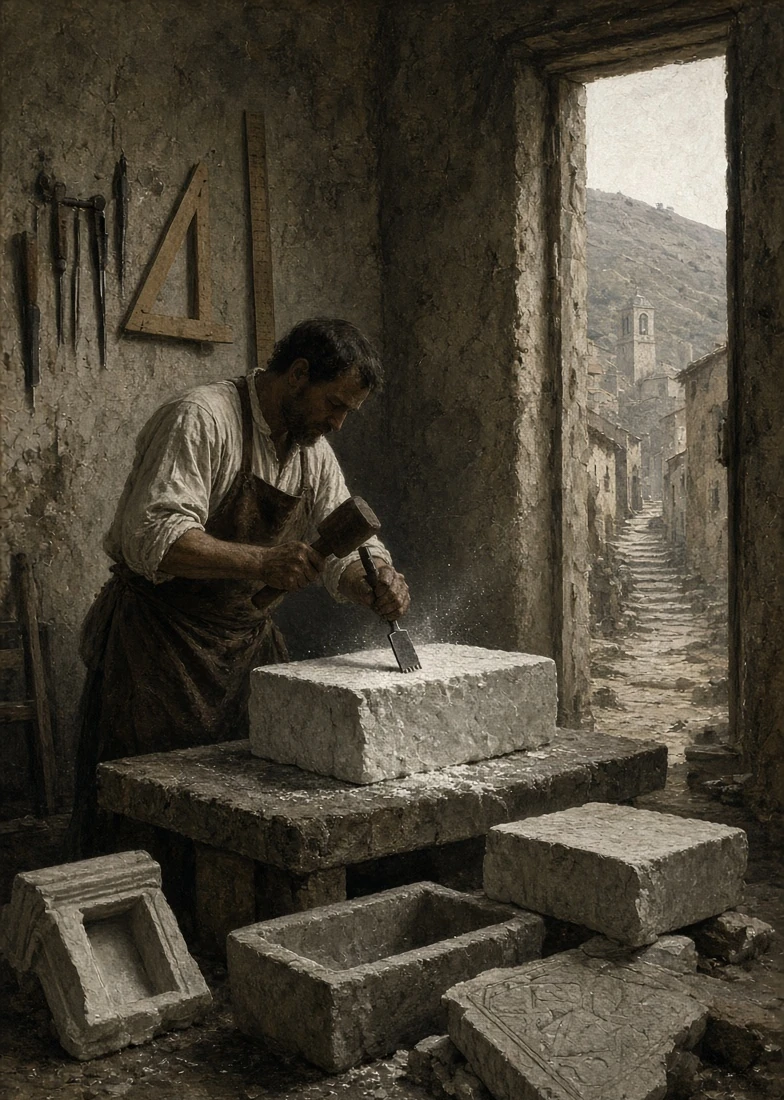
A lapidarius of Gračišće. This is not Antonio. No likeness of Antonius Defranceschi exists
and none is claimed here. The face in this picture is invented, and because it is invented it is not given his name
— a made-up face captioned with a real person's name is a forgery, and that rule does not bend for a good painting.
What it is instead is the trade, which the record does describe. The Gračišće Status Animarum of 1870 enters house 19
as «Antonius Defranceschi, lapidarius» — stonecutter — born 20 September 1825; his father in house 5 was an
agricola, a farmer, and his son Josephus carried the trade to the coast, where the Crikvenica register of
1906 calls him «vešti klesar sada tvorničar», a skilled stonemason now a factory worker. A lapidarius is not
a sculptor. He cut window surrounds, kerbs, troughs and grave slabs out of white Istrian limestone, and the workshop
was poor. Every one of those things is in the picture, and they are the reason it is here.
Checked against the family tree
Checked against the family's own tree, September 2026
This archive had been leaning on a GEDCOM exported from MyHeritage in July 2018 — 8,286 people. David's live tree holds 15,643, and his verdict on the old file was that it is «really old and really wrong». So the live tree was read directly: 459 individuals of this surname, with their dates, places and — the part that matters — the source citations David enters by hand. The direct line agrees wherever both hold a fact. Where they differ, or where one has something the other lacks, it is set out here rather than quietly merged.
Generation 1 — and an ark on the man nobody could put a page in front of
This page has said for months that Giovanni, 1750–1829, is carried on the family chart and implied by «q. Joannis», but that no register page had ever been put in front of him. The tree gives him a birthplace, a death place and a citation: born 1750 at Gologorica, died 14 October 1829 at Gračišće, with FamilySearch image 3:1:3QS7-899X-5SJM. That is the first documentary handle on generation one this project has ever had.
Generation 2 — a death date, and a birthplace that moves
The tree gives Giovanni Battista as born 13 August 1787 at Gologorica and died 14 September 1846 at Gračišće. This archive had the birth date from the Gologorica register and the death only as a year. The birthplace matters: it puts the move from Gologorica to Gračišće between his birth and his son's, which is exactly where the 1819 marriage to Francisca Salamon sits.
Generation 3 — the day he died
Antonius the lapidarius, died 4 August 1894 at Gračišće, ark 1:1:6YBR-MQ7K. This archive had 1894 from the parish repertorium and no day. The tree also carries his occupation in plain English — «Lapidary» — and his whole household as a timeline: the son of 6 August 1856, the marriage of 25 November 1856 fifteen weeks later, and then Francisca born 21 April 1858 and dead on the 23rd, Catharina born 22 November 1859 and dead 6 June 1868, and four more.
Generation 4 — the three-day disagreement, settled by the parish's own second book
This site read the Gračišće baptismal register as baptised 23 March 1863, born the day before — so 22 March. The tree gave 19 March 1863, and both were printed here until an image could settle it. The image has arrived. The Gračišće Status Animarum, photographed in the reading room at the Državni arhiv u Pazinu, carries house 24 headed by Maria Defranceschi née Fernazar, her condition entered as OBSTETRIX — midwife — born 17-10-1832, married 25-11-1856, died 10-1-1916. That marriage date is Antonius the lapidarius's own, so this is his household under a later house number, and the children are listed beneath her. The third of them is Josephus, «Nativitatis dies mensis et annus» 22-3-1863. Two books of the same parish, written by different hands for different purposes, both say 22 March, and the column says birth and not baptism. This archive now prints 22 March 1863 and records 19 March as the reading that lost. It did not lose quietly: the family monument at Crikvenica, cut after 1936, is incised ✻19.III.1863 beside his wife's ✻19.IX.1863 — two nineteenths, sixty years after the fact, from people who were not consulting a register. That is where the tree's date almost certainly comes from. The same Status Animarum line adds a smaller thing worth keeping: against Josephus's marriage the priest wrote «1887?», with the question mark. The tree gives 12 October 1889 at Klenovica. The priest at Gračišće was guessing at a wedding that had happened somewhere else.
Generation 5 — and his wife's baptism, with an image reference
Anton Rudolf agrees exactly: born 20 January 1890 at Ledenice / Klenovica 22, dead about 1943 at Crikvenica. And his mother Ana Kalanj, born 3 January 1864, now carries a hard image citation — «Ledenice, Modrus-Fiume, Hungary records», FamilySearch 3:1:3QS7-L99X-K7DD, image 33 of 342, Hrvatski državni arhiv u Zagrebu, image group 005494765. That is a page number, not a database entry.
And the 1979 that was not 1999
This site has carried an open question about Zdravko: the family file and the MyHeritage tree both once gave his death as 1999 at Horsham, while two Horsham memorials give December 1979. The tree now cites the Australia, Victoria, Index to Probate Registers, ark 1:1:JVKL-2T1, for «Zdrovko De Franceski». Probate the year after a December 1979 death is what the record ought to look like. The 1999 was the error and this closes it.
David Defranceski's live MyHeritage tree, «My Family Tree (Defranceski, Lerena, Taylor, Barry, Blazevic, Booyzen)», read from his own logged-in session on 7 September 2026. 459 individuals of the surname harvested with their facts and citations; the working notes are in this project's repository. The July 2018 GEDCOM export is retired.
Gračišće, photographed
Gračišće, photographed
Three stones from the cemetery of the parish this line came out of — including the one that turns Francisca Salamon from a surname into a family still in the ground.
The eldest son
Raymundus — the eldest son, and what happened to him
He is one line on a card on this page: «Raymundus — eldest of four sons». He is also the reason this line exists in the shape it does, because the house went to his younger brother. The Status Animarum page has been re-read at full magnification for him, and the record indexes searched in every spelling. Here is everything there is.
What the page actually says
House 5 of Gallignana, in the ruled columns: «Raymundus eorum filius · 9 8bris 1823» — their son, 9 October 1823. Born thirteen months before Antonio. The four tick-columns beside him — vaccinatus, confirmatus, confessus, communicatus — are all four marked, so he was vaccinated, confirmed, and admitted to confession and communion. His brother Franciscus Liberatus, born 1840, has only the first two ticks, which dates the writing of the page: after the father's death in September 1846, and before the youngest boy came to communion. Say about 1848.
And what it does not say
The «Matrimonii contracti» and «Obitus» columns are empty for every one of the children. Their father's marriage and death are entered on his own line; not one of the four sons has either. So the page tells us Raymundus was alive, at home, and unmarried at Gallignana at about twenty-five — and then the priest stopped keeping it up, and the household falls out of the record on that line.
Searched, and not found
Every spelling of the surname against every form of the given name — Raymundus, Raimondo, Rajmund, Raymond — across the whole indexed record: Croatia, Italy, Austria, the United States, Brazil, Argentina. Nothing. Not a marriage, not a death, not an emigration. The name is rare enough that a hit would be unmistakable, and there is no hit. He is not in the indexes at all, anywhere, ever.
What the silence probably means — and the three ways to break it
An eldest son who is at home at twenty-five and then never appears again, while the second son inherits, marries and moves to house 19, is a recognisable shape. He died young, or he left, or he went into the church. Inferred — the archive is not choosing between them.
Three things would settle it, and all three are bounded. The Gallignana death register for 1848–1880: one book, and if he died at home he is in it. The Gallignana marriage register for the same years: if he married out of the parish, the entry names his father. And the Austrian conscription lists for the County of Pazin — 1848 and 1849 took men of exactly his age, and the Kriegsarchiv in Vienna holds the Grundbuchblätter.
One more thought worth writing down rather than acting on: 1848 is the year of revolution, and a literate twenty-five-year-old farmer's son in a Habsburg county was precisely who got called up.
Why he matters even so
Because of what his absence did. Antonio, the second son, becomes the stonecutter of house 19 — and the whole of this archive's spine, down through Josip, Anton Rudolf, Ivan, Ivan and David, runs through the younger brother. If Raymundus had married and stayed, the line on this page would be a different household in a different house, and most likely still in Istria. One missing man is the hinge.
Status Animarum of the parish of Gallignana, house 5 — Državni arhiv u Pazinu, DVD 18, ZM34K 217, M01072071, supplied by the archive in 2021 and re-read at full magnification in September 2026. The negative was run against the FamilySearch record indexes in every spelling of surname and given name, with no country filter.