Zuane Ivan Franceschi
A landowner on the Omiš coast who took in six hundred refugees and kept them for two and a half years, then raised a company at his own expense, took the town of Imotski before the Venetian army arrived, was first through the wall of the fortress — and was ruined by it.
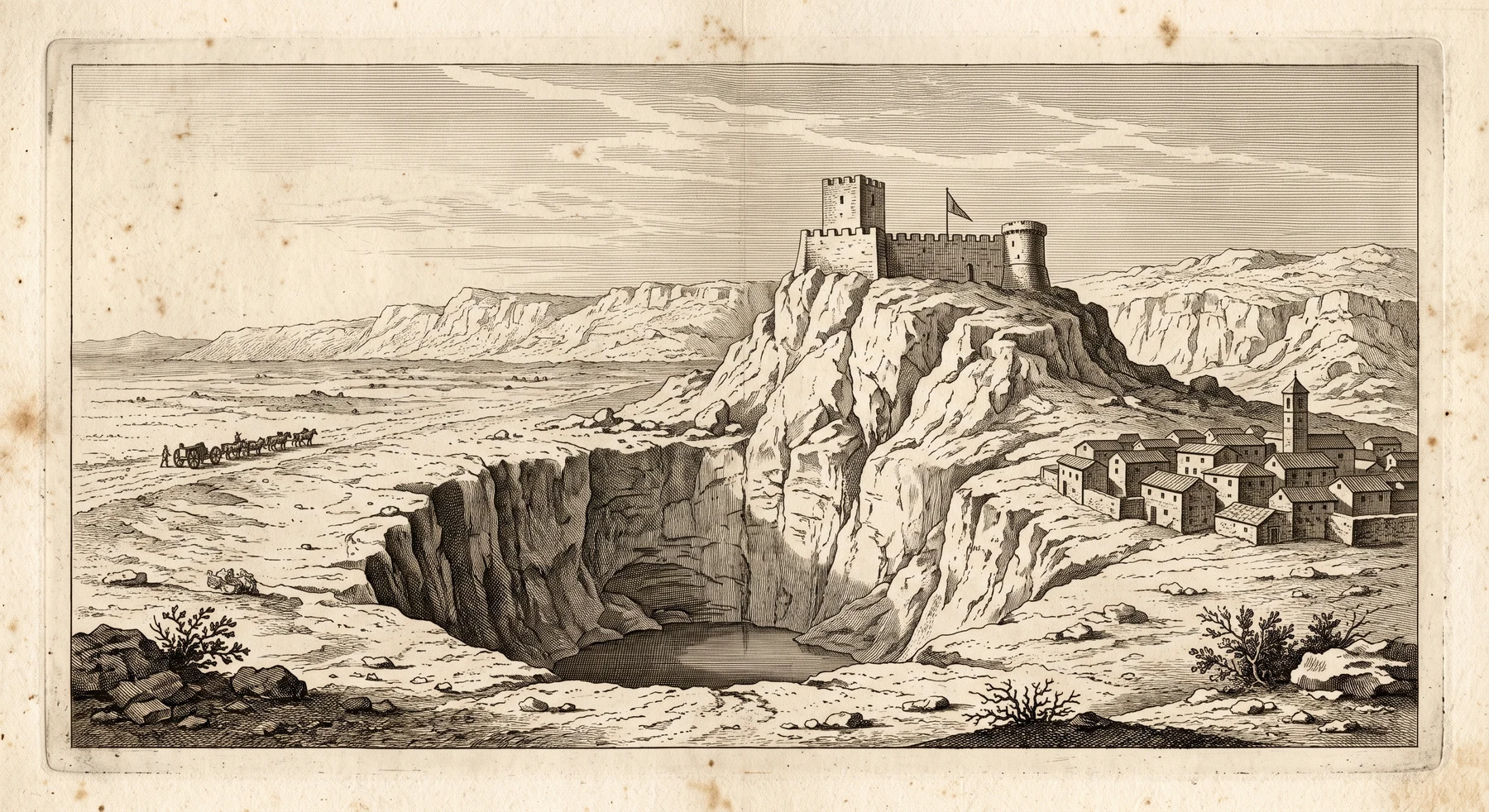
Two things in it are the model’s and not the record’s, named here so that nobody mistakes them for findings. At Imotski the fortress stands directly on the rim of the sinkhole; here the crag and the chasm are drawn as neighbouring features. And the fortress is rendered in a generic Venetian manner — square keep, round tower — rather than as Topana, which was an Ottoman work. The brief, its negative constraints and the checks against them are kept with this project’s papers, and the unaltered original file is in its source library.
The life
*The war he was caught in was not about him.* On 9 December 1714 the Ottoman Empire declared war on Venice, and inside a hundred days the Republic lost the whole Peloponnese, the great prize of the previous war. In July 1716 an Ottoman army landed on Corfu; the siege was lifted in August. Austria came in on Venice's side in April 1716 and won the battles that mattered — Petrovaradin, then Belgrade in 1717. Dalmatia was a sideshow of a sideshow: a mountain frontier where the pasha of Bosnia came down on Sinj in the summer of 1715 with a reputed forty thousand men and was thrown back. It is on that frontier, in that summer, that this family enters the record.
*January 1715: the refugees. The Ottoman line ran within sight of the Franciscan house at Prološko blato. When it broke, fifteen friars and the people of the Imotski district went over the mountain and down to the sea. On 11 January 1715 Zuane Ivan Franceschi took the whole of it onto his own land at Dobrče — today Pisak, on the coast road below Omiš: the fifteen friars, about two hundred families, some six hundred people, and their livestock. They stayed until July 1717. Two and a half years of feeding, pasturing and defending a refugee camp on a private estate, in a war, with thieves working the coast. He also went to Alvise Mocenigo III, the Provveditore Generale of Dalmatia, and got them leave to build a monastery at Skalice in Omiš, where until then there had only been a chapel. That house carried the by-name imotski* until the Imoćani went home.
*Nobody wanted the campaign. Venice was exhausted and had lost the Morea; the Imotski kadiluk* was of no strategic use to a republic whose priorities were now at sea. The push came from below — from the friars in exile, from the Omiš gentry, Franceschi and Caralipeo among them, and from a Mostar-born merchant, Šoić-Mirilović, who offered to pay for the artillery and to cover the loss of any gun, and put up a deposit in gold to make Mocenigo move. Only then did Mocenigo order Balbi and General Emo to raise an army.
*What it cost the brothers.* Three of them — Zuane Ivan, Frane and Matija — recruited a company of 250 men and carried the cost themselves. The state's money ran two months late and the rate was halved: ten soldi a day for a foot-soldier, down from twenty, and a piece of ship's biscuit. Fra Stipan Vrljić and fra Lovre Šitović raised the local volunteers, mostly Imoćani out of the refugee camp with some men from Sinj. Count Pavao Caralipeo brought the guns over roadless country on ox-teams as far as Zadvarje; from there the volunteers dragged them. Of the three brothers only Zuane went with the company as its commander.
*25 July 1717. He took the varoš — the town below the rock — before the main force arrived. When Emo came up that evening with all his artillery he found the work already done, and said so to the Doge on 1 August: «nakon što je Gov. Zuane Franceschi zauzeo varošicu…»*, after Governor Zuane Franceschi had taken the town. What was left was the fortress on the cliff above the lake, held by a garrison who refused the summons, provisioned for a siege, expecting relief from the thirty thousand Ottoman troops gathered in the Duvno plain — relief that never came, because their communications had been cut. The sappers went at the base of the rock. Somewhere in that, Zuane Ivan Franceschi went through the outer wall first and put the standard of St Mark on it.
*And then it destroyed him. He had bankrupted himself on the campaign. The reward was the begluk* of the arci-beg Čaušević on the Vrljika — a house, a Turkish tower, eight mills — and it was worthless when he got it: the district had fled, the mills barely turned, and grain could not cross a new and skirmishing frontier from the Bosnian hinterland. With nothing left he took a Venetian war galley, and off the Albanian coast near Durrës the Turkish galleys caught the fleet and destroyed it. He escaped on the flagship, which happened to carry the war chest — and saving the money is the only reason Venice did not imprison him for life for the loss of the ships. They interned him instead on his own estate at Pisak, forbidden to leave it. He never saw Omiš again and never returned to Imotski. He died at Pisak in 1741 and lies in the little church of St Mark, built in 1564, where his grave still is.
*The frontier he helped fix is still there.* The Treaty of Passarowitz of 21 July 1718 confirmed the Dalmatian gains, and the line drawn then is, with adjustments, the border between Croatia and Bosnia-Herzegovina today. Imotski is in Croatia because of that summer. Of the seventy Venetians living in the town afterwards, only the de Franceschi settled and stayed.
*Two things survive of him that are not deeds. One is a letter to his friend Dr Antonio Lubin, written after he had ridden round the freed district, describing the karst chasms above Imotski — «Crven je to kamen, a nema na njemu ni mladice ni grma da pruže utjehu tim strahovitim liticama», it is red stone, with neither shoot nor shrub on it to comfort those fearful cliffs — printed long afterwards in the Zadar weekly La Dalmazia in 1846, and still one of the most vivid descriptions of that landscape anyone has written. The other is a song. Fra Andrija Kačić Miošić, a contemporary, put the taking of Imotski into the Razgovor ugodni naroda slovinskoga — the Pismarica*, first printed 1756 and reprinted sixty-five times — in the folk decasyllable, to be sung to the gusle. He is in it. But he is in it under the wrong name.
*The name that was not his. Perinuša, the estate, is not called after him or after any Franceschi. It is called after the Perinović — Perin — of Zadar, whom the family brought in at the start of the eighteenth century as stewards and overseers, and who followed them to their other properties. The by-name attached to the place, then to the owners, and so Kačić sings of the hero of Imotski as «Perinović Ive». After 1945 the same confusion was used against the family, as evidence that the Franceschi were merely Italianised Perinovići and therefore not to be trusted; the two lines are distinct and the genealogy runs unbroken from the fourteenth century. The other standing slander — that an ancestor rode round the estate in a day and kept whatever he could enclose — is answered by the documents: the land was a begluk* that had belonged to Ottoman lords for two centuries, and it was assigned in lieu of pay.
*Why almost nobody in Imotski knows this.* Because the story that took hold instead is that the Ottomans fled from a herd of cattle with candles tied to their horns, and that the town was freed by the friars and the people alone. A local historian working the Zadar and Omiš archives put it bluntly: the friars never repaid the memory of the man who housed them for two and a half years, and his part was deliberately pushed out of the account so that theirs should not be diminished. The Venetian dispatches say otherwise, and they were written the same week.
The world around him
Assembled automatically from the timeline for the years of his life.