Antenati
What Antenati holds
The Italian State Archives' own portal, which for most of this research was closed to us. Opened by hand, it answers two questions that had been left hanging — and the answers are not the ones we wanted.
There are indexes. This archive read 1,350 acts without them.
The research queue has said for months: “No index, no indice decennale, no marginal surnames — all three checked and absent. One screenshot per act.” That recipe governed twenty-eight years of death-register sweeps.
It is wrong. Antenati's own catalogue lists one hundred index volumes for Arienzo alone — thirty-nine for deaths, forty-four for marriages, seventeen for diversi — and seventy-nine more for San Felice a Cancello.
Arienzo death indexes run 1809 = an_ua14271, one volume a year — verified at 1818, 1828 and 1834. Each is one to four images. A year of the register itself is about fifty images and ninety acts.
And this is what an index holds, column by column:
Num.° d'Ordine | Nomi e Cognomi de' Defunti | Patria | Professione | NOMI E COGNOMI DE' GENITORI | Giorno della Morte
Every death of the year, with both parents named, on one opening — the same information the sweeps were extracting one screenshot at a time.
Two cautions, because this is not a free lunch.
The sort order changes from year to year. 1818 is alphabetical by forename; 1834 is by surname. Check before assuming.
The scans are not always complete. The 1834 index is a single image covering A to C only, and marked END. A name beyond C is simply not there. An absence in an index is not a negative.
What it changes, and what it does not. The register is no longer the place to start — read the index, then go to the acts that matter. But the acts still carry what an index omits: the street, the hour, the declarants, and the word «parente» on which this archive's best finds have turned. Corrections →
Two missing volumes
Two people in this archive could not be documented: Angelo Zampiello , born at Arpaia on 31 August 1895, and Filomena Annecchino , born at Forchia on 10 April 1897. Neither appears in FamilySearch, and neither appears in Antenati's name index.
The reason is now clear, and it is the same in both cases. The volume is not digitised. The archive's own shelf-marks give it away — they run consecutively and skip a year:
Arpaia, births
1890·591 · 1891·592 · 1892·593 · 1893·594 · 1894·595 — 1895 absent — 1896·596 · 1897·597 · 1898·598 · 1899·599 · 1900·600
The shelf-marks do not skip. The year does.
Forchia, births
1890·3654 · 1891·3655 · 1892·3656 · 1893·3657 · 1894·3658 · 1895·3659 · 1896·3660 — 1897 absent — 1898·3661 · 1899·3662 · 1900·3663
The same pattern, two years and one province apart.
So these are not research failures. They are two specific volumes, each holding one of the two births this archive cannot prove, and each sitting un-scanned in the Archivio di Stato di Benevento. Anyone able to order or read them would close both questions at once.
Moiano — a cluster nobody had looked at
Antenati's name index was harvested in full for both surnames: 439 Zampiello and 603 Annecchino records. They do not sort the way the FamilySearch harvest suggested.
| Surname | Total | Arpaia | Moiano | Forchia | S. Agata | Airola | Dugenta |
|---|---|---|---|---|---|---|---|
| Zampiello | 439 | 259 | 104 | 16 | 19 | 10 | 0 |
| Annecchino | 603 | 63 | 215 | 237 | 40 | 0 | 9 |
Moiano is the second stronghold of both families — 104 Zampiello and 215 Annecchino — and until now this archive had never once looked there. It sits in the same valley, about ten kilometres from Arpaia. Whether the Moiano Zampiello are the same kindred as the Arpaia Zampiello is untested; with 37 bearers left in Italy it would be surprising if they were not.
The seam that has not been touched
Beyond the name index, Antenati holds the register images themselves — and among them the processetti, the marriage supplement files. These are the richest genealogical source in the Italian system: attached to each marriage are the couple's birth extracts, the parents' consents, and the death certificates of any parent already dead. One file can carry two generations backwards.
| Town | Births | Marriages | Deaths | Processetti | |
|---|---|---|---|---|---|
| Arpaia | 99 | 61 | 61 | 43 | Zampiello home town |
| Forchia | 110 | 71 | 73 | 73 | Annecchino home town |
| Moiano | 131 | 82 | 109 | 99 | second cluster of both — unexamined |
| Paolisi | 100 | 70 | 63 | 43 | where Francesco Falco came from in 1714 — unexamined |
258 volumes of marriage supplements across these four towns, none of them read. That is where Matteo Falco's parentage would be found, if it survives anywhere.
Moiano and Paolisi, swept
The name index was harvested town by town — 1,087 records.
| Town | Falco | Zampiello | Annecchino |
|---|---|---|---|
| Paolisi | 406 | 0 | 1 |
| Moiano | 310 | 104 | 215 |
| Forchia | 31 | 16 | 237 |
| Arpaia | 22 | 259 | 63 |
| Arienzo | 0 — not indexed | — | — |
Paolisi holds the largest Falco cluster in the valley — and it is where Francesco Falco came from when he turned up at Arienzo in 1714.
And a caution that matters more than the counts
716 Falco records at Paolisi and Moiano is a great many, and the temptation is to absorb them. The in-law names say don't. The Arienzo Falco marry Crisci (113 register pages), Morgillo (76), Martone (49), de Lucia (40). Set that against the others:
| Town | Who the Falco there married | Shared with Arienzo |
|---|---|---|
| Paolisi | Carbone, Maietta, Lanni, De Gregorio, Nola, Maddaloni, Perrotta, Guerriero, Mauro, Girardi, Tirone, Cioffi | Ruggiero, Rivetti only |
| Moiano | Amoriello, Maglione, Tedesco, Massaro, Cesare, Tirino, Buonanno, Palma, Mauriello, Izzo, Ciaramella, Iodice | Morgillo only |
These look like largely different populations — which is exactly what this archive's founding premise predicts, since Falco was coined independently many times over. caveat the comparison sets 1861–1942 civil records against 1650–1830 parish records, so some divergence follows from the dates alone. Suggestive, not conclusive — and not a reason to merge anyone into the line.
One further negative worth recording: across all 1,042 indexed Zampiello and Annecchino records there is no Zampiello–Annecchino marriage. They shared four towns for a century without marrying each other.
The processetti — and one volume that matters
321 volumes of marriage supplements: Arienzo 63, Forchia 73, Arpaia 43, Moiano 99, Paolisi 43. Three hard constraints came out of the reconnaissance.
- They stop at 1865. Forchia and Arpaia return nothing for 1866–1950 — so the marriages of Carminantonio and Filomena in the 1920s, and of Angelo Zampiello and Giuseppa Ferrara, are not there. Nor are the marriage registers for those years.
- Arienzo is not name-indexed at all — zero records for Falco or Crisci. The home parish can only be read as images.
- The images are Cloudflare-blocked to direct fetch. The IIIF manifest is open and gives every page URL, but those URLs return a block; they render only inside the viewer on the record page.
The target is identified. Vincenzo Falco married Andreana Crisci about 1817, and the Arienzo processetti for 1817 survive — ark an_ua14158, shelf-mark 66.1021, 310 pages. Under Neapolitan practice a marriage file attaches the groom's birth extract, the parents' consents, and the death certificates of any parent or paternal grandparent already dead.
If Matteo Falco's death act survives anywhere, that volume is where it will be — and it would name Matteo's own father, which is the question this archive has never been able to answer. Reading it means paging a viewer through 310 images. Slow, but it is the obvious next piece of work.
Read from the images: the marriage act of 1814
Antenati's images are Cloudflare-blocked to direct download, but they render inside a page served from Antenati's own domain, and IIIF's region syntax crops and magnifies them server-side. That made the handwriting legible, and it produced a document.
Numero d'ordine 26. L'anno mille ottocento quattordici, a dì quindici 15 del mese di Dicembre… è comparso Vincenzo Falco , di anni ventuno, di professione contadino… figlio maggiore di Pasquale Falco… e comparsa egualmente Andreana [Crisci]… figlia di Arcangelo. — Arienzo, civil marriages 1814, act 26
- The date was wrong and is now right. This archive had the marriage at about 1817, inferred from where it sat in the parish register. The civil act fixes it: 15 December 1814.
- Vincenzo was 21 — born 1793, confirming the family record from an independent source.
- He was a contadino, a peasant farmer. The first occupation recorded for that generation.
- Pasquale was alive. "Figlio maggiore di Pasquale Falco" — eldest son, and the father named without fu, "the late". So Pasquale Falco was living in December 1814.
That last point closes off a hope. Because the father was alive, the marriage file would have carried Pasquale's consent — not the death certificates of dead ancestors. Matteo Falco's death act was never going to be attached to this marriage.
And the file itself is missing
The 1814 processetti volume was worked from the back. Act 25 is there — the publication for Francesco Crisci and Teresa Morgillo, 20 November 1814, with the archpriest's certificate behind it. Then comes a divider card reading "Anno 1815 · Arienzo (66) · dal n° 1 al n° 25", and then January 1815.
The volume runs to act 25 and stops. The second 1814 volume is a separate short series starting again at n° 1. Act 26's supporting file is in neither. Whether it was never filed, was lost, or sits in a volume nobody has scanned is not established — only that it is not on Antenati.
Hunting Pasquale's death — and finding his wife's
With Matteo unreachable through the marriage file, the better route above him was Pasquale Falco's own death act: a civil death record names the deceased's parents outright. The hunt turned up his wife's instead, and it was worth more than expected.
…die vero decima sexta 16: Clara Rivetti , uxor quondam Paschalis Falco , filia quondam Nicolai et Anna…, aetatis suae annorum octoginta 80… obiit, et in Sodalitate Sanctae Mariae Gratiarum eius cadaver humatum est. — Arienzo parish deaths, 1843
- A generation nobody had. Chiara Rivetti was the daughter of the late Nicola Rivetti and Anna.
- She was already a widow, so Pasquale was dead by September 1843. Her stated age of 80 puts her birth near 1763; the family record says 1772, so one of the two is loose. Ages in death records are routinely approximate.
That bracketed his death to 1829–1843 — named without fu at his son's marriage in December 1814, named again without quondam in his daughter Angela's death entry of 1829, and dead by 1843. The Arienzo civil death registers survive one volume per year across that window, all digitised, all without an alphabetical index. So they were read linearly: 1835 first, then 1836, then 1834.
Found: 1 October 1834
Arienzo, an_ua14336, image 43 of 57, page 236, act no. 69.
…sono comparsi Virgilio Saccavino , di anni quarantacinque, di professione contadino, domiciliato ivi, strada Camellara, vicino del defunto, e Nicola Corsi , di anni trenta… i quali han dichiarato, che nel giorno primo del mese di Ottobre, anno corrente, alle ore cinque, è morto nella sua propria casa Pasquale Falco , d'anni settantaquattro, marito di Chiara Rivetti , di professione contadino, nato in Arienzo, figlio di Matteo Falco, defunto, di professione contadino, e di Francesca Crisci, defunta. — Arienzo, Stato civile della restaurazione, Morti 1834, atto 69
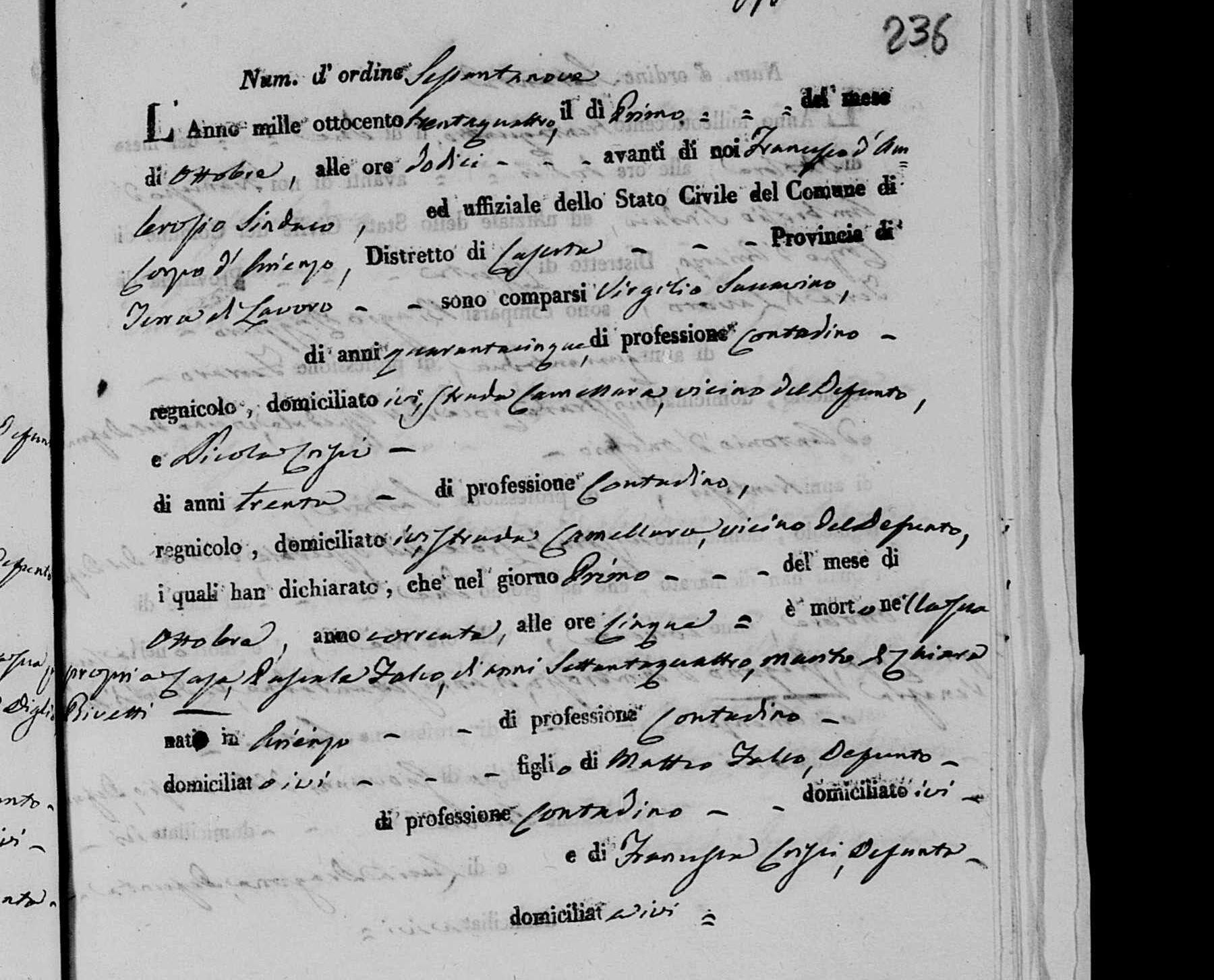
- The oldest open question in the line is closed. He died at five in the morning at his own house on strada Camellara, and was buried from there.
- The parentage is confirmed twice over. The 1767 baptism gave Matteo Falco and Francesca Crisci from the parish register; this gives them again from the civil register, sixty-seven years later, from two neighbours rather than a priest. Two institutions, two record series, one answer.
- Both of his parents were already dead by October 1834 — each marked defunto.
- Chiara Rivetti was still alive. He is recorded as her husband, not she as his widow. She outlived him by nine years.
- The age does not fit. Seventy-four implies a birth around 1760; the baptism is October 1767, which would make him sixty-six. The declarants were neighbours, not family. The parentage and the wife identify him; the age is the loose figure, and is recorded here as such.
Three more Falco deaths in the same year
Reading the volume in full — rather than stopping at the target — turned up three others, and together they put an address on the family.
- Pasquale Falco, ten days old, died 25 December 1834, son of Vincenzo Falco of strada Camellara. Vincenzo is the elder Pasquale's eldest son — named as such in his own marriage act of 15 December 1814. This child was born about a fortnight before he died, eleven weeks after his grandfather, and given his name. He is the ancestor's namesake and his grandson, and he lived ten days.
- Maria Rosa Falco, sixteen, contadina, died 30 May 1834, daughter of Michele Falco of strada Camellara. Michele's household buried a fourteen-month-old son, Salvatore, in August 1836.
- Anna Falco, eight days old, died 7 March 1834, daughter of Michelangelo Falco of strada Camellara — a name new to this archive.
Going back a year further: 1833
With the target found, the neighbouring years are still worth reading — the Camellara cluster is unexplained, and every act names parents. 1833 (an_ua14335, 58 images) yielded one Falco, and it turned out to matter.
Num. d'ordine sedici… sono comparsi Grazio Torrino, di anni quaranta, di professione contadino, domiciliato strada Camellara, vicino del defunto, ed Angelo Lombardo, di anni trenta… i quali han dichiarato, che nel giorno ventidue del mese di Febrajo, anno corrente, alle ore una di notte, è morto nella sua propria casa Pasquale Falco, di anni tre, nato in Arienzo, figlio di Vincenzo Falco , di professione contadino, e di Andreana Crisci . — Arienzo, Morti 1833, atto 16
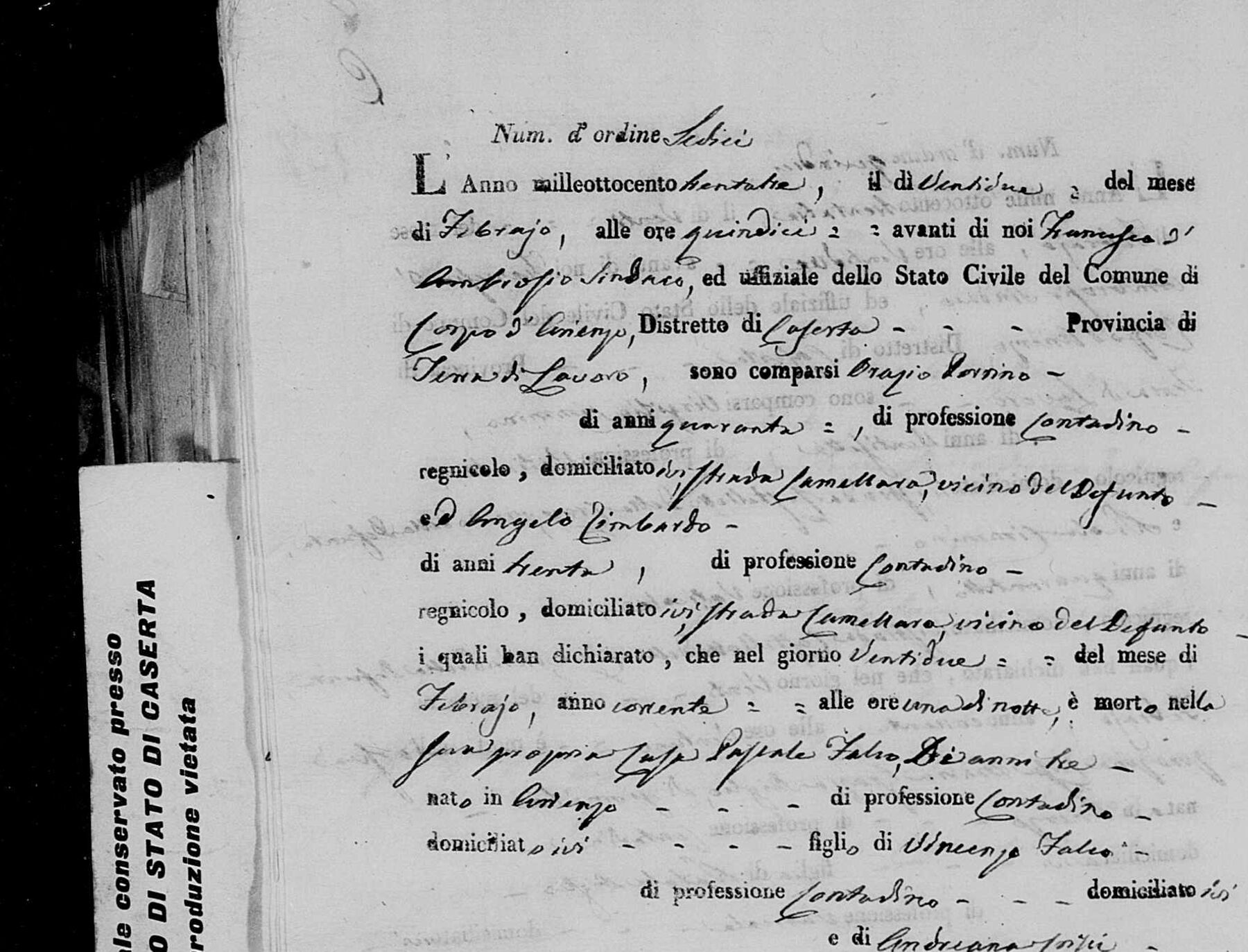
- The first civil record of Vincenzo Falco and Andreana Crisci as a household, at their address. Until this, the couple was attested only by their marriage act of December 1814 and by their son Raffaele's baptism in 1818.
- He used his father's name twice, and buried the child both times. This Pasquale died at one in the morning on 22 February 1833, aged three, while his grandfather was still alive. The grandfather died on 1 October 1834. About a fortnight after that, Vincenzo's next son was born and given the name again — and died at ten days old on Christmas Day. Two children, one name, twenty-two months apart.
1832: a second Falco household in the founding generation
1832 (an_ua14334, 53 images) gave two Falco, and the first of them opens a door that had been shut.
…è morta nella propria casa Giovanna Falco, d'anni settanta, moglie di Antonio Sett[embre], nata in Arienzo, di professione contadina, figlia di Michele Falco, defunto, di professione contadino, e di Vincenza Esposito, defunta. — Arienzo, Morti 1832, atto 32, 14 May 1832
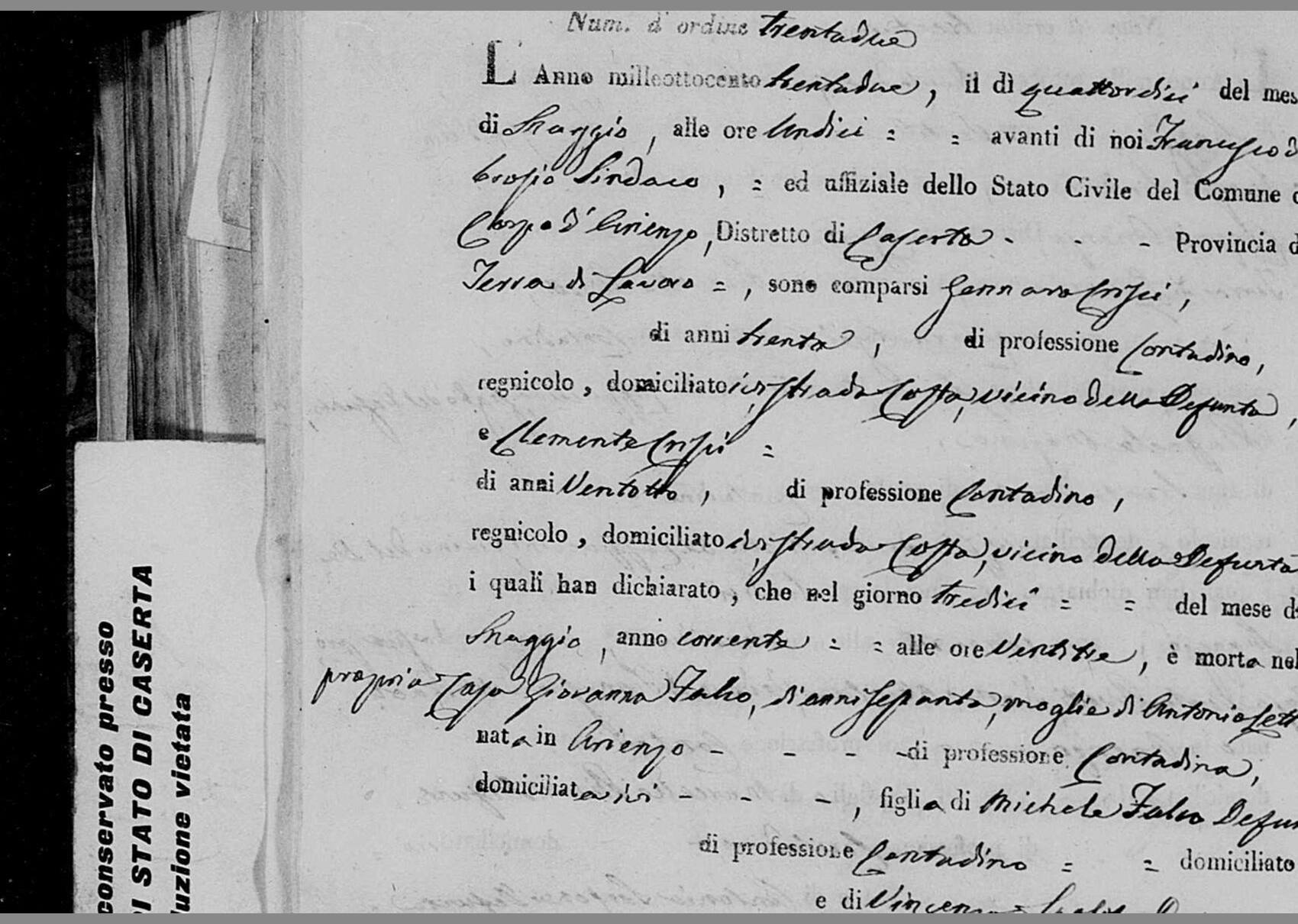
Giovanna was born about 1762, five years before Pasquale. Her father was Michele Falco , a contadino, married to Vincenza Esposito . Pasquale's father was Matteo Falco , a contadino, married to Francesca Crisci .
So there were two peasant Falco households at Arienzo in the founding generation, both raising children in the early 1760s, in a town of a few thousand people. Whether Michele and Matteo were brothers is not established — it is the obvious reading, and nothing yet proves it. What the act does give is a second named Falco couple of that generation, and a plausible source for the Michele and Michelangelo Falco who turn up on strada Camellara in the 1830s. It is the first real handhold above Matteo that this archive has found.
A Falco who married a Falco
The second, on the last page of the year:
…è morta nella sua propria casa Carmina Falco, di mesi sei, nata in Arienzo, figlia di Francesco Falco , di professione contadino, e di Raffaela Falco . — Arienzo, Morti 1832, atto 80, p. 145, 19 December 1832
Both declarants — Giovanni Crisci, thirty-two, and Francesco Lettieri, forty — were contadini of strada Camellara, the neighbours again. And Francesco Falco's wife was herself a Falco. In a town this size that ordinarily means cousins, and it would have needed a dispensation to marry. This is the same Francesco Falco whose ten-month-old daughter Pasqualina died on that street in September 1836: his household now stands at both ends of the sweep.
The Morgillo were already neighbours
On 9 May 1832 Raffaele Morgillo , twenty-two, son of Carlantonio Morgillo, died on strada Camellara. Two generations later Raffaele Falco — the fourth generation of this line — married Angela Rosa Morgillo . The family he married into were living a few doors away before either of them was born. That is what these registers are for: not only the line, but the street it happened on.
Why these years cannot be searched, only read
Each annual volume has a printed form bound into the back: “Tavola alfabetica annuale de’ Morti per l’anno mille ottocento…” — an alphabetical index, with ruled columns for surname, forename, birthplace, profession, parents and date of death. In Arienzo it was left blank. The clerk signed the closing certificate and never filled the table in.
That is the concrete reason the 1829–1843 hunt could not be shortcut, and it is worth stating plainly for anyone who comes after: it is not that these volumes lack an index. It is that Arienzo's index pages were never completed. There is no substitute for reading the acts.
Strada Camellara
Across the seven volumes now read, six Falco householders are recorded on the same street: Pasquale, his son Vincenzo, Michele, Michelangelo, Francesco, and Giuseppe — with Pasquale's sister Rosa, who married Carlantonio Morgillo, living there too. Every one of them a contadino, and the declarants who came to the town hall for each death were neighbours from the same street. Whether the four besides Vincenzo are Pasquale's other sons, his brothers' sons, or unrelated Falco is not yet established — but they are one neighbourhood, and the answer is in the birth registers.
The gentry Falco of Arienzo — Don Francesco Falco, proprietario, and his daughter Donna Raffaela, a nun of the Ave Gratia Plena, both in the 1836 register — live elsewhere in the town. Nothing so far joins them to this family, and this archive does not join them.
Eight years, read end to end
The registers for 1829 through 1836 have now been read image by image — roughly four hundred and sixty images and some nine hundred acts. Eight years, twelve Falco deaths, and one year — 1829 — with no Falco in it at all.
That null is worth stating, because it cuts against something this archive had been relying on. The claim that Pasquale was alive in 1829 rested on a parish entry, read through machine transcription, naming him without quondam at the death of a daughter Angela. The civil register for that year contains no Angela Falco and no Falco of any name. A death at Arienzo should ordinarily be in both books. The parish entry needs re-reading against the image before it is used again — and it is now an open question. It changes nothing about the line, because the death act of 1834 settles that independently.
Where it was searched for and not found, so nobody repeats it: 1,145 pages of the Arienzo parish death register harvested from FamilySearch's full text — searched by name, by OCR variant, and by male-adult-with-age across 1828–1845; and every one of the 1,162 Falco records in FamilySearch's index of Caserta civil registration 1809–1866, of which 249 fall in the window. The only "Pasquale Falco" principals there are two Falcone men of other families. The act exists in none of them. It was found only by reading the register itself, act by act — 1835 and 1836 in full and empty of him, then 1834.
What this changes
- Antenati is reachable. Earlier work recorded it as blocked; it is not, and the open questions have been updated accordingly.
- Two unproven births are now located rather than merely missing — a specific volume each, in a specific archive.
- Moiano and Paolisi join the list of places this family has to be searched in.
- The processetti are the largest unworked seam — 321 volumes — but they stop at 1865, which rules them out for the twentieth-century marriages.
- Pasquale Falco's death act has been found, and with it his parentage confirmed from a second, independent record series. The 1829–1843 search is closed.
- Strada Camellara is the family's address, and four more Falco householders on it are now named.
- Five annual death registers have been read in full — 1832 through 1836 — and the page-by-page logs are published with the archive, so the reading does not have to be repeated. Ten Falco deaths in five years, almost all of them on the same street.
- A second Falco couple of the founding generation — Michele Falco and Vincenza Esposito — now stands beside Matteo and Francesca. The relationship between the two households is the next thing worth proving.