The Kosina
30 people, from a Carniolan cottage where three infants died in eight years to an autumn in Senj that took three grown Kosina in thirteen months — the family Hedviga's own aunt married into, and for a long time the family this archive could not see.
This family had no page here until a week ago, and the reason was a rule rather than a doubt. This archive publishes the people of eight surnames, and Kosina is not one of the eight — so ten people who are as much a part of this family as anyone in it were nowhere on the site. They existed here only in fragments: a name on a list of the Senj dead, a marriage that brought the Boras in, and one line cut at the foot of somebody else's gravestone.
The rule changed on 21 September 2026. What decides publication now is descent and not the spelling of a surname, so everyone drawn on this page has a page of their own — apart from two who may still be living, and those two are named and nothing more.
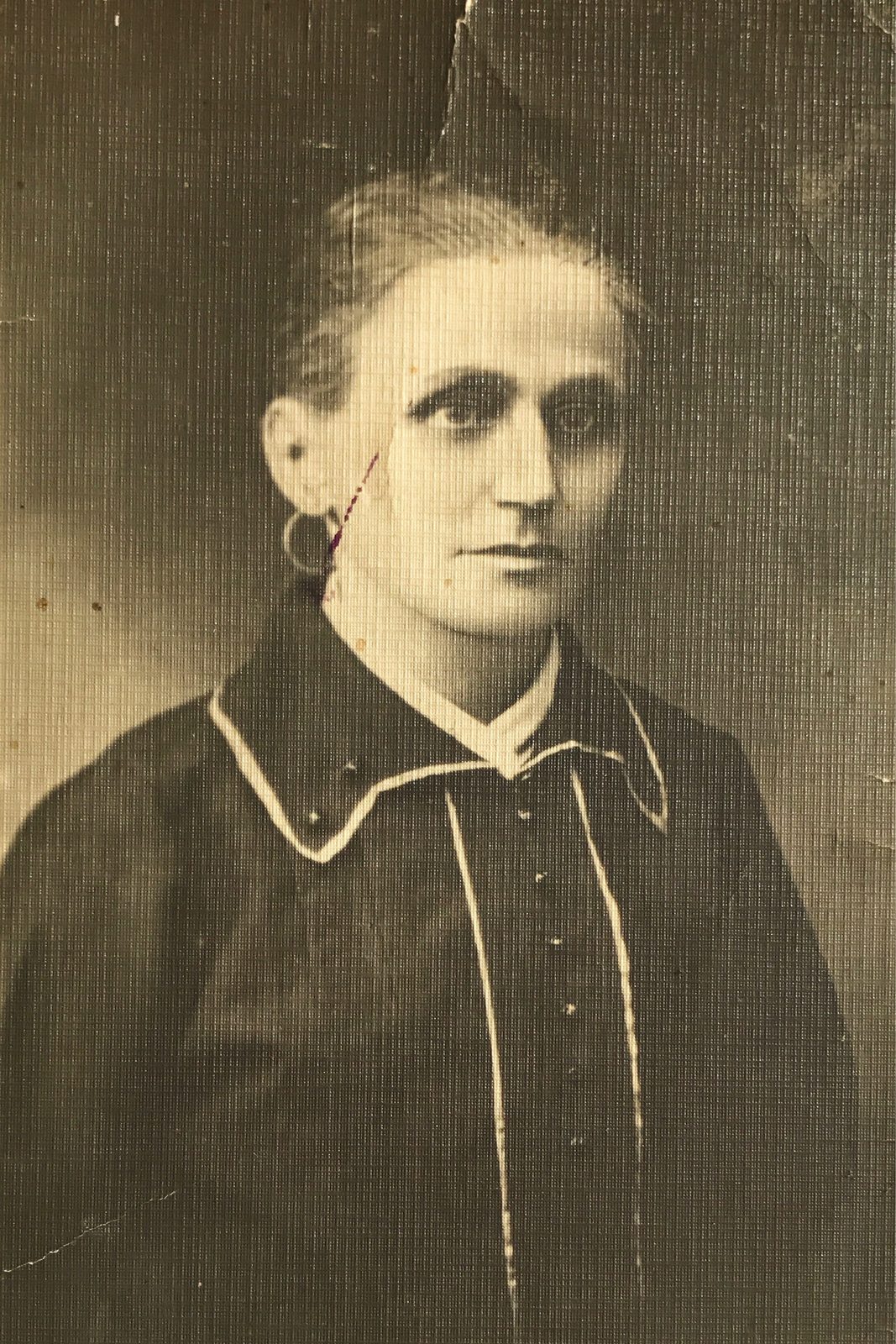
They join this family twice over. In 1919 Pavao Kosina married Anka Blažević, the daughter of Juraj Blažević and Tereza Žubrinić — Hedviga's own grandparents. That makes Anka Hedviga's aunt, her father's sister, and the five Kosina children of that marriage Hedviga's first cousins. And Pavao's own mother was Angelika Boras — the woman through whom the Boras enter this archive at all. So two of this archive's eight families meet in one Senj household, and it is this one.
And then the Slovene register was opened, and there he was
The 1888 marriage named the parish. This archive stopped at the border, because Croatian registers do. They did not have to: the Nadškofijski arhiv Ljubljana publishes its books free on Matricula, and the parish is there under its own name — Kranj–Šmartin.
Baptismal index, Kranj–Šmartin 1832–1870 —
104 — Martin Kozina — 64, under 1841
| Born and baptised | 16 November 1841 — the same day. The tree had «1841» and nothing more. |
|---|---|
| Where | Oberfeichting, house 9 — Zgornje Bitnje, a village west of Kranj. |
| Ehelich / Unehelich | The tick is in UNEHELICH — born outside marriage. The register has a column for it and the priest used it. |
| Vater | The column is blank. |
| Mutter | «Gertraud Kosina, hüblnn. Tochter» — a Häusler's daughter, the bottom of the land-holding order. |
| Godparents | Lorenz Pizz and Maria Kashar. Baptised by Blas. Ulzhar, Coop. |
Kranj, 1841 — Vater: blank. Mutter: Gertraud Kosina. Senj, 1888 — a dash where the groom's father belongs. «Gertruda Kozina, posjednica.» The gap in this family tree is not a gap in this family tree. It is what the parish priest wrote down, twice, in two languages, because there was nothing else to write.
And she rose. In 1841 she is a cottager's daughter. By 1888 her son describes her to a Croatian priest as a posjednica — a property-owner.
There is no dagger against her name in 1888, and this page once read that as a sign she was alive on the day her son married. She had been dead for eight years — 5 March 1880, at Zgornje Bitno 9, aged sixty-five. The 1888 priest simply did not mark her. The correction is kept further down, and the rule it cost is the one this page now works by: an absent mark is not a record.
Every other Kozina baptism in that book belongs to one household
There are six in the whole volume. This page said five for six days. On 27 September 2026 the letter-K section of the volume's index was read end to end — entry 1 to entry 369, 1832 to 1870, seven name columns across two openings — and it gave a sixth: Maria, 1859, a daughter this archive did not have. The count was not corrected by searching for her. It was corrected by counting.
| Baptised | House | Father | Mother |
|---|---|---|---|
| Anton 20 Jan 1834 | Oberfeichting 9 | Johann Kosina, Häusler | Lucia Labornik |
| Petrus 29 Jun 1836 | Oberfeichting 9 | Johann Kosina, Häusler | Lucia Labornik |
| MARTIN 16 Nov 1841 | Oberfeichting 9 | — none — | Gertraud Kosina, Häuslerstochter |
| FRANCISCA 19 Sep 1853 | Oberfeichting 9 | Johann Kozina, Hüblar | Ursula Sedej |
| ANNA 25 Jul 1856 | Oberfeichting 9 | Johann Kozina, Hüblar | Ursula Sedej |
| MARIA 7 Aug 1859 | Oberfeichting 9 | Johann Kozina, Hüblar | Ursula Sedej |
«Franz 1853» was a girl
For six days the fourth row of that table read Franz, and this archive built on it: Johann's second family was a son and a daughter. Then the death register produced Franziska Kozina, weiblich, a cottager's daughter dead of measles at Oberfeichting 9 on 7 March 1864, aged eleven — born about 1853. Either a twin, a second child of the same year, or the same child read as a man.
The baptismal page settles it. Book p. 130: 19 September 1853 · Obr. Feichting · house 9 · FRANCISCA · ehelich, father Johann Kozina, Hüblar, mother Ursula Sedej, godparents Johann Pevc and Marina Dolenc — and the stroke stands in the MÄDCHEN column, with a dot in Knaben. Read at eight times magnification, then checked a second way: the tick columns were cropped from the printed heading down to her line and counted against all sixteen entries of the page, so the mark is placed by the column above it and not by eye.
One child, not two. There is no Franz. The index writes the given name short and it can be read either way; the register writes it in full. The death register had her right for eleven years before the baptismal register was asked — and it also gave her back her parents, which the death book never named.
One Häusler called Johann, two wives, twenty-five years — and in the middle of it one unmarried woman and one child with no father. Lucia bore her last recorded child in 1836 and died in that house on 30 November 1850; Ursula is beside the same husband by 1853, and bears him three daughters in six years. The entries from 1853 on spell the surname KOZINA with a z, which is the spelling the Senj priest reached for in 1888.
And what settles it is his marriage. The marriage register for 1816–1855 (sig. 00899) has a column headed «Aeltern des Bräutigams» — the groom's parents. Find Johann's marriage and you have Gertraud's parents too, if she is his sister. The volume carries no index and runs to seventy-seven pages, so it is a scan rather than a lookup, and it is the next thing to do.
Gertraud is a Häuslerstochter — a Häusler's daughter — and she stands godmother on page 33. Johann is a Häusler. Father and daughter, or brother and sister, is likely and it is not established, and they stand in the people this tree does not have and nowhere else.
And then her own baptism was found, by admitting a mistake
The marriage register settled it, because it has a column headed «Aeltern des Bräutigams».
1833, 6. Jänner · Obern feichting 9
JOHANN KOSINAR, Häusler, katholisch, 30, ledig
× LUZIA LABORNIK, house 3, 38, ledig
des Vaters: Franz Kosinar, Häusler · der Mutter: Mina Tom[sh]shan, Häuslerin
And the identification does not rest on the surname at all. Johann Kosina, Häusler of Oberfeichting no. 9, had his first child with Lucia Labornik on 20 January 1834 — a year and a fortnight after this wedding. The house, the trade, the wife and the date all agree.
His father is FRANZ, a Häusler, with a wife written Tom[sh]shan — against the 1814 baptism's Franz Kosinar, Hüblar and Maria Do[m]shan. Mina is the short form these registers use for Marija. The same couple.
So the line runs two generations further back
| Franz Kosinar × Maria «Mina» Dortschen | Martin's grandparents — and four generations above Hedviga. Named in six entries across thirty-three years and never once in person: their own marriage in 1800, four of their children's baptisms, and their son's marriage in 1833. He has a death; she does not. |
|---|---|
| Gertraud | Baptised 18 March 1814. Twenty-seven when she bore Martin. |
| Johann | Born about 1802–03; married 6 January 1833; the Häusler of Oberfeichting no. 9. |
| Martin | Born 16 November 1841 at Oberfeichting no. 9, unehelich — in his uncle's house. |
Gertraud was not a lodger and not a stranger. She was the householder's sister, and she bore her son under her brother's roof seven years after he brought a wife into it.
And then their own marriage, which explains the houses
The 1780–1815 marriage book has no index either, so images 30–35 were cropped to the Bräutigam column and read as strips. It is on image 33, under 1800.
Den 27ten [8ber] · Feichting b. St. Joh. · 10
FRANZ KOSINAR, katholisch, 24, ledig
× MARIA DORTSHEN, katholisch, 20, ledig
Beystände: MATTHÄUS KOSINAR — signing with a cross — and Simon Rauth, Bauern. Married by Matthäus Lauts, coop.
27 October 1800, at twenty-four and twenty. So Franz was born about 1776 and Maria about 1780.
A third Kosinar — and for one day nobody could say what he was. MATTHÄUS KOSINAR stood witness and signed with a cross, because he could not write. A man of the same surname witnessing for a twenty-four-year-old groom is most likely his father or his brother, and this page said for a day that nothing here says which.
And the 1818 candidate is settled rather than merely moot. Her father — read for a week as «Lukas Ko[s]in…», house 12 — is on image 31 of this same book: «LUKAS KOSINA, katholisch, 29, ledig», married 1799, so born about 1770. A real man and a different household. The 1814 Gertraud is left with no rival.
And then the same mistake again, an hour later
Having corrected page 16, this page turned to «Kosina Dorothea — 8», re-read page 8 at 3.2×, found two Dorotheas — house 28 to Primus Wit[nitz], house 18 to Johann Holz — and published that page 8 still has no Kosina.
There are three Dorotheas on page 8. The whole father column was then read at 8×, and the third is:
6. [Hornung 1813] · 12 · DOROTHEA · ehelich
Vater: ANTON KOSINER recte KATZIN, Inwohner
Mutter: MARGARETH ZUBERTH
Both index entries are accounted for now, and neither child belongs to Franz Kosinar's line: Marianna is Lukas's, Dorothea is Anton's.
And one rung further up is a wall, for now
Franz's own baptism is not in this parish. He was twenty-four in October 1800, so born between late 1775 and late 1776. The baptismal register was walked from October 1775 to January 1777 — ten openings, every Infans and Parentes column — and there is no Kosinar in it at all.
The absence says something, because the same surname is all over the same register fifty years later: Johann's children in 1834, 1836, 1853 and 1856, and Gertraud's Martin in 1841. In the mid-1770s it is simply not there.
| He came from elsewhere | He married into Feichting house 10 at twenty-four, which is what a man who marries a household does — and it would make the Kosinar of Kranj–Šmartin his descendants rather than his ancestors. Matthäus the witness cuts against it, and proves nothing either way. |
|---|---|
| The age is wrong | «24» in a marriage register is very often a round number. |
| The name is unreadable | The 1770s hand may write the surname unrecognisably — which it already proved to do in 1814, when «Kosinar» was read as «Kosnar» and a real candidate was struck out on this very page. |
So the death register was opened, and it confirmed him
The death index is letter-tabbed, and the whole K section for 1836–1869 holds exactly two Kozina.
22. — 24. [Jänner 1849] · Ob. Feichtg · 9
FRANZ KOSINA, Ausnehmer · katholisch · männlich · ALTER 73 · Lungenentzündung · versehen
Aged 73 in January 1849 — born 1775–76, which independently confirms the «24» he gave at his own wedding forty-nine years earlier. Two records, two clerks, one birth year. And it means the missing baptism really is missing, rather than the age being wrong.
30. — 2. Xbr [1850] · Ob. Feichtg · 9
LUZIA KOSINA, Hüblersweib · weiblich · ALTER 55 · Lungenentzündung · versehen · Jos. Kartely
Lucia Labornik. Aged 55 in November 1850, so born about 1795 — and she was 38 at her marriage in January 1833, which gives 1794–95. The same woman. She is entered a Hüblers-Weib and not a widow, which is right, because Johann outlived her.
And it answers a question this page had left hanging: why Johann is beside Ursula Sedej by 1853. Because Lucia died in 1850 — in the same house and of the same pneumonia as his father, twenty-two months apart.
The scans are the archdiocese's, not ours, so they are transcribed here and linked rather than republished — index sig. 04632 image 246, register sig. 00886 image 65, at data.matricula-online.eu.
The page we went to find one woman on, and found two
The index for 1812–1835 lists «Kozina Maria — 34» under the year 1816. Page 34 is the left leaf of the eighteenth opening, and the year is written across the top of it. It carries two Maria Kozinar, four weeks apart, and neither of them is Martin's grandmother.
Den 27 [Februar 1816] · Z[ubern] · 4
MARIA KOZINAR, Häubl. · katholisch · weiblich · ALTER 78 Jahre · Altersschwäche
Den 31 [März 1816] · Oberfeichting · 9
MARIA KOZINAR, Häubl. · katholisch · weiblich · ALTER 3/4 Jahr · Fraiß
A woman of seventy-eight and a baby of nine months. Maria Dortschen was twenty at her wedding in 1800, so in 1816 she was thirty-six. The first woman was born about 1738 and the register says why she died — Altersschwäche, the weakness of age. The second had lived three quarters of a year and died of Fraiß, convulsions, which is what this book writes over almost every infant. The index was not wrong. It listed both, one line under the other, and the archive had only read the first line.
So the whole K section was read, and the house came with it
Reading one page for one name is how a search gets long. The K section of the 1812–1835 death index runs across two openings and holds six Kozina; the baptismal index for the same years holds eight. Read together they give a household.
One word recurs below and it is worth having. A Häubler — the same word as Häusler and written Hüblar by yet another clerk — is a cottager: a man with a house and a garden and not enough land to live off, the bottom rung of the village land-holding order. It is what Franz was, what his son Johann was, and what Martin was born into.
| Who | What the register says | How they stand to the line |
|---|---|---|
| Maria Kosinar the elder parish register · not yet in the family tree | d. 27 February 1816, aged 78, of Altersschwäche | The oldest of the name the archive has reached — a generation above Franz and Matthäus. A CANDIDATE for their mother and nothing more: another village, no husband named, and this book names no parents. probably kin — not proved |
| Elisabeth Kosinar parish register · not yet in the family tree | baptised 18 November 1812 · died 11 April 1813, aged five months | Franz and Maria's daughter. Convulsions. daughter of Franz and Maria |
| Maria Kosinar parish register · not yet in the family tree | baptised 8 August 1815 · died 31 March 1816, aged three quarters of a year | Franz and Maria's daughter, and THE «Kozina Maria» the death index sends a reader to page 34 to find. Convulsions. daughter of Franz and Maria |
| Valentin Kosina parish register · not yet in the family tree | baptised 15 February 1820 · died 29 February 1820, aged one week | Franz and Maria's son, fourteen days old. HIS BAPTISM IS THE PROOF OF THE HOUSE: it is the record that puts Franz at Oberfeichting 9 as a Häubler, twenty-one years before Martin was born there. son of Franz and Maria |
| Maria Kosinar the second parish register · not yet in the family tree | baptised 6 December 1818 · d. 6 January 1868, aged 49, unmarried, at Zgornje Bitno 9 | Franz and Maria's sixth known child, named for the sister who had died twenty months before she was born. She turned 49 one month before she died, so the register's age is exact. LIKE GERTRAUD SHE NEVER MARRIED AND NEVER LEFT: both sisters are entered as lodgers in the house they were born in, twelve years apart. daughter of Franz and Maria |
| Ursula Kosina parish register · not yet in the family tree | d. 28 March 1845, aged 85, of Altersschwäche · Oberfeichting 13 | The second-oldest of the name this archive has reached, and at a THIRD Oberfeichting house — neither Franz's 9 nor Matthäus's 14. And she is entered ABNEHMERIN: she had HELD that house and handed it over, the same institution this register calls Franz an Ausnehmer for and Maria Dortschen an Auszüglerin. The third Kosina house in the village was hers. Still only a candidate for the generation above Franz — no parents, no husband, no children are named. probably kin — not proved |
| Franziska Kozina parish register · not yet in the family tree | baptised 19 September 1853 · d. 7 March 1864, aged 11, of measles · Oberfeichting 9 | Johann and Ursula's daughter, and a correction now made: this archive recorded their child of 1853 as a FRANZ. The register writes FRANCISCA and TICKS MÄDCHEN. One child, not two, and the death register had her right for eleven years before the baptismal one was asked. daughter of Johann and Ursula |
| Lukas Kosina the elder parish register · not yet in the family tree | named as the father of two Kosina girls baptised 1773 and 1779 | A KOSINA FATHERING CHILDREN IN THE 1770s, and the generation this page has been short of. The 1603–1779 baptismal index gives «Kosina Gertrud (Lukas)» in 1773 and «Kosina Helena (Lukas)» in 1779 — and the Lukas this archive already has was three years old in 1773. An older man of the same name, fathering children exactly when Matthäus (b. ~1774), Franz (1775–76) and Lukas (b. ~1770) were born. A candidate for their father and nothing more: no entry yet read gives his wife, his house or his village. probably kin — not proved |
| Ana Kozina parish register · not yet in the family tree | born and baptised 25 July 1856 · Oberfeichting 9 | Johann and Ursula's second daughter. This archive carried her as «Ana 1856» for six days on the strength of an index line; the page gives the day, the house, the sex column and both parents. She was seven when Franziska died of measles in that house and twelve when her father died in it, and nothing is known of her after 1870. daughter of Johann and Ursula |
| Maria Kozina of 1859 parish register · not yet in the family tree | born and baptised 7 August 1859 · Oberfeichting 9 · m. Kancijan Česen, summer 1883, at Stražišče | Johann and Ursula's youngest, and the sixth Kozina baptism in a volume this archive had counted five in — found by reading the whole K section of the index to settle that count, not by looking for her. HER MARRIAGE, FOUND THE SAME DAY, joins two rows of this file into one person: the entry gives her as «rojena v Zgornjem Bitnju št. 9», daughter of «Janez Kozina, gruntar, in Urša Sedej», living at the railway station at Podnart and twenty-three years old. She is the Marija Kozina this archive carried as UNPLACED — the only Kozina woman it found in twenty-five years of the 1890–1911 deaths, known there only as the mother of two children who died at Stražišče 84. daughter of Johann and Ursula |
| Joseph Kosina parish register · not yet in the family tree | d. 27 March 1843, aged two, of Halsentzündung · Oberfeichting 9 | A Häubler's son at the house Johann held and Martin was born in, so almost certainly Johann and Lucia's, and a brother of Anton 1834 and Petrus 1836. This book names no parents — AND THE BAPTISMAL INDEX HAS NO JOSEPH. Its whole K section was read end to end on 27 September 2026 and the six Kozina it holds do not include him, so he was baptised outside the parish or that index missed him, as the death index for these years missed nine. probably Johann and Lucia's son |
| Marianna Kosina parish register · not yet in the family tree | baptised 12 August 1813 · d. 10 January 1840, aged 26, unmarried, of Abzehrung · Breg 12 | LUKAS KOSINA'S DAUGHTER, and so a sister of the 1818 Gertraud this archive had to rule out before Martin's mother could be settled. Her baptism gives «Vater: LUKAS KOSINER, Kaischler» — and she dies a Keuschlerstochter at twenty-six, which is the same word and the right age to the month. Born the same year as the other Gertraud and at a village that is not Feichting. daughter of Lukas — not of Franz's line |
| Margaretha Kosinar parish register · not yet in the family tree | d. 14 March 1826, aged 45, a Häubler's daughter, unmarried | She died in Franz's house at forty-five, of his own generation. Most likely his sister; nothing in the entry proves it. probably Franz's sister — not proved |
Where Maria Dortschen's death is — 27 September 2026
The index said she was not in 1836–1869. The register says she is. Book page 27, April 1841:
am 11. gestorben · am 13. begraben · OBERFEICHTING · 9
MARIA KOSINA, Auszüglerin · katholisch · weiblich · ALTER 60 Jahre · Convulsionen · versehen
| Auszüglerin | The female of Ausnehmer — a householder who has handed over and lives on the Ausnahm. It is the exact word this same register uses for Franz at his own death, in this same house, eight years later. |
|---|---|
| ALTER 60 | Born about 1781. She gave her age as 20 at her marriage in October 1800. The two agree. |
| Oberfeichting 9 | The house Franz held in 1820, Johann kept from 1833, Franz died in in 1849, and Gertraud died in in 1880. |
| Convulsionen | Convulsions. She was sixty. |
Then the walk was finished, and the house closed around them
All 174 pages are read now. The register holds nine Kozina deaths for 1836–1869. The index lists two.
| Who | Died | Where | Age and cause |
|---|---|---|---|
| Marianna Kosina Lukas's daughter | 10 Jan 1840 | Breg 12 | 26, unmarried · Abzehrung |
| Maria «Mina» Dortschen | 11 Apr 1841 | 9 | 60, Auszüglerin · Convulsionen |
| Joseph Kosina | 27 Mar 1843 | 9 | 2 · Halsentzündung |
| Ursula Kosina | 28 Mar 1845 | Oberf. 13 | 85, Abnehmerin · Altersschwäche |
| Franz Kosinar in the index | 22 Jan 1849 | 9 | 73, Ausnehmer · Lungenentzündung |
| Lucia Labornik in the index | 30 Nov 1850 | 9 | 55, Hüblersweib · Lungenentzündung |
| Franziska Kozina | 7 Mar 1864 | 9 | 11 · Masern, measles |
| Maria Kosinar | 6 Jan 1868 | 9 | 49, ledige Inwohnerin · Auszehrung |
| Johann Kozina | 10 Oct 1868 | 9 | 64, Häubler · Auszehrung |
How the index came to be believed for so long
The search for it is now exhaustive for this parish, which is worth more than another guess. The K section of the death index for 1812–1835 holds Elisabeth 1813, two Maria in 1816, Matthäus 1819, Valentin 1820 and Margareth 1826. The K section for 1836–1869 holds Franz 1849 and Luzia 1850. She is in neither.
For five days this page said her death was not found, on the authority of a letter-tabbed index that lists two Kozina for 1836–1869. The register itself, walked page by page, yields four more in its first 105 pages alone — Marianna 1840, Maria 1841, Joseph 1843 and Ursula 1845 — and Johann is a fifth, inferred. An index proves what it contains and never what it omits.
Jera Kozina, 5 March 1880
The register for 1890–1911 was read opening by opening, all 199 of them, and held nothing. So the one before it was opened too — 1870–1890, another 138 openings — and on book page 69, under March 1880, there she is.
5. — 7. [Marec 1880] · Zg. Bitno · 9
JERA KOZINA, neomožena gostja · katolik · ženski · ALTER 65 let · božjast in jetika · M. Žarnik
| Jera | The Slovene short form of Gertruda. The book is in Slovene by 1880, and it gives her the name her neighbours used. |
|---|---|
| 65 let | She was baptised 18 March 1814. She died thirteen days short of her sixty-sixth birthday, so the clerk's 65 is not approximate — it is exact. |
| Zg. Bitno 9 | Zgornje Bitno is Oberfeichting. House 9 is the house her father held in 1820, her brother held from 1833, her father died in in 1849 — and the house she bore Martin in, in 1841. |
| neomožena | Never married. Which is what the tick in unehelich on Martin's baptism had already said, thirty-nine years earlier. |
| gostja | A lodger — the word for a woman living in a house that is not hers. She spent her life in her brother's. |
| božjast in jetika | The falling sickness and consumption — epilepsy and tuberculosis. |
Corrected two hours after it was published
This page said, earlier on 22 September 2026, that Gertraud had left the parish. The reasoning was that her son's Senj marriage of January 1888 carries no dagger against her name, so she must have been living then — and she was not in the Kranj–Šmartin deaths after 1887.
She had been dead for eight years. The 1888 register simply did not mark her. An absent mark is not a record, and the conclusion built on one lasted exactly as long as it took to open the previous volume.
One Kozina woman does turn up — and she turned out to be Johann's daughter
Twenty-five years of that register hold exactly one person of the name, and only as a mother. Marija, born Kozina, married Kancijan Česen, a hišar-dninar — a cottager and day-labourer — at Stražišče 84, the parish seat rather than Bitnje. Two of their children are in the book: Kancijan, 1892, aged one and three quarter months, and Pavla, 1893, aged two.
For six days this page said nothing joins her to this family but the surname and the parish, put her birth somewhere around 1860–1870 on the ages of her children, and named the document that would settle it: her marriage, in the Kranj–Šmartin marriage book for 1881–1899, which names both parents of both parties. It had never been opened.
27 September 2026 — it was opened, and it settles it
The book has no index, so it was walked: the groom's and the bride's surname columns cropped out of every opening and tiled five to a sheet. She is on book page 14.
Ženin: Stražiše 120 · KANCIJAN ČESEN, kajžarski sin · 32 · svoboden
Nevesta: Kolodvor v Podnartu 12, rojena v Zgornjem Bitnju št. 9 · MINA KOZINA, gruntarska hči · 23 · svobodna
Roditelja nevestina: JANEZ KOZINA, gruntar, in URŠA SEDEJ · Roditelja ženinova: Matevž Česen, kajžar, in Urša Peternel · priči Franc Sušnik and Jošt Trebar, both signing with a cross
Born at Zgornje Bitnje number 9 — Franz Kosinar's house, the house Martin was born in and Johann died in. Janez Kozina and Urša Sedej are Johann Kozina and Ursula Sedej. She is twenty-three, and the Maria baptised at that house on 7 August 1859 — found the same morning, by counting the baptismal index — was twenty-three and ten months that summer.
Two rows of this archive are one woman. She was living at the railway station at Podnart, twenty kilometres from the house she was born in.
Her death, found by looking for the wrong name
This archive walked the 1890–1911 death register opening by opening looking for KOZINA and found her two children and not her. On 28 September it was walked again for ČESEN. Book page 45, entry 33:
1895, April · 2. umrla, 3. pokopana · STRAŽIŠČE 84
MARIJA ČESEN, hišarja in sitarja žena · katoliške · ženskega · starost 35 let · OTROŠKA MRZLICA · previdena Alojzij Železny, kapelan
She is entered under her husband's surname with no maiden name at all. And the register is inconsistent about it — Marija roj. Eržen and Neža roj. Mravlje keep theirs on the same openings — so this was not a rule anybody could have known in advance. The walk was right and the query was wrong.
Baptised 7 August 1859, she was 35 years and eight months. The age is exact.
And one index entry in three turned out not to be there
The baptismal index lists Kosina Dorothea — 8 and Kosina Marianna — 16 for 1813 alongside the Maria at page 84. Page 84 delivered: it is Franz and Maria's second daughter of that name. Pages 8 and 16 did not. Both were opened and the whole Namen des Vaters column of each was read at two and a half times — there is no Kosina on either page. The Dorothea on page 8 is the daughter of Anton Polzner, Inwohner, at house 12.
This is the same index that sends a reader to page 132 for Margareth Kozinar, who is on page 130. So the two 1813 entries are not wrong, they are misdirected — the children exist somewhere in the volume and the page numbers do not reach them. They are left open rather than explained away.
The scans are the archdiocese's, not ours, so they are transcribed here and linked rather than republished. Deaths 1812–1835, sig. 00894, images 4, 18, 33, 37 and 66; its index, sig. 04634, images 125–126. Baptisms 1812–1831, sig. 00885, images 4, 5, 9, 23, 43 and 55; its index, sig. 04631, image 169. Deaths 1870–1890, sig. 03916, and 1890–1911, sig. 03917, read opening by opening. All at data.matricula-online.eu.
Kosina, or Kozina — and they are not the same word
The family writes Kosina, with an s, and has done for over a century. The one document that says where they came from writes it with a z.
Senj marriages, 12 January 1888, entry 1 — the groom is entered KOZINA, and his origin is given as Kranjska župa sv. Martin kod Krainburg.
That single letter carries the whole question, because the two spellings are two different words.
Kozina — goatskin
From koza, «goat». The standard dictionary of Slovene, the SSKJ², gives kozina two senses and both are the same animal: usnje iz kozje kože — leather made from goat hide — and kozje meso, goat meat.
It is an ordinary Slovene noun, and it is an ordinary Slovene surname: the Slovene Wikipedia keeps a page of notable bearers, among them the composer Marjan Kozina (1907–1966).
This is the family's own spelling in the family's own oldest record, in the hand of the priest who also wrote down that the groom came from Carniola.
Kosina — the scythe, or the blackbird
With an s it belongs to a different root: kosa, «scythe» — so a mower, a harvester, or a maker of scythes — or, on another reading of the same syllable, kos, the blackbird. The -ina ending is the ordinary Slavic «belonging to».
There is also a village called Kosina in south-eastern Poland, which gives the Polish surname Kosiński, «someone from Kosina».
None of that is this family. It is worth setting out only because it is what a search engine will tell you, and it is the wrong answer for a household that came out of a Slovene parish near Kranj.
So the honest reading is this. The older, Slovene, documented form is Kozina, and it means goatskin — a herdsman's or a tanner's word, from the same hill country the Kranj parishes sit in. Kosina is what the name became after it settled in a Croatian town, where the z softened to an s and nobody was pronouncing it as a Slovene word any more.
And that is not a footnote — it is why the family could not be found. Five spellings of Kosina had been searched against the Croatian indexes and returned nothing. The name was in the other language all along. The other names in this archive →
Is there a Kosina coat of arms? No — and here is how that was checked
Type the name into a search box and several companies will sell you a «Kosina family crest» on a scroll. They are selling a picture attached to a string of letters.
Arms are granted to a PERSON, and descend in that person's line. There has never been such a thing as a coat of arms belonging to everyone who happens to share a surname — no more for Kosina than for Smith. So the real question is narrower and answerable: was there ever an armigerous Kozina family in the lands this one comes from?
| Croatia — nothing | Ivan von Bojničić, Der Adel von Kroatien und Slavonien (Nürnberg, 1899), the standard register of Croatian and Slavonian noble families and their arms. The full text was searched on 21 September 2026: not one Kosina and not one Kozina. And the search is sound — the same file returns Korjenić 119 times and Kovačić 13. |
|---|---|
| Slovenia — nothing | Plemiška heraldika na Slovenskem, the ZRC SAZU database of noble arms surviving in Slovenia. No Kozina. |
And the family's own documents say why, without any apology being needed. Martin Kozina is entered a trgovac — a merchant. His mother is a posjednica, a property-owner, and the register puts a dash where his father belongs. Pavao's godfather in 1894 was another merchant. This is a trading household out of a Carniolan hill parish, and the name itself means goatskin. None of that is armigerous. None of it is a lesser thing, either — it is simply what they were, and it is why the register can tell you so much about them.
It begins with a marriage in a front room
Before there is a Kosina here there is a Boras, and their own beginning is one of the more human entries in this archive.
Caelebs Josephus Boras, filius Denatorum Josephi et Annae Boras natae Butvalz — cum Vidua Maria … in domo privata copulate fuere.
Senj marriages, 9 February 1857, entry 52. Ages 32 and 28.
They married in a private house, by dispensation of the bishop. He is entered a bachelor, she a widow — and they already had three children. It is a legitimation: a union of some years put right in a front room under episcopal licence.
Angelika Boras follows the marriage, later in 1857. She is the one who becomes a Kosina, and she died in 1902 — before her son married, and forty-one years before the raid.
And Martin and Angelika lost two children in one year
The tree gives them two sons, Antun in 1891 and Pavao in 1894. The Senj death index gives them two more, and the tree has neither.
| Who | Born and buried | Read from |
|---|---|---|
| Marija Kosina parish register · not yet in the family tree | 1896 — 1896 | Senj deaths, indexed · «Martin Kosina × Angjelina Kosina» · ark 1:1:6B47-LG4G |
| Josip Kosina parish register · not yet in the family tree | 1896 — 1896 | Senj deaths, indexed · the same household · ark 1:1:6B47-LGH2 |
Found by audit on 23 September 2026, not by a search. Both had been sitting in the people this tree does not have since September, and no page named them.
The descent
Two sources, one ladder — and the rows carrying a «parish register» pill are the better-evidenced half, not the weaker one.
The family tree is a separate document. It is the one kept on MyHeritage — 15,643 people — and it is where almost everything on this site comes from. This archive reads it and never writes to it.
This archive also reads parish registers. When it finds somebody in a register whom the tree has never heard of, it records them beside the tree instead of quietly slipping them in — so that you can always tell which statement came from a document and which came from the tree.
So «not in the family tree» does not mean «not proven». It means nobody has typed them in yet. Look at what the two kinds of row actually cite. Martin's own row says «1841» and offers no source at all. Gertraud's gives a day, a house number and the page of the register it was read from. The people carrying a «parish register» pill are the ones with documents behind them.
What decides which side a person falls on is not evidence. It is only whether somebody has entered them into MyHeritage — and not one of the people carrying that pill has been, yet.
To add them to the family tree — what to type, and what to cite
| Gertraud Kosina | b. 18 March 1814, Feichting house 10, Kranj–Šmartin. Mother of Martin. Source: Krstna knjiga Kranj–Šmartin 1812–1831, book p. 28 · NŠAL sig. 00885, image 15 |
|---|---|
| Franz Kosinar | b. about 1776; m. 27 October 1800. Father of Gertraud and Johann. Source: Poročna knjiga 1780–1815 · sig. 00901, image 33 |
| Maria «Mina» Dortschen | b. about 1780; m. 27 October 1800. Wife of Franz, and mother of at least six. Same entry. Six clerks spell the surname six ways; four of them write Dortschen and that is what should go in, with the others as a note. |
| Johann Kosina | b. about 1802–03; m. 6 January 1833 to Lucia Labornik. Son of Franz, brother of Gertraud. Source: Poročna knjiga 1816–1855, book p. 35 · sig. 00899, image 37 |
| Lucia Labornik | b. about 1795; m. 6 January 1833 to Johann, aged 38; d. 30 November 1850, aged 55. Johann's wife — not Martin's blood, but the woman keeping the house he was born in. Sources: Poročna knjiga 1816–1855, book p. 35 · sig. 00899, image 37. Mrliška knjiga 1836–1869, book p. 71 · sig. 00895, image 72. |
| Matthäus Kosinar | b. about 1774; witness at Franz's marriage 1800; d. 16 April 1819, aged 45, Oberfeichting 14. Franz's brother — the age proves the generation, not the parents, so he should go in as Franz's sibling with the doubt written down. Source: Mrliška knjiga 1812–1835, book p. 64 · sig. 00894, image 33 |
| Elisabeth, Maria and Valentin Kosinar | Children of Franz and Maria, baptised 18 November 1812, 8 August 1815 and 15 February 1820 and dead at five months, nine months and fourteen days. Gertraud's brother and sisters. Sources: Krstna knjiga 1812–1831, book pp. 6, 44 and 108 · sig. 00885, images 4, 23 and 55. Mrliška knjiga 1812–1835, book pp. 6, 34 and 72 · sig. 00894, images 4, 18 and 37. |
| Margaretha Kosinar | d. 14 March 1826, aged 45, an unmarried daughter of the cottage at Oberfeichting 9. Probably Franz's sister; unproven, and should go in as a note rather than a link. Source: Mrliška knjiga 1812–1835, book p. 130 · sig. 00894, image 66 |
Once they are in the tree, their pills will go away by themselves on the next build and their names will point at /people/ instead of /found/.
6 children recorded Gertraud «Gertruda» Kosina carries the line show ↓ hide ↑
Brothers and sisters · 1 show ↓ hide ↑
Her parents are not named in the marriage entry and no register of her own has been opened.
The evidence show ↓ hide ↑
Franz Kosinar. Martin's grandfather. A Häusler, and an Ausnehmer — a householder who has handed over — by the end. HE DIED AT OBERFEICHTING 9, THE HOUSE HE HELD HIMSELF IN 1820, on the evidence of his son Valentin's baptism; his son Johann was keeping it by 1833, and his grandson Martin was born in it in 1841. He did not move in with his son. He gave his son the house and stayed in it.
Maria "Mina" Dortschen. Martin's grandmother, and the mother of six children now known by name — three of whom died before they were a year old. SHE DIED IN THE HOUSE SHE HAD HANDED OVER: «Auszüglerin» is the female of the «Ausnehmer» this same register calls Franz at his own death in that house eight years later. AND HER GRANDSON MARTIN WAS BORN IN IT SEVEN MONTHS AFTER SHE DIED IN IT. Six clerks wrote her surname across thirty-three years and FOUR OF THEM WROTE «Dortschen» — 1800, 1812, 1815, 1820 — against this archive's own bracketed «Do[m]shan» of 1814 and «Tom[sh]shan» of 1833. The archive now leads with Dortschen and keeps all six.
Matthaeus Kosinar. FRANZ'S BROTHER, and for a day the archive could not say whether he was that or Franz's father. His death settles it: aged 45 in 1819 is born about 1774, and Franz was born 1775–76. He was twenty-six when he stood witness, and he could not write his own name.
1 child recorded Martin Martinus Kosina carries the line show ↓ hide ↑
Brothers and sisters · 5 show ↓ hide ↑
Martin’s father is named in no record this archive has found.
The evidence show ↓ hide ↑
Gertraud "Gertruda" Kosina. MARTIN'S MOTHER — the «Gertruda» the tree knows only as a name, and now the only person on this page with a birth and a death both read at the page. Twenty-seven when she bore him, unmarried then and unmarried at the end, and she died in the house she bore him in, thirteen days short of sixty-six.
2 children recorded show ↓ hide ↑
Brothers and sisters · 5 show ↓ hide ↑
Her parents are named — Ma[thes] Labornik, Häusler, and Gertraud Mag[nishan] — and no brother or sister has been read.
The evidence show ↓ hide ↑
Johann Kosina. Martin's uncle, and the householder of the house Martin was born in — a Häubler at his wedding and a Häubler at his death thirty-five years later, in the same house both times.
Lucia Labornik. Johann's wife — Martin's aunt by marriage rather than his blood, and the woman keeping the house he was born in. She died there of the same pneumonia as her father-in-law, twenty-two months after him, and that is why Johann is beside a second wife by 1853.
2 children recorded Pavao Kosina carries the line show ↓ hide ↑
The evidence show ↓ hide ↑
The family tree begins here, and going up it stops here: it holds Martin, and above him only the word «Gertruda». Everything above this row was read out of the parish registers of Kranj–Šmartin on 21 and 22 September 2026.
5 children recorded Antun Anton Kosina carries the line show ↓ hide ↑
Brothers and sisters · 4 show ↓ hide ↑
The evidence show ↓ hide ↑
THIS IS THE JOINT. Anka is the archive’s own blood and Pavao married her, so the five children below are Hedviga’s first cousins — and three of them were lost within thirteen months of each other in 1943.
1 child recorded show ↓ hide ↑
Brothers and sisters · 4 show ↓ hide ↑
Recorded on his mother Anka’s row above, and not repeated here.
The evidence show ↓ hide ↑
He outlived the three who died in 1943 by sixty years, and it is his daughter who is named below.
1 child recorded show ↓ hide ↑
Brothers and sisters · 4 show ↓ hide ↑
Recorded on his mother Anka’s row above, and not repeated here.
Every name in the ladder above is a link now, and on 22 September it was not. Publication was Hedviga's blood, so Anka Blažević's children had pages while Martin, the elder Antun and Pavao — who married into the family or fathered into it — had none, even though this archive had read more documents for Pavao and Martin than for most people who did. The rule gained two more doors that day. A person this archive has opened a page for gets a page, listed in sources/documented.psv; and the parents of every published person, to the root, because a page that says «child of X» must be able to link X. 1,460 people became 1,903 that afternoon, and the archive publishes 1,833 today — the two numbers are not the same thing and this page will not pretend they are. 1,903 is what the change did; the live figure moves every time the tree is swept.
Where they came from, in one cell of one page
For as long as this archive has held the Kosina, the question above Martin has been blank. His baptism is in no index anywhere in the world and his mother appears in exactly one record. The answer was never going to come from a search box — it was in the Locus Originis column of his own marriage.
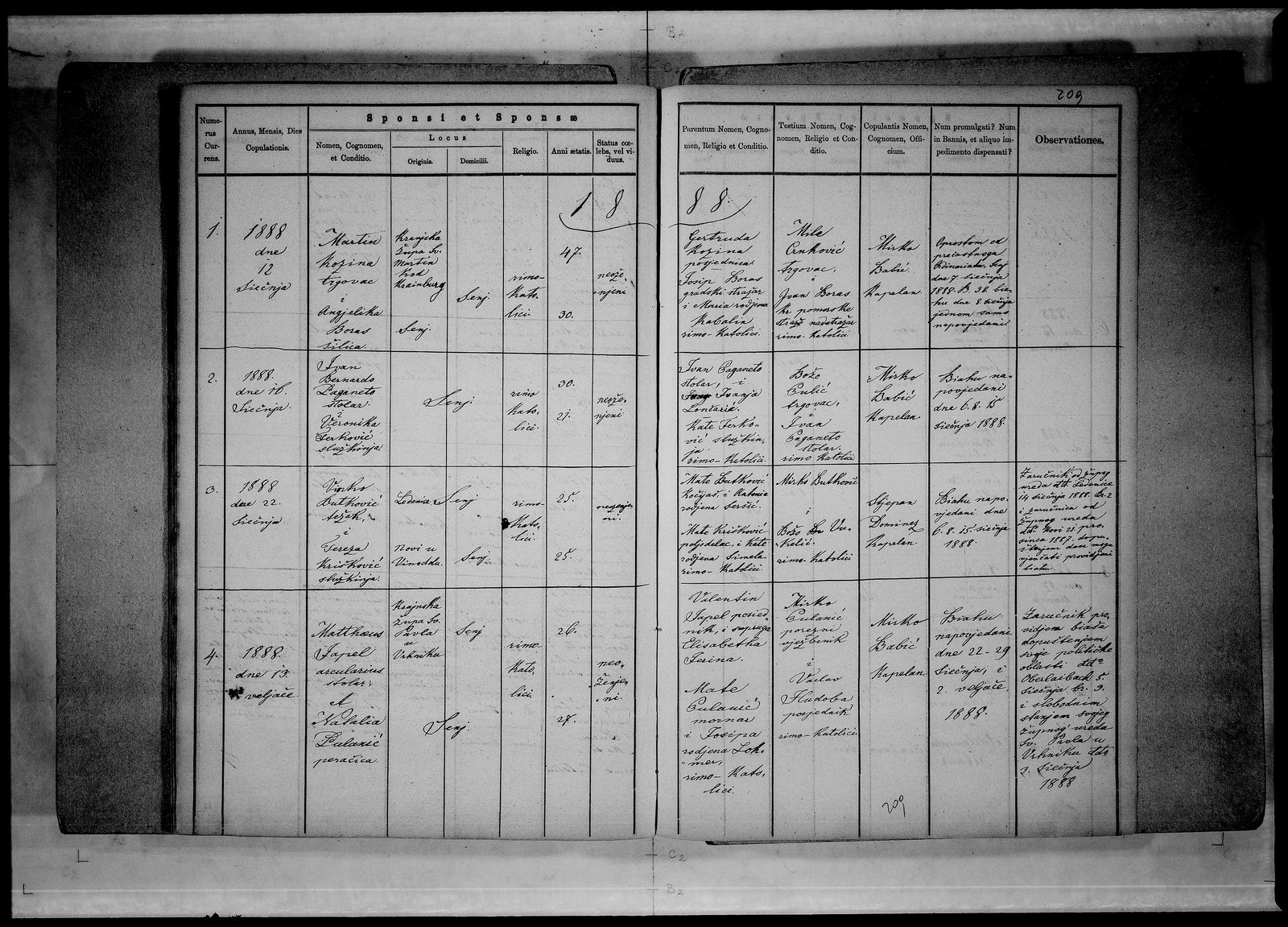
Kranjska župa sv. Martin kod KRAINBURG
Kranjska is Carniola. Krainburg is the German name of Kranj. So Martin Kozina was born in the parish of St Martin near Kranj — in what is now SLOVENIA, about 1841, and came down to the Croatian coast as a trgovac, a merchant. He was 47 and a bachelor when he married; Angjelika Boras of Senj was 30.
It explains every dead end at once. No Croatian baptism, because he was not baptised in Croatia. The surname spelled Kozina with a z, which is the Slovene spelling and the reason five spellings of Kosina found nothing. And his mother called Gertruda — a German name that looks wrong on the Velebit coast and is ordinary in a Habsburg crownland whose towns carried German names.
| His parents | Gertruda Kozina, posjednica — a property-owner — and a dash where the father should be |
|---|---|
| Her parents | Josip Boras, gradski stražar, a city watchman, and Maria rodjena Kabalin |
| Witnesses | Mile Crnković, trgovac — and Ivan Boras, kr. pomorske straže nadstojnik, superintendent of the royal maritime guard. The bride's brother, signing at her wedding |
| Banns | By dispensation of the Senj Ordinariate, 7 January 1888, no. 38 — read once instead of three, as at the Boras marriage of 1857 |
How this household joins the Blažević line
One marriage carries it, and it is worth drawing rather than describing. Anka Blažević was Ljubomir's sister — both children of Juraj Blažević and Tereza Žubrinić — so she was Hedviga's aunt, and the five Kosina children below were Hedviga's first cousins. Three of them did not survive 1943.
Ljubomir is on the direct line; Hedviga is the generation below him. Everyone drawn here who has a page of their own is linked.
Anka Blažević marries Pavao Kosina
On 20 November 1919, at Senj. She was a tobacco-factory worker, as her sister-in-law Milka was. She was born 7 October 1893, the daughter of Juraj Blažević and Tereza Žubrinić, and the sister of Hedviga's father.
Five children followed in the next five years, and then a long gap, and then one more: Otilija (1920 – 1943), Antun Anton (11 FEB 1921 – 23 JUN 2003), Oskar (4 SEP 1922 – 1954), Neda (1924 – 7 SEP 1943), Krizan (3 MAY 1940 – 22 JAN 1941).
The parish wrote his death in the margin of his birth
The fourth Kosina scan had been in this archive's own library since 9 September and had never been opened. It is the most complete single document this family has.
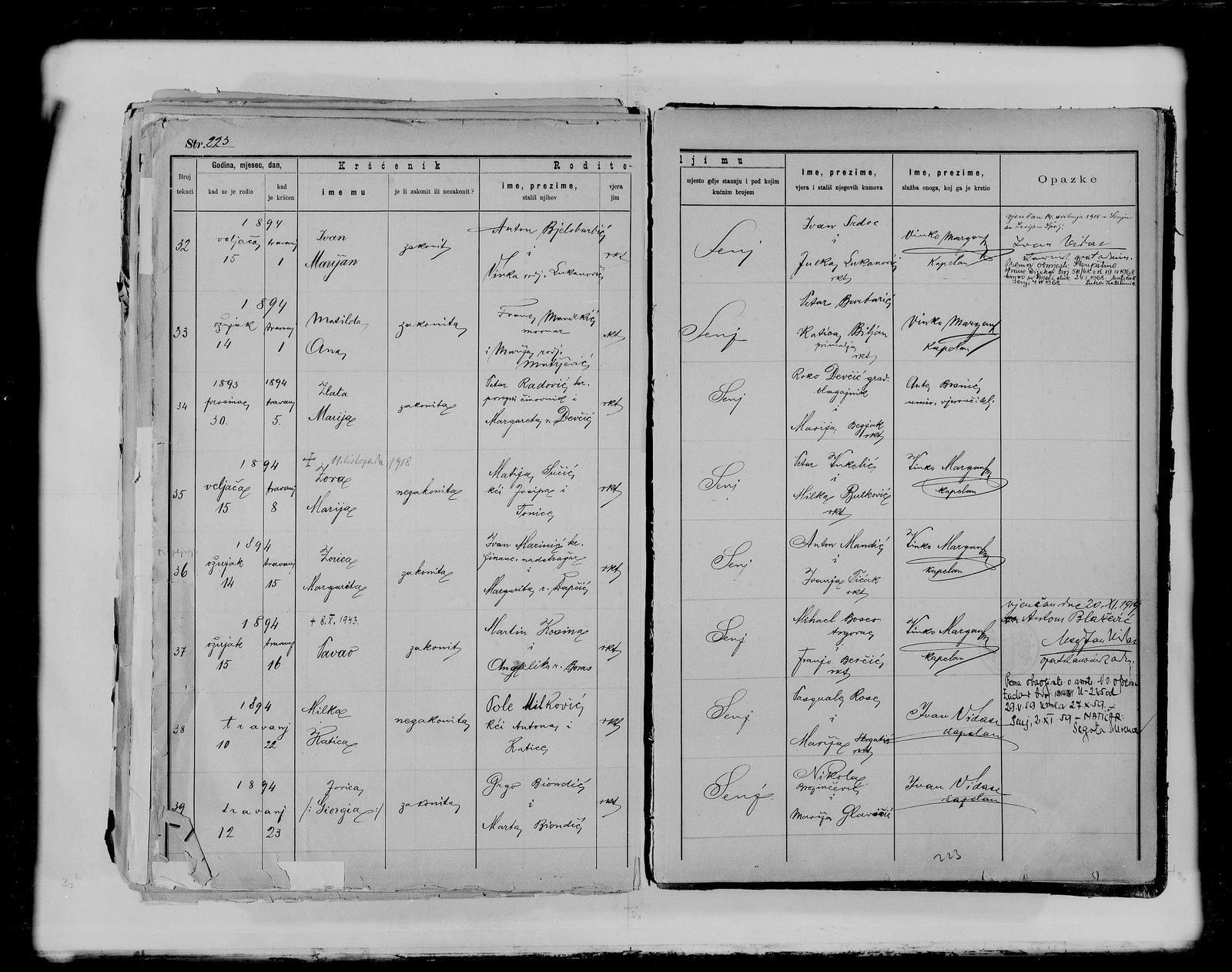
| Born | 1894, ožujak 15 — 15 March, as the tree has it. |
|---|---|
| Baptised | travanj 16 — 16 April 1894, a month and a day later. Most children on this page were christened within a fortnight. |
| Name | Pavao — and above it, in a later hand, † 8. X. 1943. |
| Parents | zakonit — legitimate. Martin Kosina i Angjelika r. Boras, of Senj. |
| Godparents | Mihael Bosco, trgovac, i Franjo Berčić. |
| Baptised by | Vinko Margan, kapelan. |
| Margin | «vjenčan dne 20. XI. 1919» |
The death is the thing. Until today the only authority for 8 October 1943 was the stone his wife and sons raised — and this archive's own rule is that a gravestone is a memorial, not a register. Now the register says it too, written above his name in the book that recorded his birth forty-nine years earlier. The two agree to the day.
And the marriage, for the third time. A reading, an index and an annotation — three separate books — all give 20 November 1919. The bride in the margin is written «Antom» or «Ankom», one letter in a hand that appears twice on the page and nowhere else. The person is not in doubt; the letter is.
The godfather was another merchant. Martin Kosina was a trgovac and a Slovene incomer; Bosco is an Italian surname. That is Senj's commercial class in a single line, and it is where to look if this family is ever traced sideways instead of upwards.
What happened to this household
Read the dates in order and the page stops being a genealogy.
| 22 January 1941 | Križan, born the previous May, dies at eight months old. |
|---|---|
| 7 September 1943 | Neda dies, aged nineteen. Her stone says what of: žrtva zračnog napada — a victim of an air attack. A month before the October raid, so Senj was bombed more than once. |
| 7–8 October 1943 | German aircraft bomb Senj, killing thirty local residents and twenty-two others and destroying about half the town. |
| 8 October 1943 | Pavao Kosina is killed, on the second day. |
| 11 November 1943 | Otilija dies, aged twenty-three — five weeks after her father, and her stone does not call her a victim of anything. She was čin. Velike župe, a clerk of the wartime administrative region. |
Three of a household of seven, inside thirteen months. Anka outlived them all by a decade and died in 1953.
OTILIJA i NEDA
The two daughters have a wall plaque of their own, a few steps from their father's. It is the document that gave this page every date in the table above, and it arrived from the family on 21 September 2026.
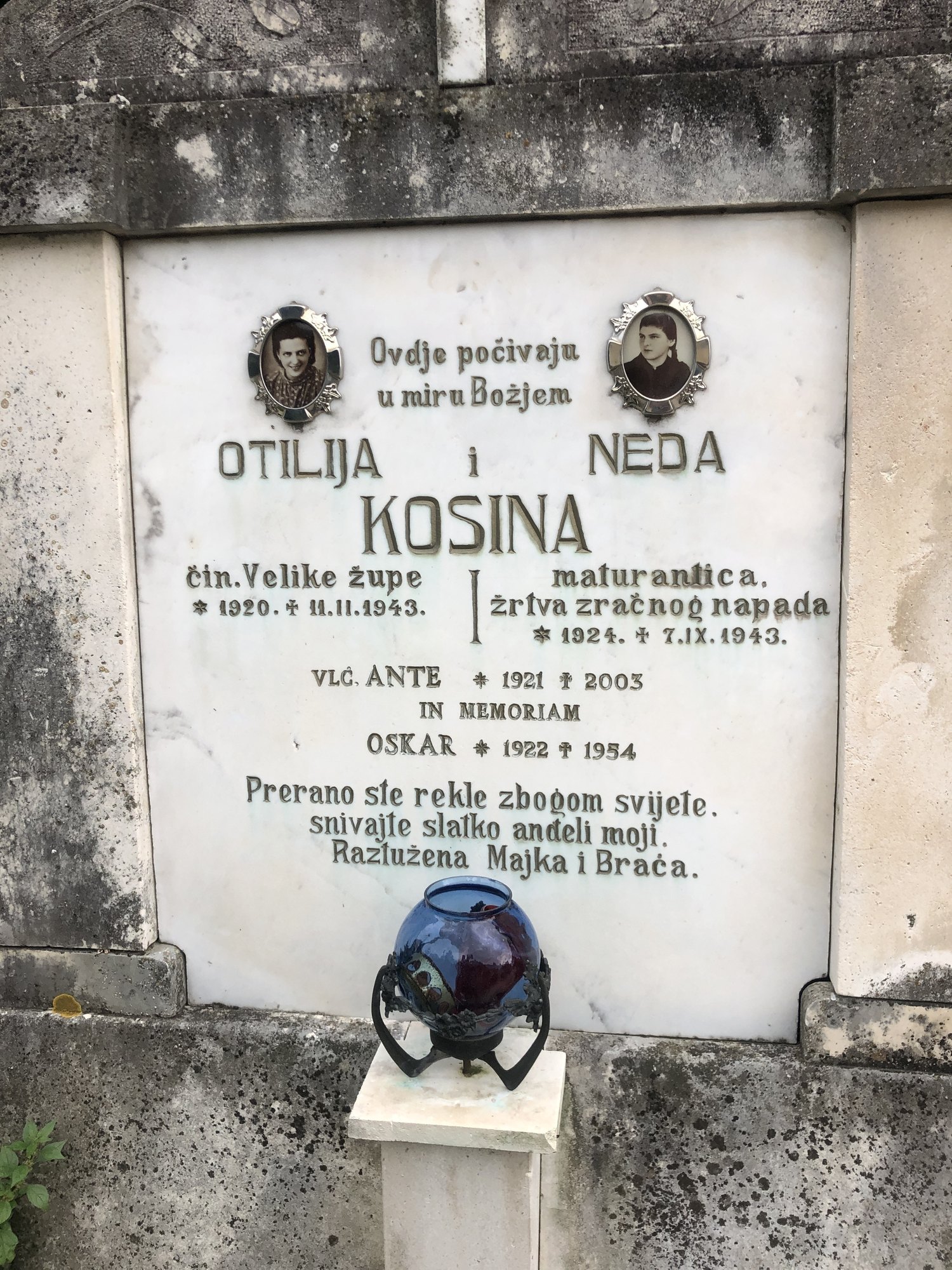
Ovdje počivaju u miru Božjem
OTILIJA i NEDA KOSINA
čin. Velike župe ✻ 1920. † 11.11.1943.
maturantica, žrtva zračnog napada ✻ 1924. † 7.IX.1943.
VLČ. ANTE ✻ 1921 † 2003 — IN MEMORIAM — OSKAR ✻ 1922 † 1954
Prerano ste rekle zbogom svijete.
snivajte slatko anđeli moji.
Raztužena Majka i Braća.
“Here rest in God's peace Otilija and Neda Kosina. Otilija, clerk of the Velika župa. Neda, a school-leaver, a victim of an air attack. Too soon you said goodbye, O world; sleep sweetly, my angels. The saddened Mother and Brothers.”
Two words are worth the magnification on their own. Svijete is a vocative — the line is spoken to the world, not to the girls. And Raztužena is rastužena cut with a z, the older spelling, in a hand that also wrote siečnja and napadaja.
Read the four names as a sequence and the plaque has been cut three times. Majka i Braća raised it for two sisters in 1943 — so Anka, Ante and Oskar. Then Oskar's own dates went on it after 1954, and Ante's after 2003, both under IN MEMORIAM, because neither of them lies there: Oskar died in Buenos Aires, and Ante is buried at his grandmother's grave — the one he had restored in 1991. He outlived every person named on the plaque he helped to raise, and then went into a different grave in the same cemetery.
«Nevina žrtva»
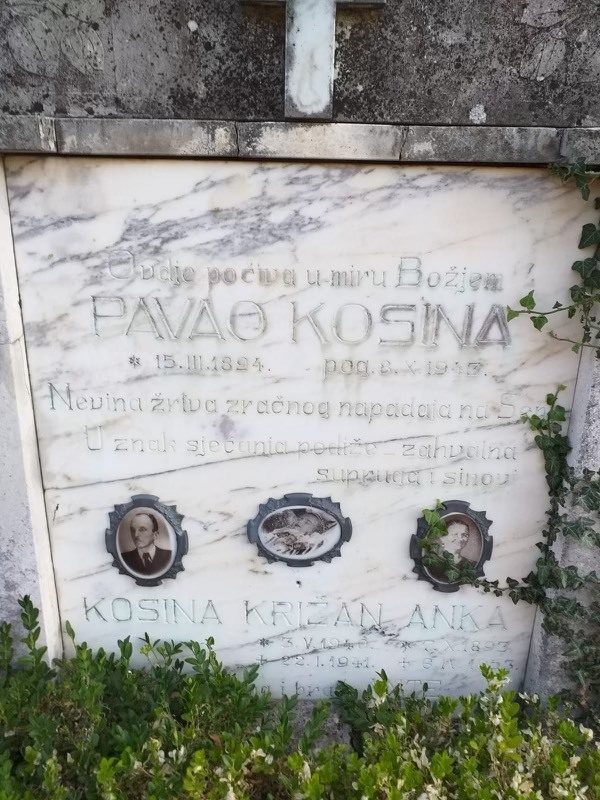
Ovdje počiva u miru Božjem
PAVAO KOSINA
✳ 15.III.1894. · pog. 8.X.1943.
Nevina žrtva zračnog napadaja na Senj
U znak sjećanja podiže — zahvalna supruga i sinovi
“Here rests in God's peace Pavao Kosina, born 15 March 1894, killed 8 October 1943. An innocent victim of the air raid on Senj. Raised in memory by his grateful wife and sons.”
Pog. is poginuo — the word kept for a violent death rather than an ordinary one. The family did not merely record the date. They said what it was, on stone, in a town that had just lost half its buildings. The raid →
What the survivors did
Argentina
Oskar Kosina died at Buenos Aires on 15 January 1954, aged thirty-one, eleven years after the raid — his printed memorial card gives the day. He left a son, Ivan Christian. He may be living, so this archive gives a given name and nothing else.
The card reads ✻ 4. IV. 1922 — the fourth of April — where the tree says 4 September. The day agrees and the month does not, and the two candidates are IV and IX. A card set by a grieving family in Argentina is not a register; neither is a tree. Recorded, not resolved.
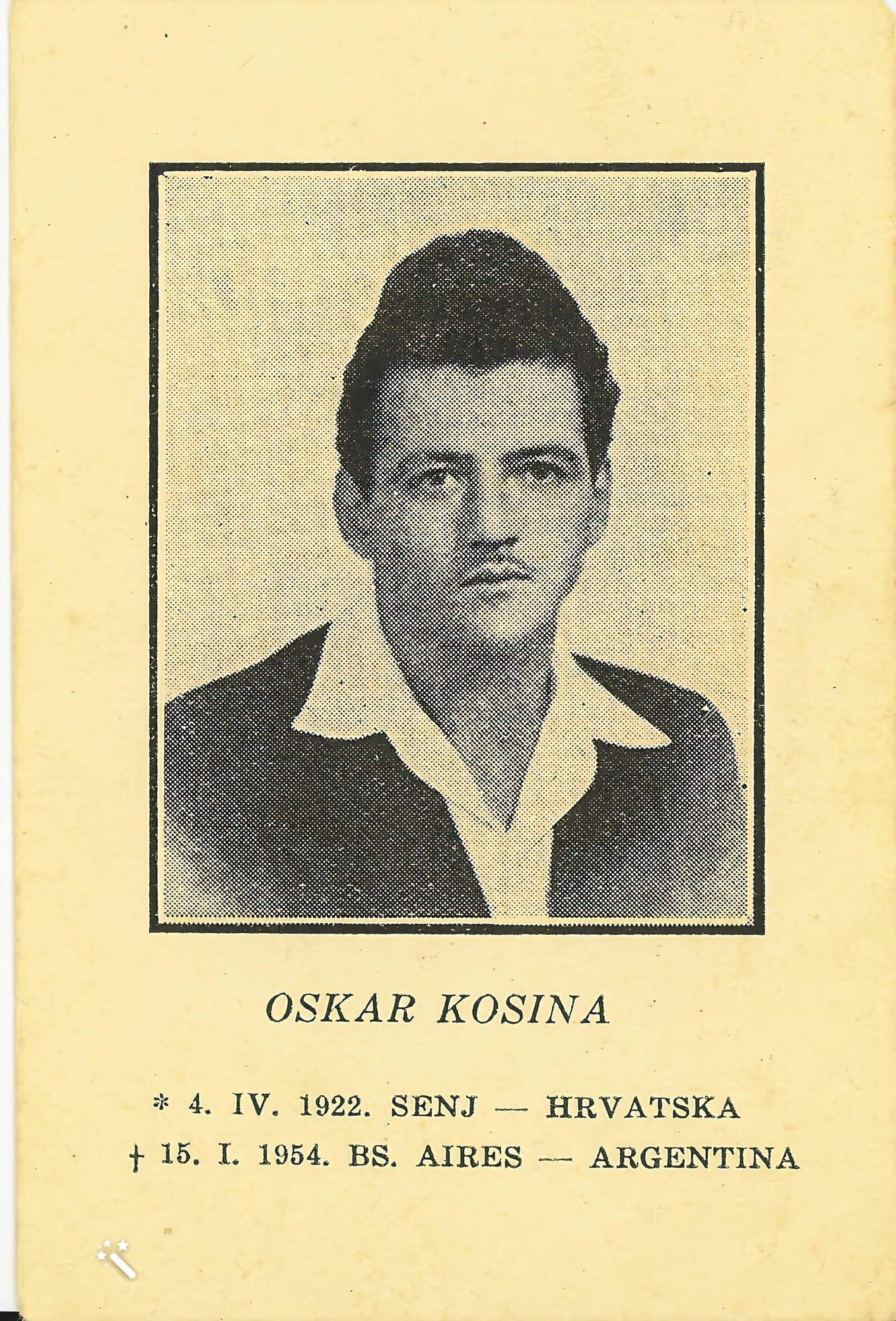
It is the second documented destination of this family after Port Pirie, and it fits: of the sixty-nine people in the world spelling the name Zubrinic, twenty-nine are in Argentina.
Germany
Antun Kosina (1921–2003) — the eldest surviving son, the one who was twenty-two when his father was killed — became a priest. His cross reads vlč., velečasni: Reverend. He has a published career, and it is the best-documented life on this page — see below.
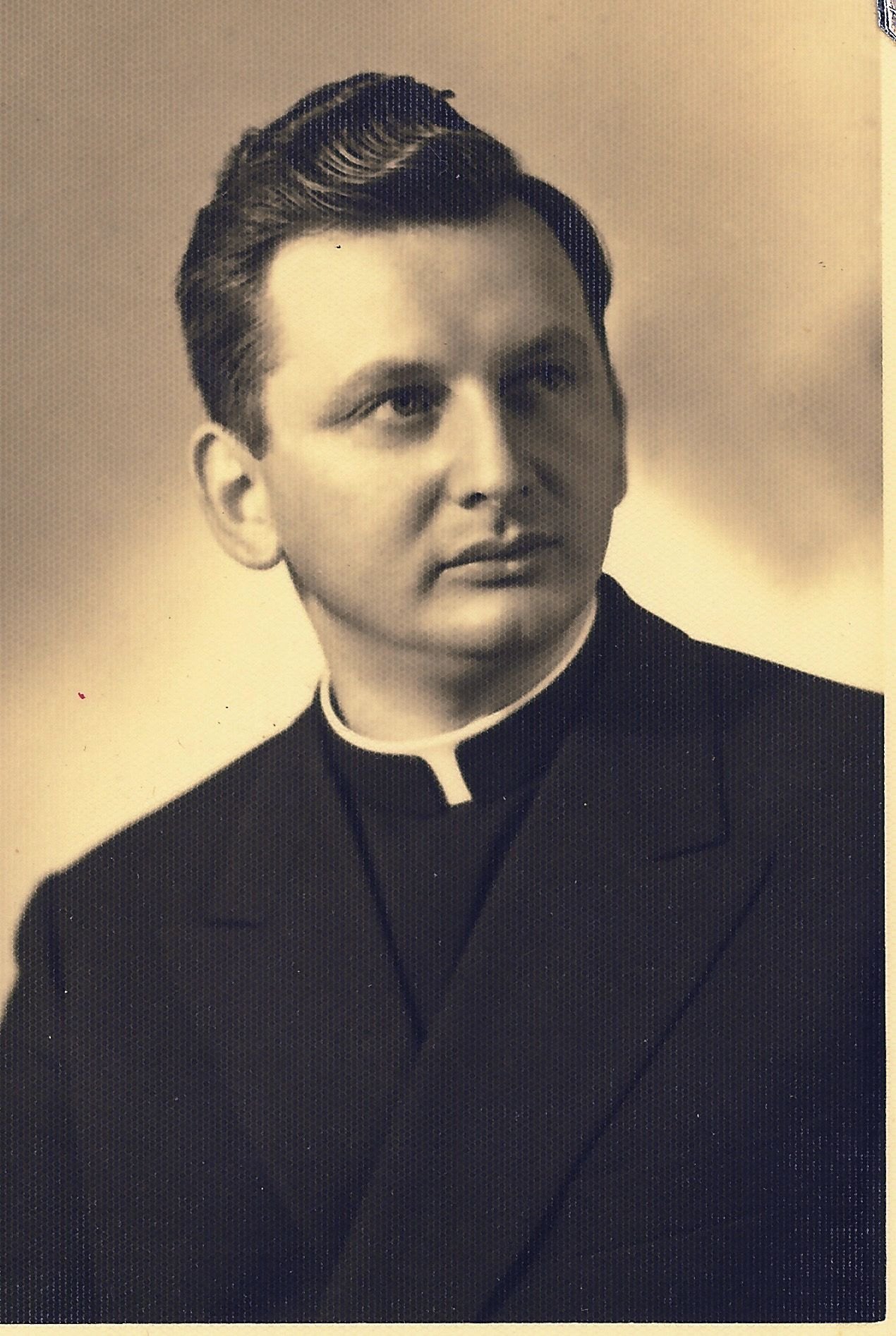
He had a daughter, Paula. She may be living, so this archive gives a given name and nothing else — no surname, no date, no place. A surname and a first name and a country together are an identification, and named-bare was always meant to mean enough that the family knows who is meant and not enough that a stranger can go looking.
What he did with the rest of his life
He was twenty-two when his father was killed and his two sisters died within five weeks. A household of seven became three. What Ante Kosina did next is the best-documented life on this page, and it is not documented by this family — it is in the German and Croatian church press, because he spent forty years being useful to strangers.
Na području Ludwigshafena je 1958. iz Rima došao vlč. Anton Kosina, svećenik tadašnje Riječko-senjske nadbiskupije. Vlč. Kosina se smjestio na području Kaiserslauterna. Tada je u Njemačkoj bilo samo šest hrvatskih svećenika, pa je pastoralno djelovao u više pokrajina. «In 1958 vlč. Anton Kosina came to the Ludwigshafen area from Rome, a priest of the then Rijeka-Senj archdiocese. He settled around Kaiserslautern. There were then only six Croatian priests in Germany, so he worked pastorally across several provinces.»
Read that number again. Six priests, for the whole of West Germany. He was not given a parish; he was given a share of a country. For nine years the job was a car, a case and a Mass wherever Croatians had gathered.
Then 1967, and everything changed at once. The first great wave of Croatian workers — the Gastarbeiter — arrived in the chemical towns of Ludwigshafen and Mannheim, BASF country, where the Wirtschaftswunder ran on other people's hands. He moved to meet them, and founded the Hrvatska katolička misija there, under the patronage of Blessed Alojzije Stepinac. He led it from its founding in 1967 until 1985 — eighteen years.
What that mission actually was
It is easy to read «mission» as a building. For the people who came off those trains it was the one room in Germany where the language was theirs — a Mass they could follow, a baptism and a funeral done properly, catechism for children who were growing up German, and a priest who could read a German letter for you. He turned a travelling chaplaincy into an institution, and it outlived him by decades.
| It seeded others | «Više godina prije osnutka HKM Karlsruhe u tom gradu i okolici pastoralno je djelovao vlč. Anton Kosina iz Ludwigshafena.» Karlsruhe got its own mission on 3 October 1970 — on ground he had been working for years. Mannheim, Mosbach and Speyer were served the same way before they stood on their own. |
|---|---|
| He brought help | vlč. Marijan Bevanda (1970–1971) and vlč. Milivoj Galić (1971–1978), both of the Mostar-Duvno diocese, came to assist him as the community outgrew one man. |
| He handed it on | On 1 August 1985 to fra Ljubo Sesar, who held it for thirty-one years, to 2016 — so the thing Ante Kosina started has had three leaders in sixty years. |
| It is still there | About four thousand people. It celebrates at St Hedwig in Ludwigshafen, in the Franciscan sisters' chapel at Kaiserslautern, at St Joseph in Speyer and at Our Lady of Peace in Homburg — still saying Mass in the town where he began in 1958. |
There is a shape to it that is worth saying plainly. A war took his father and his sisters out of one small Adriatic town and scattered what was left — one brother to Buenos Aires, a nephew after him, and Ante himself to Rome. Twenty years later he spent his working life meeting other people's trains: Croatians leaving home for work rather than for their lives, and someone waiting for them who spoke the language. He of all people knew what it was to arrive somewhere and know no one.
Then he went home. In 1991, in his seventies, he was back in Senj having his grandmother's grave repaired, and he put his name at the foot of it. He died in 2003, and he was buried in that grave — a wooden cross against the stone reads OVDJE POČIVA U MIRU BOŽJEM · vlč. ANTUN KOSINA · ✱ 1921 † 2003. He is named on his sisters' plaque as well, under IN MEMORIAM. He mended his grandmother's grave and then went into it. The stone and the cross →
What is documented, and what is only claimed
Everything above is from four published sources — the Croatian church agencies IKA and KTA, CroExpress, and the HKM Mittelbaden mission's own history of Karlsruhe — all reachable and all quoted in the register of what has been searched.
They are kept, because they are good questions. An ordination year and a death date are exactly what a diocesan archive can confirm or deny in one line. They are not published as facts, and the stone gives the year 2003 on its own authority.
The two doors worth knocking on are the mission itself and the archdiocese. HKM Ludwigshafen will hold its own founding records and very probably a photograph of him; the Riječka nadbiskupija and the Hrvatski dušobrižnički ured in Frankfurt would each hold an obituary for 2003 and his ordination year. A letter to the mission is drafted and has not been sent, and it asks first for a photograph the family may publish.
Oskar came in on the Philippa, and he was already married
This page said, earlier today, that the Argentine trail was empty. It was empty because the right database had not been searched.
KOSINA · OSCAR · 25 · C · YUGOSLAVA/S.H.S. · SEGKA · COLONO · 1947/10/09 · PHILIPPA · GENOVA CEMLA — the Buenos Aires port arrival books, 4.4 million people, 1882–1960.
| 9 October 1947 | His arrival, which this archive did not have at all. He died six years and three months later. |
|---|---|
| Aged 25 | Born about 1922 — agrees with the tree and with his memorial card. |
| «SEGKA» | SEGNA — the Italian name for SENJ. A Buenos Aires clerk writing an Italian form of a Croatian town, which is what you get when the man boarded at Genoa. |
| «COLONO» | Settler — the visa class for post-war agricultural immigration, which is how displaced Europeans entered Argentina in 1947. |
| From GENOA | The route out of the Italian displaced-persons camps. Not a voyage from home. An exit. |
| «C» — CASADO | HE WAS ALREADY MARRIED ON THE DAY HE LANDED. |
That last one changes the work. This archive has been looking for Oskar's wife in Buenos Aires, on the assumption that a man of twenty-five arriving alone married there. He did not. He married in Europe — in the camps or in Croatia — and she travelled with him, followed him, or is on the same manifest under her maiden name. So the next document is not an Argentine marriage register. It is the passenger list of the Philippa, 9 October 1947.
And he was not the only Kosina on that ship
KOSINA · FRAJNO · 47 · C · CROATA (HRVATSKA) · AGRONOMO · 1947/04/01 · PHILIPPA · GENOVA
FRAJNO is FRANJO. Born about 1900, married, an agronomist — the same ship, the same port, six months earlier. Two men of one surname on one vessel in one year by one exit route is not coincidence; it is a family or a network, and probably both.
Is he a brother? Martin Kozina and Angjelika Boras had sons in 1891 and 1894, and she died in 1902 — so a son born about 1900 is possible. It is possible and it is not established, and he is filed as exactly that in the people this tree does not have.
One detail of his is worth keeping. His nationality is entered «CROATA (HRVATSKA)» where every other Yugoslav on these pages is «YUGOSLAVA/S.H.S.». In April 1947 that is a man telling a clerk what he was, and the clerk writing it down.
The other rows, and one that had to be checked
| 10 April 1911 | A whole household off the Sofia Hohenberg from Trieste, all «AUSTRIACO - DALMATA»: Gerko 30 and Clara 25, with Anka 4, Irma 4, Ojeskoslaio 2 and Gelka 0. Gerko is Jerko, Ojeskoslaio is Vjekoslav, Gelka is Jelka; the two four-year-olds are twins or an age is wrong. Croatian names, Adriatic Austrians — and nothing but the surname joins them to this family. |
|---|---|
| 30 November 1928 | Ivan Kosina, 27 and single, from Hamburg, born «Velic», a farm labourer. He is NOT Ivan Christian. Oskar's son was born in Argentina after October 1947; this man was born about 1901. The names collide and the dates cannot. It was checked. |
| 15 January 1929 | Michal Kosina, 42, Polish, from Cherbourg — the Kosina of the Subcarpathian village, and no relation. |
| Twelve rows | No wife and no son. She would be under her maiden name; he was not born yet. Ivan and Michal each appear twice — CEMLA indexes some arrivals from two books. |
The z-spelling was run too, and it is a clean negative
KOZINA returns 23 rows and not one of them is this family — which is worth as much as the find, because it tells you which spelling to stop searching.
| Bijača | Spelled BIJACA, BJOCAR, BEJACA and BYCA by four different clerks — a village in Herzegovina. Ladislav 1927, Jozo and Jure 1928, Bqne and Krunko 1930. An emigration village, and not ours. |
|---|---|
| Derventa | In Bosnia. Lovro 26 and Jela 23 with their baby Maria, arriving together on 11 March 1948 off the Cordoba from Hamburg, and Petar, 70 and a widower, three months behind them. The baby's birthplace is entered BAGNOLI — the displaced-persons camp at Naples — and her nationality Italiana. A child born in the camp on the way out. |
| The rest | Polish (Piotr of Zawoja, Rudolf of Świątoławiec), one Slovene (Franc of Dolenja Vas, 1930), and two unplaceable. Nothing touches Senj or Kranj. |
| And COSINA | The Spanish phonetic form gives five rows and not one of them is Slavic — Clemente 1884 and Nicola 1922, both italiana out of Genoa; José 1907, española; Nicolina 1908, levantina. Cosina is an Italian and Spanish surname in its own right, not a mangling of ours. Which is the useful part: the clerks were not turning Kosina into Cosina. They were writing Kosina. |
So the older, Slovene z is not how they were written in Argentina. Oskar went in as KOSINA, with the s the family still uses.
And CAUSINA, the last variant, returns one row — Ramón Causina, Spanish, 1905, out of Barcelona. Which means CEMLA is worked out: four spellings, forty-one rows, and exactly one of them is this family. The database has been asked everything it can answer. Everything further is on the page of the book rather than in the index, and the page has been asked for.
CEMLA is free and behind a CAPTCHA, which this archive will not answer, so the search was run by hand by the account holder. Everything tried, with what it gave →
And then a Kosina went back and mended a grave
In the Senj cemetery stands the stone of Tereza Žubrinić (1867–1931) — Hedviga's grandmother, and one of the sixteen people on this archive's direct line. She was Anka's mother, so she was Antun Kosina's grandmother too.
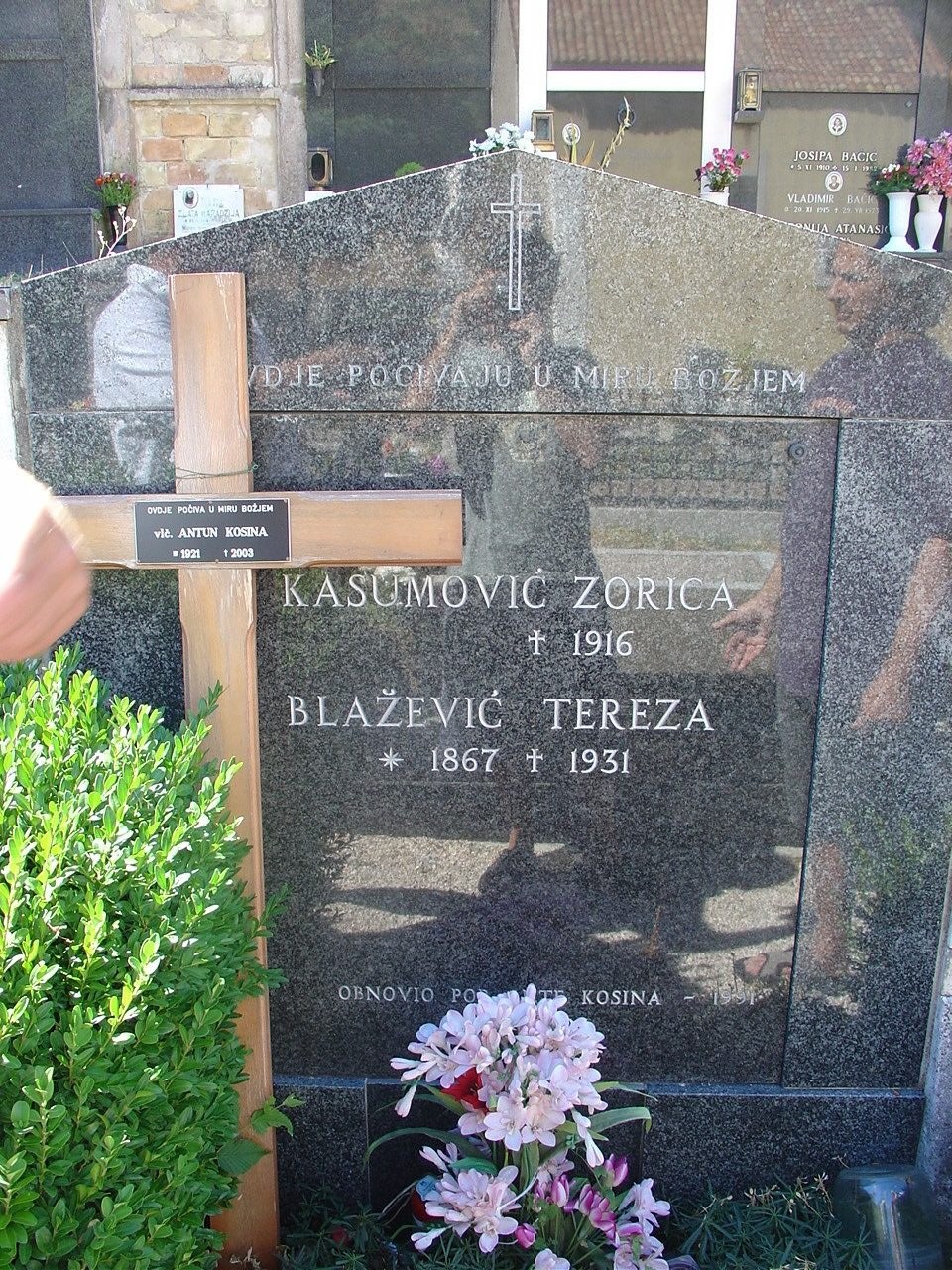
OVDJE POČIVAJU U MIRU BOŽJEM …
and at the foot:
OBNOVIO POP ANTE KOSINA ~ 1991
“Restored by Fr. Ante Kosina, 1991.”
The son of the man killed in 1943 — by then a priest in his seventies — went back and had his grandmother's stone repaired, and put his name on it as the man who did it. That line is the only reason the name Kosina was anywhere in this archive's own records before the Carniolan research began: a footnote on somebody else's grave, read off a photograph in October 2024.
And the same photograph says where he is
Standing against that tomb is a wooden cross with a black plaque. It is in the frame of the photograph above, and it was not transcribed when the stone was.
OVDJE POČIVA U MIRU BOŽJEM
vlč. ANTUN KOSINA
✱ 1921 † 2003
Corrected 23 September 2026
This page has said in two places that Antun Kosina does not lie in Senj — that he is on his sisters' plaque under IN MEMORIAM because he died elsewhere.
«POČIVA» is singular: here rests. Not the POČIVAJU of the stone behind it, and not an in memoriam. The two facts sit together without contradicting each other — he is remembered on his sisters' stone and buried at his grandmother's.
He restored this grave in 1991 and was buried in it in 2003. His name was never cut into the granite; the wooden marker is all there is, and it was still standing twenty-one years later when the photograph was taken.
The archive has held this photograph since October 2024 and read the stone out of it in September 2026 without reading the cross in front of it. It also transcribed a second wooden cross at the foot of the same tomb — Branko Blažević, 1957–2023 — and stepped over this one. A photograph is not read until everything in it is.
notes/the-k-section-gave-a-household.md is the
account of the evening the archive went to book page 34 for one woman's death and came back
with ten people: what was cropped, at what magnification, in what order, and which readings
were wrong first.
It is kept because the method is the
transferable part. The names below belong to this family; cropping one surname column
and tiling five openings to a sheet belongs to anybody with a register and an
evening.Franz Kosinar's own baptism is not where it should be
He is the oldest man on this page with a date: born 1775–76 on two independent ages — the 24 he gave at his marriage in October 1800 and the 73 at his death in January 1849. So his baptism belongs in the Kranj–Šmartin register for 1747–1779, and that volume has an index.
The index (sig. 00872) is arranged by initial letter and then chronologically, giving the surname, the given name, the father in brackets and a date — and no page number, so it finds a date rather than a page. Its K section runs to about image 72, where it stops at 1779. Images 71 and 72 were read end to end and cover 1772 to 1779 without a gap.
A Dolenc stands at four baptisms of this house across forty-one years
The godparent columns were opened for Anton 1834 and Petrus 1836 — and read together with the two already known, they give the only standing relationship this archive has documented for the Kosinar.
| Baptism | The child | The Dolenc who stood |
|---|---|---|
| 18 Nov 1812 | Elisabeth, Franz's daughter | JAKOB DOLLENZ, with Elisabeth — both signing with a cross |
| 20 Jan 1834 | Anton, Johann's son | MARIA DOLLENZ, with Stephan Sh[e]snar, Hüblar |
| 29 Jun 1836 | Petrus, Johann's son | JAKOB DOLENZ, signing with a cross |
| 19 Sep 1853 | Francisca, Johann and Ursula's | MARINA DOLENC, with Johann Pevc |
And the last unknown woman in the house turns out to have owned it
Ursula Sedej bore Johann three daughters and this archive knew nothing else about her — no age, no parents, no village. Her marriage to Johann is not in the Kranj–Šmartin book: the 1816–1855 register was walked across book pages 66 to 71, April 1850 to February 1853, and holds no Kozina. A marriage is celebrated in the bride's parish, so she came from outside — which was as far as the negative could take it.
Then the 1856–1881 volume was walked in full for a different question, and five openings from the end:
28 May 1873
Ženin: Zgornje Bitno 72 · MARTIN BRENK, gost · 48 · vdovec
Nevesta: Zgornje Bitno 9 · URŠULA SEDEJ, po ranjcim možu KOZINA, POSESTNICA · 46 · vdova
Roditelja nevestina: ANDREJ SEDEJ, gruntar na novi Oslici, in JERA ROJE · Roditelja ženinova: Anton Brenk, gruntar, in Maria Ravnikar · priči Janez Bašar and Lorenc Brenk, both signing with a cross
Johann's widow, remarrying five years after he died — and a second marriage names parents exactly as a first one does.
Nova Oselica, opened the same evening — and it did not settle
Eleven volumes, confirmed free on Matricula, no login. Neither register has a name index, so this was a walk rather than a lookup, and it did not reach the end.
Sedej is confirmed as a real, resident family there. Gertraud Sedej and Catharina Sedej are mothers of two different brides marrying in January 1827; Agnes Sedej stands godmother the same years — different women, one surname, the ordinary evidence of a settled household rather than a single family.
And an Andre Sedej turns up as a father — «½ Hüblor», wife MARIA BRIZ, a child baptised about 1829–30. The wife's name does not match. Two readings are open and neither is settled: a different Andrej Sedej of the same parish and generation, or Maria Briz is a first wife who died before Jera Roje married him — exactly the pattern this page has already documented once, forty kilometres away at Johann Kozina's own house.
Ursula's own baptism was not found. The baptismal register was walked from 1826 to 1834; the marriage register's final pages for 1824–1826 and its opening pages for 1826–1828. Four Sedej women and three Sedej men turn up as parents and godparents across that decade — this is a settled kin-group, not one household — but no Ursula Sedej, and no Andrej Sedej × Jera Roje marriage, anywhere in it.
And Roje is confirmed too, independently. The same walk gives a mother entered «Agnes Roj[s]ka» — the adjectival form these clerks give a woman surnamed Roje. A different, unrelated case; but both halves of «Jera Roje» now belong to this parish, not one verified name propping up an invented one. The order worth trying next is set out at work-list row 78.
notes/the-kozina-of-zgornje-bitnje.md is the hand-off:
the line as read, the three rules it cost — an index proves only what it contains,
the magnification that shows a column has names in it is not the one that reads
them, and a married woman is not always under her maiden name — and
the five things still open.
It matters to them for one reason above the
others: Kranj–Šmartin is on Matricula, free, and needs no login. Every other
archive in this estate is waiting on FamilySearch for something. This parish is open
right now.What is not known, and is worth asking for
| ANSWERED | Martin's father. This row used to say that Senj baptisms are filmed from 1734 and nobody had looked. Martin was not baptised in Senj. He was baptised at Kranj–Šmartin on 16 November 1841, and the register puts the tick in unehelich and leaves the Vater column blank. There is no father to find in a baptismal register — only, possibly, in a paternity acknowledgement or a later marriage, and neither has surfaced. |
|---|---|
| Maria Dortschen's death | The last of the six Carniolans without one, and the parish indexes for 1812–1835 and 1836–1869 have both been read end to end. She is in neither. Next: the death registers of 1870–1890 and 1890–1911. |
| ANSWERED | Otilija died 11 November 1943 and Neda was the air-raid victim, 7 September. Both off the family's own gravestone, sent 21 September 2026. This row asked which of them died with their father: neither did. |
| Which raid killed Neda | Her stone says žrtva zračnog napada on 7 September 1943, a month before the one that killed Pavao. How many times Senj was bombed that autumn is now the open question, and this archive has been writing as though there were one. |
| ANSWERED | The elder Antun's wife is not «a name and nothing else». This row said so until 23 September 2026, and this archive had her parents the whole time. Antonius Joannes Kosina (1891–1925) married Anka Kasunić at Senj in 1891, and the entry names Petar Kasuniž and Marija Turina as her father and mother. He died at thirty-four. Senj marriages, indexed · ark 1:1:X9D5-MWF2 |
| Oskar's wife | Unnamed in the tree, though their son is in it. Buenos Aires, before 1954. |
Built by tools/kosina.py from the family tree, with the living-person rule applied in the data rather than the template. The work list row that governs this page →